Finding a Good Idea and Creating a Distinctive One
When a blank page leaves us unsure where to begin, generative AI can be a useful thinking partner. It suggests directions and adds unexpected details to familiar concepts, offering starting points we might not have found on our own.
But what happens when others seek similar assistance? Could everyone’s work improve while becoming more alike?
Anil R. Doshi and Oliver P. Hauser examine this question. The key distinction is between how creatively an individual work is evaluated and how different multiple works are from one another. These may sound like similar measures, but they capture different qualities.
How AI Changes the Starting Point
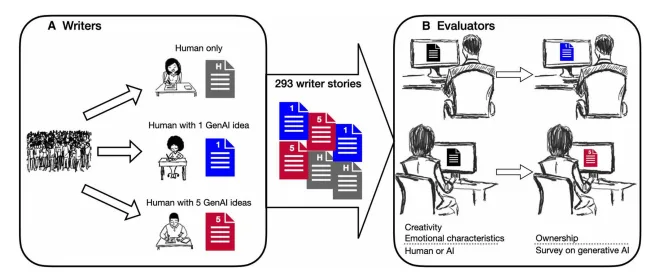
The researchers conducted a short-story experiment involving 293 writers in the final analysis. Participants were randomly assigned to write without AI assistance, with access to one GPT-4 idea, or with access to up to five ideas. Each produced an eight-sentence story, which was assessed by a separate group of 600 evaluators.
AI did not write the finished stories. It supplied starting ideas that participants could develop. The experiment therefore examined how access to AI ideas changes human creative output, rather than whether humans or AI write better stories.
Individual Stories Received Better Ratings
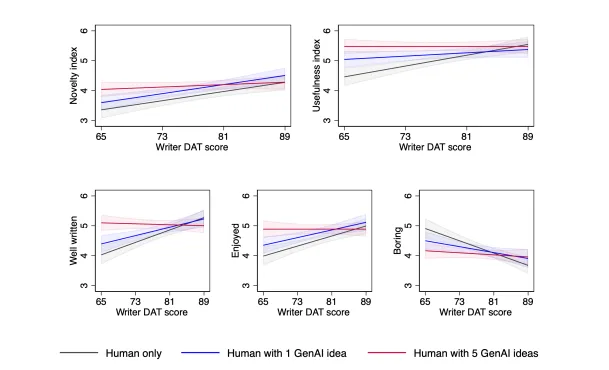
Access to up to five ideas increased novelty ratings by 8.1% and usefulness ratings by 9.0% compared with writing without AI. Here, usefulness included suitability for the intended audience and potential for publication.
Writers with lower scores on the preliminary creativity task benefited more. This suggests that AI’s value may lie partly in helping people turn an uncertain beginning into something they can develop.
In practice, creative assistance need not produce an unprecedented breakthrough to be valuable. Helping someone move beyond a stalled idea can also matter.
Yet the Collection Became Less Diverse
Stories produced in the AI conditions were more similar to one another. Individual writers could produce better-rated work while the collection contained less variation.
Consider a hypothetical set of campaign proposals. Each might become clearer and more polished, yet the range of options could narrow if they adopted similar premises and approaches. This is an illustration, not a finding about advertising campaigns.
The distinction encourages a more precise question than simply asking whether creativity increased: What improved, who benefited, and how much difference remained across the results?
Polished Work and Distinctive Work
For creative practice, an interesting question is how far an AI suggestion remains the organizing premise of the work.
Refining the language and details of an idea differs from reconsidering its underlying perspective. Both can be worthwhile, but they serve different purposes.
When reviewing a campaign, for example, a team might ask both, “Is the message clear?” and “Why is this a story only this brand can tell?” Different settings do not necessarily produce different ideas if the assumptions about the audience, the central conflict, and the proposed resolution remain unchanged.
These are practical reflections inspired by the distinction between individual performance and collective diversity. They were not tested as working methods in the study.
What the Study Does Not Establish
The findings do not mean that using AI inevitably makes creativity uniform. The task involved brief fiction, without customized prompts or ongoing dialogue with the model.
Real creative work also involves research, experience, collaboration, and revision. This experiment cannot establish the long-term effects on professional creators or outcomes across advertising, film, and design.
Likewise, a preliminary task score should not be treated as a complete assessment of someone’s creative potential.
What Do We Add After AI Makes a Suggestion?
The question is not simply whether to use AI, but how to judge the improvement it helps produce.
Creating clear, compelling work and contributing a distinctive perspective are compatible goals. Yet achieving one does not automatically secure the other.
That gives creators a reason to assess quality and distinctiveness separately. After asking, “Is this a good idea?” it is worth asking, “What perspective remains here that makes this work its own?”