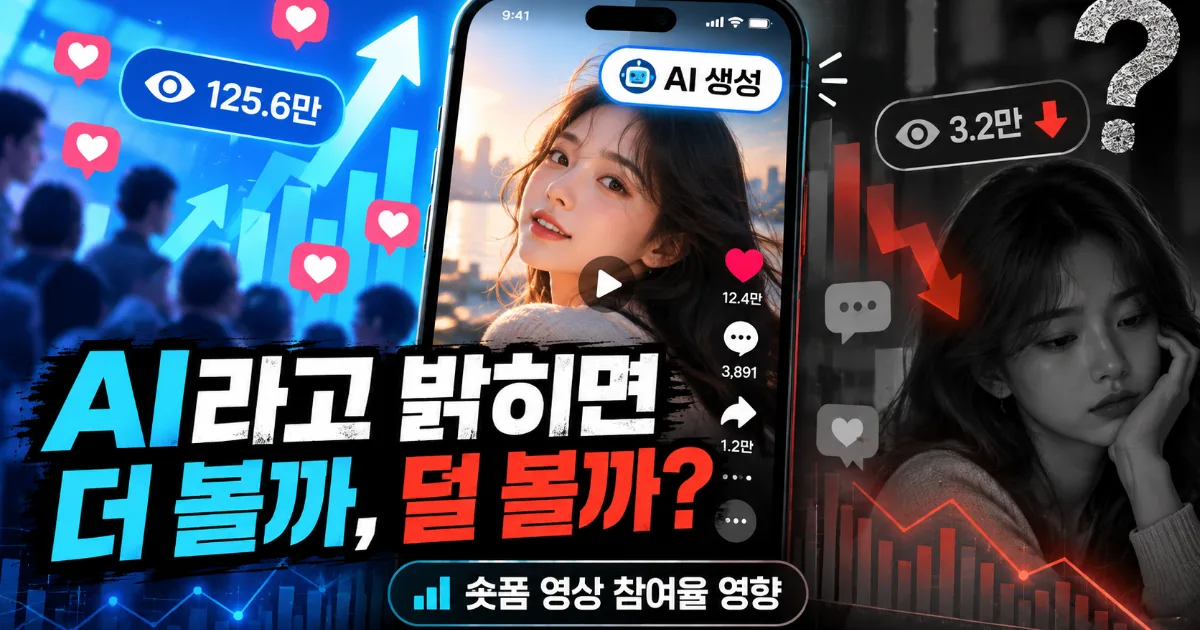
If people know a video was made by AI, will they watch more?
Or will they watch less?
This is a question that short-form video platforms and creators will continue to face. As generative AI rapidly changes the production of text, images, voice and video, AI-generated content is already becoming part of everyday content creation. At the same time, governments and platforms are increasingly asking creators to clearly label AI-generated content.
TikTok encourages labeling AI-generated content. The European Union has also pushed major technology companies such as Google, TikTok, Microsoft and Facebook to identify and clearly label AI-generated images, videos and text. In this sense, AI disclosure is becoming part of a broader policy movement toward content transparency.
But transparency does not automatically mean higher engagement.
The paper AI in the Spotlight: The Impact of Artificial Intelligence Disclosure on User Engagement in Short-Form Videos addresses exactly this point. The researchers examined how disclosing whether a short-form video was generated by AI affects users’ engagement intention, and how perceived content quality and perceived AI capability shape that process.
The conclusion is not simple.
AI disclosure has a direct positive effect on user engagement intention. In other words, telling users that “this video was made by AI” can stimulate interest and curiosity, increasing their willingness to engage. But at the same time, AI disclosure can make users evaluate content quality more negatively. If users think “AI-made content may be lower quality,” their engagement intention can fall.
That contradiction is the core of the paper.
AI disclosure produces both positive and negative effects.
On one side, it acts as a signal of novelty and technology. Users may feel curious about AI-generated content and expect a new kind of experience. On the other side, it raises doubts about quality. Users may think AI can make mistakes, produce inaccurate information or feel less authentic than human-created content.
Both effects operate at the same time.
To explain this, the researchers used the heuristic-systematic model, or HSM. HSM suggests that people process information through two routes. One is heuristic processing, which is fast and simple. People rely on cues, shortcuts and intuition without deep analysis. The other is systematic processing, which requires more cognitive effort. People analyze and evaluate information more carefully.
In short-form videos, AI disclosure activates both routes.
Through heuristic processing, the fact that “AI made this” becomes a signal of novelty and technological sophistication. Users may receive AI-generated content as a new experience and feel curiosity or immersion. The researchers argue that AI as a source cue can trigger automatic judgments and increase engagement.
Through systematic processing, however, users become more cautious.
Once users learn that the content was made by AI, they may begin evaluating content quality more carefully. Is the video accurate? Is it interesting? Is it valuable? Could AI have made an error? If concerns about AI misinformation or manipulated content arise, perceived content quality may fall.
So AI disclosure is double-edged.
“Because it is AI, it feels interesting” can increase engagement.
“Because it is AI, I doubt its quality” can reduce engagement.
The paper tested this dual effect experimentally.
The researchers conducted an online experiment on the Chinese platform Credamo. Participants were asked to imagine opening a short-form video app and watching a product-introduction video. The experiment had two conditions. In one condition, participants were not told the content was generated by AI. In the other, they were told that the video content and images were generated by AI. Afterward, participants answered questions about perceived content quality, engagement intention and perceived AI capability.
The researchers also conducted a pre-test before the main experiment.
After analyzing 36 valid responses, they found that participants had low familiarity but high interest in the video content, and 92% of participants did not recognize that the video content had been generated by AI. Based on this, the researchers created disclosure and non-disclosure conditions. In the non-disclosure condition, users simply saw the video screen. In the disclosure condition, a label appeared at the top of the screen stating that the content was generated by AI.
The final analysis used 479 valid responses.
There were 239 participants in the AI disclosure condition and 240 in the non-disclosure condition. The manipulation check showed a significant difference between the two groups in whether participants judged the video to be AI-generated, which means the AI disclosure manipulation worked as intended. The sample was 60.9% female and 39.1% male, and most participants were between 25 and 40 years old. Among respondents, 48.3% watched short-form videos for more than one hour per day.
The results were clear.
AI disclosure had a direct positive effect on engagement intention. In the structural model, AI disclosure significantly increased users’ intention to engage. However, AI disclosure also had a significant negative effect on perceived content quality. Perceived content quality, in turn, had a strong positive effect on engagement intention.
In other words, AI disclosure directly increased engagement, but indirectly reduced engagement by lowering perceived content quality.
This is what the paper describes as a suppression effect.
The total effect of AI disclosure was not statistically significant because the direct and indirect effects moved in opposite directions. AI disclosure directly increased engagement intention, but reduced engagement intention through the path of lower perceived content quality. The researchers interpret perceived content quality as a suppressor variable.
Put simply:
When people see that something was made by AI, they may initially become interested.
But soon they may also wonder whether the quality is good enough.
Interest pulls engagement up.
Doubt pulls engagement down.
That is why the effect of AI disclosure cannot be described simply as good or bad.
Here, an important moderating variable appears: perceived AI capability.
In the paper, AI capability consists of reliability, flexibility and integration. Reliability refers to AI’s ability to perform expected functions stably. Flexibility refers to AI’s ability to adapt to different user needs and changing situations. Integration refers to AI’s ability to combine information from multiple sources to support decision-making and content generation. Together, these three dimensions form users’ perception of AI capability.
Perceived AI capability reduced the negative effect of AI disclosure.
The study found that the more users perceived AI as capable, the less AI disclosure reduced perceived content quality. More importantly, when perceived AI capability became sufficiently high, AI disclosure could have a positive indirect effect on engagement intention through perceived content quality.
This is highly important in practice.
Simply saying “this was made by AI” is not enough.
Users must feel that AI is capable.
They need to believe that AI is reliable, adaptable to different needs and able to integrate multiple sources of information to create high-quality video content.
When that happens, AI disclosure can become a quality signal rather than a source of anxiety.
Conversely, if users perceive AI capability as low, AI disclosure can strengthen doubts about quality. The paper explains that when perceived AI capability does not reach a certain level, disclosing AI authorship may still reduce perceived content quality and weaken engagement intention.
What makes this study interesting is that it expands the discussion of AI transparency beyond ethical obligation and into user experience.
There is a valid reason to require AI-generated content to be labeled. Users have the right to know whether the content they are viewing was created by a human or by AI. When we consider deepfakes, misinformation, copyright, manipulated media and accountability, AI disclosure will only become more important.
But platforms and creators face another question.
Will AI labels reduce engagement?
This paper answers: possibly yes, possibly no.
AI disclosure can directly increase engagement, but if it increases doubts about content quality, engagement may fall. The key is how AI disclosure is presented and how users perceive AI’s ability.
The paper’s practical implications move in this direction.
The researchers suggest that short-form video platforms can increase transparency about AI, but must also help users believe that AI can produce accurate, effective and high-quality content. They mention that platform notices, promotional videos and user guides can help improve users’ understanding of AI capabilities.
There are implications for creators as well.
Creators should be careful when disclosing AI-generated content. The researchers note that without sufficient understanding of the audience and the video content, it may be difficult to predict how AI disclosure will affect user response. They also emphasize that because AI disclosure can trigger doubts about content quality, creators must manage accuracy, effectiveness and quality even when content is AI-generated.
This connects directly to today’s platform environment.
As AI-generated content increases, simply attaching an “AI-generated” label will not be enough. A label provides transparency, but it also gives users a reason to evaluate. Users may ask: If AI made this, is the quality good? Is it accurate? Is it real? Can I trust it?
That means AI disclosure must go together with content quality management.
This is especially true in short-form video, where judgment time is extremely short. Users decide within seconds whether to keep watching or swipe away. In that brief moment, an AI label becomes a powerful signal. For some users, it is a signal of interest. For others, it is a signal of doubt.
An AI label is not neutral information.
It gains meaning inside the user’s perception structure. For users who are favorable toward AI, it may signal novelty, efficiency and technological progress. For users who distrust AI, it may signal manipulation, error or lower authenticity.
The paper explains this difference through perceived AI capability.
For people who believe AI is capable, AI disclosure can be positive.
For people who see AI as unreliable or incomplete, AI disclosure can be negative.
Ultimately, the success of AI disclosure depends not on the label itself, but on the beliefs that label activates.
This study also has implications for AI regulation.
Policy usually focuses on requiring AI-generated content to be labeled. But user response is not simple. Labeling requirements may improve transparency, but depending on the wording, design and context of the label, they may also affect perceived content quality and engagement behavior. Therefore, regulation and platform policy should not stop at “label it.” They must also consider how AI content is labeled and what additional information users receive.
For example, a blunt warning that says “AI-generated” may feel like a risk signal to some users. But if the label explains what role AI played, what human review was involved and how quality was managed, user perception may change.
The paper also points to future research questions.
The study focused on a single form of AI disclosure, but in real platform environments AI disclosure may appear at different levels. For example, platforms may distinguish between fully AI-generated content, AI-human co-created content and fully human-created content. Future research needs to examine how these different disclosure types affect user response.
The researchers also note that the data were collected on a Chinese platform, which may create sample bias. Future studies should examine AI disclosure from a more global perspective and consider differences in national AI disclosure policies and cultural attitudes toward AI.
This limitation matters.
Attitudes toward AI may differ by country, generation, industry and platform. In some markets, an AI label may be received as a signal of innovation. In others, it may be read as a sign of manipulation or low quality. So rather than applying the results mechanically to every platform and country, it is better to read the study as showing a structural insight: in short-form video, AI disclosure can produce dual effects.
Even so, the message of the paper is clear.
AI disclosure is becoming unavoidable.
But AI disclosure is not just a notice.
It is a signal that changes user judgment.
That signal can create curiosity.
It can also create doubt.
So content strategy in the AI era must move in two steps.
First, platforms and creators must transparently disclose whether AI was used.
Second, they must also provide confidence that the AI is capable, the content is accurate and human quality control is working.
Transparency without quality trust turns an AI label into a warning sign.
But when quality trust is present, an AI label can become an invitation to a new experience.
For short-form video platforms and creators, that difference matters. As AI-generated content increases, users will see more and more AI labels. When that happens, users will not respond only to the word “AI.” They will respond to the quality of the experience attached to that word.
The question, then, is no longer simply whether to disclose AI.
The more important question is this:
When you disclose AI, have you also made the content trustworthy enough for people to keep watching?