AI-written text is looking more and more human.
The sentences are becoming smoother. Exaggerated phrasing is being reduced. Even the em dash, once treated as one of the most visible fingerprints of AI writing, is rapidly disappearing.
But that does not mean the traces of AI writing have vanished.
They are not disappearing.
They are changing.
The marketing firm Graphite’s October 1, 2026 report, AI Tells: Opus 5.5 Update, quantifies this shift. The report updates Graphite’s earlier September 16 study on AI writing tells by adding Claude Opus 5.5, which was released on September 22. The researchers compared human writing and AI-generated writing across 9,974 aligned topics.
The central conclusion is striking.
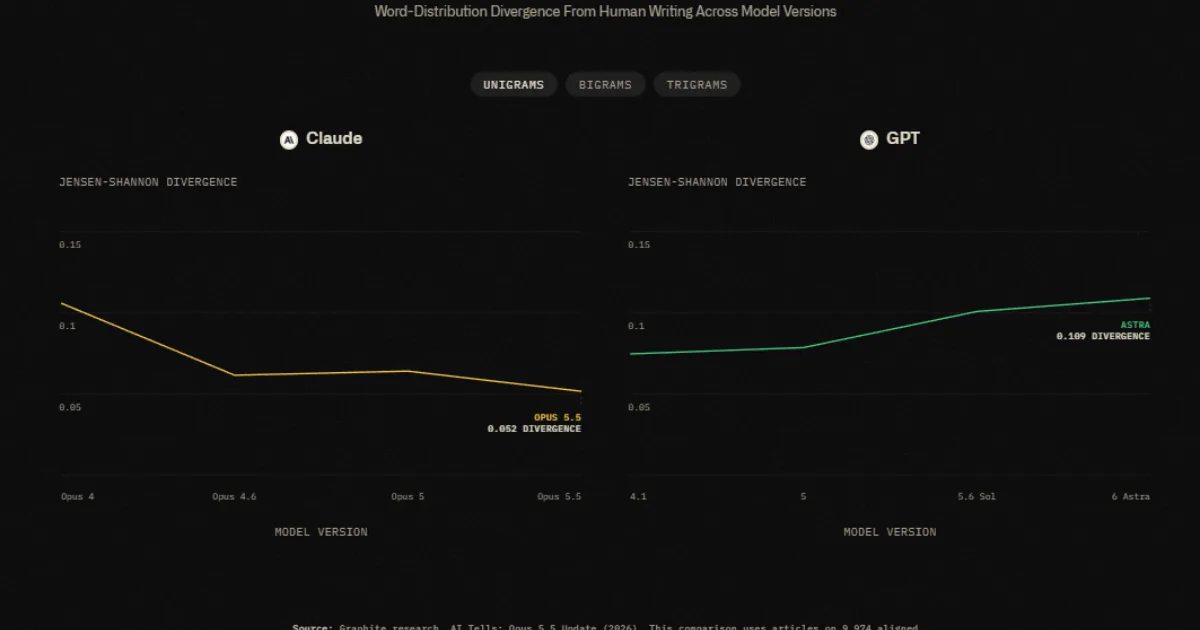
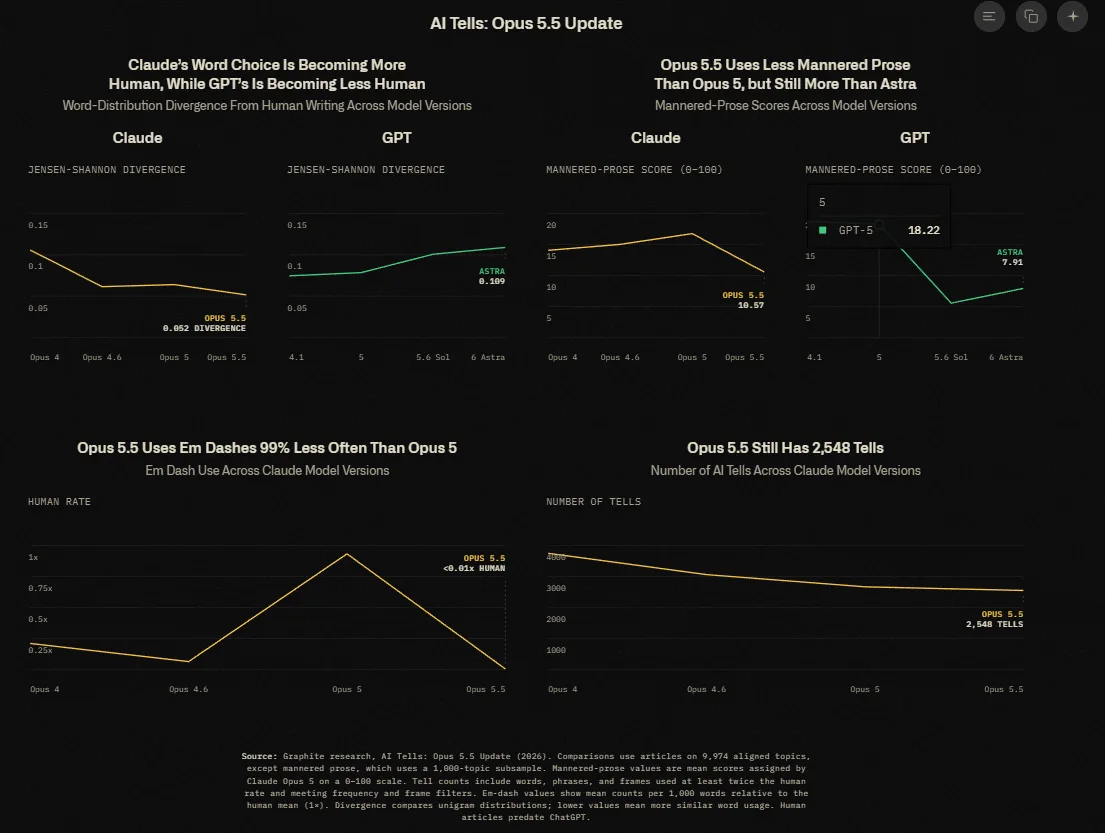
Claude’s word choice is becoming more similar to human writing. By contrast, GPT models, at least in Graphite’s measurements, are moving farther away from human word distributions in newer versions. Opus 5.5’s word-distribution divergence from human writing was 19% lower than Opus 5’s. GPT-6 Astra’s divergence was 8% higher than GPT-5.6 Sol’s.
That result marks an important shift in the discussion of AI writing.
Until now, many people have tried to identify AI text by looking for specific expressions: “delve,” “not only…but also,” “in today’s world,” excessive em dashes, or formulaic conclusions. But as models are updated, these obvious signals can disappear quickly.
Graphite’s report shows exactly that.
Opus 5.5 used em dashes 99% less often than Opus 5. In raw terms, Graphite counted 0.015 em dashes per 1,000 words in Opus 5.5’s articles, compared with 2.92 in Opus 5. Both Opus 5.5 and GPT-6 Astra now use em dashes much less often than human writers.
But this does not mean Opus 5.5 has become indistinguishable from human writing.
Graphite still found 2,548 AI tells in Opus 5.5. That is only 4% fewer than the 2,666 tells found in Opus 5. The number has declined from Opus 4 to Opus 4.6 to Opus 5 to Opus 5.5, but thousands of words, phrases and frames still appear disproportionately often compared with human writing.
In other words, the traces of AI writing have not disappeared.
The visible trace called the em dash has nearly disappeared.
But other traces remain.
Opus 5.5 overused words such as “dependable,” “clearer,” “matters,” “quietly,” “practical,” “steady,” “reflects,” “thoughtful” and “genuine” compared with human writing. TechCrunch, summarizing Graphite’s findings, noted that “dependable” appeared 23 times more often than in human samples, while phrases such as “this matters” and “why X matters” appeared at dramatically higher rates.
The common feature of these words is stylistic safety.
Opus 5.5 often uses language that makes writing feel stable, practical and meaningful. It leans toward evaluative words such as dependable, clearer, practical, thoughtful and genuine. Graphite classifies many of Opus 5.5’s tells as evaluative adjectives, transition phrases, contrast structures and markers of importance.
The phrase “this matters” is especially revealing.
According to Graphite’s data reported by TechCrunch, Opus 5.5 used “this matters” 116 times more often than human writers, and “why X matters” 92 times more often.
This shows one of the deeper habits of AI writing.
AI often tells the reader what is important.
AI often builds contrast structures.
AI often prefers the frame, “This is not simply A, but B.”
AI often repeats transition phrases and meaning-making sentences to smooth the flow of an argument.
These sentences are easy to read.
But when repeated, they create a recognizable scent.
Graphite’s concept of “mannered prose” points to the same issue. The report defines mannered prose as the use of metaphor and flourish in place of direct statements. Using Claude Opus 5 as an evaluator, Graphite scored articles on a 0-to-100 scale. Opus 5.5 scored 10.57, down 37% from Opus 5’s 16.75. But it was still about 1.6 times the human average of 6.65, and higher than GPT-6 Astra’s score.
The important point is that each model sounds artificial in a different way.
Opus 5.5 is less exaggerated and less rhetorical than Opus 5. But compared with GPT-6 Astra, it still uses more superlatives. Graphite reported that Opus 5.5 used phrases such as “the most powerful” 24 times as often as Astra, “the most popular” 45 times as often, and “perhaps the most” 29 times as often.
Astra has different traces.
According to Graphite and TechCrunch, Astra leans more heavily on terms and constructions such as “therefore,” “distinguish,” “approximately,” “establish,” “merely,” “distinction,” “necessarily” and “solely.” TechCrunch also described Astra’s tendency toward “corrective framing,” including constructions such as “not simply X” or “rather than relying on X.”
So the problem is not that “AI uses these words.”
More precisely, each model has its own overrepresented language habits.
Claude Opus 5.5 has moved in a softer and more human direction. But in that process, it still leaves behind more language about helpfulness, practicality, importance and clarity. Graphite found that Opus 5.5 used “can help you” eight times as often as Opus 5, “is especially helpful” 12 times as often, and “makes it easier” six times as often.
By contrast, Opus 5 used stronger emphatic phrasing.
Compared with Opus 5.5, Opus 5 used “is genuinely” 26 times as often, “matters enormously” 15 times as often, and “an enormous amount” eight times as often.
This change hints at the direction of AI model development.
Model providers are trying to reduce the feeling that AI writing looks too artificial. Users want more natural, less exaggerated prose. So newer models reduce certain obvious stylistic markers. But the models do not become fully human. They find a new equilibrium.
Opus 5.5 appears to have reduced ornate and emphatic phrasing, while strengthening a more helpful, advisory style.
That also connects to product identity.
Claude is often positioned as an assistant, adviser, analyst and writing partner. It makes sense, then, that words such as “help,” “helpful,” “helps” and “makes it easier” appear more often. A model’s brand personality and tuning direction can leave traces in its prose.
Graphite’s divergence analysis shows the broader pattern.
Jensen-Shannon divergence measures how different a model’s word or phrase probability distribution is from that of human writing. The higher the value, the farther it is from human writing; the lower the value, the closer it is. Opus 5.5’s unigram divergence was 0.052, lower than Opus 5’s 0.064 and far lower than Opus 4’s 0.106. For GPT models, Graphite reported increases from GPT-4.1 to GPT-5, GPT-5.6 Sol and GPT-6 Astra.
At first glance, this makes it look as if Claude is becoming more human while GPT is becoming less human.
But it should not be read as a simple ranking.
Graphite notes that different measurements capture different aspects of writing. Mannered prose and well-known tells capture specific habits. Divergence measures overall word distribution. Tell count measures the number of overrepresented words, phrases and frames. A model may reduce well-known tells while still moving farther from human distribution overall. Another may become more human in aggregate while keeping thousands of statistical tells.
That is the heart of the issue.
AI writing can no longer be detected by a single signal.
The era of saying “this has many em dashes, so it is probably AI” is ending. Newer models seem to avoid those well-known markers. But subtler signals remain: word distributions, repeated frames, evaluative adjectives, transition structures, importance markers and patterns of sentence rhythm.
AI writing becomes more human.
But as it is optimized to appear more human, it creates new traces.
This is a repeated game between detectors and generators.
Detectors identify AI traits.
Model developers reduce those traits.
New traits appear.
Detectors then look for the new ones.
Graphite’s conclusion points in this direction. Opus 5.5 is closer to human writing than Opus 5 in word choice, and it uses less mannered prose and far fewer em dashes. But it still shows 2,548 tells. Some tells become less common, while others become more common.
This research matters because the evolution of AI writing directly affects the content ecosystem.
First, AI detection becomes harder.
Older detectors often relied on specific words, punctuation, sentence structures and an overly balanced tone. But as models update, those markers quickly become outdated. Opus 5.5’s dramatic reduction in em dash use is the clearest example. A human’s intuitive sense that “this feels like AI” can become obsolete.
Second, the standard for human writing also shifts.
As AI writing becomes more human-like, human writers are influenced by AI prose. Blog posts, articles, reports, marketing copy, emails and proposals may begin to absorb AI-like structures. As that happens, the boundary between human-sounding writing and AI-sounding writing moves.
Third, this becomes a platform trust issue.
As search results, news summaries, reviews, product descriptions, education materials and corporate blogs fill with AI writing, readers must pay more attention to sources and quality. Text that looks human is not necessarily verified. Conversely, text with AI traces is not necessarily low quality. The real issue is transparency and accountability.
Fourth, writing education must change.
The advice “do not write like AI” is no longer enough. Writers need to know which kind of AI style they are trying to avoid. They need to reduce overused contrast structures, repeated “why this matters” framing, helpful-advice tone, abstract evaluative adjectives and sentences that feel balanced but lack concrete detail.
This is especially important in journalism and analytical writing.
AI is good at structure.
But when structure becomes too smooth, the sense of reality can disappear.
AI is good at meaning-making.
But when meaning-making becomes excessive, interpretation gets ahead of fact.
AI likes balanced sentences.
But too much balance can dull judgment.
Good writing is not simply writing that avoids AI tells.
Good writing has density: concrete facts, observation, judgment, rhythm and accountable sentences. Avoiding words that AI overuses does not automatically make writing human. What matters more is whether the writer’s experience, question, evidence and reason for choosing each sentence are visible.
Graphite’s research quantifies the traces of AI writing, but it also reveals the task facing human writers.
AI is becoming less obvious.
AI removes old fingerprints.
AI creates new fingerprints.
So human writing must do more than look different from AI.
It must feel as if a human being had a reason to write it.
The report also highlights the instability of the AI-detection market.
When models change, tells change. Opus 5.5 has different tells from Opus 5. Astra has different tells from Opus 5.5. Therefore, a detector tuned to one model at one moment may become much less reliable after the next model update. Graphite’s point is not that AI tells disappear. It is that they change by model and version.
That has implications for schools, media companies and businesses.
They should not rely on a single AI-detection score to judge whether text was AI-generated. Stylistic signals are only clues. The writing process, sources, raw materials, revision history, fact-checking and accountable authorship must also be considered. As AI writing becomes more human, transparent usage rules may matter more than detection alone.
The future of AI writing is likely to move in two directions at once.
One direction is toward more human-like prose. Word distributions become closer to human writing, exaggerated phrasing decreases and obvious tells fade.
The other direction is toward stronger model-specific identities. Claude may continue to emphasize helpfulness and practicality. GPT may strengthen analytical and argumentative structures. Gemini may develop different language habits. Readers may eventually stop asking only whether something is AI-written and begin asking which model’s habits it resembles.
Graphite’s Opus 5.5 update captures this transition.
AI writing is no longer one style.
Each model has its own style.
Each version has its own traces.
Even the direction of becoming more human is not the same.
That is why the question “How can we detect AI writing?” is becoming harder.
The better questions are these:
What language habits does this text repeat?
What optimization traces does this style carry?
Does this writing come from actual observation and judgment, or from a smooth recombination of patterns?
The traces of AI writing are not being erased.
They are only changing shape.