Data centers in the AI era are often described as factories that consume electricity.
But power is not the only critical resource.
Water is becoming just as important.
High-performance AI chips generate far more heat than conventional servers. As computing density rises, heat becomes more concentrated, and the cooling systems required to manage it become more complex. The expansion of data centers is therefore placing pressure not only on electricity grids, but also on local water systems.
Amazon’s latest sustainability disclosures make that reality more visible.
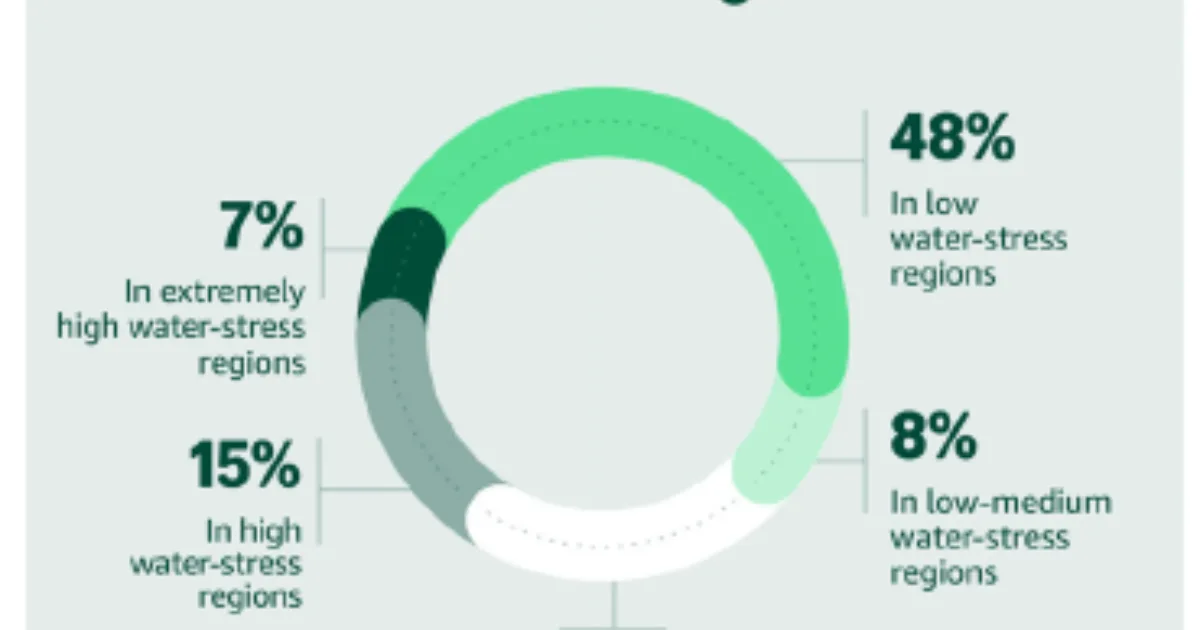
The company said its leased, owned and shared data centers around the world withdrew about 9.4 billion liters of water in 2025. About 22% of that withdrawal occurred in regions classified as high or extremely high water-stress areas.
That distinction matters.
A liter of water used in a water-rich region does not have the same environmental or social meaning as a liter used in an area already facing drought, population growth, agricultural demand or limited groundwater availability.
Amazon has set a goal of becoming “water positive” in its data-center operations by 2030. The company defines that target as returning more water to communities and the environment than it directly uses in data-center operations.
By the end of 2025, Amazon said it was 75% of the way toward that goal, up from 53% in 2024.
On paper, the progress is clear.
But the AI data-center boom is making the water question more complicated.
The issue is no longer simply how efficiently a company uses water. It is where that water comes from, when it is used, whether it is potable, how much pressure already exists in the local watershed and whether replenishment projects genuinely benefit the same communities affected by data-center demand.
AI Is Not Only an Electricity Problem
AI is often discussed through the language of electricity.
Large language models require GPUs, specialized AI chips, dense server racks, high-speed networks and massive computing clusters. Those systems consume large amounts of power.
But electricity use and water use are deeply connected.
Many data centers rely on water-based cooling systems to remove heat. The hotter and denser the computing environment becomes, the more difficult it is to cool equipment using air alone.
That is especially relevant for AI infrastructure.
The growth of generative AI has pushed cloud companies to deploy higher-density computing systems. These systems can produce enormous quantities of heat in a concentrated space. Cooling therefore becomes a central design challenge, affecting energy use, water use, construction costs and where a data center can be built.
Amazon is attempting to reduce this burden through more efficient cooling systems.
The company reported a global data-center Water Usage Effectiveness, or WUE, of 0.12 liters of water withdrawn per kilowatt-hour of IT load in 2025. It said this was a 20% improvement from the previous year and 52% lower than its 2021 level.
Amazon also said it reduced cooling-water use by 938 million liters and expanded efforts to secure recycled water for cooling.
These figures matter. They show that the company is improving the amount of water required to support each unit of computing.
But efficiency is not the same as lower total consumption.
If AI demand expands faster than efficiency improves, the total amount of water used by data centers can still rise.
The Rebound Effect of AI Infrastructure
This is the central paradox.
A more efficient cooling system reduces the amount of water needed for a given amount of computing. A more efficient AI chip produces more output per megawatt of electricity. A smarter operations platform can detect leaks and optimize cooling.
But if computing becomes cheaper and easier to deploy, companies may use more of it.
As AI tools spread across search, enterprise software, customer support, advertising, video production, scientific research, finance, education, defense and public services, total demand for data-center capacity can increase rapidly.
The same pattern is visible in energy efficiency.
When technology becomes more efficient, it can lower the cost of using that technology. Lower costs can encourage more use. Economists often call this the rebound effect.
For data centers, the risk is clear.
Cooling may become more efficient.
Water use per server may fall.
But AI infrastructure may expand so quickly that total water use still grows.
Amazon is trying to improve water efficiency while simultaneously expanding AWS capacity to meet growing cloud and AI demand. That means its long-term water footprint will depend not only on how efficiently individual facilities operate, but also on how many facilities are built, where they are located and how much AI demand continues to grow.
Local Water Stress Matters More Than the Global Average
The most important water question may not be Amazon’s global average.
It may be the location of each data center.
Amazon says that 48% of its data-center water withdrawals occur in low water-stress areas. The company has also stated that it does not use water for data-center cooling in some highly water-stressed regions, including parts of the Middle East, South Africa and India.
That strategy is important.
When a large data center uses significant volumes of water in a water-stressed region, the impact can extend beyond the facility itself. It can affect household water access, agriculture, local industry, municipal infrastructure and ecosystem health.
A data center may be highly efficient on paper while still creating conflict if it operates in a community where water is already scarce.
This is why water sustainability cannot be measured only through corporate-wide averages.
A company may reduce its overall WUE while building facilities in regions where even a relatively small amount of additional water demand creates serious local pressure.
The relevant question is not only, “How much water does the company use?”
It is also, “What does that water mean in this particular place?”
“Water Positive” Is Not the Same as Water Neutral Everywhere
Amazon says it invested in 45 water-replenishment projects and that these projects returned 9.4 billion liters of water to communities by the end of 2025. It has also secured agreements intended to replenish more than 18 billion liters annually in the future.
Water-replenishment projects can take many forms.
They may reduce leaks in municipal systems, improve irrigation efficiency, restore watersheds, expand rainwater infiltration, reuse treated wastewater or support water infrastructure in local communities.
Such projects can provide real benefits.
But water is different from carbon.
A ton of carbon dioxide emitted in one place affects the global atmosphere. Water, by contrast, is deeply local. A liter saved in one watershed does not always compensate for a liter withdrawn in another.
A data center using water in a stressed area cannot automatically offset that impact by funding water-saving projects elsewhere.
The environmental value of water depends on geography, season, quality, infrastructure and community needs.
That means water-positive commitments must be evaluated carefully.
How much water is returned?
Where is it returned?
When is it returned?
What kind of water is involved?
Does the replenishment benefit the same watershed or community affected by the facility’s withdrawals?
And does it improve access for residents, farms and ecosystems?
These questions matter because water accounting can otherwise create a misleading sense of equivalence.
Recycled Water Could Become the Most Important Cooling Resource
Amazon is responding to this challenge by expanding the use of reclaimed water.
The company said that 26 data centers were using recycled water for cooling as of 2025, preserving nearly 849 million liters of potable water. It has also signed agreements with 13 utilities to provide reclaimed water to 130 data centers in six countries.
This is one of the more meaningful changes in data-center sustainability.
The shift is not only about using less water.
It is about avoiding the use of drinking-quality water for industrial cooling whenever possible.
Reclaimed water, treated wastewater and harvested rainwater can reduce pressure on municipal drinking supplies. In regions where water scarcity is a serious concern, that distinction may be more important than marginal efficiency gains.
Amazon is also developing new cooling technologies for high-density AI hardware.
The company has described in-row heat exchangers designed to capture heat closer to the server racks where it is generated. Rather than cooling the entire room at the same intensity, the system focuses on the hottest areas.
Amazon is also expanding liquid-to-chip cooling, which brings cooling liquid closer to the AI chips themselves. The company says this can reduce mechanical-energy use during peak cooling periods by as much as 50% without increasing water use per megawatt.
These technologies could reduce cooling demand.
But the bigger question remains whether they can scale fast enough to keep pace with the expansion of AI infrastructure.
AI Can Help Save Water — but It Also Creates Water Demand
Amazon argues that AI can help address the water challenge.
The company is using smart meters, leak-detection systems, sensor networks and cooling-optimization tools to monitor water use in real time. It is also involved in the Water-AI Nexus Center of Excellence, a collaboration intended to develop sustainability principles for AI infrastructure and water management.
This reflects an important truth.
AI can help identify leaks, reduce waste, forecast demand and optimize industrial systems.
But AI’s ability to conserve water does not mean AI itself is water-neutral.
Every large AI system requires infrastructure. That infrastructure requires cooling. Cooling requires energy, engineering and, in many cases, water.
The real challenge is not simply to make AI more efficient.
It is to build AI infrastructure in a way that respects local environmental limits.
That means deciding where data centers should be located, how water-stressed those regions are, whether reclaimed water can replace potable water, how cooling systems are designed and how local communities share in decision-making.
India Offers Both a Milestone and a Warning
Amazon said it reached 120% water-positive status in India in 2025, achieving its target two years ahead of schedule.
That milestone is notable because India faces significant water stress in many regions. The country has a large population, rapidly expanding industrial demand and uneven freshwater availability.
But India also demonstrates why water-positive claims require careful scrutiny.
A corporate claim that more water has been replenished than withdrawn is important. Yet the real test is whether the benefits occur in the same communities and watersheds where water pressure is most severe.
For AI data centers, water responsibility cannot end with a global target or a headline number.
The more important questions are local.
Which region is supplying the water?
Does the community already face water scarcity?
Is drinking water being used for cooling?
Can recycled water be used instead?
And does the company’s water-replenishment effort restore water in the same place, at the same time and with the same value as the water being consumed?
The Cloud Is Not Weightless
AI often appears intangible.
A person types a question into a chatbot. A model generates an answer. An image appears. A software agent completes a task.
But none of this happens in the air.
The cloud is made of physical infrastructure: data centers built on land, supplied by electricity, cooled with water and connected through networks and chips.
Amazon’s water-positive goal is a meaningful attempt to address that reality.
Its efficiency gains, reclaimed-water projects and cooling innovations show that the company is taking the issue more seriously than many data-center operators did only a few years ago.
But AI-era water responsibility cannot be measured only by how much water a company replenishes or how low its global WUE becomes.
The harder question is whether the rapid expansion of AI infrastructure can remain compatible with the water needs of the communities around it.
AI may run in the cloud.
But the cloud still drinks from the ground.