The center of gravity in AI infrastructure competition is widening again.
For the past several years, discussions about AI infrastructure have centered on GPUs. Training larger models required more GPUs. Delivering faster inference required powerful accelerators. As a result, Nvidia GPUs, massive data centers, power, cooling, optical networking and HBM became the major bottlenecks of the AI industry.
But the new agreement between Anthropic and Akamai raises a different question.
Is GPU capacity really all that AI companies need?
On September 24, 2026, Akamai Technologies announced that it had signed a seven-year, $11.6 billion agreement with Anthropic. The deal is intended to support Anthropic’s accelerating CPU workload demands by using Akamai Cloud’s distributed AI infrastructure and software.
The scale alone is significant.
The base commitment is $11.6 billion. If the relationship expands, up to an additional $9 billion may be added, bringing the total potential commitment to about $20 billion. Akamai also issued Anthropic a warrant for non-voting convertible preferred stock representing 7.7 million shares of Akamai common stock on an as-converted basis, or up to roughly 5% of Akamai’s outstanding common stock, at an exercise price of $111.33 per common share.
This is not a simple cloud-purchasing agreement.
Anthropic becomes a major Akamai customer while also gaining the potential to participate in Akamai’s equity upside if certain conditions are met. Akamai secures a large AI customer, and Anthropic becomes tied to Akamai’s infrastructure expansion over the long term. The relationship between cloud providers and AI model companies is moving beyond a simple seller-buyer structure and becoming a strategic alliance.
The most striking word in this deal is not GPU.
It is CPU.
Akamai said the agreement is designed to support Anthropic’s “accelerating CPU workload demands.” That shows that the infrastructure needs of AI companies are not limited to GPU clusters for model training.
As AI services scale, CPU workloads also explode.
Data processing before and after model calls, request routing, user session management, search and retrieval-augmented generation, tool calls, agent orchestration, file processing, security checks, log analysis, monitoring, caching, API gateways, billing, account management, policy filtering and workflow execution all require CPU-based infrastructure.
This demand grows even larger in the age of AI agents.
A chatbot is closer to a structure in which a user asks once and receives one answer. An agent is different. It understands a user’s goal, plans multiple steps, calls external tools, reads web pages, runs code, analyzes files, stores intermediate results and makes new judgments. In that process, the demand is not only for model inference, but also for the surrounding compute that handles all of the work around the model.
In other words, the cost structure of AI services cannot be explained by GPU inference alone.
For large-scale AI services to reach real users, countless CPU workloads must run behind the GPU layer. This is one reason Anthropic’s agreement with Akamai matters. For AI models such as Claude to serve more users and enterprise workloads, they need not only accelerators that run the model, but also a stable, globally distributed computing layer.
Akamai’s strength is distributed infrastructure.
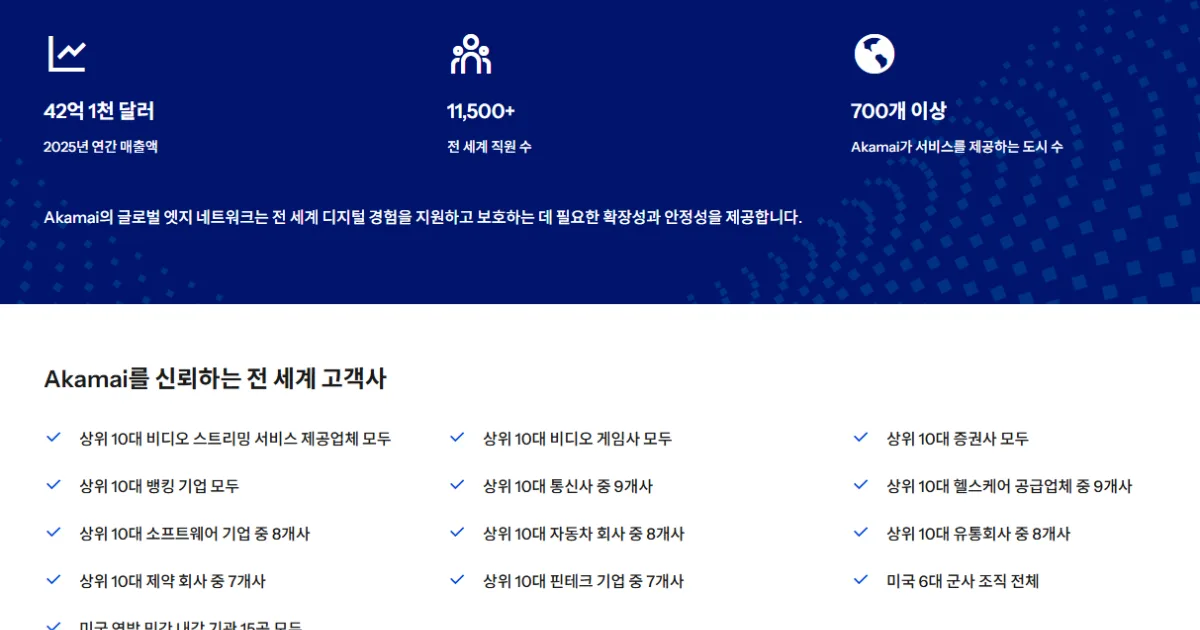
Akamai has long built its identity around content delivery, security and edge networks. In this announcement, Akamai emphasized that Akamai Cloud supports a computing continuum from core to edge and is built on a broad distributed network spanning thousands of points of presence.
That point matters.
AI services increasingly do not operate only inside centralized data centers. Users are spread around the world, and enterprise customers care about latency, reliability, security, data location and cost. As AI agents enter real workflows and application flows, response speed and network stability become central to the user experience.
Distributed cloud is one answer to this problem.
Instead of sending every request to a small number of massive regions, some workloads can be processed closer to users. Security, routing, data preprocessing, caching and lightweight compute can be distributed. That is why Akamai emphasizes “core to edge.”
The agreement is also a turning point for Akamai.
Akamai said it had already announced more than $2.8 billion in multi-year cloud infrastructure service deals across its customer base this year. With the $11.6 billion Anthropic agreement added on top, Akamai Cloud is increasingly being redefined not as an extension of a CDN business, but as an infrastructure business for AI workloads.
Akamai CEO Tom Leighton said Anthropic is advancing the AI revolution and that Akamai is pleased Anthropic has chosen its capabilities to build and operate AI infrastructure. He emphasized Akamai’s global footprint and experience supporting large enterprise customers, positioning the company as an infrastructure provider for secure and responsible AI applications and workloads.
Akamai’s differentiation rests on three elements.
First, distribution.
Akamai is built on infrastructure spread across the world. As AI services scale globally, latency, accessibility and network efficiency become more important. Centralized data centers alone cannot satisfy every user and enterprise requirement.
Second, security.
Akamai also has a strong identity in security. As AI workloads become integrated into enterprise operations, security becomes a core condition for infrastructure selection. Model calls, APIs, data processing, agent tool use and enterprise network connections can all become attack surfaces.
Third, operational experience.
AI companies cannot succeed only by building strong models. They must operate large-scale services reliably. They need to survive sudden demand spikes, meet enterprise customers’ service-level and security requirements, and manage performance and cost across regions. Akamai is arguing that this operational layer is where it has an advantage.
The financial structure of the agreement also deserves attention.
Akamai estimated that the contract will require roughly $5.5 billion in capital expenditure. It said the deal has no impact on its 2026 revenue guidance, but expects 2026 capital spending to increase by about $1.7 billion to secure and pre-purchase supply-chain components needed to support the agreement, including memory.
This shows that AI infrastructure contracts are not merely revenue contracts.
They are capital-intensive expansion projects.
When a cloud provider secures a large AI customer, it gains a long-term revenue opportunity. But to realize that revenue, it must first invest in data centers, servers, networks, memory, power, cooling and supply chains. AI infrastructure is not a market where supply appears immediately simply because demand exists. Long-term contracts, upfront investment, component procurement and facility expansion move together.
For Anthropic, the agreement is also strategic.
Anthropic is growing rapidly in the enterprise AI market around Claude. To expand beyond conversational models into coding, analysis, document work, agentic workflows and enterprise data processing, it needs reliable infrastructure. Enterprise customers demand not only performance, but also stability, security, scalability and predictable cost.
A long-term agreement with Akamai can be read as a move by Anthropic to reduce infrastructure bottlenecks and secure a large-scale foundation for CPU-based surrounding workloads.
The deal also matters for the competitive structure of the AI cloud market.
The AI infrastructure market has largely developed around hyperscalers. AWS, Microsoft Azure and Google Cloud have provided large GPU clusters and cloud services. But as AI demand explodes, the role of alternative infrastructure providers, specialized clouds, edge clouds and distributed infrastructure companies is also growing.
Akamai is aiming at that gap.
Not every AI workload has the same shape. Massive model training requires huge GPU clusters. But actual service operation also requires distributed CPUs, networking, security, edge processing and global routing. Akamai appears to be positioning itself as a differentiated provider in exactly that layer.
The agreement also reveals another trend.
AI companies are trying not to depend on a single infrastructure supplier.
Frontier AI companies need enormous compute resources for model development and service operation. If they are tied too tightly to a single cloud or accelerator supply chain, they may face constraints in cost, negotiating power, outage risk and regional expansion. Anthropic’s expanded long-term relationship with Akamai can also be interpreted as part of a strategy to diversify and deepen its infrastructure supply chain.
Still, the deal carries risks.
For Akamai, the required capital spending is large. The $11.6 billion agreement creates a long-term revenue opportunity, but it also requires about $5.5 billion in capital expenditure. If demand forecasts are wrong, if AI workload structures change, or if competitive pressure reduces pricing, profitability could come under pressure.
For Anthropic, a long-term infrastructure commitment may also limit flexibility.
AI technology changes quickly. Model architectures, inference methods, hardware efficiency, agent architectures and data-processing patterns can all change. Even if the judgment that CPU workloads will grow sharply is correct, the optimal location and form of that infrastructure may continue to evolve.
The warrant structure is also double-edged.
Anthropic can participate in Akamai’s equity upside as the relationship expands. Akamai offers a large customer an incentive to remain aligned over the long term. But this also binds the two companies’ interests more strongly. A cloud-purchasing agreement becomes not merely a cost transaction, but a deal connected to capital-market incentives.
This is also a pattern increasingly seen in AI infrastructure.
Relationships between AI model companies, cloud providers, semiconductor companies and data-center operators are becoming more complex. Simple purchases, equity stakes, prepaid contracts, supply guarantees, revenue sharing, warrants and long-term commitments are being combined. Because AI infrastructure is so capital intensive, companies are designing long-term financial structures rather than relying only on short-term service contracts.
The forward-looking language in Akamai’s announcement is also worth noting.
Akamai warned that expected effects of the transaction, the potential impact of the warrant, the possibility of expanding the relationship with Anthropic, and effects on its financial condition and guidance are forward-looking statements. Actual results may differ because of factors including competition, pricing pressure, data-center capacity, supply-chain constraints, financing, security breaches, macroeconomic conditions and regulatory changes.
This shows how much uncertainty sits beneath large AI infrastructure contracts.
AI demand is strong.
But whether demand becomes profit is a separate question.
The contract is large.
But the infrastructure must be built and operated on time.
The customer is significant.
But technology and cost structures keep changing.
Even so, the direction of the agreement is clear.
The AI industry needs more computing.
That computing is not made only of GPU training clusters.
CPU-based workloads, distributed cloud, edge infrastructure, security and network operations are becoming important together.
Frontier AI companies are model companies, but they are also massive infrastructure customers.
Cloud companies are using large upfront investment and strategic equity incentives to capture AI demand.
The $11.6 billion agreement between Anthropic and Akamai symbolizes this shift.
AI competition is expanding from model-performance competition into infrastructure-supply-chain competition. It is no longer enough to ask who can build the smartest model. It is also necessary to ask who can deliver that model more reliably, faster, more securely and across the world.
Akamai is using this agreement to explain itself anew as a distributed cloud infrastructure provider for the AI era. Anthropic is trying to secure long-term infrastructure to support the growth of Claude and agentic AI services.
Ultimately, the essence of this deal is not simply that Anthropic will use Akamai Cloud.
It is that the computing required for AI services to become real industrial infrastructure has become much wider and more complex.
The bottleneck of the AI era is not one model.
GPUs are needed, but CPUs are needed too.
Central data centers are needed, but the edge is needed too.
Speed is needed, but security is needed too.
Short-term usage matters, but so does a seven-year supply chain.
The Anthropic-Akamai agreement shows that the AI infrastructure war is now expanding beyond the inside of the data center into global distributed cloud networks.