A bipartisan group of U.S. senators has reintroduced a bill to increase transparency around digital surveillance.
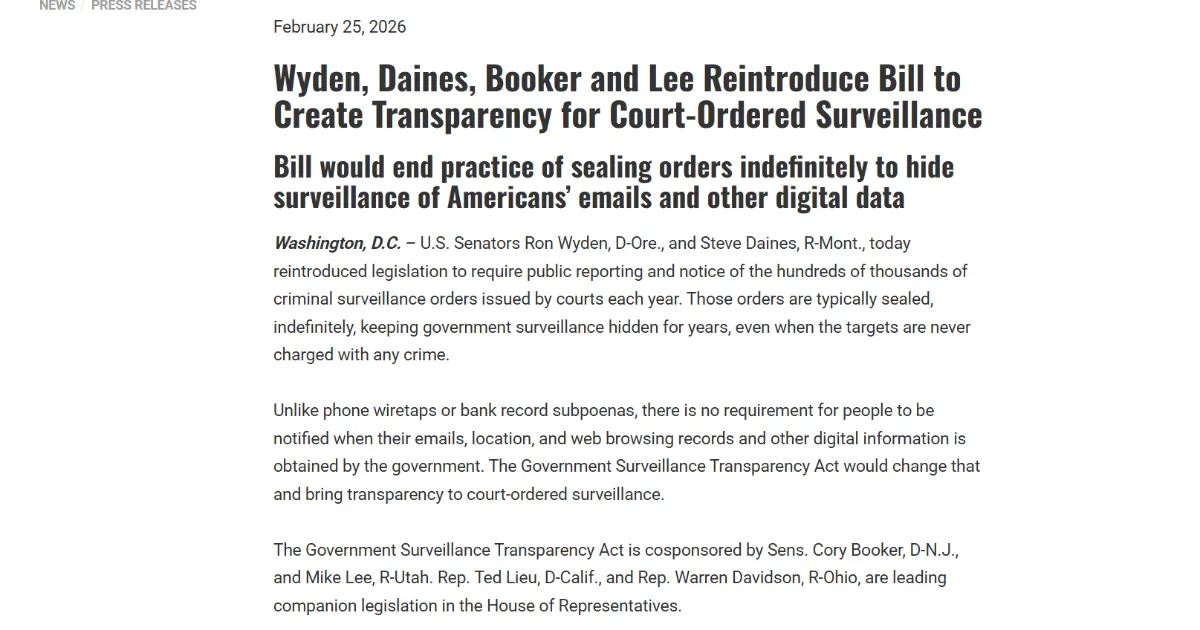
On February 25, 2026, Senators Ron Wyden, Steve Daines, Cory Booker and Mike Lee reintroduced the Government Surveillance Transparency Act. In the House, companion legislation has been led by Representatives Ted Lieu and Warren Davidson. The bill’s purpose is clear: to require public reporting and eventual notice for the hundreds of thousands of criminal surveillance orders issued by courts each year.
Today, these orders are often sealed.
And the sealing can last for years.
Sometimes, it can effectively continue indefinitely.
Even if a target is never charged, that person may never learn that the government obtained their email, location information, web browsing history or other digital records.
The bill is an attempt to challenge that practice.
Its premise is that digital surveillance should not exist in a transparency gap. Unlike wiretaps or bank-record subpoenas, many forms of digital-data access lack a clear process for notifying the affected person after the need for secrecy has passed.
In an era when a person’s life is stored in email, smartphone location logs, browsing history, cloud files, messages and app records, digital surveillance is no longer an exceptional investigative tool.
If the fact of surveillance can remain hidden indefinitely, citizens may never know that they were monitored.
The government power was exercised.
But after-the-fact accountability never arrived.
Why Digital Surveillance Is More Dangerous
Older forms of surveillance were more physical and limited.
The government might search a home, tap a phone line or subpoena bank records. These were still powerful state powers. But digital surveillance is broader and deeper.
Email contains personal conversations and work records.
Location data can reveal where a person went and whom they may have met.
Web browsing history can expose interests, illness, political views, religion, spending patterns and private worries.
Cloud files and message histories can preserve memory, relationships and personal identity.
Digital data can reconstruct a person’s life over time.
That means government access to such data is not simply a matter of viewing one document. It can be closer to looking into the person’s entire lived environment.
The issue is notice.
There are times when disclosure during an investigation may be difficult. If a suspect is notified too early, evidence may be destroyed, flight may occur or accomplices may respond. Temporary sealing can therefore be necessary.
But the question changes when the investigation is over, when disclosure no longer creates danger or when the target is never charged.
Should secrecy continue then?
The Government Surveillance Transparency Act answers no.
What the Bill Would Change
The bill does not require immediate public disclosure of every digital surveillance order.
Its core principles are eventual notice and eventual unsealing. Once disclosure would no longer compromise an investigation or endanger someone, the affected person should be notified, and the relevant applications and orders should become part of the public record.
The bill includes several mechanisms.
First, law enforcement agencies would be required to provide notice to targets when subpoenas or court-ordered surveillance involving electronic data occur. This mirrors the logic that already exists for older forms of surveillance such as wiretaps and bank-record subpoenas.
Second, service providers and other interested parties would be able to challenge sealing orders. If the government loses, it may be required to pay the challenger’s costs and attorney’s fees. This is designed to discourage routine or excessive sealing.
Third, surveillance applications and orders would eventually be unsealed and placed on the docket once secrecy is no longer necessary to protect an investigation or safety.
Fourth, courts would be required to publish basic data online about the surveillance orders they approve, while excluding information that could identify individuals or compromise investigations.
Fifth, law enforcement agencies would have to notify courts if they searched the wrong person, house or device under a court order, or if a provider disclosed data beyond what the court authorized.
Sixth, the Administrative Office of the Courts would expand the existing annual wiretap report to include data about stored communications surveillance, metadata interception and gag orders.
Finally, the bill includes grant support to help state courts and Tribal courts comply with the new requirements.
The structure of the bill can be summarized in one principle:
necessary secrecy during an investigation may be allowed, but secrecy must not become permanent.
A Bipartisan Privacy Bill
One striking feature of the bill is its bipartisan sponsorship.
Wyden has long been associated with privacy rights and opposition to unnecessary government surveillance. His office has also described his work on issues such as cell-site simulators, foreign and domestic surveillance law reform and limits on warrantless access to sensitive data.
But the bill also includes Republican lawmakers such as Daines, Lee and Davidson. Their framing emphasizes constitutional protection against unreasonable searches and seizures.
Digital surveillance does not fit neatly into ordinary partisan categories.
Progressives may frame the issue as civil liberties and privacy.
Conservatives and libertarians may frame it as limiting government power and protecting constitutional freedoms.
Technology-policy advocates may focus on platforms and data providers.
Press-freedom advocates may focus on public access to surveillance records and after-the-fact accountability.
The starting points differ.
But the conclusion is similar.
A system in which the government can quietly inspect a person’s digital life and never tell them is hard to reconcile with democratic oversight.
Why This Bill Matters Now
The bill matters because digital investigations have become routine.
Law enforcement can obtain large volumes of information from telecom companies, email providers, cloud services, social-media platforms, search services, app operators and data brokers. In the past, investigators might have needed separate access to diaries, phone calls or bank transactions. Today, one account, device or platform record can reveal a broad map of a person’s life.
But legal procedures are still shaped in part by older surveillance tools.
Wiretaps have reporting and notice systems. Bank-record subpoenas are familiar legal instruments. But the bill’s sponsors argue that emails, location data, web records, stored communications, metadata and gag orders lack adequate transparency structures.
Long-term sealing is the central problem.
Sealing can be necessary during an investigation. But if sealing becomes indefinite, the public, press and courts cannot easily see how surveillance powers are being used. It becomes difficult to know whether the wrong person’s data was collected, whether too much data was disclosed or what standards courts used to approve orders.
Surveillance may begin in secret.
But it should not remain secret forever.
The Objection: Could Disclosure Harm Investigations?
There is, of course, a counterargument.
Law enforcement agencies may argue that disclosing surveillance orders can harm investigations. Criminal organizations could learn investigative techniques, hide evidence or threaten victims and witnesses.
That concern is real.
The bill does not ignore it.
It does not demand immediate disclosure. Instead, it is built around delayed disclosure. Applications and orders are to be unsealed and docketed only when doing so would no longer interfere with an investigation or endanger individuals. Court-published data would also be limited to basic information that does not identify people or compromise active cases.
The bill is therefore trying to balance transparency and investigative protection.
The key question is not whether secret investigations can exist.
The key question is whether secrecy has an end point.
In a democracy, coercive investigative powers may sometimes be exercised in secret. But citizens, courts, lawmakers and the press should be able to review how those powers were used after the need for secrecy passes.
Investigative necessity can justify secrecy.
It cannot justify indefinite secrecy.
The Role of Platform Providers
The bill also matters for service providers.
Companies that operate email, cloud, messaging, social-media, search or location-information services may receive subpoenas or court orders requiring them to provide user data. At the same time, they are expected to protect user privacy.
The problem is the gag order.
If the government combines a data demand with a non-disclosure order, the company cannot notify the user. If such orders continue for long periods, the user may never know they were subject to surveillance. The company also has limited ability to contribute to public debate.
The Government Surveillance Transparency Act would allow providers and interested parties to challenge sealing orders. This positions platforms not merely as passive channels for government requests, but as actors that can contest secrecy on behalf of user privacy and procedural transparency.
The fee-shifting provision is also important.
If the government loses a challenge and must pay costs and attorney’s fees, providers and other parties may be more willing to bring legitimate challenges. Without such support, the cost of litigation can discourage enforcement of rights.
Digital surveillance transparency is not only a matter for government and courts.
Platforms that hold user data are part of the surveillance structure.
Wrong Searches and Overbroad Disclosures
One notable part of the bill is the requirement to notify courts when errors occur.
If law enforcement searches the wrong person, home or device under a court order, or if a service provider discloses data not authorized by the court, the court must be informed.
This is practical and important.
Digital investigations can involve identification errors. An IP address, account name, device identifier, location signal or communication record can be misattributed. A provider may also accidentally turn over more data than the court order permitted.
These errors can seriously harm individuals.
The wrong person may become a target.
Irrelevant personal information may enter government hands.
Excessive data may become subject to analysis.
The bill tries to prevent those mistakes from being buried. Court notification would improve accountability in the execution of surveillance orders.
Investigative power must be precise.
In digital investigations, mistakes can scale quickly because the data volume is large.
Expanding the Annual Wiretap Report
The bill would also expand the annual wiretap report produced through the judiciary.
The idea is to go beyond traditional wiretap statistics and include stored communications surveillance, metadata interception and gag-order data.
This strengthens statistical transparency.
Individual orders may eventually be unsealed. But the public also needs aggregate data: how many orders are issued, what types of data are collected and how often gag orders are used. Without such numbers, Congress, journalists and civil society cannot understand the scale of surveillance.
Modern surveillance cannot be described through phone wiretaps alone.
Stored emails.
Cloud files.
Message histories.
Location data.
Metadata.
Browsing records.
App data.
Platform account information.
If access to these records is expanding, reporting systems must expand as well.
Power that is not measured is difficult to control.
What This Means for Korea
Although this is a U.S. bill, it has clear implications for Korea.
Korea also faces debates over law enforcement access to communications data, search-and-seizure warrants, location tracking, platform-data disclosure and cloud records. Digital data can reveal a person’s life, relationships, political expression, consumption, movement, health and financial activity in broad detail.
The key issue is after-the-fact notice and transparency.
Investigative secrecy may sometimes be necessary. But if a person never learns after the investigation that their data was collected, it becomes difficult to seek remedies. If the wrong person was targeted or excessive data was provided, the affected person may never have a chance to challenge it.
Korea should ask similar questions.
When investigators obtain personal data from platforms, when should the person be told?
After an investigation ends, what notice is required?
Can providers challenge overbroad or excessive demands?
Do courts publish statistics about digital surveillance orders?
Is there a reporting system for wrong targets or overbroad disclosure?
How are metadata, location data and web records governed?
Digital surveillance transparency is not a uniquely American issue.
As AI, data and platforms converge, state access to data can become more powerful. After-the-fact notice, public reporting, judicial statistics, provider challenges and error reporting are core elements of democratic oversight.
Why the Issue Becomes More Important in the AI Era
The meaning of the bill becomes even greater in the AI era.
Digital data obtained by the government is no longer just stored evidence. When combined with AI analysis tools, large volumes of email, location records, web history and metadata can be automatically summarized, classified and connected. Patterns and networks that once required human analysts can now be inferred at scale.
The size and speed of surveillance change.
The issue is no longer only whether the government reads one person’s email or location history. It may involve automated analysis of relationships, movement patterns, interests and behavioral predictions.
In that environment, after-the-fact notice and public reporting become more important.
Government access to data becomes a stronger surveillance power when combined with AI analysis.
Digital surveillance transparency is therefore not only a privacy issue.
It is a question of power control in the AI era.
Secret Investigations May Be Necessary. Permanent Secrecy Is Not.
The Government Surveillance Transparency Act is a bill about investigative transparency in the digital age.
Senators Wyden, Daines, Booker and Lee, along with House sponsors including Lieu and Davidson, are trying to change the practice of indefinitely sealing court orders that allow the government to obtain emails, location data, web browsing records and other digital information.
The bill does not deny the need for secrecy during investigations.
Instead, it says that once the investigation is over and the risk has passed, the affected person should be notified, surveillance applications and orders should be unsealed and docketed, and courts should publish basic data online. It also allows providers and interested parties to challenge sealing orders, requires notification when wrong searches or overbroad disclosures occur, and expands annual reporting beyond wiretaps to include stored communications, metadata interception and gag orders.
The principle is simple.
If the government can look into a citizen’s digital life, the citizen should at least be able to learn that fact later.
In the digital age, a search is no longer only the opening of a physical door.
It can be the opening of an email inbox, a location history, a browsing record or a cloud account.
If that door is opened and the person never learns it, constitutional limits on search and seizure become harder to enforce in practice.
Investigations may require secrecy.
Democracy requires eventual accountability.
The Government Surveillance Transparency Act is an attempt to turn that balance into law.