When we are young, the world often feels simpler than it truly is.
There is time spent with family. There are quarrels with friends, followed by reconciliation. We like what we like, and tomorrow promises another new day. Without ever needing to name it, life can feel, for the most part, peaceful.
But as we grow older, another world slowly begins to appear.
Through the news, we learn of wars and conflicts unfolding across the globe. We come to understand that the Korean Peninsula, where we live, remains divided. We begin to see how environmental issues, cultural differences and competing interests collide.
To learn about the world is to broaden one’s view. But it also means beginning to see realities that were once invisible.
For eighteen-year-old Seo So-young, that realization came gradually.
“When I was little, I think I just lived by looking at the things I liked. Spending time with my family felt peaceful, and being with my friends felt peaceful too. But as I watched the news and began to understand the world little by little, I realized that we live amid far more conflict than I had thought.”
For Seo, peace was once so ordinary that she had never stopped to question it. Over time, however, it became something she wanted to ask herself about.
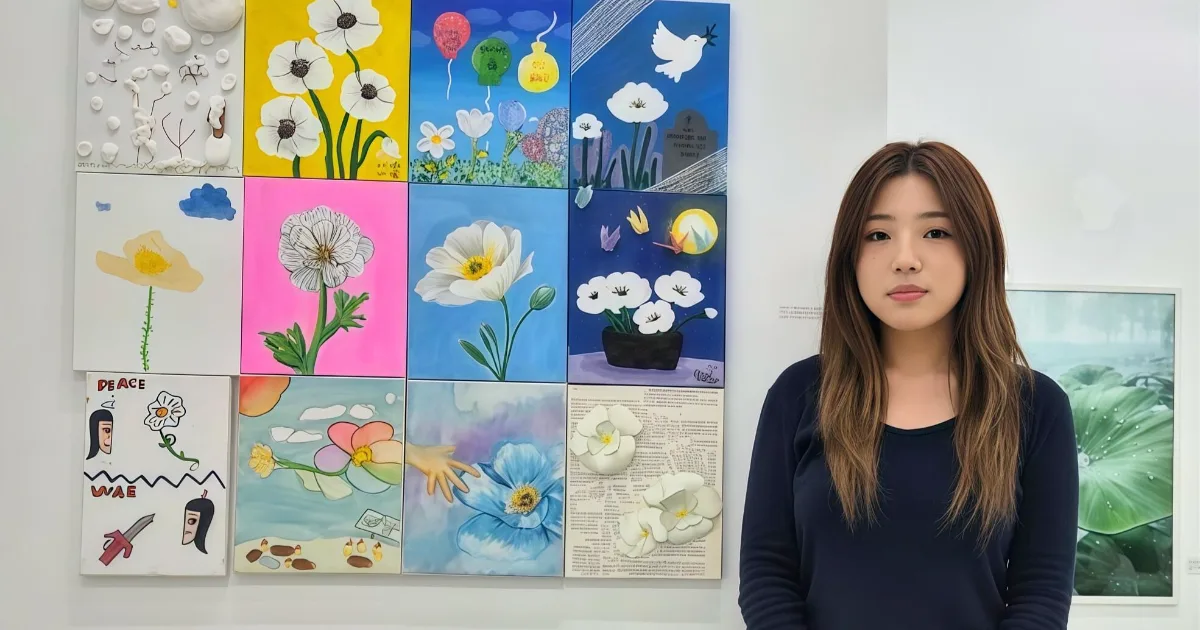
That question eventually led to an exhibition space in Cheongdam-dong, Seoul.
White Poppy: Sustainable Peace I.
The exhibition brings together works by children, teenagers and established artists, each expressing their own understanding of peace.
Its curator is only eighteen years old.
“My Wish Was for War to Stop”
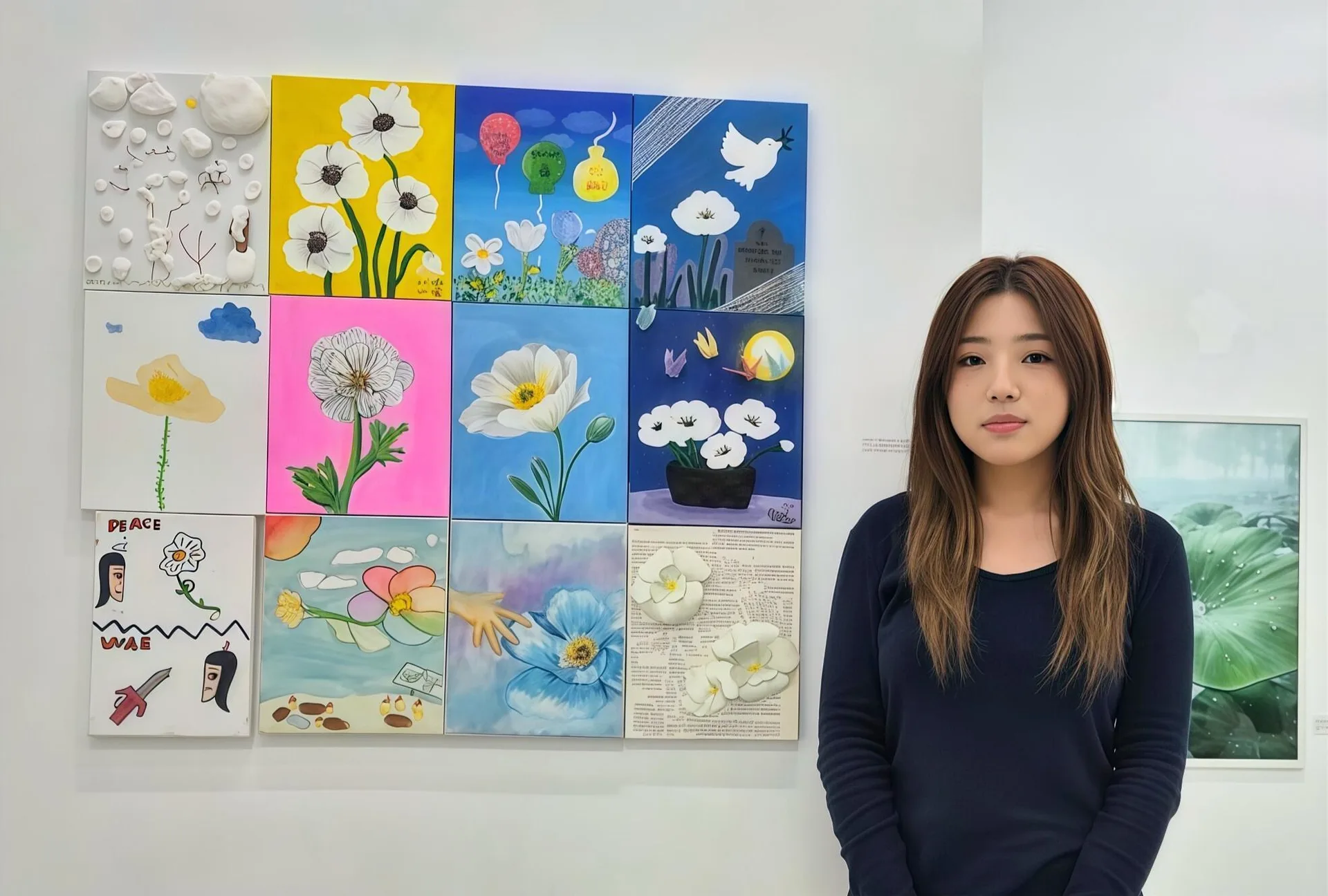
Seo’s interest in peace began much earlier.
As a child, she often took part in English speech contests. One day, in a school English diary, she wrote down a wish:
I hope war stops.
That sentence later became the theme of a speech competition.
At the time, it was not a statement shaped by a deep understanding of international politics. To a child, war simply meant people getting hurt and becoming sad. That was why she wanted it to end.
Later, through her work as a children’s reporter, Seo had the opportunity to meet North Korean defector youths.
It was a time when public interest in inter-Korean summits was high. South Korean students and North Korean defector youths took part together in a mock inter-Korean summit.
That experience narrowed a distance that had once felt abstract.
“Before that, North Korea felt very far away to me. But when I actually met peers from there, I realized they were not completely different from what I had imagined.”
Seo continued those connections through volunteering, choir activities and other forms of engagement.
In that process, the word “peace” also began to expand.
At first, peace meant the absence of war. But as she grew older, she began to think about the environment, cultural differences and conflicts between people.
One of the conclusions she reached was respect.
Respecting people who are different from me. Recognizing different environments and ways of thinking. Considering how one’s choices affect others.
For Seo, peace gradually became less a grand term of international politics and more a way in which people relate to one another.
During the interview, she was asked what peace means to her as an eighteen-year-old.
After thinking for a while, she gave a short answer.
“Just not fighting.”
The simplicity of the answer was striking.
As the conversation continued, Seo spoke about how her own understanding had changed.
“As I came to know more about the world, I think I began to realize that peace is not something we can take for granted.”
When she was younger, she did not consciously think about peace. Time with family and time spent playing with friends were simply part of everyday life. But as she grew older, she learned more about what was happening across the world.
From then on, peace began to feel less like something already given and more like something people must continue to create together.
A similar idea appears in the exhibition statement:
“Peace is not a completed state, but an ongoing practice created through memory and testimony, mourning and care.”
In that way, this eighteen-year-old curator has taken the more complicated world she has come to know and returned it to one simple question.
How Can We Live a Little More Peacefully?
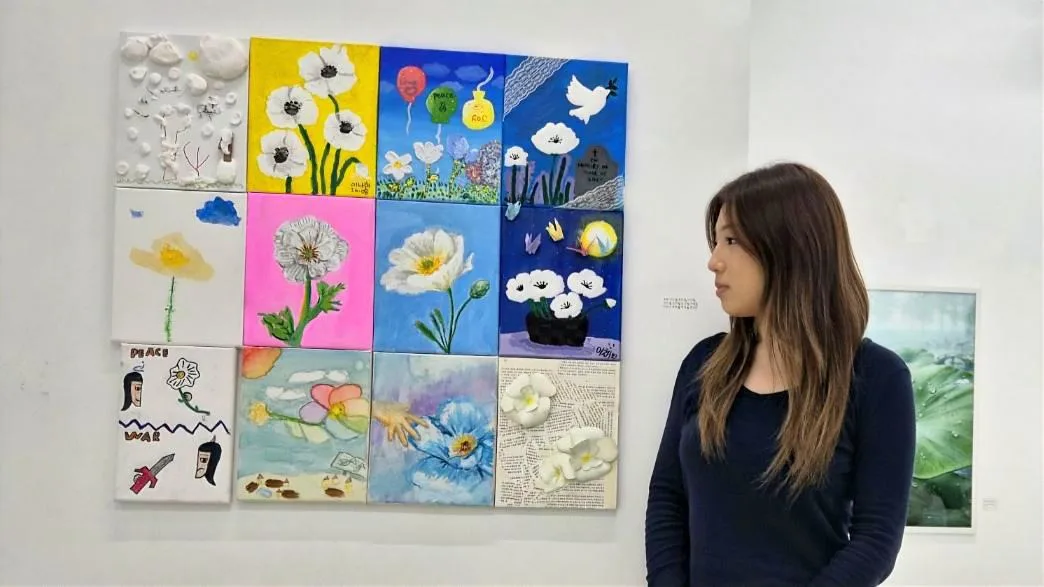
Among the works in the exhibition are drawings by young children.
There is one painting Seo especially likes. It shows a yellow flower set against shades of blue.
There are no complicated sentences. No grand symbols.
Just one flower in bloom.
“I liked that painting. It felt like it wasn’t trying to explain too much. It was just a flower the child had imagined.”
For Seo, that painting connects closely to the meaning of the exhibition.
“I don’t think we always need to think of peace as something difficult.”
Looking around the exhibition, one notices an interesting difference.
The works by younger artists tend to be simpler. As the age of the artists rises, more colors, symbols and words begin to appear.
Of course, this is also a difference in expressive style.
But to Seo, it seemed to resemble her own process of growing up.
When she was young, the world was simple. As she grew older, she learned more, and peace too became a more complicated question.
And yet the work she felt most drawn to was the simplest one: a single flower.
Perhaps this exhibition is, in the end, a process of returning to the most basic question in a world that has grown increasingly complex.
Placing Different Visions of Peace in One Space
When choosing the exhibition space, Seo paid particular attention to one feature: the open center.
On one side are works by students. On the other are works by established artists. They are clearly different areas, but from the center of the space, they can be seen together at once.
“When you look this way, the feeling is different, and when you look the other way, it feels different again. But I liked that you could see them all together from one place.”
The way people understand peace can also differ.
The peace imagined by a child does not need to be the same as the peace imagined by an adult. A person who has experienced war closely may think of peace differently from someone who has not.
This exhibition does not try to force those perspectives into one answer. Instead, it places them together in one shared space.
The exhibition includes works by a Ukrainian artist, children and teenage artists, and established artists. During the exhibition period, performances, artist talks and docent programs are also being held. Programs inviting young adults preparing for independence and children in care were also planned.
Seo said she wanted to create not only a place where artworks are displayed, but a space where different people can meet and talk.
What Her First Curatorial Project Taught Her: The Difficulty of Connection
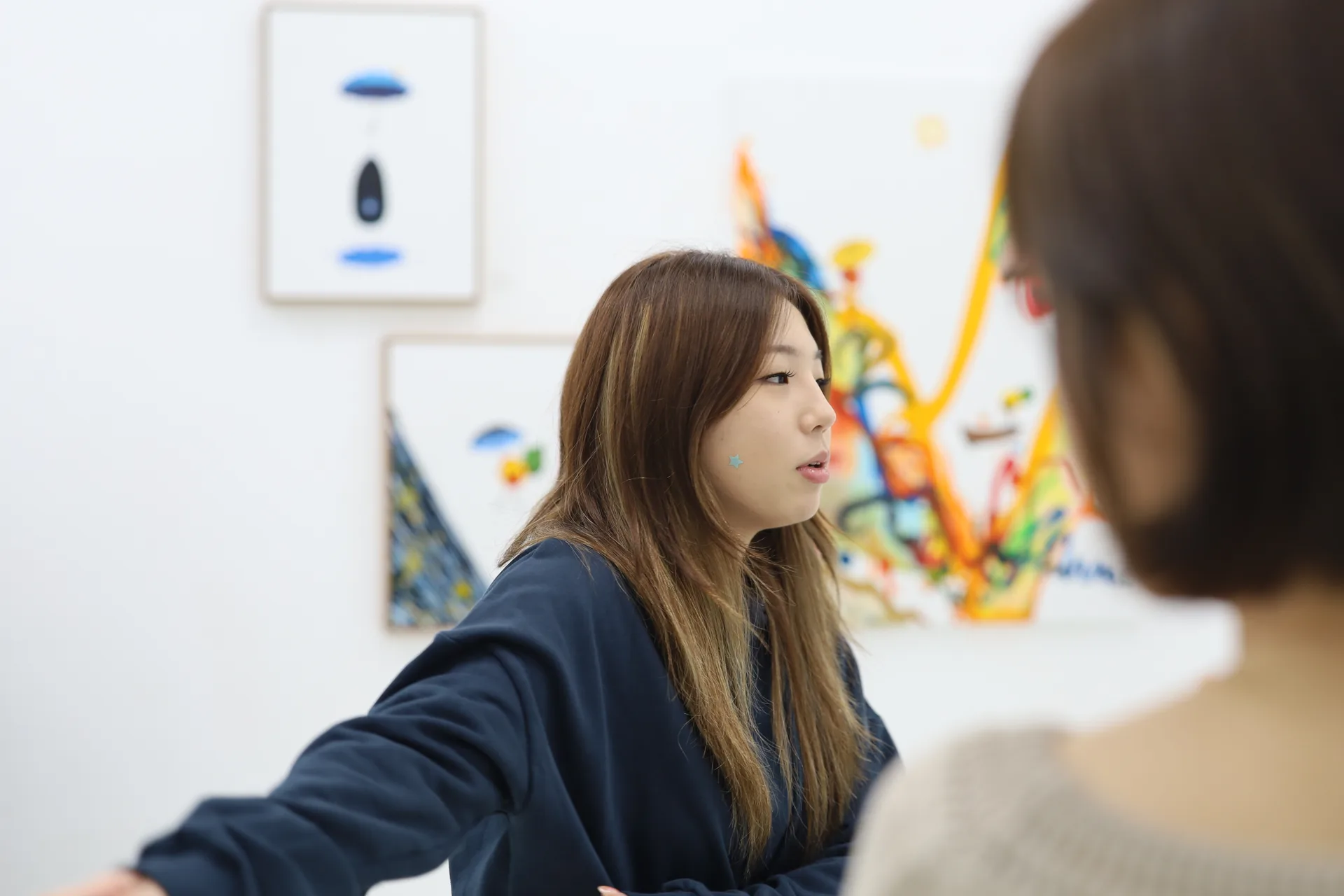
Turning an idea into reality was not easy.
The hardest part was connecting people.
In particular, inviting young students to the exhibition required cooperation from schools and institutions. Communicating with different organizations also brought unexpected difficulties.
Through that process, Seo learned something important: just because an intention feels meaningful to her does not mean others will receive it in the same way.
Even the word “peace” can be understood differently by different people.
That is why she did not try to impose her own idea of peace. Instead, she invited each participant to express their own.
In preparing an exhibition about peace, the process itself became an experience of understanding and coordinating different perspectives. Curation, she learned, is ultimately about connecting people with people.
Seo hopes to continue the exhibition overseas someday. Next time, she would also like to include more specific images of society in the works. She wants to explore, in her own way, the questions she discovers while observing the world.
What that future exhibition will look like is not yet decided.
And perhaps that is only natural for someone who is eighteen.
This exhibition is not a completed answer. It is closer to a first question.
Near the end of the interview, the conversation returned to where it began.
Before she learned more about the world, Seo had not thought much about peace. The more she came to know, the more she realized that peace is not as easy as it once seemed.
And yet what she brought into the exhibition space was not a grand answer.
It was a flower drawn by a child.
It was a collection of people’s stories.
If asked again what peace means to her, her answer would probably not change much.
“Just not fighting.”
Perhaps this first exhibition by an eighteen-year-old curator is an invitation to stay a little longer with that short sentence.