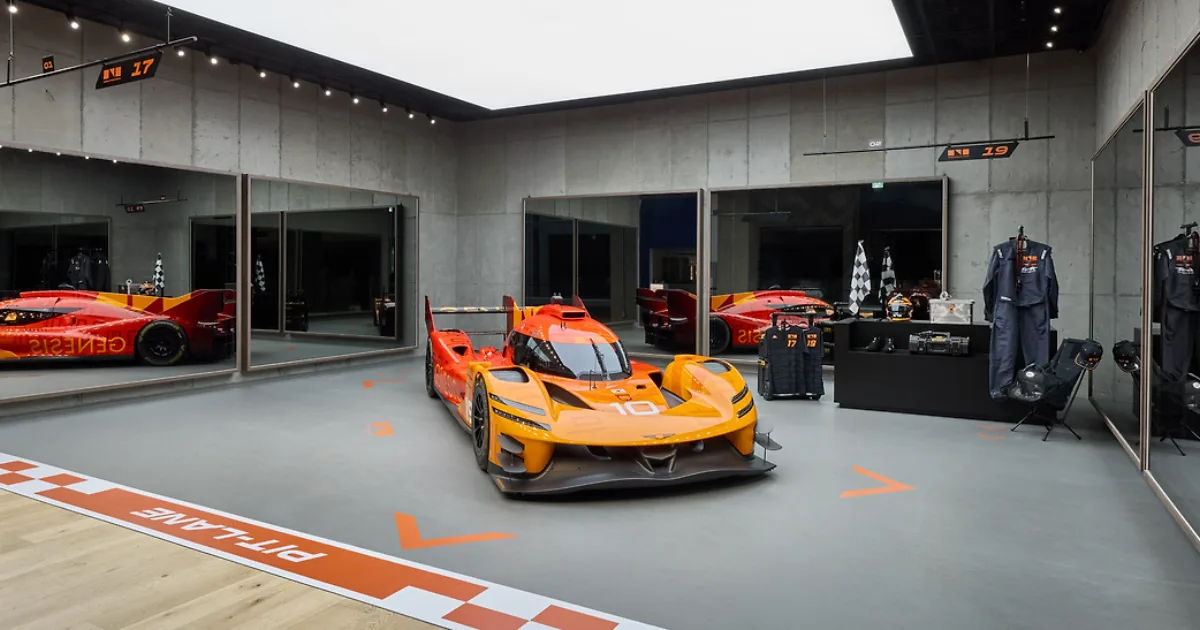
Not long ago, I visited Starfield Hanam and stopped in front of the Genesis showroom.
At the center of the space sat a car that looked as if it were burning red. Its body was low and close to the ground. The bright Magma Orange at the front gradually deepened into a darker red toward the rear.
It was the Genesis Magma Racing GMR-001 hypercar.
The GMR-001 hypercar design model is a full-scale representation of the racing car Genesis Magma Racing plans to run in the World Endurance Championship. It looked so different from the Genesis I had known that I found myself staring at it for a long time.
When I thought of Genesis, the words that usually came to mind were “Hyundai’s premium brand,” “quietness” and “comfort.”
But at some point, Genesis and “racing” began appearing in the same sentence.
This was not simply the addition of a high-performance trim. Genesis created a separate performance identity called Magma, formed a racing team, and entered the world of endurance racing.
As I looked at the car, one question came to mind.
Why Now?
Then several keywords surfaced at once.
EVs.
AI.
Dark factories.
Autonomous driving.
At first, these may seem like separate technologies.
EVs change the powertrain. AI is software. Dark factories change production. Autonomous driving changes how cars are used.
But from a distance, all four changes point in the same direction.
They are changing what it means to make cars well.
EVs are changing the technical structure of the automobile. AI and robotics are changing the production structure. Autonomous driving may change the very way cars are used. If these changes continue far enough, one day car companies may be left with a very different question.
Can a car company survive simply by making good cars?
Looking at the GMR-001, I wondered whether Genesis had already begun preparing its answer to that question.
Could Cars One Day Become More Like PCs?
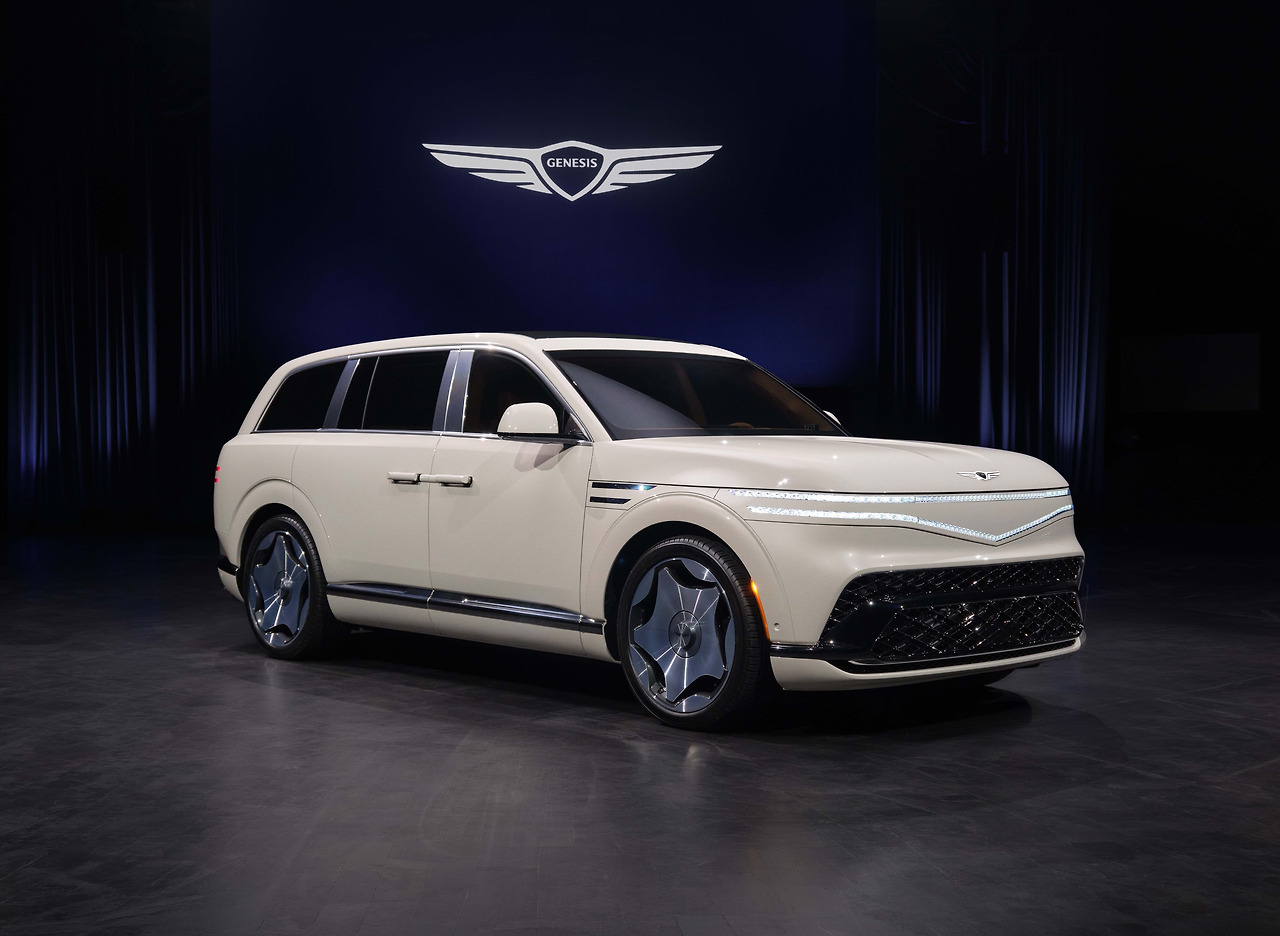
For a long time, I have thought that the EV era could make the structure of the automobile industry resemble the PC industry in certain ways.
Of course, saying cars may become like PCs does not mean that consumers will one day buy parts and assemble cars at home.
A car is a product that carries human life. It requires crash safety, durability, national certifications, quality guarantees, recalls and service networks.
Even so, the PC industry offers one important lesson.
Technology did not become easy.
The location of technology changed.
Until the 1990s, a computer was widely seen as a complete product made by a finished-product company. People bought branded PCs from companies such as Samsung or Trigem.
Then the structure of the PC became more standardized.
Intel and AMD made CPUs. ASUS and Gigabyte made motherboards. Samsung Electronics and SK hynix made memory. Specialized companies emerged for graphics cards, SSDs and power supplies. Consumers could combine these parts and build the PCs they wanted.
The important point is not that CPU or GPU technology became simple.
In fact, each individual technology became far more complex.
What changed was that one finished-product company no longer needed to develop every core technology by itself. Technology became specialized across different companies. The competitive advantage of the finished-product company shifted from “making everything directly” to “selecting the best technologies and integrating them into one product.”
A similar shift is visible in EVs.
In the internal-combustion era, the engine and transmission were the core technological assets of automakers. To create a good engine, a company had to accumulate decades of knowledge in combustion, durability, vibration, noise, cooling and control systems. That is why BMW’s inline-six engine or Porsche’s flat engine could become part of a brand’s identity.
But in EVs, the competitive structure changes.
Batteries, motors, inverters, power semiconductors, thermal-management systems and software become more important. Many of these technologies are being advanced by specialized companies.
Of course, making a good EV is still difficult.
Battery safety, crash safety, body rigidity, thermal management, suspension, braking, NVH, software stability and cybersecurity must all be integrated perfectly inside one vehicle.
So it would be too simplistic to say that automakers’ technical capabilities will disappear.
It is more accurate to say their role is changing.
In the internal-combustion era, one key capability was the ability to create core technologies directly. In the EV era, the increasingly important capability may be the ability to integrate many technologies into one coherent experience.
Automakers are becoming massive system integrators.
Here, I see one important shift.
Technology is not losing value.
But the period during which technology alone can create differentiation may become shorter.
Good technology can be copied.
Good components can be purchased by other companies.
Then companies must compete over what they create with those technologies.
What Happens When AI and Robots Are Added?
The structure of technology is not the only thing changing.
The way cars are made is also changing.
Automobile factories are already among the most automated manufacturing sites in the world. Industrial robots have long been used in welding, painting, parts movement and parts of the assembly process.
But when AI is added, the nature of automation itself can change.
Until now, automation largely meant repeating tasks that humans had predefined. In the future, factories may increasingly judge situations and adjust production methods on their own.
AI can forecast market demand, adjust production schedules and detect equipment anomalies before failures occur. Autonomous mobile robots can move parts. Robots can assemble components. Vision AI can inspect quality. Digital twins can test new production methods without stopping the real factory.
If humanoid robots are eventually deployed at scale, some complex tasks that previously required human workers may also become automated.
This is interesting not simply because robots may replace people.
It is interesting because it could affect one of the deepest formulas of the automobile industry: economies of scale.
Until now, becoming a car company required massive production facilities. A company needed huge capital investment, thousands of workers, many suppliers and the ability to produce hundreds of thousands of vehicles at consistent quality. Knowing how to design a car was not enough. Manufacturing capacity itself was a giant entry barrier.
But if AI and robots make production facilities more flexible, the story may begin to change.
A single production line may produce multiple models. Production volume may adjust more quickly to demand changes. Smaller production bases may be able to produce various vehicle types more realistically than before.
This is why microfactories attract attention.
Of course, this does not mean giant automotive plants will disappear overnight. When we consider stamping, painting, battery packs, supply chains, certification, quality and recalls, the automotive industry remains a heavy industry.
But the question can still be asked.
Will the ability to operate massive car factories remain as absolute a competitive advantage as it once was?
If EVs change some parts of the technology barrier, AI and robots may gradually change parts of the manufacturing barrier as well.
Then the competitive advantage automakers must protect will naturally move elsewhere.
What If Humans No Longer Drive?
Autonomous driving goes one step further.
If EVs change the power source of the car, autonomous driving may change the meaning of the car itself.
Today, a car is a machine an individual owns and uses directly. I buy it. I drive it. I park it. I maintain it.
That is why personal taste naturally enters the automobile. The car one drives can reveal economic power, lifestyle, preference and social position. Mercedes-Benz, BMW, Porsche, Ferrari, Rolls-Royce — these names are not just names of transportation devices. Each evokes a certain life and taste.
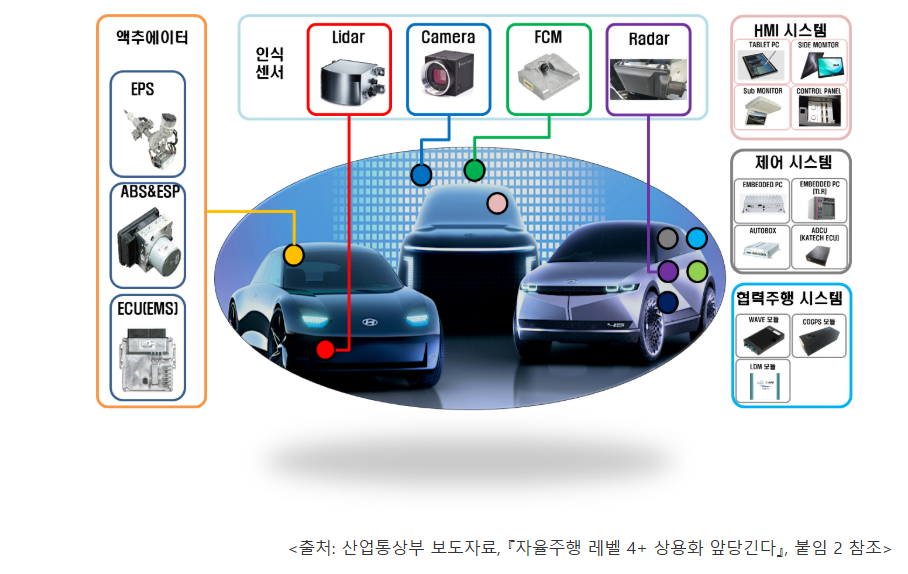
But if full autonomous driving advances far enough, this relationship may be shaken.
You enter your destination in an app. A car comes to pick you up. You get in, and it takes you to your destination. Vehicles share road and traffic information and find the best route.
At that point, the car may shift from “a machine I must drive” to something closer to a terminal that provides mobility.
Just as we do not care much about what engine is inside the bus we take, we may care less about certain aspects of the vehicle that moves us.
Then the important things may no longer be the feeling of driving.
How safe is it?
How accurate is it?
How comfortable is it?
What can I do while moving?
The value of the car moves from “a machine for driving” to “a moving space.”
Inside the car, people work, watch movies, sleep and talk.
Then the car may also shift from product to service. The issue will no longer be simply selling a vehicle once. The more important questions may become: Who dispatches the car? Who manages the data? Who optimizes charging and maintenance? Who handles payment and insurance? Who provides content inside the vehicle?
If that happens, a car company’s competitors will no longer be only other car companies.
AI companies, semiconductor companies, cloud companies, mapping and data companies, and mobility platform companies will enter the automotive industry.
A future car company may not be able to remain only a manufacturer.
It may need to be a software company, a service company, a company that designs moving spaces, and a company that operates an ecosystem.
When Mobility Becomes a Service, Ownership Moves Into the Realm of Desire
Here, an interesting paradox appears.
As cars become more perfect as transportation tools, the reason to own a car may actually decline.
If a clean, safe autonomous vehicle comes to pick me up whenever I need it, why spend tens of millions of won to buy a car?
Why pay insurance and taxes, secure parking space, maintain the vehicle and absorb depreciation?
Especially in cities, car ownership and mobility may increasingly separate.
From the standpoint of function alone, calling the right vehicle at the right moment may be more rational.
Then the future car market may split in two.
One is the car of necessity.
It only needs to take people to their destinations safely, cheaply and efficiently. Autonomous robotaxis and shared mobility belong here. In this market, the car brand may become less important than it is today. It may resemble how we think about buses or subways: the quality of the service matters more than the manufacturer of the vehicle.
But another market will remain.
The car of desire.
A car one does not need to live, but still wants.
A car one buys even though there are cheaper and more convenient ways to move.
Here, the reason to buy a car goes beyond function.
People buy it because they like the design, because they want to drive it themselves, because they love the brand, because it expresses their taste, or because owning it carries meaning.
At that point, the question a car company must answer changes.
Not “Why is this car better?”
But “Why would someone still want to own this car?”
The ability to make a good car and the ability to make a desirable car are not the same.
A good car can be made through technology and quality.
A desirable car requires more than technology. It needs history, design, culture, scarcity, symbolism, story and the identity the owner feels when choosing that brand.
Rolex Survived the Smartwatch
This is where I think of today’s mechanical watch market.
There is almost no practical reason to buy a mechanical watch just to check the time. A smartphone is enough.
If one needs a device on the wrist, a smartwatch does far more. It shows calls and messages, manages schedules, tracks heart rate and exercise, and can even call for help in emergencies. Functionally, the smartwatch is overwhelming.
And yet Rolex did not disappear.
Patek Philippe did not disappear.
Audemars Piguet did not disappear.

Why?
Because people are no longer buying those watches only to tell time.
They are buying history, scarcity, craftsmanship, design and the meaning of wearing that brand on the wrist.
The mechanical watch did not disappear when it lost its functional necessity.
It became a symbol once it was liberated from function.
Something similar may happen to cars.
As the mobility function of the automobile becomes generalized as a service, cars owned by individuals may become even more emotional products.
The more functions become standardized, the more values outside function matter.
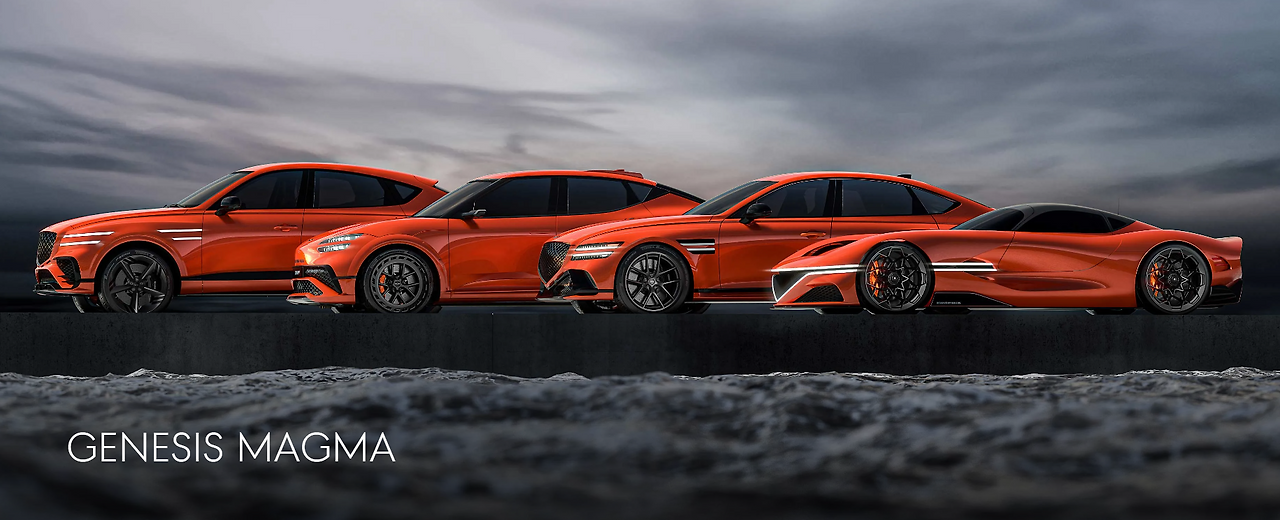
This is where Genesis Magma and the GV90 meet.
Magma Racing Creates the Past Genesis Does Not Yet Have
Luxury car brands depend heavily on history.
Ferrari has racing history. Porsche has Le Mans and countless motorsport memories. Aston Martin has its own long story of sports cars and racing.
The reason their high-performance cars are special is not simply that they are fast. It is that decades of time sit behind them. There were victories, failures, legendary drivers, legendary cars and fans who remember those moments.
To buy a Ferrari or a Porsche is not simply to buy a high-output vehicle.
It is to buy the memory accumulated by the brand.
That is heritage.
And this is what Genesis lacks most.
Genesis is still a young brand. Its design has been recognized quickly. Its product quality has improved. It has grown its presence in the global market. But decades of motorsport history cannot be bought with money. A company cannot go back today and create a Le Mans record from the 1950s.
There is only one way.
Start creating the past of the future now.
That is how I see Genesis Magma Racing and the GMR-001.
The team may fail, finish races, compete, one day reach the podium and perhaps eventually win. Those scenes will accumulate and become history.
What looks to us today like the record of a single season may become, 20 or 30 years from now, the memory of “the time Genesis first entered global endurance racing.”
Just as Hyundai’s Pony from the 1970s has been reinterpreted decades later as a symbol of the Korean auto industry’s beginning, the GMR-001 sitting today in a Starfield Hanam showroom may one day stand at the center of a Genesis museum.
In that sense, motorsport is not a way for Genesis to compress time instantly.
It is the place where Genesis begins accumulating time.
The desire Magma must create is also clear.
Even in an age when I no longer need to drive, I still want to drive this car myself.
Speed.
Cornering.
The feeling of connection between human and machine.
If the day comes when driving is no longer an obligation, driving itself may become a rarer and more precious experience.
That is why I see Magma as a project for creating desire.
GV90 Tries to Create the Symbol Genesis Does Not Yet Have
If Magma is a project to create heritage for Genesis, the GV90 is closer to a project to create an icon.
In the luxury car market, technical excellence alone does not make a top-tier brand. Consider Mercedes-Maybach, Rolls-Royce, Range Rover and the G-Class.
These names already carry clear images.
Maybach evokes top-level chauffeured luxury and the rear seat.
Range Rover evokes British luxury and SUV tradition.
Rolls-Royce evokes the highest level of luxury and bespoke craftsmanship.
The G-Class is especially interesting. Most people who buy a G-Wagen today are not buying it to cross extreme off-road terrain. Yet they pay a high price because they are buying its boxy design, long history, ruggedness, scarcity and the social image attached to owning it.
Function has become symbol.
This is where luxury cars separate from ordinary cars.
The ordinary car asks, “What can this vehicle do?”
At some point, the luxury car asks, “What does it mean to be seen in this vehicle?”
Genesis already makes many good cars.
But it is still difficult to say that the name Genesis instantly evokes a social image as clear as Maybach, Rolls-Royce or Range Rover. This is not a problem of quality. It is a problem of time and symbolism.
I believe the GV90 challenges this wall.
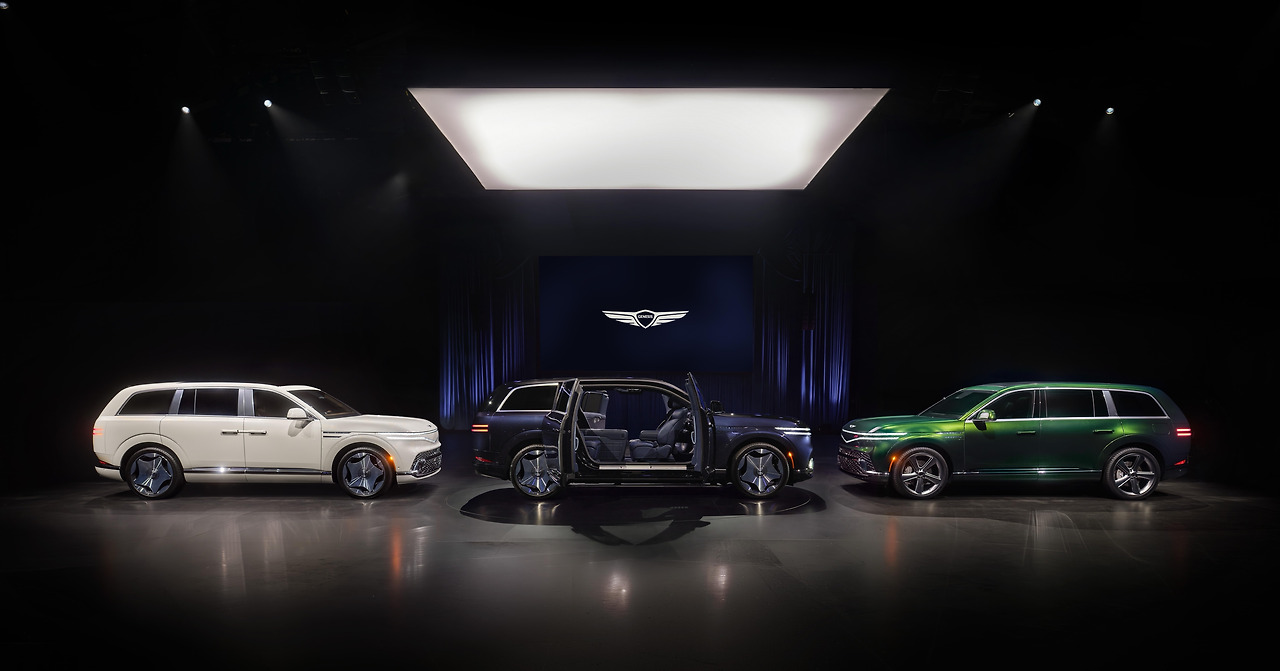
If the GV90 means only “the largest and most expensive Genesis SUV,” it is not that special. The market already has larger and more expensive SUVs.
What matters is how the GV90 defines Genesis’ own luxury.
That is why the language of Korean luxury and hospitality matters.
Genesis does not need to imitate Maybach.
If Range Rover has British luxury and the G-Class has rugged symbolism, Genesis must build its own grammar.
Negative space.
Restraint.
Space.
Hospitality.
If, one day, people look at the GV90 and feel, “That is what Genesis means by luxury,” then the GV90 will begin to become more than a large electric SUV.
It will become an icon.
Magma and the GV90 appear to move in opposite directions, but they are actually heading toward the same place.
Magma asks:
Even in an age when you do not need to drive, do you not still want to drive this car?
GV90 asks:
Even in an age when you do not need to own a car, do you not still want to be the kind of person who rides in this one?
One is desire for driving.
The other is desire for ownership and identity.
That Is Why Genesis Becomes More Important to Hyundai Motor Group
From this perspective, Genesis’ role inside Hyundai Motor Group also looks different.
If Hyundai and Kia are responsible for the mass market, scale, productivity and electrification, Genesis must answer a different question:
How much value can we command as a brand?
The power of a luxury brand is not simply the ability to charge a high price. It is the ability to make consumers accept that price and still choose the product despite paying more.
That is pricing power.
For SUVs of similar size, people may pay 50 million won for one brand, 100 million won for another, and several hundred million won for another. That difference cannot be explained by manufacturing cost alone.
History, design, service, scarcity, social symbolism and emotional attachment to the brand all enter the price.
If Genesis becomes a true global luxury brand, that means Hyundai Motor Group is no longer merely a company that makes good cars well.
It becomes a company that can attach higher value to good cars.
It moves from “a good car for the price” to “a car people want beyond the price.”
Can Korean Manufacturing Move Beyond Making Things Well?
This question is not only about Hyundai Motor Group.
More broadly, it connects to the next challenge for Korean manufacturing.
For a long time, Korea has been a country that makes things well.
Cars, semiconductors, ships, batteries.
The country grew through high quality, productivity, fast execution and cost competitiveness.
But in an age when technology and manufacturing know-how spread quickly around the world, “making things well” may not be enough to sustain differentiation forever.
What comes next?
I believe the next question is how much meaning can be attached to well-made products.
France makes bags, but sells Louis Vuitton.
Switzerland makes watches, but sells Rolex.
Germany makes cars, but sells Porsche.
Italy makes cars, but sells Ferrari.
The price does not contain only raw materials and manufacturing cost. It contains history, culture, design, story, symbolism and human desire.
That is why Genesis’ challenge is symbolic for the Korean auto industry.
Magma tests whether a Korean automotive brand can create its own story inside global motorsport.
GV90 tests whether “Korean luxury” can become a value global consumers are willing to pay for.
Can concepts such as negative space, restraint, space and hospitality be placed inside an industrial product called the automobile and translated into the grammar of global luxury?
From a country that makes good cars to a country that makes cars people desire.
From a country that exports technology to a country that exports culture and symbolism on top of technology.
Perhaps that is the next threshold Korean manufacturing must cross.
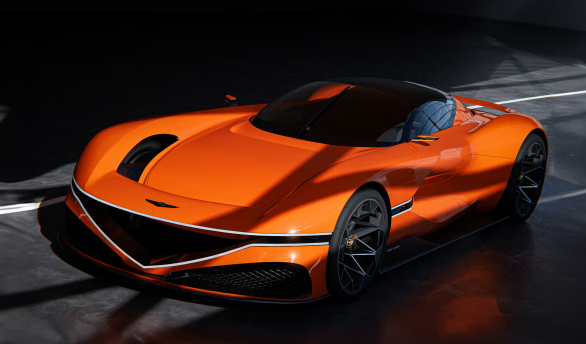
Back in Front of the Burning Orange Car at Starfield Hanam
The GMR-001 stood at the center of the Genesis showroom in Starfield Hanam.
At first, I thought it was simply a beautiful racing car.
Genesis is making racing cars now.
That was about all I thought.
But once I placed it alongside EVs, AI, robots, autonomous driving and the GV90, the car began to look different.
The change now taking place in the auto industry may not simply be the replacement of engines with batteries.
The technology of making cars is changing.
The method of producing cars is changing.
The way people use cars is changing.
Ultimately, even the reason to own a car may change.
At the end of that transformation, one difficult question remains for car companies.
Even then, why would people still want your car?
Genesis seems to be building two answers.
Magma begins creating the past Genesis will one day be able to boast about.
GV90 tries to create the symbol people may one day desire.
One builds heritage.
The other builds an icon.
If those two accumulate properly, Genesis may one day become a brand that needs no explanation.
Like Ferrari.
Like Porsche.
Like Maybach.
Like Range Rover.
Like the G-Wagen.
These brands have one thing in common. They do not need to explain that they make good cars. The moment people hear the name, an image already appears: speed, luxury, success, adventure, craftsmanship or a certain way of life.

The brand name itself becomes meaning.
And that meaning becomes desire.
A car one may not be able to buy now, but wants to drive someday.
A car one hopes to own if success comes.
A car that becomes a dream beyond function.
Perhaps that is the highest point a luxury automotive brand can reach.
That may also be the place Genesis ultimately wants to reach.
A brand that no longer needs to be explained as “Hyundai’s luxury car.”
A brand that no longer needs the qualifier “a premium car with strong value for money.”
A brand whose name alone evokes an image and an emotion.
If Genesis reaches that point, it will no longer be merely a brand chasing existing luxury automakers.
It will be a brand with its own standards and its own world.
And this is where I find my answer to the original question.
Why is Genesis starting racing now, and why is it preparing a flagship like the GV90 at the same time?
Perhaps because cars are becoming more perfect as mobility tools.
Paradoxically, the more that happens, the hardest task for a car company remains outside technology.
Not creating a faster way to move.
But creating a reason why people still want that car.
Even in an age when cars may no longer be necessary.
Even in an age when people may no longer need to drive.
A reason for people to say:
Still, I want that car.
Perhaps the most expensive capability in the future automobile industry will not be batteries, AI or autonomous driving.
It may be what remains after all those technologies become common.
The ability to create human desire.
That may be the most important asset Genesis is now building together with its cars.