I opened my eyes.
The room was still dark. I checked my phone. It was a little past 6 a.m.
I looked beside me.
My son was asleep.
I remembered the conversation we had had the night before.
At first, I had simply felt uncomfortable about a few YouTube videos my son had been watching. They were videos where someone was teased, embarrassed, and made into a source of laughter because of their reaction.
I did not like that kind of content.
More than anything, I was bothered by the way my son kept scrolling through such videos without much thought.
“I’m not saying you shouldn’t watch YouTube.”
I think that is how I began.
“But it’s your time. Whether it’s one hour or two, if you keep watching, that part of your life is going into it. What you watch and what you hear may seem like nothing, but eventually they shape how you think and what kind of person you become.”
I had meant to keep it short.
But one thought led to another. The feeling that I needed to teach him something came first. Even while thinking I should stop, I brought up another point.
In the end, nearly an hour passed.
After the conversation ended, an awkwardness that was difficult to explain remained in the room.
As I lay down to sleep, I thought,
Did I push him too hard?
Was what he really needed from me a one-hour lecture?
Would it have been better to speak briefly and give him time to think on his own?
Six in the morning.
I was looking at my sleeping son and thinking about the same thing again.
I picked up my phone.
This time, it was not to check work messages. It was to look for something my son might enjoy doing that day.
It was the last full day we could spend on this trip. The next day, we would check out and head to the airport.
What would he like to do today?
I searched for restaurants. I searched again for the Eshima Ohashi Bridge, which my son had once said he wanted to visit. And most of all, I searched for model kits.
My son likes car model kits. We had gone all the way to Yonago the day before and bought two at Edion, but if there was a place with model kits, he enjoyed even just looking around.
While searching, I found a place called PLANT-5 Sakaiminato. It seemed to be a fairly large shopping center. When I zoomed in on the map, I saw that there was a McDonald’s right in front of it.
Then I remembered what my son had said the day before.
“Dad, I want to eat McDonald’s.”
That seemed good enough.
Rent electric bicycles. Go to PLANT-5. Look at model kits my son likes. Eat lunch at McDonald’s. Then go to Eshima Ohashi Bridge.
It seemed like a reasonable plan for the day.
I spent almost an hour searching here and there.
Perhaps that was the apology I was capable of that morning.
Instead of explaining again in words that I was sorry, I wanted to spend the day doing things my son would like.
Around 7:30, I woke him.
“Son, time to wake up.”
Without opening his eyes, he mumbled,
“Mmm…”
“You asked me to wake you early yesterday.”
There was no real response.
I waited for a while.
At home, on weekends, he usually sleeps until ten or eleven. But during this trip, he had started each day much earlier than usual. I did not know whether it was because he was excited to be in a new place or because he felt he had to do something with his father.
Looking at his sleeping face, I did not want to wake him after all.
He must be tired.
I decided to let him sleep.
I lay back down too.
And I fell asleep again.
I do not know how much time passed. I woke to the sound of movement beside me. When I checked the time, it was around 9:10.
My son was awake.
“Did you sleep well?”
“Yeah.”
His voice had not yet fully lost the awkwardness from the night before.
I told him, one by one, about the things I had searched for at dawn.
“I looked some things up this morning. There’s a big shopping center called PLANT-5. It looks like they have model kits too.”
His eyes changed a little.
“They have model kits?”
“Yeah. And there’s a McDonald’s right in front of it.”
His response came much faster.
“Let’s go.”
As expected, it was model kits and hamburgers.
Maybe becoming close again with my son did not always require a grand conversation.
We went down to the first floor of the hotel and rented two electric bicycles. Since we had ridden them once on the second day of the trip, we were already familiar with how to use them.
But just as we were about to leave, something was wrong with my bicycle.
I turned on the power. The display lit up. A few moments later, it turned off. I turned it on again. It turned off again. It felt as if the engine kept shutting off.
I told the front desk staff.
First, the staff changed the battery.
I turned on the power again.
It turned off again.
Apparently, the battery was not the problem.
In the end, they changed the entire bicycle. When I turned on the new one, the display stayed on.
“It works.”
It was nothing much, but a thought suddenly came to me.
In life, there are problems that cannot be solved simply by turning the power back on again and again. We repeat the same method, thinking that if we try a little harder, it will work this time. But sometimes, the problem is somewhere else entirely.
At such times, it may not be enough to change the battery.
Sometimes, the whole bicycle needs to be changed.
Life may be similar.
When something does not work, pushing harder is not always the answer. Sometimes it is faster to change the method, change direction, or let go of what I have been holding onto.
For the past month, I had lived as if everything could be solved if I simply worked harder. The more the engine shut off, the more I tried to restart it. The more tangled the work became, the more force I poured into it.
But on a trip, there was no reason to struggle with a broken bicycle.
If it did not work, I could change it.
I envied that simplicity a little.
My son set off first. I followed him and pressed down on the pedals. I felt the motor gently push me from behind. During this trip, I had grown quite fond of electric bicycles.
I could move forward without forcing myself to speed up. But it was not so fast that the scenery disappeared. I could see alleys I would have simply passed by in a car, and I could reach places that would have been too far to walk.
Most of all, I liked being able to ride with my son.
If I went too fast, I worried about him behind me. If I went too slowly, he became frustrated. I would ride a little ahead and look back, and he would be following. At times, we rode side by side.
Maybe going together means something like that.
It does not mean always staying perfectly side by side. It does not mean one person keeps leading from the front. Sometimes I look ahead first. Sometimes my son goes ahead. We keep enough distance to still see each other and move in the same direction.
PLANT-5 was about 5.9 kilometers away.
As a number, it did not sound like much. But by bicycle, it became a small journey.
I set the destination on Google Maps and turned on navigation. This time, I rode ahead, and my son followed.
I looked back from time to time.
He was following well.
When the road became quiet, we somehow ended up riding side by side.
The sun was hot. But when the bicycle moved, the wind came. I liked that wind.
We stopped at a convenience store on the way and each chose a drink.
After resting for a moment, we set off again.
A few days earlier, when we first rode bicycles in this neighborhood, everything had been unfamiliar. I did not know which road led where. But now, the shape of the roads felt a little familiar.
Travel always seems to be like that.
Just when a strange place begins to feel like part of your daily life, the time to leave draws near.
When we arrived at PLANT-5, my son, as expected, went looking for model kits first. He picked up boxes of car models and put them down again.
In the end, he found one he liked.
As we passed the shoe section, Asics running shoes caught my eye. They were on stock clearance. I checked the Korean selling price, and the discounted price was around 40% of what they cost in Korea.
“What do you think of these?”
I thought the all-black model looked good.
My son chose a pair with a black upper and a white sole.
“I think these are prettier.”
This time, his taste won.
To me, the all-black pair looked better. But they were his shoes.
“Okay. You’re the one who will wear them, so you choose.”
A little later, my son came over holding a small container for mechanical pencil lead.
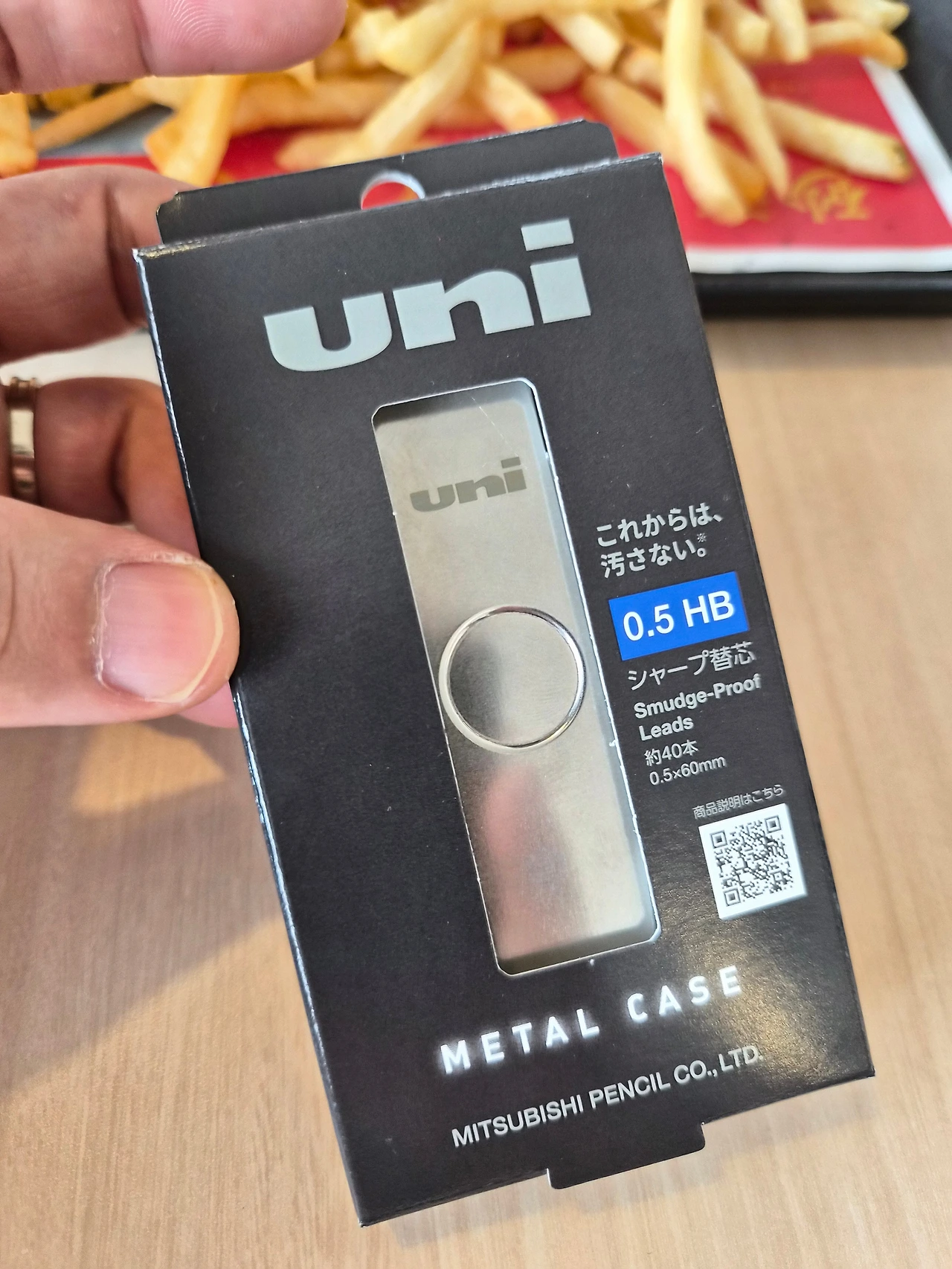
“Dad, they say you can only buy this in Japan.”
It was a small container that looked like aluminum.
But the moment I saw it, an old memory came back.
When I was in middle school, I used a small case for bus tickets. Back then, when you took the bus, you handed in a small paper ticket. There was a little metal case for holding those tickets. If you pushed the top, the lid opened and one ticket came forward.
My son was now holding a case for pencil lead.
I was remembering the ticket case I had carried when I was around his age.
For a moment, I felt something strange.
The middle-school version of me and my middle-school son seemed to meet for a moment across that small metal case.
The times had changed.
The thing placed inside the case had changed too.
But perhaps the feeling of carrying something small and necessary with care had not changed that much.
After shopping, we went to the McDonald’s right in front.
As always, I ordered a Big Mac. Even abroad, when I go to McDonald’s, I get a Big Mac. My son chose the teriyaki burger set he usually liked.
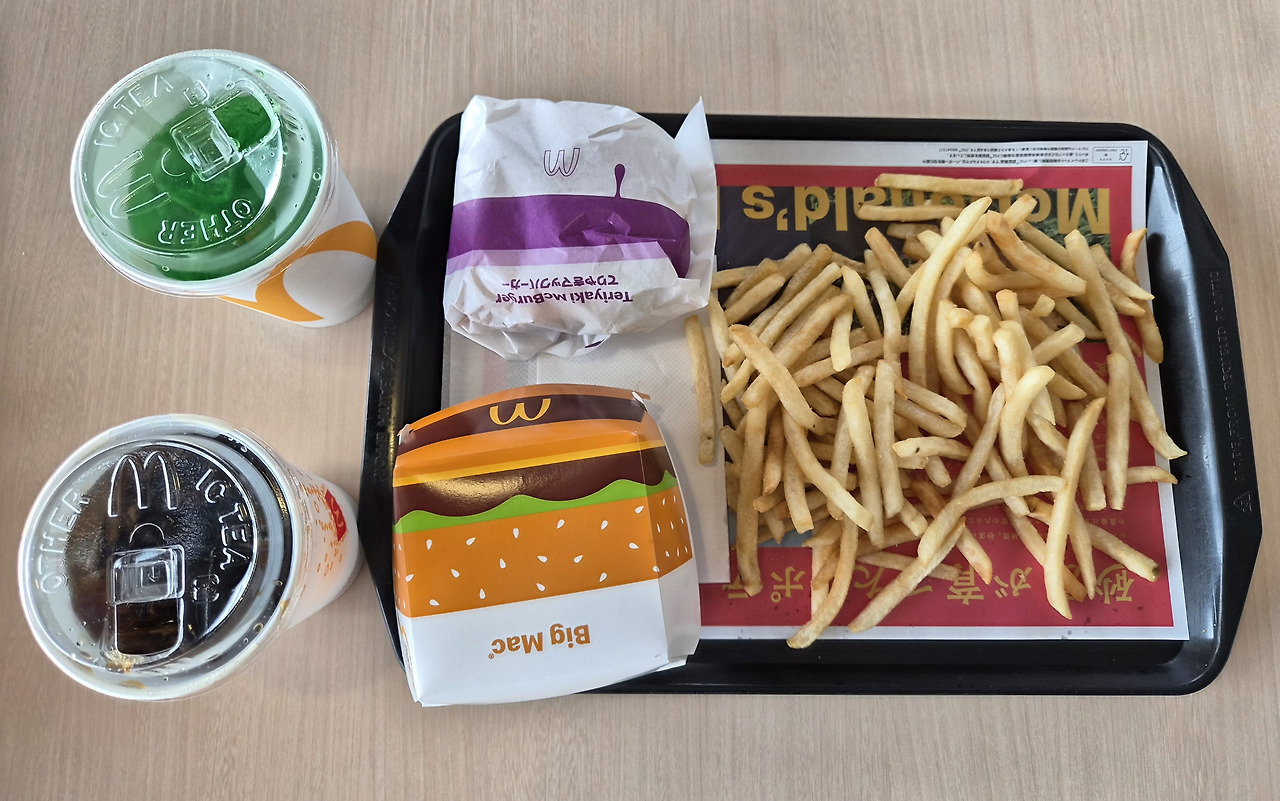
As we ate our burgers and looked out the window, my son spoke first.
“Alphard.”
It was a car he liked.
Toyota Alphard.
In Japan, I noticed many minivans of similar shape, including Alphards. Noah. Vellfire. Voxy.
For a while, we talked about cars. There were also many small kei cars on the streets. Vehicles with sizes and forms rarely seen in Korea were moving naturally through everyday roads. They seemed to fit narrow alleys and parking spaces as practical tools of daily life.
This was not an exact analysis, just the impression of a traveler who had spent a few days looking at the streets.
My son and I exchanged thoughts like that.
It was hard to believe we were the same two people who had sat facing each other so seriously the night before. The awkwardness that had remained in the morning had almost disappeared.
Family is strange.
We fight, feel hurt, regret saying too much, and then, with one hamburger in front of us, we talk about cars and somehow return to our usual places.
Of course, I had done a bit of gift diplomacy.
I bought him a model kit, shoes, and a pencil-lead case.
Did I buy his favor with money?
I had that thought by myself too.
Still, I was grateful for that moment.
Until the night before, my son and I had been a little awkward with each other. Now we were laughing again, eating hamburgers, and talking about cars.
That alone was enough.
Of course, it probably was not only because of the gifts.
I want to believe he understood, at least a little, that I had searched since dawn for places he might like.
Sometimes the heart is delivered without being fully explained in words.
There are days when action reaches the heart before language does.
Today, the time we spent together was loosening the knot between us before our words could.
We got back on the bicycles.
Our next destination was Eshima Ohashi Bridge.
The bridge began to appear in the distance. The far end looked as if it rose sharply like a cliff.
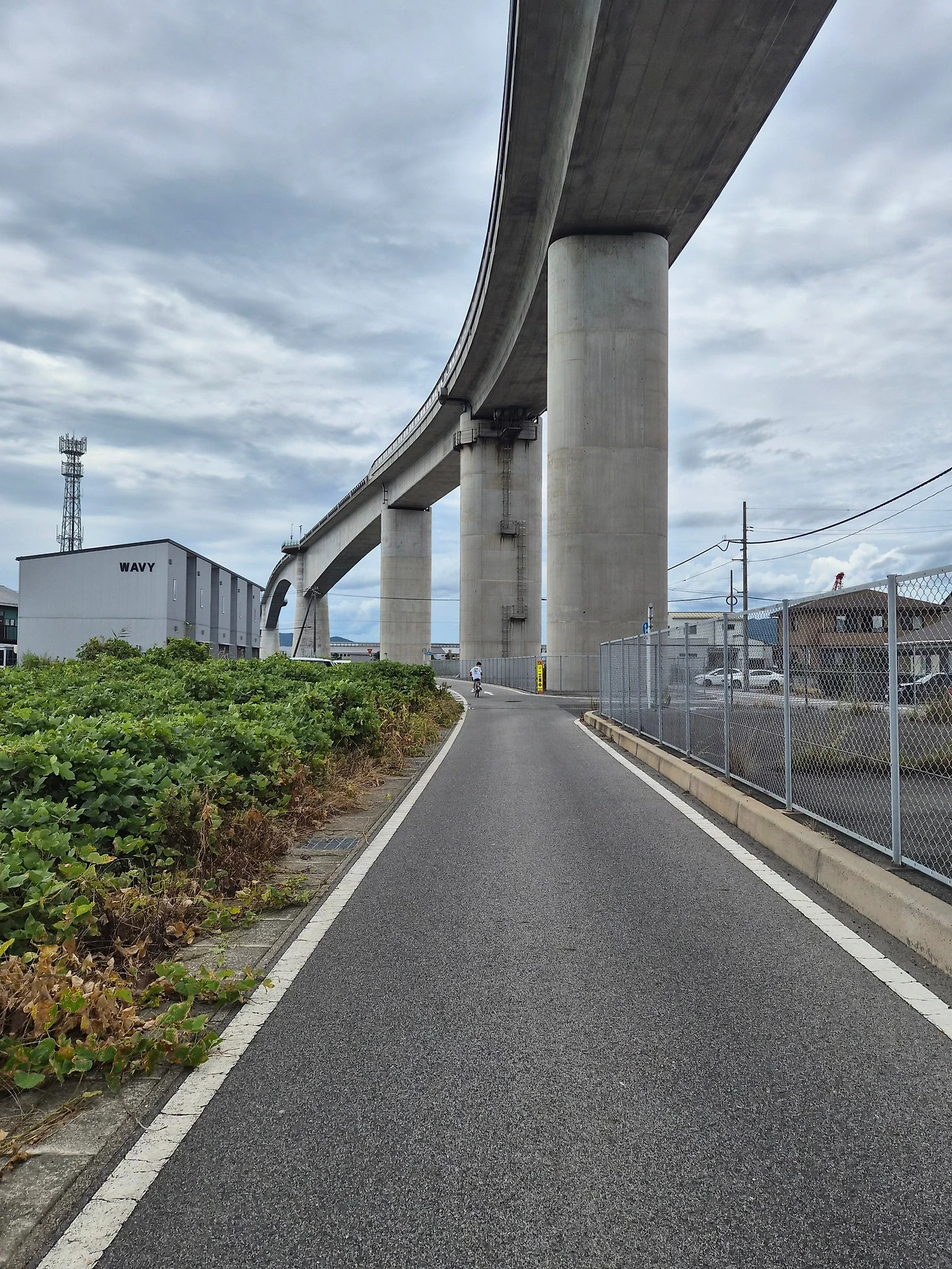
“No way. It can’t really be that steep, can it?”
I said.
My son answered as if it were nothing.
“Dad, that’s an optical illusion. We’ll know when we get there.”
This time, my son began finding the way first.
As we got closer, the bridge felt larger and larger.
“Wow…”
The sound came out of me without my realizing it.
It was far more intimidating than it had looked in photos. Honestly, I was a little scared. I thought it would be enough to take a photo from far away of how steep it looked and turn back.
If it was an optical illusion, I felt I could simply believe it was an illusion and leave.
Was there really a reason to drag our bicycles across that high bridge over the sea?
But my son looked at me.
“Should we cross it?”
I looked up at the bridge again.
“Really?”
“We came all the way here. Let’s try.”
After hearing that, it became hard to back away.
If I said I was scared, I thought he might be disappointed.
In the end, I got off the bicycle.
The two of us began slowly walking up the bridge, pushing our bicycles.
At first, it was fine.
A few steps.
A few dozen steps.
We kept going up.
But the higher we climbed, the wider the view became.
I began to see below.
I saw the sea.
The wind also grew stronger.
The wind that had felt cool down below felt completely different up on the bridge.
I gripped the bicycle handles tightly.
This is really high.
Once I looked down, my body suddenly tightened.
Fear rose inside me.
Each time the wind blew, it felt as if fear struck my chest.
What if I lose hold of the bicycle?
What if I suddenly lose my balance?
All kinds of thoughts came.
My son was walking close behind me. He seemed to find my reaction slightly amusing.
“Be careful.”
I did not know whether I was saying it to my son or to myself.
I took one step.
Then another.
The closer we got to the top, the more my fear grew.
Maybe we shouldn’t have come up.
That thought came too.
But we had already come this far. Whether we moved forward or went back, we had to move.
I clenched my teeth and kept walking.
Eventually, we came down to the other side.
The moment my feet touched flat ground, the tension in my entire body loosened.
I let out a deep breath.
I looked up at the bridge.
We crossed it.
But there was one problem.
We had to go back to the hotel.
And to return to the hotel, we had to cross the same bridge again.
Whether he knew how I felt or not, my son was busy taking pictures with Eshima Ohashi Bridge in the background. From the opposite side, the road looked as if it were dropping off a cliff.
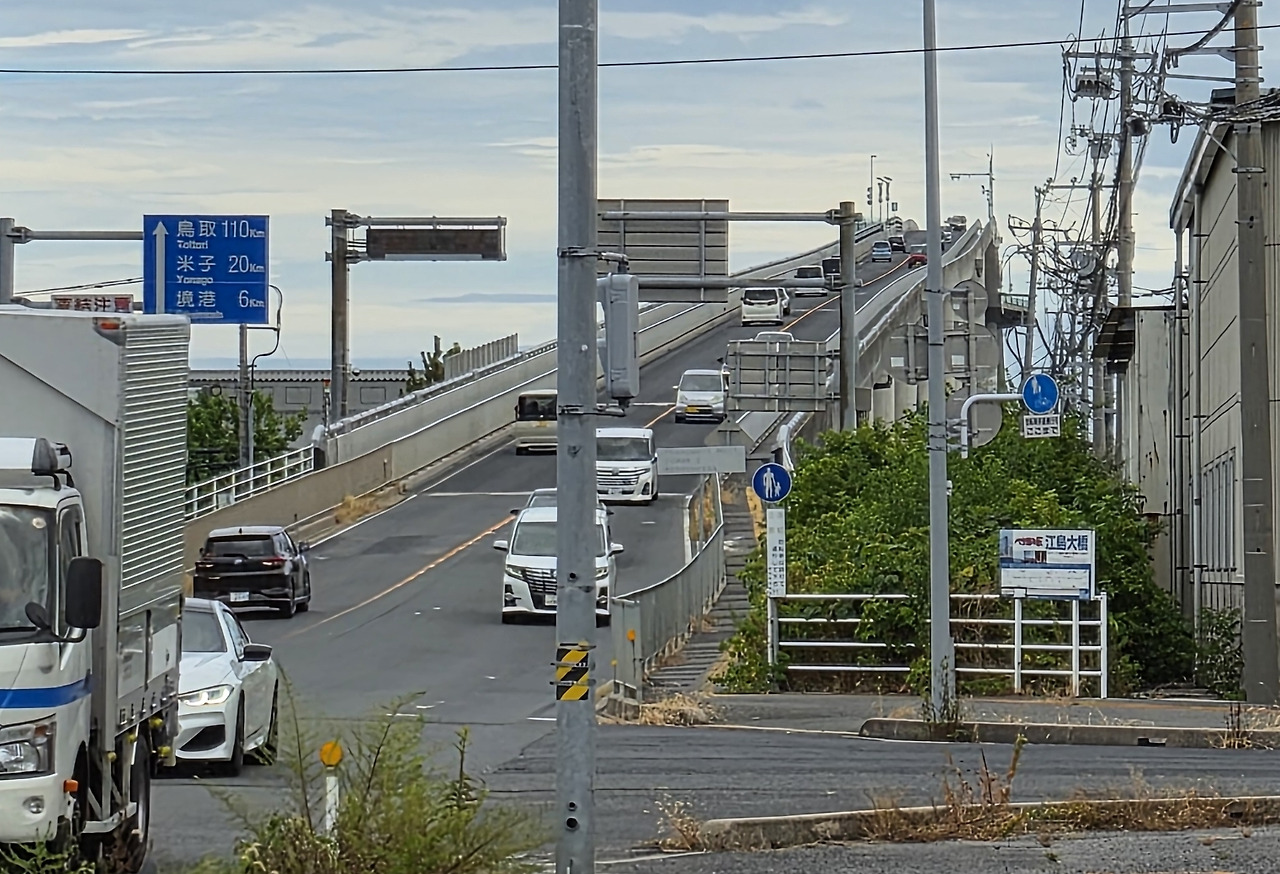
He checked the screen several times, as if it was fun.
I did not have the room to laugh.
To my son, that bridge was scenery worth photographing.
To me, it was a frightening stretch I had to cross one more time.
Now it was time to go back.
I gripped the bicycle handles again.
This time, I knew.
I knew where it would start to feel scary. I knew at what point the wind would become strong. I knew how high it was.
So I was even more afraid than the first time.
I took one step again.
From that moment, a voice began speaking inside my head.
Do not stop.
One step.
If I stop here, I will have to stay with this fear longer.
Another step.
There is an end.
I did not look left or right.
I looked only ahead.
I gripped the bicycle handles tightly.
One step.
Then another.
The wind blew.
I was scared.
I did not try to pretend I was not.
The fear was still there.
But in that moment, I felt I understood something.
What mattered was not becoming a person without fear.
What mattered was continuing to move even while afraid.
I walked.
I kept walking.
Then, at some point, the feeling changed.
I passed it.
The entire bridge was not yet over.
But the section I had feared most had already gone behind me.
The place that had felt so frightening only a few minutes earlier was now already in the past.
Only then did I understand.
A frightening stretch was still only a stretch.
It did not continue forever.
At that moment, the past month came back to me.
My first proposal PM assignment.
I had not known where to begin. I had been confused about what I needed to do myself and what I should assign to others. I had not known how to lead people. Every day brought a new problem. I went to work before dawn and returned home close to midnight. There were barely any weekends.
In the middle of it, I thought several times,
Why did I say I would do this?
At the time, I could not see the end.
But it ended.
The final slides were completed.
The final review ended.
The day came when the proposal was submitted.
And the day also came when I opened the door to the proposal room I had wanted so badly to escape.
Even the work that had felt as if it would never end had an end.
When I think about it, most things have been like that.
Things that felt impossible to endure had endings.
And moments so good that I wished they would last forever also had endings.
This trip was the same.
Not long ago, I had arrived at unfamiliar Yonago Airport and felt nervous just buying one ticket. But now the last night was already approaching.
Life itself may be like that too.
Good stretches pass.
Difficult stretches pass.
One day, life itself will also come to an end.
Thinking that way, the time spent standing still in front of fear began to feel a little wasteful.
There was no need to wait until fear disappeared.
I could walk with fear.
If I stayed still, I would have to remain with fear longer.
But if I took even one step, I would move a little closer to the end of that stretch.
That day, on Eshima Ohashi Bridge, I learned it not with my head, but with my body.
The task is not to erase fear.
The task is to pass through the frightening stretch.
We came down from the bridge.
I got back on the bicycle.
My son and I rode back toward the hotel.
Both of us were soaked in sweat. By then, we had already ridden more than ten kilometers in one day.
“Tired?”
“It’s hot.”
“I know.”
A convenience store appeared.
We stopped our bicycles.
My son chose a bottle of Asahi Bireley’s Otona no Sawayaka Lemonade, a lemonade drink with 3% fruit juice and vitamin C.
I picked the same one.
As soon as I opened the cap, I could not hold back my thirst and drank several gulps.
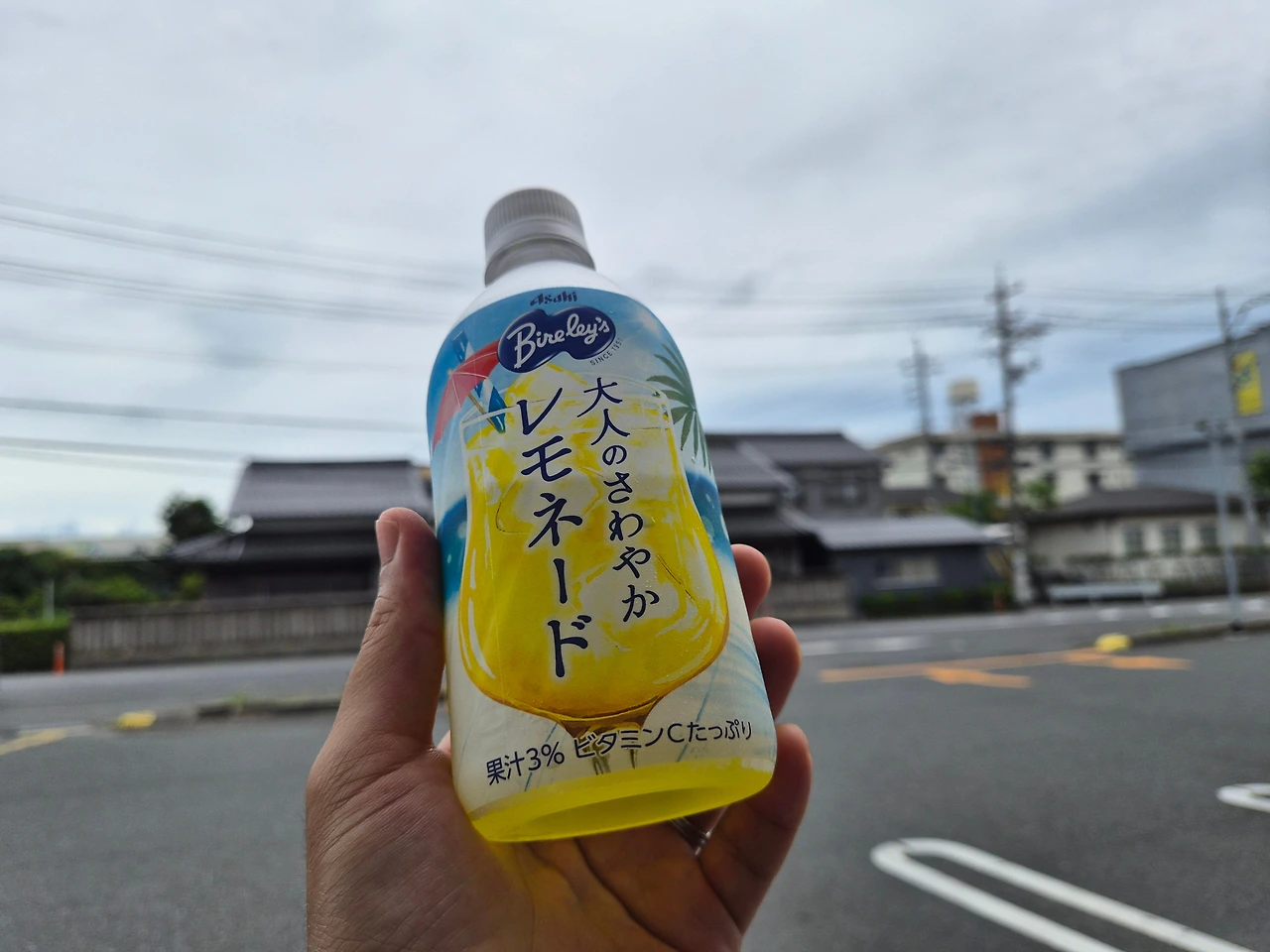
“Oh, this is good.”
It was cold and tart.
The moment it went down my throat, the heat and thirst seemed to settle a little at once.
My son laughed.
I laughed too.
We were the same father and son who had sat facing each other with serious faces the night before. Now we were standing in front of a convenience store, soaked in sweat, laughing over a drink.
Maybe relationships are like this.
They are not completed by one conversation. They are built by continuing to walk together, sweat together, eat together, feel afraid together, and laugh again.
We returned to the hotel.
We washed up and rested for a while.
In the evening, my son and I went up to the sauna again. I lowered myself into the hot water. By now, even this sauna had become so familiar.
At first, it had been a special hot spring at a travel destination. But at some point, it had become the place where we ended the day.
At night, we went down to eat ramen, as we had grown used to doing. The yonaki soba that had seemed novel at first had now become part of our travel routine.
My son and I sat side by side and ate ramen.
Unlike the night before, it was not awkward.
When we returned to the room, my son began talking about 3D printers. He said he wanted to design something he had imagined and turn it into a real form.
I liked hearing that.
That was, in fact, the reason I had spoken so long the night before.
I was not trying to say he should not watch YouTube.
I was not trying to say he should not play games.
I did not want him to spend his time only consuming.
I wanted him to take one step beyond scrolling through videos others had made, laughing, scrolling again, and letting time flow away. I wanted him to experience the joy of taking something inside his own head and making it himself.
Thinking.
Designing.
Failing.
Revising.
Finally turning it into a form he could touch with his hands.
A 3D printer was only one tool for that.
What mattered, I thought, was the experience of moving from being a person who consumes to a person who makes.
Come to think of it, writing is not so different for me.
I do not end a trip by simply consuming it. I think again about what I saw, turn what I felt into sentences, shape it into a story, and send it out into the world.
Perhaps that resembles my son designing an image in his mind and bringing it out through a 3D printer.
I do not know what he will make.
It may not be anything impressive.
Failed prints may pile up in one corner of his room.
That is fine.
If he is spending time trying to bring something that existed only in his head into reality, I will gladly cheer him on.
I got ready for bed.
I thought back on the day.
At dawn, my heart had been heavy. I had felt sorry toward my son. So I searched for places he might like. I bought him a model kit, shoes, and a pencil-lead case. If someone called it a gift offensive, I would have nothing to say.
But perhaps what I really wanted to give him was not an object.
Dad is thinking of you.
Maybe that was what I wanted to say.
I want to believe my son understood at least a little.
That is why we talked again, laughed again, rode bicycles together, and crossed Eshima Ohashi Bridge together.
Between parents and children, there are feelings that do not travel well through words alone. On such days, the day spent together sometimes explains them instead.
Sincerity does not always arrive before words.
Sometimes it arrives much later, after eating together, walking together, and laughing together.
Tomorrow, we would go home.
In the morning, I wanted to see the sunrise. To match the sunrise time, we would have to wake up a little after 5 a.m.
See the sunrise, go into the hot spring one last time, return to the room, pack, and check out.
The plan was perfect.
There was only one problem.
Whether I could actually wake up at that hour.
I told my son,
“Dad is going to wake up early tomorrow to see the sunrise.”
I do not think I need to write down what kind of expression my son made.
I was not confident either.
I turned off the light and lay down.
It was our last night in Sakaiminato.
When I first came here, I was exhausted. I felt like someone who had barely escaped a month of work and had only dragged his body all the way to Japan.
I worked even in my dreams. I could not put down my phone and was told by my son that he felt hurt.
I clashed with him. I thought about how far a father should speak, how far a leader should intervene, and why I lived as if every minute had to be used.
And on the last full day, I rode more than ten kilometers with my son.
We walked up a bridge that looked like a wall.
I was scared.
But I kept walking.
And I learned:
Even the frightening stretches come to an end.
Perhaps the most important souvenir I would take from this trip was not an object, but that sentence.
In the future, I will again encounter stretches where the end is not visible. It may be because of work, because of people, or because of some moment that comes with age.
When that happens, I think I will remember the moment I walked across Eshima Ohashi Bridge, gripping the bicycle handles tightly.
The wind was blowing.
I was afraid.
I wanted to stop immediately.
But still, I took one step forward at a time.
I will bring back the words I said to myself then.
Do not stop.
Even the frightening stretches come to an end.
Even when you are afraid, move forward one step at a time.
That is how the last full day in Yonago came to an end.
And the next morning, hoping to see the sunrise with my son, I closed my eyes.