
Authors: Nicholas Bloom, Ruobing Han, and James Liang
Title: “Hybrid working from home improves retention without damaging performance”
Journal: Nature
Publication: 2024, Vol. 630, No. 8018, pp. 920–925
Published: June 12, 2024
DOI: https://doi.org/10.1038/s41586-024-07500-2
ISSN: 0028-0836 (Print), 1476-4687 (Online)
The Continuing Debate over Working from Home
The debate over working from home has generally been divided into two perspectives. Employees emphasize reduced commuting burdens and a better work–life balance, whereas employers often worry about weaker collaboration, lower productivity, and limited career development.
Much of this debate, however, has relied on personal experiences or perception surveys. Employees who choose to work from home may already differ from those who prefer office work. A randomized experiment is therefore needed to separate the effects of hybrid work from employees’ pre-existing preferences and characteristics.
A Real-World Experiment Involving 1,612 Employees
Bloom, Han, and Liang conducted a six-month randomized experiment involving 1,612 employees at Trip.com, a global travel technology company based in China. The participants were university-educated employees working in software engineering, marketing, accounting, and finance.
Employees were assigned to groups according to whether their birthdays fell on odd- or even-numbered dates. The treatment group could work from home on Wednesdays and Fridays while attending the office on the other three days. The control group continued to work in the office five days a week.
This design allowed the researchers to examine the causal effects of hybrid work while reducing the influence of individual preferences and voluntary selection.
Lower Attrition and Higher Job Satisfaction
The most noticeable effect appeared in employee retention. The attrition rate was 7.2% in the five-day office group but 4.8% in the hybrid group. This difference of 2.4 percentage points represents a 33% relative reduction in attrition.
The effects were not equally distributed across all employees. Attrition among non-managers declined from 8.59% to 5.33%, representing a reduction of approximately 40%. Among female employees, it decreased from 9.19% to 4.18%. Employees with longer commutes also showed a strong tendency toward lower attrition.
Job satisfaction increased from 7.84 to 8.19 on a ten-point scale. Employees reported that hybrid work reduced commuting time and costs while providing greater flexibility for managing occasional personal responsibilities.
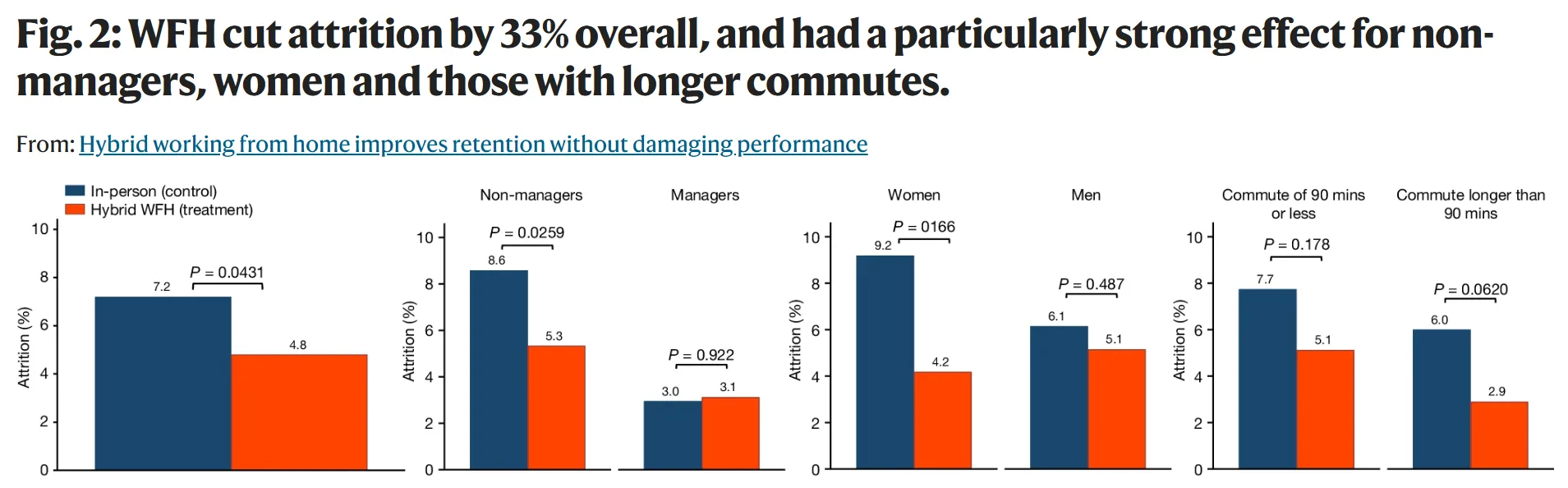
Note: Long commuters were employees whose round-trip commute exceeded 90 minutes. This result did not reach the conventional .05 significance level.
No Evidence of Performance Damage
The study should not be interpreted as proving that hybrid work increases performance. Its more defensible conclusion is that hybrid work did not meaningfully damage performance.
The researchers examined employee performance evaluations and promotion outcomes for up to two years after the experiment began. Equivalence tests showed no meaningful difference in performance evaluations between the groups. Coding output from 653 computer engineers also showed no meaningful decline. The researchers found no evidence of a difference in promotion rates.
The main conclusion is therefore not that “working from home makes employees more productive.” Rather, one or two days of working from home may reduce employee turnover without sacrificing measurable performance.
Experience Changed Managers’ Beliefs
Before the experiment, managers expected hybrid work to reduce productivity by an average of 2.6%. After experiencing the system, they estimated that it would increase productivity by 1.0%. Managers’ perceptions shifted from negative to slightly positive even though measured performance remained largely unchanged.
This finding highlights the value of organizational experimentation. Instead of deciding new work policies solely through managers’ expectations or employees’ preferences, organizations can test a policy on a limited scale and evaluate concrete indicators such as attrition, performance, satisfaction, and promotion.
More Than an Employee Benefit
Trip.com estimated that replacing and training one employee cost the company approximately US$20,000. A one-third reduction in attrition could therefore produce substantial financial savings. After reviewing the experimental results, the company expanded its hybrid work policy across the organization.
Hybrid work should consequently be viewed not only as an employee benefit but also as a potential retention strategy. Flexibility may be particularly valuable to non-managers, women, and employees with long commutes, whose costs of attending the office every day may be relatively high.
Can One Company’s Results Apply Everywhere?
The study has important limitations. It was conducted at a single travel technology company in Shanghai, and most participants were university-educated office workers. The results cannot automatically be generalized to manufacturing, healthcare, education, hospitality, or other occupations that require employees to be physically present.
The experiment also examined a hybrid arrangement rather than fully remote work. Although employees could work from home twice a week, many used the option only once a week, usually on Fridays. The findings should therefore not be interpreted as evidence that more remote work always produces better outcomes.
Despite these limitations, the study provides strong real-world evidence that giving employees some control over where they work does not necessarily undermine organizational performance. The central question is not whether home or the office is universally better. It is how organizations can combine the advantages of both settings according to the nature of the work and the circumstances of their employees.
Reference
Bloom, N., Han, R., & Liang, J. (2024). Hybrid working from home improves retention without damaging performance. Nature, 630, 920–925. https://doi.org/10.1038/s41586-024-07500-2