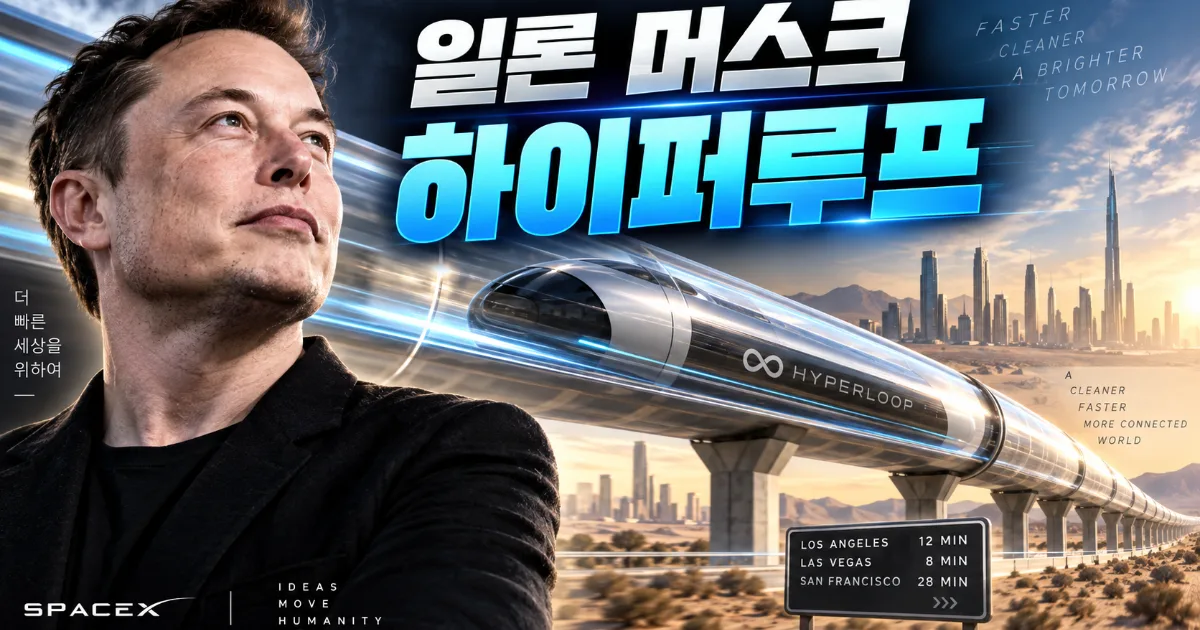
Elon Musk has brought Hyperloop back into the conversation.
On X, he said The Boring Company is working on a “simple, precursor Hyperloop” tunnel between Austin and San Antonio. The target speed is more than 200 miles per hour. Because of traffic congestion, the trip between the two cities can currently take up to two and a half hours, Musk said, but The Boring Company could reduce it to a consistent trip of less than 30 minutes. (elonmuskarchive.org)
The statement was short, but its implications are large.
Austin and San Antonio form one of the key growth corridors in Texas. The I-35 corridor between the two cities mixes commuting, logistics, tourism, universities, military, healthcare and technology industries. Under normal conditions, the drive takes around an hour and 20 minutes, but during periods of congestion, it can stretch beyond two hours.
Musk’s proposal is to cut through this bottleneck underground.
If surface roads are congested, go underground.
If intercity travel is unpredictable, create predictability through tunnels.
If car traffic is stuck above ground, bypass it with high-speed underground transport.
This connects directly with the problem The Boring Company has described from the beginning. The company’s Loop is an express underground transport system in which electric vehicles or electric-based vehicles travel through tunnels directly to their destination without intermediate stops. The company has operated the Las Vegas Convention Center Loop since 2021, and says the system has demonstrated peak capacity of more than 4,500 passengers per hour and more than 32,000 passengers per day. (boringcompany.com)
But the Austin–San Antonio concept is different in nature from the Las Vegas Loop.
The Las Vegas Loop connects relatively short urban, tourism and convention districts. Austin–San Antonio, by contrast, is an intercity long-distance corridor. This is not simply a matter of digging one more tunnel. It is a matter of operating high-speed underground infrastructure across dozens of miles.
The Boring Company has not yet operated Hyperloop as a commercial long-distance transportation system. The company describes Hyperloop as a proposed ultra-high-speed public transportation system in which passengers travel in autonomous electric pods at more than 600 mph, and says it constructed a short Hyperloop tunnel in Bastrop, Texas, in 2022 to test vacuum-pump systems. (boringcompany.com)
What Musk referred to this time was a “precursor Hyperloop.”
That phrase matters. It likely suggests not a full Hyperloop, but an earlier stage, perhaps a simplified high-speed tunnel before moving toward a low-pressure or vacuum-based ultra-high-speed system. The speed Musk mentioned, more than 200 mph, is also below The Boring Company’s 600-plus-mph Hyperloop vision.
In that sense, this concept may be closer to a long-distance high-speed underground expressway or high-speed electric pod tunnel than to a full Hyperloop.
Even that would not be easy.
A speed of more than 200 mph is in a very different category from The Boring Company’s existing operating examples. The Las Vegas Loop is operational, but it is not a system that runs through long-distance tunnels at speeds closer to high-speed rail or aviation. Publicly available evidence shows that The Boring Company has proven short urban tunnels and limited operating environments. The approved Vegas Loop may expand to 68 miles and 123 stations, but that is still a staged urban network, not a long-distance ultra-high-speed corridor like Austin–San Antonio. (boringcompany.com)
The core question is not speed.
Speed is the vision.
Infrastructure is the reality.
To deliver a sub-30-minute trip between Austin and San Antonio, tunneling, station locations, land rights, environmental review, safety standards, emergency evacuation, ventilation, fire response, communications, power supply, vehicle control, insurance, fares, capacity, operators and permits all become necessary.
Safety becomes much more complex in a long-distance tunnel.
If a problem occurs in a short urban tunnel, evacuation and rescue may be relatively straightforward. But a system moving at high speed through dozens of miles underground must account for emergency exits, ventilation, fire suppression, vehicle failures, earthquakes, flooding, inundation risks and power outages. As speed increases, the margin for response decreases.
Another problem The Boring Company must solve is capacity.
The claim that the trip can take less than 30 minutes is separate from the question of how many people can use the system. To meaningfully reduce road congestion, the system must not only be fast. It must also provide enough throughput. Whether vehicles move one by one, whether pod-style mass transport is used, what headways are possible and how many passengers can be processed at peak hours all matter.
The Las Vegas Convention Center Loop’s demonstrated peak capacity of more than 32,000 passengers per day is meaningful, but replacing intercity commuting and regional travel demand requires a different order of design. (boringcompany.com)
Cost is also central.
The Boring Company’s business logic rests on the claim that it can dig tunnels much more cheaply and quickly than traditional tunneling methods. The company has tried to lower tunneling cost and speed up construction with its Prufrock line of tunnel-boring machines. It has also expanded tunnel projects in Las Vegas, the Austin Gigafactory’s Cybertunnel and Nashville’s Music City Loop. (boringcompany.com)
But an Austin–San Antonio corridor would likely be far longer than any commercial tunnel The Boring Company has completed so far. TechCrunch reported Musk’s latest remarks as The Boring Company once again pitching a Hyperloop between Austin and San Antonio. It also noted that many previously announced Boring Company projects, including systems in Chicago, Los Angeles and between New York City and Washington, D.C., have not materialized. (techcrunch.com)
This is where the distinction between a concept and a project matters.
Musk’s post is a strong statement of direction. But it does not mean that permits have been completed, financing has been secured, the route and station locations have been disclosed, or a public infrastructure plan has been approved. What is currently confirmed is Musk’s public statement that The Boring Company is pursuing the idea, and the broader fact that The Boring Company is expanding Loop projects in other regions.
That distinction must be clear.
Musk’s transportation visions often begin with large imagination. Some have become real. The Boring Company has dug real tunnels and operates a system in Las Vegas. But Hyperloop has long remained in the realm of promise, experimentation, prototypes and concepts. Whether the Austin–San Antonio idea is different from the past must be shown through public procedures and technical demonstration.
Still, the statement matters because of the location: Texas.
Musk’s business ecosystem is already deeply rooted in Texas. Tesla operates its Gigafactory near Austin, and The Boring Company has been active around Bastrop. The company also says it built the Cybertunnel at the Austin Gigafactory to move completed Cybertrucks to a final staging lot on the other side of an eight-lane highway. (boringcompany.com)
Texas is a fast-growing state. The corridor between Austin and San Antonio is an area where both population and industry are expanding. Traffic congestion is already a real problem. There is also a growing sense that surface-road expansion alone may not absorb long-term demand.
Against this background, The Boring Company’s tunnel concept is not simply a futuristic transportation show. It can be read as part of an infrastructure contest along one of Texas’ growth axes.
But whether Hyperloop is the right solution remains to be proven.
High-speed rail is suitable for high-volume intercity transport.
Highway expansion reinforces automobile-centered mobility.
Air travel is powerful for long distances, but on a corridor as close as Austin–San Antonio, airport access and security time become burdensome.
Tunnel-based high-speed pods offer predictability and avoidance of surface congestion, but face questions of capacity, cost and safety regulation.
Musk’s promise of a “consistent” trip of less than 30 minutes is particularly attractive.
In transportation, average speed is not the only important factor. Predictability can matter more. For commuting, business travel, hospital or university access, and airport connections, the uncertainty of not knowing when one will arrive creates real costs. If a tunnel can reduce exposure to surface congestion and weather, it can improve reliability.
But achieving consistency requires closed-system operation.
Vehicle count, dispatching, entry control, emergency response, maintenance and station processing capacity must all work together. If demand spikes, queues can form at tunnel entrances. If stations cannot process passengers fast enough, even a high-speed tunnel becomes bottlenecked. Ultimately, the whole system must be evaluated not only by tunnel speed, but by departure, boarding, alighting, transfer and access times.
The meaning of “less than 30 minutes” also depends on where the trip begins and ends.
Is it downtown to downtown?
Suburban station to suburban station?
Gigafactory to a specific hub?
Depending on the answer, the perceived travel time can change significantly. Even if the underground high-speed segment takes less than 30 minutes, long access and waiting times can reduce competitiveness.
Another issue is publicness and access.
Is this system public transportation or premium transportation?
What will the fare be?
Who will be able to use it?
Will public subsidies be involved?
Will it be built entirely with private capital?
How will land rights and the use of public road space underground be handled?
How will it connect with existing transportation networks?
The Boring Company’s Las Vegas projects have grown mainly around private facilities and convention demand. Intercity transportation is much more public in nature. A transport network connecting Austin and San Antonio is not only an issue for corporate customers or tourists. It concerns residents, commuters, students, workers, logistics operators and local governments.
For the concept to become reality, public discussion will be necessary.
Where will the tunnel route pass?
Which areas will benefit, and which will be affected?
How will station-area development be handled?
How will environmental impact be evaluated?
If the project does not generate enough revenue, who bears the burden?
If an accident occurs, who is responsible?
None of these questions can be answered by one post on X.
The Boring Company does have opportunities.
The company recently raised $3 billion at a valuation of $23 billion, according to Reuters. That shows investors still place large expectations on its tunnel infrastructure business. (reuters.com)
With capital, the range of experiments expands. A long-distance high-speed tunnel in Texas would require substantial upfront investment. Tunnel-boring machines, land, engineering, safety certification, vehicles, operating systems, power infrastructure, station construction, legal work and permitting would all require money.
But capital alone is not enough.
Transportation infrastructure is difficult to build only in the style of a technology startup. Public infrastructure depends on regulation, safety, community acceptance, long-term maintenance and financing structure. Intercity high-speed transportation in particular requires operational responsibility over decades. It is different from software, where speed and rapid iteration dominate.
Musk’s strength is imagination and execution pressure.
He publicly sets goals that appear impossible and pushes companies and engineers to move faster. At Tesla and SpaceX, this method has produced real results in some areas. But in transportation infrastructure, the same method does not always work. Cities, state governments, federal regulators, landowners, environmental groups, local residents and safety authorities are all stakeholders.
The Austin–San Antonio concept is therefore another test of Musk’s vision-driven approach.
Words move fast.
Tunnels move slowly.
The vision is simple.
Permitting is complex.
A speed of 200 miles per hour sounds impressive.
Capacity and safety certification sound boring, but they decide the outcome.
This is also why Hyperloop has repeatedly invited public skepticism.
The concept is attractive. In a low-pressure tunnel, friction is reduced and ultra-high-speed travel becomes possible. The vision promises something simpler than aviation, faster than rail and more predictable than cars. But commercialization is difficult. Maintaining pressure in long tunnels, emergency evacuation, high-speed safety, spacing between vehicles, passenger comfort, construction cost, operating cost and regulatory certification are all hard problems.
If The Boring Company uses the word “precursor,” it may be trying to start from a less complex stage than a full Hyperloop. That could be a more realistic approach. Instead of beginning with a 600-plus-mph vacuum system, the company may try to validate technology, regulation and demand with a 200-plus-mph dedicated tunnel.
If so, the evaluation standard also changes.
The question is less whether this is a “real Hyperloop” and more whether long-distance high-speed underground transportation can be implemented safely and economically. The name matters less than the function.
If the Austin–San Antonio corridor can deliver travel under 30 minutes, reliably, at sufficient scale, with reasonable fares and safe operation, that alone would be a major innovation. Conversely, if the tunnel is too expensive, serves too few people, has poor station access and carries significant public cost, it may become an expensive niche service rather than the future of transportation.
There are also implications for Korea.
Korea is pursuing various transportation infrastructure projects, including GTX, regional rail, high-speed rail, urban air mobility, autonomous driving and underground roads. Metropolitan congestion and regional hub connectivity are also central challenges in Korea. Musk’s concept may look exaggerated, but one question remains valid.
When surface transportation reaches its limits, how should underground space be used?
Korea is already familiar with subways, high-speed rail and road tunnels. But underground space in cities and metropolitan regions is becoming increasingly complex. Electricity, telecommunications, water and sewage, subways, roads, logistics and disaster-prevention infrastructure are all intertwined. Long-distance high-speed underground transportation would require not only tunnel technology, but urban planning, safety, transfers and cost allocation.
Another lesson is the role of private infrastructure companies.
The Boring Company is challenging public transportation infrastructure with the methods of a private technology company. It emphasizes faster tunneling, standardized tunnels, electric-vehicle-based operations, private capital and direct operation. Korea also has room for private companies to participate in transportation infrastructure innovation. But standards for publicness, safety, fares, data and accessibility must be clearer.
There is no need to take Musk’s statement at face value.
But it is also hard to ignore.
He often exaggerates.
Timelines are frequently delayed.
Hyperloop has not yet become a commercial reality.
The Boring Company’s current operating record remains limited.
Yet he also moves markets and policy imagination. Even if Hyperloop does not become real immediately, the Austin–San Antonio corridor’s transportation problem is now being viewed through another frame. High-speed rail, tunnels, autonomous driving, electric vehicles and regional planning re-enter the comparison.
The true meaning of this announcement lies there.
Musk changes the standard before the technology arrives.
Should Austin and San Antonio remain a two-hour journey apart?
Is traffic congestion something people must simply tolerate?
Is intercity travel only the domain of roads, aviation and rail?
Can a private tunnel company build regional transportation infrastructure?
Can a 30-minute living radius be created underground?
These are powerful questions.
But the answers must come from engineering and public policy together. A promise on X is only a starting point. What is needed next is a route, cost, capacity, safety standards, permitting schedule, financing structure, public-burden assessment and actual test results.
For the Austin–San Antonio Hyperloop concept to become real, it must pass three gates.
First, the technology gate.
It must show that a long-distance tunnel can safely operate at more than 200 miles per hour.
Second, the economic gate.
It must cover tunneling and operating costs while providing reasonable fares and sufficient capacity.
Third, the public-interest gate.
It must present a safety, access, environmental and responsibility structure that local communities and governments can accept.
If it cannot pass these three gates, Hyperloop will again remain one of Musk’s large promises. If it can, the story changes. The imagination of American intercity transportation could shift.
At this stage, the most accurate assessment is this.
Musk has thrown out another future transportation concept.
The Boring Company has real tunnel-operating experience and capital.
But a 30-minute Austin–San Antonio tunnel remains a promise that must still pass demonstration, permitting and economic tests.
The right attitude toward this proposal is therefore neither blind belief nor easy cynicism.
It is verification.
The future of Hyperloop will not be decided by an impressive video or a post on X. It will be decided by actual tunnel-boring machines, safety certification, station throughput, operating data, cost tables and community consent.
If Musk’s “future we shall bring into being” is to become reality, he now has to persuade the world outside the tunnel.