
Korean Journal of Consumer and Advertising Psychology 2024, Vol. 25, No. 4, pp. 401–423 DOI: 10.21074/kjlcap.2024.25.4.401
Does having more comments during a live commerce broadcast lead to higher sales?
Do sales increase as consumers actively ask questions, leave likes, and click on products?
Generally, active consumer engagement is considered a positive indicator. Brands organize interactive events, encourage comments, and create opportunities for continuous interaction during live broadcasts to increase consumer participation.
However, more engagement does not necessarily lead to better outcomes.
In fact, excessive participation by individual consumers can disrupt the shopping experience of others and negatively affect sales performance.
A 2024 study published in the Korean Journal of Consumer and Advertising Psychology, titled "Live Commerce Performance Based on Consumer Engagement Levels," examines this phenomenon.
Rather than evaluating consumer engagement simply in terms of high or low participation, the researchers distinguished between individual-level and aggregate-level engagement. They then analyzed how these two forms of engagement differently influence actual product sales and consumers' sustained interest in brands.
The findings are particularly interesting.
Greater overall consumer participation was associated with higher sales performance. However, when individual consumers posted excessively frequent and lengthy comments, sales performance tended to decline.
What matters is not simply how much consumers participate, but who participates and how they engage.
Can Consumer Engagement Be Measured by a Single Number?
In online shopping environments, consumer engagement plays an important role in building relationships between brands and consumers.
Unlike conventional online shopping, live commerce enables sellers and consumers to communicate in real time.
Consumers can ask questions about products, observe other shoppers' reactions, and make purchasing decisions based on the seller's explanations.
These interactions help reduce product uncertainty and encourage purchasing decisions.
However, previous studies have primarily measured consumer engagement using aggregate indicators such as total chat volume or audience size.
This approach presents an important limitation.
For example, a broadcast in which 100 consumers each post one comment may generate the same total number of comments as a broadcast in which one consumer posts 100 comments. Yet the consumer experiences in these two situations can be entirely different.
To examine this distinction, the researchers divided consumer engagement into two levels.
1) Individual-Level Consumer Engagement
This refers to how actively individual consumers participate. It is measured by the average number of
comments posted per consumer and the average length of those comments.
2) Aggregate-Level Consumer Engagement
This represents the overall activity of consumers participating in a broadcast. It is measured by the number
of consumers posting comments, product clicks, and likes.
This distinction goes beyond differences in measurement.
Individual-level engagement reflects how actively particular consumers interact, while aggregate-level engagement indicates the overall level of participation across the audience.
The researchers proposed that these two forms of engagement would not necessarily produce the same outcomes.
What More Than 14,000 Live Commerce Observations Revealed
The researchers analyzed actual sales and consumer engagement data collected from Naver's live commerce platform.
The dataset covered approximately 17 months of live commerce activity, from May 2020 to September 2021.
The final regression analysis included 14,334 observations.
The products examined included fashion accessories, food, cosmetics, kitchenware, and nutritional supplements.
To investigate the relationship between consumer engagement and business performance, the researchers conducted multiple regression analyses. They also controlled for factors that could influence sales, including sellers' revenue, discount coupon availability, broadcast duration, and traffic sources.
Performance was measured using two indicators.
The first was the number of products sold during live broadcasts.
The second was the number of store favorites and notification subscriptions, which served as indicators of consumers' continued interest in maintaining relationships with sellers.
In other words, the researchers distinguished between immediate sales performance and indicators associated with longer-term customer relationships.
More Engagement Led to Higher Sales, but There Was an Exception
Aggregate-level consumer engagement showed relatively consistent results.
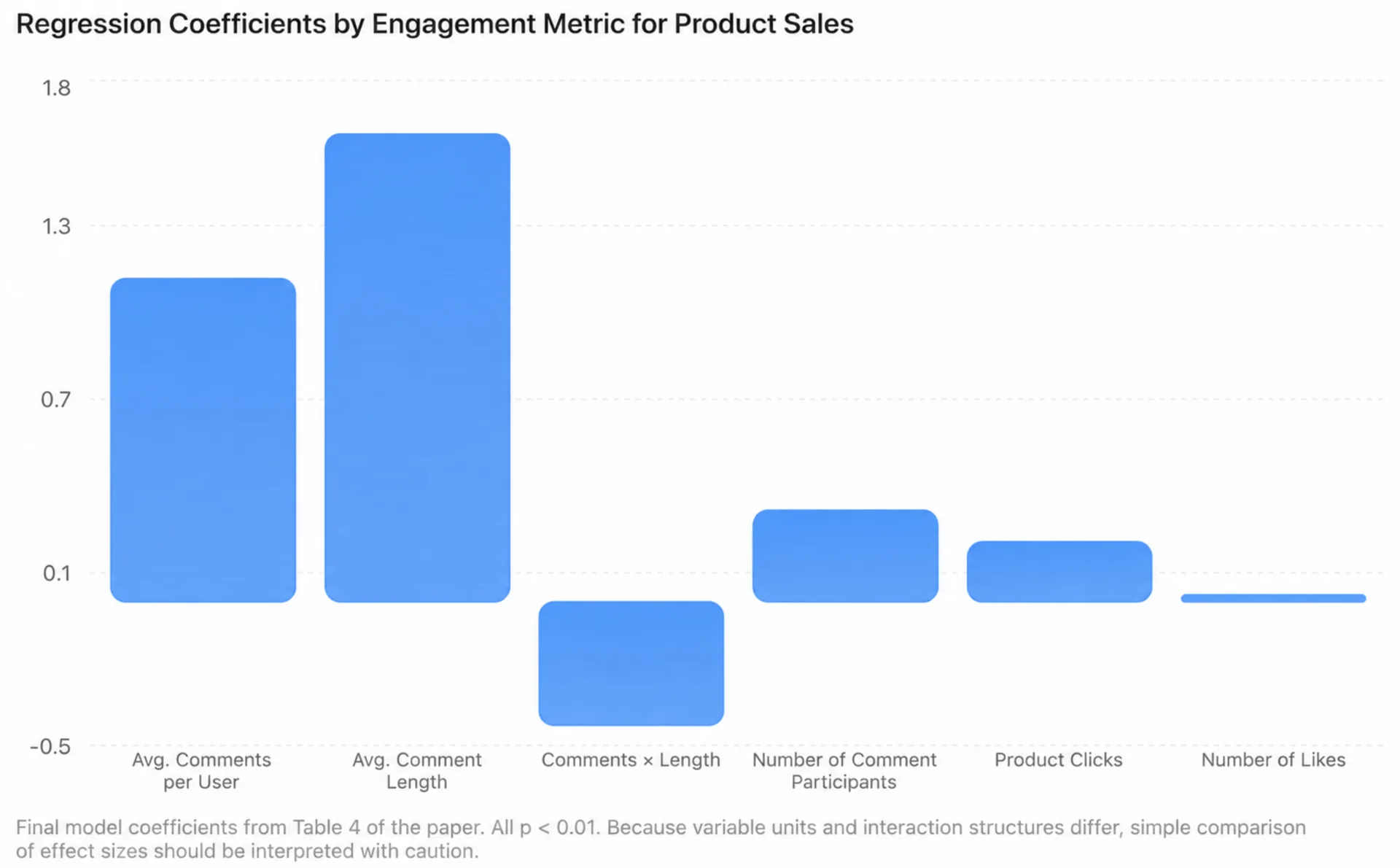
As the number of consumers posting comments, product clicks, and likes increased, product sales also tended to increase.
A larger number of engaged consumers suggests that more viewers are paying attention to the broadcast, exploring product information, and participating in the purchasing process.
However, individual-level consumer engagement revealed a different pattern.
Both the number and length of comments posted by individual consumers were positively associated with product sales when considered separately.
Yet the interaction between comment frequency and comment length showed a negative effect.
In other words, sales performance tended to decline when individual consumers posted excessively frequent and lengthy comments.
The Paradox of Consumer Engagement in Live Commerce
The researchers explained that this finding aligns with previous studies suggesting that excessive engagement can produce negative outcomes.
When individual consumers post too many comments, other viewers may find it more difficult to identify the information they need.
Additionally, if sellers devote too much attention to a small number of highly active consumers, they may be unable to respond adequately to questions and requests from other viewers.
However, these specific mechanisms were not directly measured in the study. They represent the researchers' interpretation of the observed findings.
Nevertheless, the results suggest an important implication.
Strategies aimed at maximizing consumer engagement do not always produce positive outcomes.
Brands need to maintain an appropriate balance between encouraging active participation and preserving a positive experience for other consumers.
The Effects of Engagement Also Differed by Product Type
Another important factor examined in the study was product type.
The researchers classified products into search goods and experience goods.
Search goods are products whose quality can be assessed to some extent before purchase by comparing specifications and available information.
Experience goods, on the other hand, are products whose quality and satisfaction are difficult to evaluate fully without actual use or experience.
In this study, kitchenware and nutritional supplements were classified as search goods, while cosmetics and food were categorized as experience goods.
The results showed that experience goods tended to achieve stronger sales performance than search goods in live commerce environments.
This suggests that real-time product demonstrations can help reduce purchasing barriers for experience goods.
For example, consumers may find it difficult to evaluate a cosmetic product's texture or application experience before purchasing it.
During a live broadcast, however, sellers can demonstrate how the product is used and immediately answer consumer questions.
Similarly, food products can provide indirect experiences through live demonstrations of preparation processes and product presentation.
Interestingly, the effects of product type also differed depending on the level of consumer engagement.
When individual-level engagement was high, search goods showed relatively more positive sales performance.
Conversely, when aggregate-level consumer engagement increased, experience goods demonstrated stronger positive sales effects.
These findings suggest that brands should tailor their engagement strategies to the characteristics of different products rather than applying the same approach across all live commerce broadcasts.
Highly Engaged Consumers Are Not Necessarily New Loyal Customers
Beyond product sales, the study also examined store favorites and notification subscriptions.
These indicators were used to explore consumers' interest in maintaining relationships with sellers beyond a single purchase.
The results showed that two aggregate-level engagement indicators—the number of consumers posting comments and product clicks—were positively associated with store favorites and notification subscriptions.
However, individual-level consumer engagement did not have a statistically significant effect on these outcomes.
Why did this difference emerge?
To investigate further, the researchers compared consumers with high and low levels of individual engagement and examined whether they had previously used notification features.
The results showed that highly engaged consumers were more likely to have entered broadcasts through existing notifications.
High-Engagement Group Low-Engagement Group
24.27% 17.86%
Entered via notifications Entered via notifications
This suggests that consumers who actively post comments may not necessarily be new customers discovering the seller for the first time.
Instead, they may already have established relationships with the seller.
Therefore, active commenting should not automatically be interpreted as evidence of acquiring new loyal customers.
The findings highlight the importance of distinguishing visible engagement activity from the actual formation of new customer relationships.
Brands Should Focus on the Structure of Engagement, Not Just Its Volume
The study offers several practical implications for live commerce strategies.
First, brands should encourage broader consumer participation while preventing excessive individual engagement from interfering with other viewers' experiences.
Rather than focusing solely on increasing comment counts, brands should create environments where a wider range of consumers can ask questions and receive responses.
Second, engagement strategies should differ according to product type.
For search goods, brands may benefit from encouraging individual questions and providing detailed product information that helps consumers compare and evaluate alternatives.
For experience goods, real-time demonstrations and collective participation may be particularly effective in increasing product understanding and building trust.
Third, brands should carefully manage the number of products introduced during a single broadcast.
The study found that introducing a larger variety of products was negatively associated with both sales performance and store favorites or notification subscriptions.
Offering consumers more options is not always beneficial.
Focusing on key products and providing sufficient explanations and demonstrations may create a more effective purchasing experience.
These findings also offer broader considerations for digital marketing beyond live commerce.
On brand-operated social media channels, metrics such as comments, likes, and shares are widely used to evaluate consumer engagement.
However, high engagement metrics do not necessarily indicate positive brand experiences or meaningful business outcomes.
This does not mean the study directly validated these relationships across all social media platforms.
Rather, its findings suggest that evaluating consumer engagement through a single numerical indicator deserves reconsideration.
The Study Does Not Explain Every Aspect of Consumer Engagement
This research is valuable because it examines the relationship between consumer engagement and sales performance using actual live commerce data.
Its distinction between individual-level and aggregate-level engagement, combined with an analysis of their interactions with product types, also differentiates it from earlier studies.
However, several limitations should be considered.
First, behavioral indicators such as comments and likes cannot fully reveal what consumers actually experienced during a broadcast.
Second, consumer engagement may be influenced by various factors, including pricing, promotional events, livestream hosts' capabilities, and brand awareness.
Although the researchers controlled for several relevant factors, not all potential influences could be incorporated into the analysis.
Another limitation is that the study focused on Naver, a specific live commerce platform.
Consequently, the findings cannot necessarily be generalized to every live commerce platform or social media environment.
Future research could examine qualitative differences in consumer participation more closely by analyzing comment content, emotional responses, consumer experience surveys, and experimental data.
Ultimately, the Most Important Question Is Not How Much Consumers Participate
Consumer engagement has long been considered a key performance indicator in digital marketing.
Brands have focused on encouraging consumers to respond more frequently, remain engaged for longer periods, and interact more actively.
However, this research demonstrates that participation volume alone is not enough.
Increased aggregate engagement can be a positive indicator of sales performance.
At the same time, excessive participation by a small number of consumers may limit the experiences of others.
Furthermore, the same engagement behavior can carry different meanings depending on product characteristics and consumers' existing relationships with a brand.
Ultimately, brands should look beyond the question of how many comments they can generate.
Who is participating?
What kind of experience does that participation create for other consumers?
And how does it contribute to actual purchases and lasting customer relationships?
The value of consumer engagement should not be understood solely through the total volume of participation, but through the relationship between engagement, consumer experience, and business outcomes.
The paradox revealed by live commerce raises an important question for digital marketing:
How should brands measure and manage consumer engagement to create meaningful value?