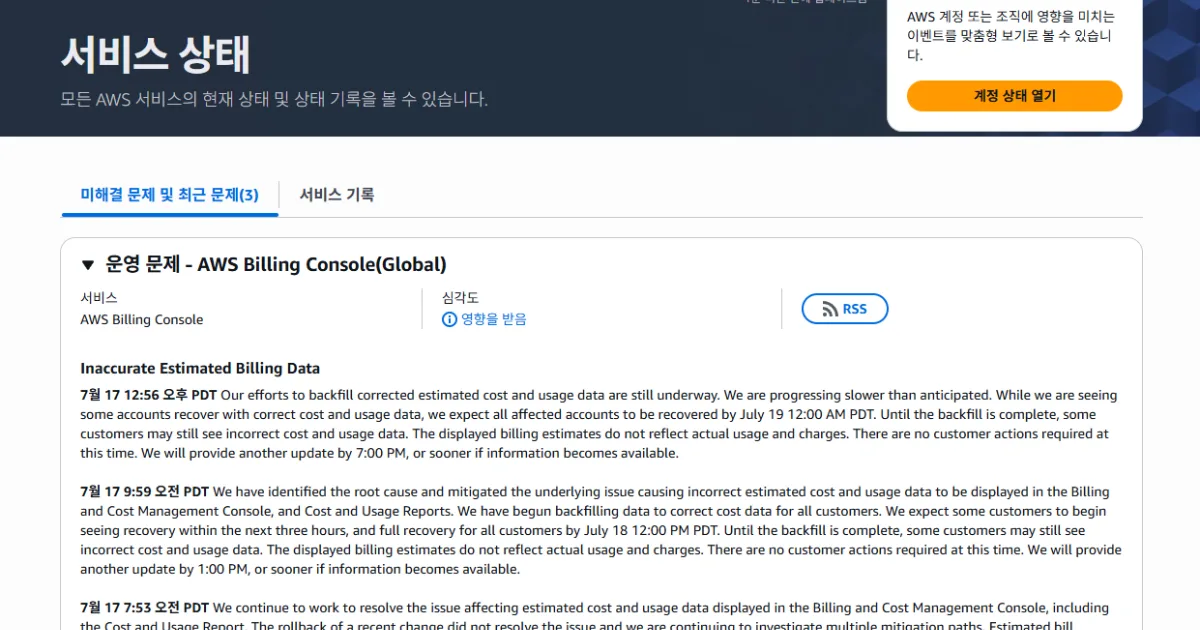
AWS suffered a billing-console incident.
The problem was not that servers went down. It was not a database outage. It was not a compute failure in a specific region.
The problem was cost data.
AWS Billing and Cost Management Console, Cost Explorer and Cost and Usage Report data began showing inaccurate estimated usage and cost information. In some cases, customers saw absurdly large figures, including bills in the billions and even trillions of dollars. WIRED reported one AWS customer seeing projected charges of more than $3 billion despite a usual monthly bill of only a few cents, while other users shared screenshots of similarly impossible amounts.
AWS said the Billing Console began displaying incorrect estimated billing data on July 16 at 10:38 p.m. Eastern Time. The company later identified the root cause as an issue with unit pricing inside the estimated billing computation subsystem. AWS then paused estimated billing computations, rolled back a recent change and worked to restore the last known good estimated bill computation.
The company repeatedly emphasized that no customer action was required.
That distinction matters.
This was not the same as saying that final invoices had been incorrectly issued. AWS framed the problem as an estimated billing-data issue, not a confirmed final billing error.
But that does not make the incident insignificant.
Cloud cost data is no longer a casual reference number. It is tied directly to enterprise budgeting, cost optimization, internal chargeback, product profitability, customer-level cost allocation, anomaly detection and executive reporting.
When that data becomes unreliable, a company may still be using the cloud normally while losing confidence in how much it is spending.
In the cloud era, a new kind of outage has emerged.
It is not only a service outage.
It is a cost-visibility outage.
Cloud Cost Data Is the Operating Dashboard Before Accounting
In the old IT world, costs were relatively predictable.
A company bought servers, purchased storage, signed software licenses and budgeted for data-center operations. Costs could be inefficient, but they usually moved slowly. IT budgets were often managed annually or quarterly.
Cloud changed that.
Compute instances, storage, networking, data transfer, managed databases, AI services, logging, backup, security tools and serverless calls are all billed by usage. A developer can misconfigure a resource. A data pipeline can run repeatedly. Logs can explode. AI inference requests can spike. A network transfer pattern can quietly create unexpected charges.
Costs can change quickly.
That is why companies watch Billing Console, Cost Explorer and Cost and Usage Reports.
How much did we spend today?
Which account is driving the increase?
Which service created the cost?
Will we exceed this month’s budget?
How much should be allocated to a specific project or customer?
Did an abnormal cost spike occur?
This data may not be the final invoice. But operationally, it functions as a dashboard.
A driver watches the speedometer and fuel gauge. A cloud operations team watches cost dashboards.
The AWS incident shook that dashboard.
Even if AWS says the numbers did not reflect actual usage and charges, inaccurate estimated data can still create real operational confusion. Cloud cost control cannot wait for the final monthly bill. It depends on early visibility, fast detection and timely response.
If the cost data is wrong, a company may overreact.
Or worse, it may underreact.
Why It Matters Even If the Final Bill Is Not Wrong
It may be tempting to dismiss the incident.
If the final bill is not wrong, why worry?
If AWS says no customer action is required, why not simply wait?
The reality of enterprise cloud operations is not that simple.
First, estimated costs are used for internal decisions.
Many companies monitor team budgets, project costs, product-level costs and department-level allocations through estimated billing data. If that data suddenly inflates, internal reporting and decision-making can become distorted.
Second, anomaly-detection systems can misfire.
Many organizations run alerts based on Cost Explorer or CUR data. If the source data is wrong, alert systems may flood teams with false alarms. Conversely, teams may become less able to detect a real cost anomaly during the affected period.
Third, customer billing and profitability analysis can be affected.
SaaS companies and platform businesses often allocate cloud costs by customer, workload, product or feature. If estimated cost data is unreliable, it becomes harder to judge whether a customer is profitable or whether a product feature is too expensive to operate.
Fourth, trust between finance and technology teams can be strained.
When cloud costs appear to spike abnormally, finance teams ask engineering teams for explanations. Engineering teams may say there was no actual usage change, but the dashboard shows a huge number. That gap creates unnecessary internal tension.
Fifth, automated cost-control workflows may be affected.
Some companies use cost data to trigger budget alerts, resource cleanup, approval workflows or spending controls. If incorrect estimated costs feed into these systems, automation itself can make bad decisions.
Estimated billing data is therefore not just an informational display.
Inside companies, it is already decision data.
A Single Point of Failure for FinOps
The most important lesson from the incident is about FinOps.
FinOps is the operating discipline through which technology, finance and business teams manage cloud spending together. Its goal is not only to reduce cost. It is to connect cloud usage with business value, accountability and transparency.
But FinOps depends on one assumption:
The cost data must be trustworthy.
For many companies, cloud-provider billing data is the source of truth. They ingest it into dashboards, allocate it across teams, build budgets, run cost-optimization campaigns and report to management.
If the source cost data is wrong, everything built on top of it becomes questionable.
The AWS incident shows that the provider of cost data can itself become a risk factor.
Companies often evaluate cloud providers based on availability, performance, security and service breadth. They should now also evaluate the reliability of cost data.
What happens if cost data is delayed?
What happens if estimated billing becomes inaccurate?
Which internal reports should be paused?
Which automation should be disabled?
Which numbers should be treated as provisional?
Cloud cost data is operational data before it becomes accounting data.
And if operational data is wrong, operational decisions can be wrong too.
What AWS’s Response Reveals
AWS’s updates reveal three important points.
First, the company traced the issue to a unit-pricing problem in the estimated billing computation subsystem. That means the problem was not necessarily raw usage data. It was the layer that converts usage into estimated cost.
That distinction is important.
Cloud billing is not simple arithmetic. It combines service prices, regions, usage types, discounts, commitments, credits, taxes, account structures and timing differences. The more complex the billing model becomes, the more important the computation layer becomes.
Second, AWS paused estimated billing computations.
That indicates a judgment that stopping the production of bad estimates was better than continuing to generate misleading data.
Third, recovery required recomputation.
The Guardian reported that AWS said full resolution would take multiple hours as it worked through recomputing estimated billing data.
That shows the nature of the system.
Cloud billing is a massive data-processing pipeline.
It requires near-real-time visibility, pricing accuracy, large-scale account aggregation and complex policy application.
When something goes wrong, it is not just a matter of fixing a number on a screen. The underlying computation and data pipeline may need to be corrected and backfilled.
The Billing Console incident was therefore not just a user-interface glitch.
It was a failure in a core data pipeline of cloud operations.
What Companies Should Do
AWS said customers did not need to take action to resolve the provider-side issue.
But that does not mean companies should do nothing internally.
First, companies should mark affected-period cost data as provisional.
If estimated billing data after July 16 appeared abnormal, cost increases or decreases from that period should not be used directly in executive reporting without qualification.
Second, cost anomaly alerts should be reviewed.
Teams should check whether false alerts were triggered, whether automated actions ran and whether any budget workflows were affected by inaccurate data.
Third, finance and technology teams should align on a shared message.
They should communicate that the issue involved estimated billing data, that AWS was recomputing and restoring data, and that final analysis should wait until corrected data is available.
Fourth, cost data should be reconciled after recovery.
Companies should compare Billing Console, Cost Explorer, Cost and Usage Reports and internal FinOps dashboards. Any internal chargeback, customer-level cost allocation or product-profitability analysis based on the affected period may need to be rerun.
Fifth, companies should create a cost-data incident procedure.
They already have incident playbooks for application outages, security events and network failures. They now need procedures for billing-data failures.
Which reports should be paused?
Which automations should be disabled?
Who decides when cost data is reliable again?
How should corrected data be reprocessed?
Cloud cost management needs its own incident response discipline.
Third-Party Cost Tools Are Not Immune
The incident also matters for third-party cloud cost-management tools.
Many companies ingest AWS source data into separate FinOps platforms. But if the source data is wrong, downstream tools cannot magically be correct.
If inaccurate estimates appear in Cost Explorer or CUR data, dashboards, alerts and reports built on top of those data sources may also be affected.
That means companies should ask harder questions when adopting cost-management tools.
How does the tool detect source-data anomalies?
Can it distinguish delayed data from incorrect data?
Can it mark a time period as provisional?
Can it reprocess corrected data after a provider backfill?
Can it prevent abnormal source data from triggering destructive automation?
The same issue becomes even more complex in multi-cloud environments.
Companies using AWS, Azure and Google Cloud must unify different billing systems, pricing models, account structures, discounts and currencies. If one provider’s cost data becomes unreliable, the entire cloud-spending picture can be distorted.
Cloud cost management is no longer an Excel exercise.
It is a data-quality discipline.
AI Makes Cost Visibility More Critical
The incident becomes even more important in the AI era.
AI workloads are cost-volatile.
GPU instances, model training, inference APIs, vector databases, data transfer, logging, agent execution and experiment loops can all scale rapidly. Generative AI and agentic AI can grow usage faster than expected.
As enterprises adopt AI at scale, accurate cloud cost data becomes more important.
Many AI projects already face the same question:
Why is this more expensive than expected?
Token usage, GPU utilization, data pipelines, model experiments and deployment costs accumulate quickly. If Billing Console and CUR data become unreliable, AI cost control becomes much harder.
AI cost management is not just infrastructure cost management.
It is the basis for AI ROI.
Which model produced value at what cost?
Which service is worth running?
Which workload should be optimized?
Which team is spending without measurable impact?
Those questions require accurate cost data.
The AWS Billing Console incident shows that cost-data reliability will become a core requirement of AI infrastructure governance.
Cloud Trust Is No Longer Only About Uptime
Cloud-provider trust has traditionally rested on availability, security and performance.
Now another category must be added.
Cost transparency.
The more companies use cloud infrastructure, the more they depend on provider billing data. They need to know how costs are calculated, which services are driving spend, how discounts are applied and whether commitments are reflected correctly.
When cost data appears inaccurate, customers become anxious.
Even if the provider says final invoices are not wrong, customers still ask:
When did the error begin?
Which accounts were affected?
Which internal dashboards are now unreliable?
Is the final invoice really correct?
Which numbers should be trusted after recovery?
Cloud providers must answer those questions quickly and clearly.
AWS’s updates offered technical detail about the pricing computation issue and the steps taken to pause and recompute estimated billing. But the visible confusion among customers shows how sensitive billing transparency has become.
The new standard of cloud reliability is not only whether services remain online.
It is whether the cost dashboard remains trustworthy.
A Warning for Korean Companies
The incident carries a clear warning for Korean enterprises.
Korean startups, large companies, financial institutions, manufacturers, game companies, commerce platforms and public-sector organizations increasingly rely on global cloud providers. AWS cost data often feeds internal decisions about product profitability, AI spending, infrastructure optimization and department-level cost allocation.
That means cloud cost data must be treated as management data.
It is not just an IT number.
It affects business-unit profit and loss, product strategy, customer pricing and AI investment decisions.
Korean companies should not assume that provider cost data is always accurate in real time.
They should separate estimated data from finalized billing data.
They should mark affected periods when provider-side billing issues occur.
They should prevent cost-based automations from acting on abnormal data without review.
They should define a reconciliation process after corrected data is restored.
They should include cost-data quality in their FinOps operating model.
Cloud cost is now business data.
A failure in that data is a business risk.
The Real Dashboard of the Cloud Is Cost
The AWS Billing Console incident may not look as dramatic as a major cloud outage.
Websites did not necessarily go down.
Applications did not necessarily stop.
Databases did not necessarily fail.
But from the perspective of enterprise operations, the event matters.
For companies using cloud infrastructure, cost data is the operating dashboard.
If the dashboard is wrong, the driver becomes anxious.
Is the speed wrong?
Is the fuel gauge wrong?
Is the warning light wrong?
Cloud is no different.
If cost data is inaccurate, companies cannot confidently know how much they are spending, where costs are rising, whether budgets will be exceeded or which services are hurting profitability.
The core issue is not that AWS necessarily charged customers incorrectly.
The core issue is that a key data layer of cloud cost control became unreliable.
As AI and cloud usage grow, enterprises will watch more cost data in near real time. But that data is itself a system output. It can be delayed, distorted, corrected and backfilled.
Companies should therefore treat cloud cost data not as absolute truth, but as a data asset that must be governed.
Cloud incident response can no longer focus only on servers, networks and applications.
Cost data must also be monitored.
Cost-data errors must be reported.
Cost-data recovery must be verified.
Cost-based automation must have safeguards.
The real dashboard of the cloud is cost.
When that dashboard shakes, companies can no longer trust the speed at which they are running.


