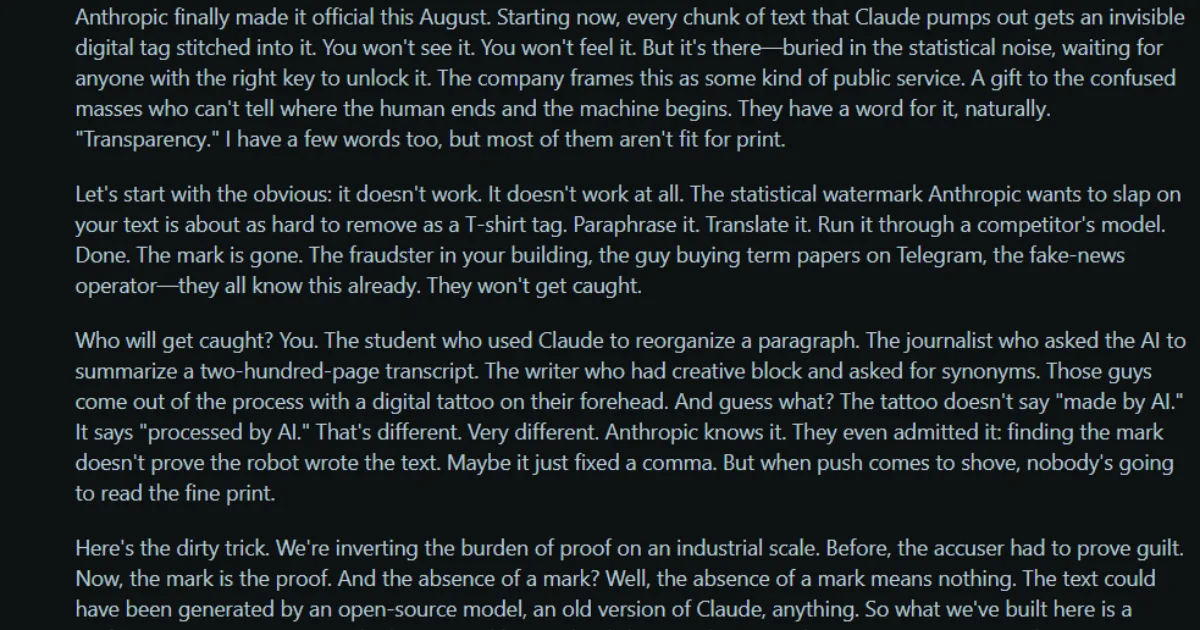
After Anthropic announced plans to watermark future Claude-generated text, a strong backlash emerged on Reddit.
The argument was simple.
A watermark may not catch truly malicious users. Anyone determined to hide AI use can paraphrase the text, translate it, rewrite it with another model or use an open-source model. But honest Claude users, such as people who organize paragraphs, summarize long transcripts or polish their writing, may be left with a trace showing that AI was involved.
That is the central issue.
Anthropic says the watermark only indicates the possibility that Claude was involved. It does not mean Claude wrote the entire text. It does not mean a human did not write it. But in real-world settings, that subtle distinction can easily collapse.
In schools, companies, hiring processes, journalism and publishing, a signal that “AI was detected” may quickly become suspicion.
That is where the Reddit writer’s distinction between “processed by AI” and “made by AI” becomes important.
A text in which AI fixed a comma is different from a text entirely written by AI.
A text summarized with AI assistance is different from a text outsourced to AI.
A paragraph polished by AI is different from thinking replaced by AI.
But when watermark detection results are socially consumed, these differences can be flattened.
The Criticism: Watermarks Catch Honest Users
The strongest criticism in the Reddit post is that watermarks may catch only honest users.
A person who wants to hide AI use can find ways to remove the watermark. They can rewrite the text with another model, use a paraphrasing tool or rely on an open-source model. But a person who uses Claude normally and keeps the output mostly intact may leave the watermark in place.
That structure can feel unfair.
Those trying to deceive may escape.
Those using the tool openly may be marked.
In that situation, the watermark becomes less of an anti-cheating tool and more of a mechanism that shifts the burden of suspicion onto the user.
The Reddit writer describes this as a reversal of the burden of proof. In the past, the person making an accusation had to prove misconduct. Now, if a watermark is found, the person associated with the text may be forced to explain their innocence.
This matters.
As AI-use detection becomes connected to grading, hiring, research ethics and workplace evaluation, the social weight of a watermark increases. A technical signal that “Claude may have been involved” can become a moral judgment that “this person cheated with AI.”
At that moment, the watermark is no longer only a transparency tool.
It becomes a stigma tool.
Who Holds the Detection Key?
Another major criticism is about power.
To detect the watermark, a verifier needs the key. That key and the detection infrastructure are controlled by Anthropic. The Reddit post criticizes this arrangement by arguing that the company selling the tool may also gain power to decide what is “real” and what has been “processed.”
That argument may sound sharp, but it points to a real issue.
If AI-content verification depends on closed infrastructure controlled by platform companies, then access, interpretation and authority become concentrated. Who can use the detection API? How are results presented? How are false positives and false negatives explained? Who resolves disputes?
A watermark cannot become trusted infrastructure through technology alone.
It needs institutional safeguards.
Independent audits of detection methods are necessary.
Clear interpretation guidelines are necessary.
Responsibility for false positives and false negatives must be defined.
Use in schools, hiring, publishing and workplaces must be limited and governed.
Users need appeal procedures.
Without those safeguards, watermark detection can become an opaque authority controlled by the same companies that provide AI tools.
AI Use and Misconduct Must Be Distinguished
The debate in the comments also reveals the core issue.
Some users argue that if the watermark catches people who simply copy and paste Claude output, then it is doing its job. Others respond that the watermark is only a weak signal, and that “processed by AI” may be unfairly treated the same as “written by AI.”
This debate will likely repeat in education and the workplace.
Is the fact that AI was used itself a problem?
Or is the problem that someone hid AI use and submitted the work as entirely their own?
Is grammar correction misconduct?
Is AI-assisted structuring allowed?
What if AI wrote a first draft but the human substantially rewrote it?
What if AI summarized a transcript but the user made the argument?
If these questions are not answered, watermarking will create more confusion.
Technology can show the possibility of AI involvement. But society must first define the difference between acceptable AI assistance and dishonest AI substitution.
The Real Issue Is Not Transparency. It Is Interpretation.
According to Anthropic’s own framing, the watermark is a limited tool.
It provides a probabilistic signal that Claude may have been involved. It does not prove human authorship or non-authorship. It does not decide copyright. It does not determine responsibility.
But the community backlash begins exactly from that limitation.
A technically limited signal may be socially overinterpreted.
The watermark may be weak for short text. It may be removable through editing. It may not identify text written by other AI models. Yet if schools or companies use it as a simple pass-fail judgment, people can be harmed.
The central question, therefore, is not whether watermarking should exist.
It is how watermark results should be used.
“Detected” is not a verdict.
“Possible Claude involvement” is not proof of cheating.
“Processed by AI” is not the same as “written by AI.”
“No watermark” is not proof of human authorship.
If these distinctions are not made clear, watermarking may increase distrust rather than transparency.
What This Means for Korea
This debate could quickly become a real issue in Korea.
Schools, job applications, self-introductions, research drafts, workplace reports, proposals, journalism and blog writing will all face questions about AI use. Korea is especially sensitive to plagiarism, ghostwriting and fairness in admissions and hiring. An “AI detected” signal could easily become a strong stigma.
The important response is not prohibition.
It is distinction.
The question should not be only whether AI was used.
It should be how AI was used.
Drafting, translation, proofreading, summarization, structuring, ideation and final writing are different activities. Acceptable assistance must be distinguished from dishonest substitution.
Detection results alone should not become grounds for punishment, rejection or reputational harm.
Schools and companies need AI-use policies before they rely on watermarking or detection APIs. The technology should support the policy, not replace it.
In the end, the Claude watermark debate is not mainly about technical accuracy.
It is about how society interprets writing touched by AI.
Watermarks can improve transparency. But if used carelessly, they may place the burden of suspicion on honest users and turn all AI-assisted writing into something seen as less authentic.
The danger of AI watermarking is not the invisible mark itself.
It is what happens when that mark is found.
If society too easily translates that signal into “misconduct,” the tool meant to create transparency can become a mechanism of stigma.
What we need next is not only stronger detection.
We need standards for interpreting the degree, context and purpose of AI involvement in education, hiring, publishing and work.


