AI data centers consume enormous amounts of electricity.
That has become widely understood.
But electricity is not the only resource behind the AI boom.
Data centers also need water.
As AI servers become denser and more powerful, they generate more heat. That heat must be removed through increasingly sophisticated cooling systems, including air cooling, water cooling, evaporative cooling and recycled-water systems.
Google’s 2026 Environmental Report makes the scale of that issue clear.
The company said it used about 41 billion liters of water across its data centers and offices in 2025, a 34% increase from the previous year.
Google compared the figure to the amount of water needed to irrigate roughly 73 golf courses in the U.S. Southwest for a year.
The increase reflects a broader reality.
As AI and cloud demand grow, data centers need more servers. More servers create more heat. More heat requires more cooling infrastructure.
The environmental cost of AI cannot therefore be measured only in electricity use and carbon emissions.
Water has become part of the calculation.
Cooling AI Requires Physical Resources
AI can feel intangible.
A user types a question into a chatbot. A model produces an answer. A picture is generated. An AI agent completes a task.
But none of this happens in the air.
It happens inside physical facilities filled with servers, chips, network equipment, cooling systems and power infrastructure.
High-performance AI chips produce significant heat. In a large data center, that heat can become difficult to manage using air alone. Water-based cooling can often reduce energy consumption compared with systems that rely entirely on mechanical air cooling.
That creates a trade-off.
Using water for cooling may improve overall power efficiency and reduce carbon emissions. But in water-stressed regions, water consumption can create tension with households, farms, local industry and ecosystems.
Google acknowledges that national-level averages do not tell the whole story.
The company says its U.S. data-center water use is less than 1% of the water used by American households for lawn care. But it also recognizes that individual facilities can have a meaningful impact on local watersheds.
For people living near a data center, the relevant question is not what percentage of national water use the company represents.
The relevant question is whether their own community has enough water.
The Dalles Shows the Trade-Off Clearly
Google’s data center in The Dalles, Oregon, is one of the clearest examples of this dilemma.
Google has operated data centers in The Dalles since 2006. In 2025, the facility used approximately 469 million gallons of water, or about 1.78 billion liters.
Google says its water-risk framework found that the area’s water supply was not facing severe depletion or high water-scarcity risk. Based on that assessment, the company uses water cooling at the site to improve energy efficiency.
The argument is straightforward.
If water cooling lowers the amount of electricity required to operate a data center, and if the local water system can support that demand, then water use may reduce the facility’s overall environmental footprint.
Google reported that at The Dalles, non-computing energy use for cooling and power distribution was around 6% to 10% of IT equipment energy in the fourth quarter of 2025. That compares with an industry average overhead-energy level of about 54%.
From an energy-efficiency perspective, the facility performs strongly.
But local acceptance cannot be measured only through Power Usage Effectiveness or cooling efficiency.
Water is not like carbon.
A liter of water saved in one region does not automatically compensate for a liter of water used somewhere else. Water has different value depending on the local watershed, season, quality, infrastructure and community demand.
That is why a company can be globally efficient and still face local criticism.
Water Replenishment Is Becoming a New Standard
Google is trying to address this challenge through a water-replenishment strategy.
The company has set a goal of replenishing 120% of the freshwater volume used across its offices and data centers by 2030. In other words, Google wants to return more water to communities and watersheds than it directly consumes.
In 2025, Google said its water-stewardship projects replenished about 7.7 billion gallons of water, or approximately 29 billion liters. That represented roughly 78% of the company’s 2025 freshwater consumption, up from 63% in 2024.
Google says it now supports 165 water-management projects across 97 watersheds. By 2030, the company estimates that these projects could have the potential to replenish more than 19.7 billion gallons of water annually.
These projects are not limited to directly supplying water.
They can include leak detection, rainwater capture, groundwater recharge, irrigation improvements, river restoration, wetland restoration and upgrades to water infrastructure for schools and public facilities.
The idea is that data-center operators should not merely consume water. They should also help strengthen the water systems around them.
But the credibility of this approach depends on where those benefits occur.
A replenishment project in one watershed may be valuable. But it does not necessarily offset the impact of water withdrawals in another.
The key question is whether the communities affected by data-center demand also receive the benefits of water investment.
The Dalles: Infrastructure Investment and Local Legitimacy
Google has also invested in local water infrastructure in The Dalles.
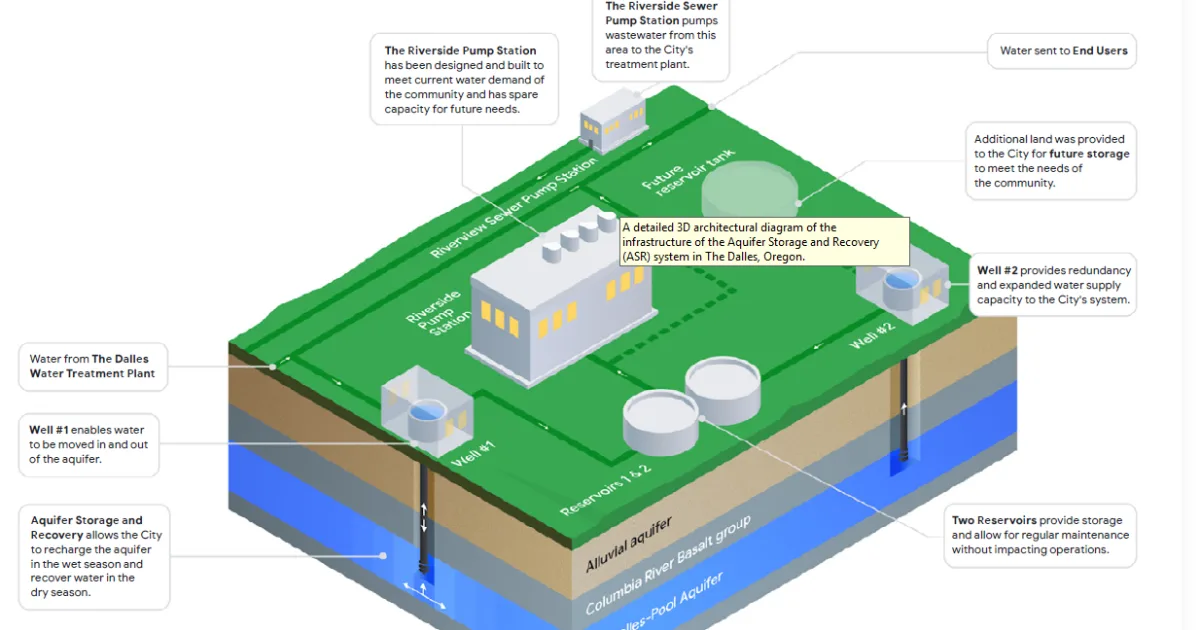
The company says it has invested more than $28 million in the city’s water system. One of the flagship projects is an aquifer storage and recovery system.
The system stores excess treated water underground during wetter periods and allows it to be recovered during the summer, when water demand is higher.
Google says it transferred the facility and associated groundwater rights to the city at no cost.
This is a meaningful model.
A company that consumes water for data-center operations can invest in infrastructure that improves a community’s long-term water resilience.
But the most important issue is not only the size of the investment.
It is whether residents see a real improvement in water security.
Do local households have more reliable access to water?
Do farmers and businesses benefit?
What happens during droughts or extreme heat?
Will data-center operations face restrictions when community water needs become more urgent?
These questions determine whether water stewardship becomes a genuine local partnership or simply a corporate sustainability claim.
AI Cooling Is Becoming Harder as Infrastructure Expands
The challenge is likely to grow.
AI hardware produces more concentrated heat than many conventional servers. As model sizes increase, inference demand expands and data centers become denser, cooling will become an even more important part of infrastructure design.
Google is trying to respond through more advanced cooling systems.
The company is working to cool equipment closer to the source of heat rather than treating an entire server room as a single thermal environment. It is also expanding systems that can shift certain non-urgent computing tasks to different times or locations depending on grid conditions.
These improvements can lower energy use.
They may also reduce the amount of water needed per unit of computing.
But they do not guarantee that total water use will fall.
Google’s 2025 water consumption increased 34%, while its replenishment rate reached 78% of freshwater use.
If AI infrastructure continues to expand faster than water-efficiency improvements and replenishment projects, the gap may become harder to close.
Water Responsibility Must Be Local
The AI water challenge cannot be solved by efficiency metrics alone.
It requires decisions about where data centers are built, how water-stressed those regions are, whether potable water can be replaced with reclaimed water and what agreements companies make with the communities around them.
The core questions are practical.
How much water does the data center use?
What type of water does it use?
Could recycled water be used instead of drinking-quality water?
What is the condition of the local watershed?
Who has priority when water becomes scarce?
And does the company replenish water in the same region where it creates demand?
AI is often described as a cloud technology.
But the cloud is not weightless.
It is made of buildings on land, powered by electricity, filled with servers and cooled with water.
For AI to become part of the solution to climate change, companies will need to explain not only how efficiently their models run, but also how the data centers behind them affect the communities that share the same water.