European Union digital market regulation is moving beyond consumer-facing platforms such as app stores and search engines and toward cloud infrastructure.
On June 25, 2026, the European Commission issued a preliminary position that Amazon Web Services and Microsoft Azure should be designated as gatekeepers under the Digital Markets Act (DMA).

No final designation has yet been made. Even so, the case is significant because it raises a broader question about where the gateways of the digital economy lie in the age of AI. In the past, those gateways were platforms that distributed apps or displayed search results. The Commission is now suggesting that the cloud infrastructure used to store data and run models may play a similar role.
The DMA Was Designed to Regulate Digital Gateways
To understand why Amazon Web Services and Microsoft Azure are being considered for gatekeeper designation, it is first necessary to examine what the DMA means by a “gateway.”
The Digital Markets Act is an EU ex ante regulation intended to prevent large platforms from using their control over the main channels connecting businesses and consumers to restrict competition. Typical examples include an app store requiring developers to use its own payment system or a search and recommendation service giving preferential treatment to its own products over competing services.
Until now, the DMA has mainly applied to platforms that consumers use directly, including search engines, social media services, app stores, and operating systems. What these services have in common is that businesses often have little choice but to pass through them in order to reach consumers.
The DMA generally assesses potential gatekeepers according to criteria such as company revenue, market capitalization, and the number of end users and business users. Services exceeding the relevant thresholds are presumed to serve as important gateways in the market. These figures, however, are thresholds for establishing a presumption rather than absolute conditions for designation. Even when a service falls below them, the Commission may conduct a market investigation and designate it as a gatekeeper if it serves as an important gateway and holds an entrenched and durable market position.
AWS and Azure Face Possible DMA Gatekeeper Designation
AWS and Azure did not meet the DMA’s usual quantitative thresholds based on revenue and user numbers. Nevertheless, the Commission believed it was necessary to determine separately whether the two services functioned as important gateways for businesses delivering digital services to their customers.
The Commission therefore opened individual market investigations into AWS and Azure on November 18, 2025. The investigations were intended to determine whether the two services constituted important gateways and whether their market positions were not merely temporary but entrenched and durable.
On the same day, the Commission launched a third investigation with a different purpose. While the first two investigations examined whether AWS and Azure could each be designated as gatekeepers, the third considered whether the DMA’s existing obligations were sufficient to address competition concerns in the cloud market. In other words, the Commission separated the question of whether particular companies should be designated from the question of whether the rules themselves were suitable for the cloud sector.
The preliminary position announced on June 25, 2026, resulted from the two investigations concerning the possible designation of AWS and Azure. The Commission identified them as the largest and second-largest cloud services in the EU and provisionally concluded that they served as important gateways connecting businesses with their customers.
The factors cited included their long-standing market positions, broad and stable user bases, and extensive service ecosystems encompassing databases, security, and development tools. The Commission also considered the technical and economic costs businesses may face when moving away from a particular cloud provider, as well as the resulting risk of vendor lock-in.
AI has emerged as an additional factor within this existing structure. The Commission believes the AI tools and partnerships offered by the two companies are becoming increasingly important in corporate cloud procurement. Its position is that new demand generated by businesses adopting AI may be absorbed into the existing AWS and Azure ecosystems, potentially reinforcing the two providers’ role as gateways.
This remains only the Commission’s preliminary position. Amazon and Microsoft may review the investigation materials and submit written responses before the Commission makes its final decision. Should the designation be confirmed, the companies would have six months to comply with their DMA obligations. Violations could result in fines of up to 10 percent of worldwide annual turnover, rising to 20 percent for repeated infringements.
In the Age of AI, the Gateway Is Changing
Why should cloud services be regarded as gateways when, unlike app stores or search engines, consumers rarely interact with them directly?
Historically, platform power was concentrated at the points where consumers discovered and used services. App stores controlled app distribution and payments, while search engines determined how information and services appeared in search results. Operating systems, browsers, social media platforms, and advertising networks similarly shaped the routes through which businesses reached consumers.
Cloud services operate at a deeper layer. Businesses use them to store data, run applications, and manage security and user permissions. In AI services, even more functions are integrated into the cloud environment, including model training and inference, data processing, API integration, performance evaluation, and deployment.

For this reason, it has become increasingly difficult to view cloud computing in the AI era as merely a service for renting servers and storage. A company’s choice of cloud provider can determine not only where its applications run, but also which AI models, development tools, databases, security systems, and partner services it can use.
For a company that has built its systems around one provider’s managed services and AI tools, moving to another cloud may require far more than transferring data. Applications may need to be redesigned, security and identity systems rebuilt, and existing development tools and model operations replaced. As these switching costs rise, businesses may remain formally free to choose another provider while finding that choice increasingly difficult to exercise in practice.
This is why the Commission sees AWS and Azure as potential new gateways. An app store provides the entrance through which a finished service reaches consumers. A cloud platform provides the foundation on which that service is built and operated. In the AI market, control over this foundation may become as important a condition of competition as control over the consumer-facing platform.
That does not mean AI will inevitably strengthen cloud lock-in. The spread of open-source models, standardized APIs, and multicloud management tools could make it easier for businesses to combine services from several providers or move between them. The central issue is therefore not AI itself, but how tightly AI models, data, and development tools become integrated into a particular cloud ecosystem.
What Could Change if AWS and Azure Become Gatekeepers
If AWS and Azure are ultimately designated as gatekeepers, the most significant change may be greater restrictions on how the two companies keep customers and services within their own cloud ecosystems. Business users could gain more freedom to connect competing technologies, move their data, and avoid being steered toward services provided by a single cloud company.
The precise obligations, however, have not yet been determined. The DMA was originally designed primarily for consumer-facing platforms such as app stores and search engines. This is also why the Commission is separately investigating whether the existing DMA rules are sufficient to address competition concerns in the cloud market.
Three main areas of change are currently under discussion.
First, self-preferencing and bundled sales could face restrictions. Cloud providers may be prevented from giving their own AI models, databases, security services, and development tools more favorable treatment than competing services, or from using pricing and contractual terms to encourage customers to adopt several of their products together.
Second, connections with other cloud services could become easier. Providers may be required to reduce technical and contractual barriers that make it difficult to connect systems built on AWS or Azure with external software or rival cloud platforms. This could lead to stronger requirements for meaningful multicloud interoperability.
Third, moving data and services to another provider could become easier. Some switching barriers and data egress charges are already governed by the EU Data Act. The Data Act requires cloud providers to remove obstacles that hinder customers from switching services and, from January 12, 2027, will in principle prohibit switching charges, including data egress fees.
The application of the DMA to cloud services would therefore be more likely to complement the Data Act than duplicate it. It could extend regulation into competition-related issues such as self-preferencing, tying and bundling, data access, and interoperability. Business users could gain more choice, while Amazon and Microsoft might be required to revise aspects of their service design, contracts, and pricing structures.
Amazon and Microsoft Push Back
Both companies oppose gatekeeper designation, but they challenge different aspects of the Commission’s position.
Amazon argues that applying the DMA on top of existing cloud regulations, including the Data Act, could create overlapping regulatory requirements. Its position is that additional obligations could discourage investment and innovation in Europe and make it more difficult for businesses to adopt new technologies.
Microsoft has challenged the scope of the regulation and the way the market is defined. It argues that regulating only AWS and Azure, while Google Cloud and Gemini are rapidly gaining influence, could distort competition rather than protect it. In its view, the cloud market should not be assessed solely through current market shares but as a broader ecosystem competition involving AI models, enterprise software, data, and development tools.
Amazon’s argument is essentially that existing regulation is already sufficient. Microsoft’s is that defining the regulated market too narrowly could give other competitors an unintended advantage.
Why the EU Is Paying Closer Attention to the Cloud
Competition policy alone does not fully explain why the EU is focusing on AWS and Azure. Behind the debate lies a broader strategy to reduce dependence on US technology companies and strengthen Europe’s ability to make its own technological choices.
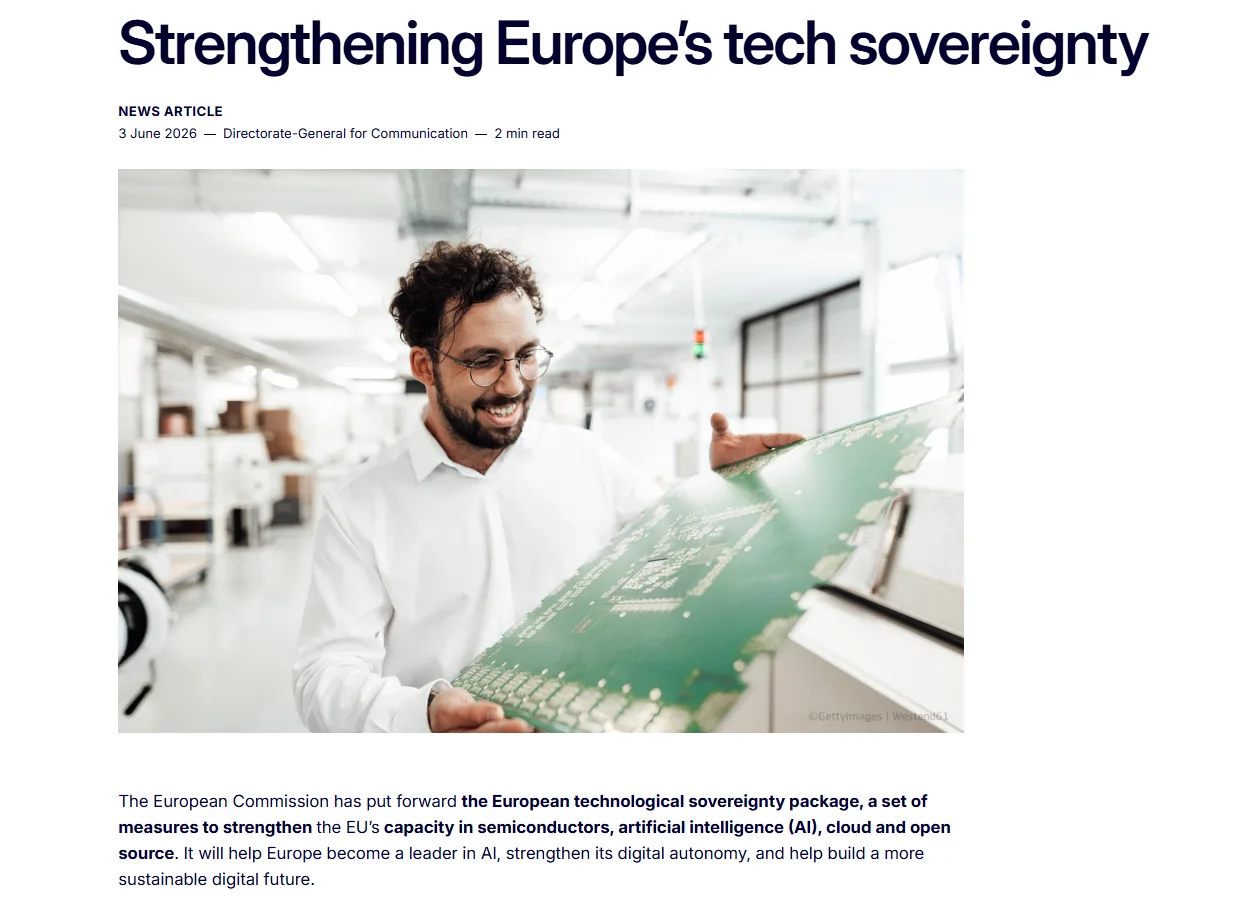
On June 3, 2026, the European Commission announced a technology sovereignty package. It included proposals for a Chips Act 2.0 and a Cloud and AI Development Act, alongside an EU open-source strategy and a roadmap for the digitalization of the energy sector and the use of AI. The broader goal is to reduce external dependence across the technology stack, from semiconductors to cloud computing, AI, and software.
This policy is driven by Europe’s structural reliance on non-EU providers. The Commission says the EU depends on non-EU countries for more than 80 percent of its major digital products, services, infrastructure, and intellectual property. According to the Cloud and AI Development Act proposal, three non-EU cloud giants—AWS, Azure, and Google Cloud—account for more than 70 percent of the European cloud market.
Within this framework, semiconductors form the physical foundation of AI, while cloud computing provides its operational foundation. Open-source technology is positioned as one way to reduce dependence on proprietary ecosystems controlled by individual companies. The possible application of the DMA to AWS and Azure is therefore not only about preventing restrictions on competition. It also intersects with a broader policy question: under what conditions should Europe entrust the core infrastructure of the AI economy to foreign providers?
Competition regulation and technological sovereignty should not, however, be treated as the same thing. The legal case for designating AWS and Azure as gatekeepers must depend on whether the two services genuinely serve as important gateways between businesses and users, and whether their positions risk restricting fair competition. Technological sovereignty may explain why the EU is particularly attentive to cloud infrastructure, but it does not by itself provide sufficient legal justification for gatekeeper designation.
Is AI a Lock—or a Key to Competition?
Ultimately, the debate comes down to one question.
Does AI lock businesses more tightly into cloud ecosystems, or does it disrupt the existing market and expand their choices?
The European Commission and supporters of regulation argue that the integration of AI tools, data, security systems, and development environments within a single cloud ecosystem can make it more difficult for businesses to switch providers. From this perspective, AI reinforces existing cloud lock-in.
Microsoft’s response, by contrast, focuses on the possibility that AI may do more than entrench established providers. It argues that AI is already strengthening competitors such as Google Cloud and Gemini and reshaping the existing market. The spread of open-source models and standardized tools could also make it easier to move between different cloud platforms.
One side therefore sees AI as a lock that binds businesses more tightly to a cloud ecosystem. The other sees it as a new competitive force capable of disrupting the existing market. A final decision on gatekeeper designation will not settle this question completely, but it may reveal how the EU understands the concentration of power in AI infrastructure.
Extending the DMA to the cloud would mean more than simply adding another category of company to the regulation. It would suggest that the location of platform power itself is changing. In the past, gatekeepers were the platforms above the screen—those that displayed apps and controlled payments. In the AI era, the infrastructure beneath the screen, where data is stored, models are run, and companies’ technological choices are shaped, may also function as a gateway.
The question the EU is ultimately asking is this:
Is the true gatekeeper of the AI era the app store above the screen—or the cloud beneath it?


