The European Union is taking aim at Meta again.
This time, the issue is not privacy, competition law or misinformation.
It is the design of Instagram and Facebook themselves.
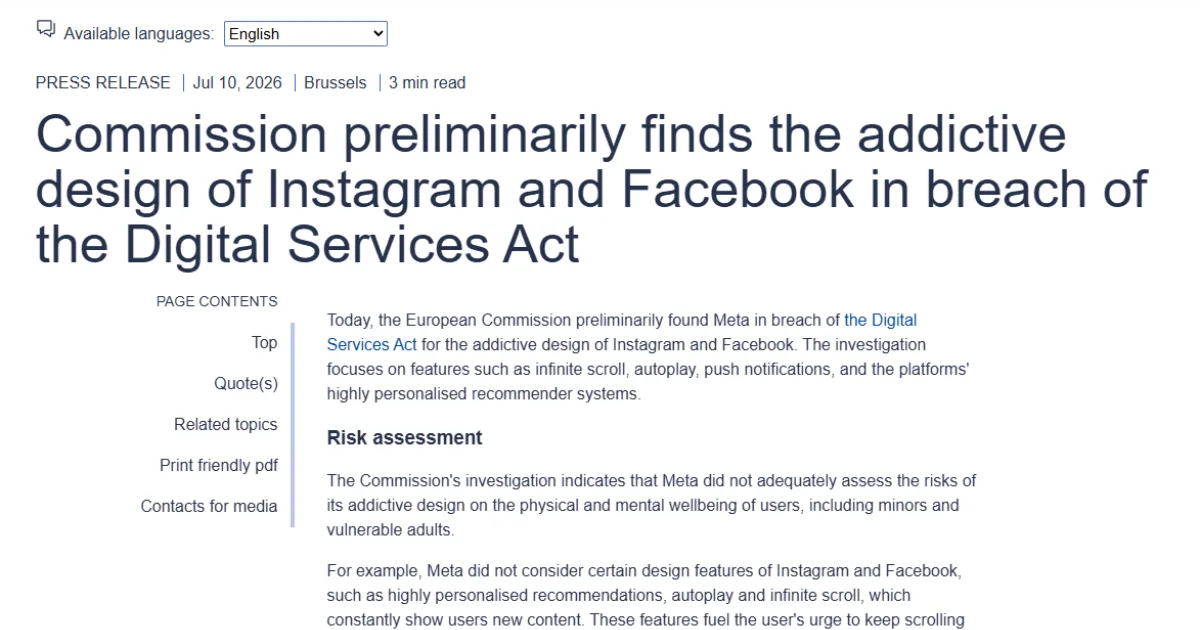
On July 10, 2026, the European Commission said it had preliminarily found Meta in breach of the Digital Services Act over the “addictive design” of Instagram and Facebook. The investigation focuses on features that have become part of the everyday grammar of social media: infinite scroll, autoplay, push notifications and highly personalized recommender systems.
These features are familiar to almost every user.
A finger moves down the screen, and new posts continue to appear. A video ends, and the next one begins automatically. The platform predicts what a user may want to see next. Notifications pull the user back into the app.
For years, these mechanisms were described as tools of convenience and personalization.
The EU is now asking a different question.
Were these features designed to help users?
Or were they designed to make stopping harder?
Is Infinite Scroll a Convenience Feature or an Addiction Structure?
Infinite scroll is one of the defining inventions of modern social media.
Older web pages had endings. A user had to click “next,” move to another page or make a conscious decision to continue. There was a moment of pause. There was friction.
Infinite scroll removed that boundary.
Content does not end. The platform keeps presenting another post, another image, another video, another recommendation. The user does not need to decide to continue. Continuing becomes the default.
Autoplay works in a similar way.
The user does not actively choose the next video. The platform chooses it and starts it. The moment of decision is reduced. The opportunity to stop is weakened.
The European Commission’s preliminary findings suggest that these design features may push users into a kind of “autopilot mode,” reinforcing compulsive use and unhealthy habits.
That is a major shift in regulatory thinking.
A platform design choice is no longer being treated merely as a user-experience feature. It is being treated as a potential risk factor for behavior, attention, self-control and mental health.
Until recently, platform regulation focused mainly on content.
Did the company remove illegal posts?
Did it leave misinformation online?
Did it properly handle hate speech, terrorist content, child sexual abuse material or scams?
The Meta case moves one step deeper.
The question is no longer only what content appears on the platform.
It is how the platform is designed to make users consume that content endlessly.
The Problem With Engagement as the Goal
Instagram and Facebook rely on recommender systems to show users personalized content.
These systems analyze signals such as clicks, watch time, likes, comments, shares, completion rates, repeat views and social connections. The platform then predicts which content is most likely to keep a user engaged.
The critical question is what the system is optimizing for.
If a platform were optimized primarily for user wellbeing, learning, healthy social connection or balanced information exposure, its recommender systems might look very different.
But advertising-based social media has historically been built around attention.
The longer users stay, the more ads can be shown.
The more users react, the more data the system collects.
The more data the system collects, the more precisely it can predict and influence future behavior.
That is the economic logic behind engagement optimization.
The EU’s preliminary findings strike at this point. The Commission said Meta did not adequately assess the risks that Instagram and Facebook’s addictive design could pose to users’ physical and mental wellbeing, including minors and vulnerable adults. It also said Meta’s existing mitigation measures were not sufficient to address those risks.
This creates a heavier standard for platform companies.
They can no longer say only that they are showing users content they may like.
They may need to explain what their recommendation systems optimize, how those systems change user behavior and what risks arise when the users are minors or otherwise vulnerable.
Algorithms are not neutral tools.
They are systems trained toward goals.
If the goal is engagement, the system may shape time, emotion, habits, relationships and even sleep.
What Did the Platform See When Teenagers Logged In at Night?
One of the most important parts of the EU’s concern involves minors.
The problem of teen social-media use is not simply the total number of hours spent online. Timing matters. Context matters. Emotional state matters. The type of content matters.
A teenager scrolling through Reels or Stories in bed late at night is not in the same situation as someone using a platform during the day to search for information.
Late-night use can interfere with sleep. It can intensify anxiety, social comparison and emotional vulnerability. It can affect school performance and daily rhythm the next day.
Short-form content can make the problem worse.
Fast, stimulating videos create a rapid reward cycle. Each clip is short, but the sequence is endless. A user may feel tired and still keep watching. The promise of “just one more” repeats itself.
This structure affects adults too.
But teenagers may be more vulnerable because their self-regulation capacities are still developing.
The EU’s position signals that platforms cannot treat minors simply as another engagement segment.
Young users are not only consumers in an attention market.
They are users who require additional protection.
A platform should not measure success only by how long teenagers remain inside the app. It should also ask whether that time is compatible with sleep, concentration, emotional health and self-control.
Why Time-Management Tools May Not Be Enough
Meta has introduced safety and wellbeing tools over the years.
Instagram and Facebook include time-management features, break reminders, parental controls and safety-center resources. Teen-focused account settings have also become part of Meta’s broader response to concerns about young users. Meta has pointed to these measures in response to regulatory criticism.
But the European Commission’s preliminary findings suggest that such measures may not be enough.
There are several reasons.
First, time-management tools can be easy to ignore.
If a user receives a reminder and dismisses it, the platform continues. A weak interruption may not be enough to counteract a design system built to encourage continued use.
Second, parental controls depend on parents’ time, knowledge and attention.
Not every parent understands complex platform settings. Not every parent has the ability to monitor usage continuously. Not every parent can translate a technical setting into a healthy family rule.
Third, mental-health information pages may not offset addictive product design.
If the main system continues to pull users deeper into the feed, a separate help page or resource link may have limited practical effect.
The EU’s message is therefore clear.
A design problem must be addressed through design.
The Demand to Change Defaults
The most consequential implication of the case is that Meta may be forced to change product defaults.
Reports on the Commission’s findings indicate that possible remedies could include disabling or modifying features such as autoplay and infinite scroll by default, introducing more effective screen-time breaks and adjusting recommendation systems so they are less aggressively engagement-driven.
That would go directly to the business model of social media.
Infinite scroll, autoplay and engagement-optimized recommendations are not decorative features. They are central mechanisms for increasing time spent on platform.
If time spent falls, ad impressions may fall.
If ad impressions fall, revenue may be affected.
That is why this is not merely a debate over safety features.
It is a debate over whether regulators can intervene in the core design logic of advertising-based platforms.
If the EU’s preliminary findings are confirmed, platforms may no longer be able to rely on the argument that users simply choose to stay.
They may have to show that the service respects user autonomy rather than exploiting psychological vulnerability.
This is where the Digital Services Act becomes powerful.
The DSA does not only require large platforms to remove illegal content. It requires very large online platforms to assess and mitigate systemic risks, including risks to public health, minors, civic discourse and fundamental rights.
The Meta case could become a defining example of how the DSA reaches into platform architecture itself.
The Bigger Threat Is Not the Fine, but the Redesign
If the EU ultimately confirms a DSA breach, Meta could face fines of up to 6% of global annual revenue.
For a company of Meta’s scale, that could be a large amount of money.
But the larger threat may not be the fine.
It may be the redesign.
A financial penalty can be paid once. A redesign changes the daily operation of the platform.
If infinite scroll, autoplay, recommendations, notification systems or teen defaults are changed, user behavior changes. If user behavior changes, time spent changes. If time spent changes, advertising revenue and growth strategy may change.
The EU’s preliminary findings send a clear signal to platform companies.
Maximizing time spent can no longer be treated as an unquestioned product success metric.
Healthy use, self-control, youth protection and protection for vulnerable users may need to become product metrics too.
The platform KPI itself is being challenged.
This Is Not Just Europe’s Problem
The EU’s move has direct implications for other markets, including Korea.
Korean digital services also widely use infinite scroll, autoplay, push notifications and personalized recommendations. These design patterns appear across short-form video, webtoons, news, commerce, games, communities, livestreaming and education platforms.
Any service with a large youth audience should pay close attention.
The question is no longer only whether harmful content has been removed.
The question is whether the service design affects sleep, attention, mental health and self-control.
Providing parental controls may not be enough. The controls must be understandable, accessible and effective. Users must be able to stop. Parents must be able to guide. Minors must be protected without being turned into objects of constant surveillance.
The same principle may soon apply to AI services.
Generative AI systems and AI companions can sustain long conversations. They can create emotional dependency. They can encourage users to keep asking questions, keep interacting and keep returning.
As AI agents become more personalized, they may create engagement loops even more powerful than social-media feeds.
Social media recommends content.
AI personalizes conversation.
That difference matters.
An AI system may understand a user’s mood, interests, anxieties and vulnerabilities more deeply than a conventional feed. That can make the experience more helpful, but also more difficult to leave.
The next generation of addictive design may not look like scrolling.
It may look like a conversation that never ends.
The Next Stage of Platform Regulation Is Design Responsibility
The Meta case shows that digital regulation is entering a new stage.
The first stage was content regulation.
Platforms were asked to remove illegal and harmful material.
The second stage was data regulation.
Policymakers focused on personal data, targeted advertising, consent and cross-border data transfers.
The third stage was algorithmic regulation.
Regulators began asking how recommendation systems affect misinformation, discrimination, political influence and transparency.
Now a fourth stage is emerging.
Design responsibility.
Where is the button placed?
Does the next video start automatically?
Does the feed have an end?
When do notifications appear?
What does the recommendation system optimize?
Can the user stop easily?
These questions are becoming regulatory questions.
That is uncomfortable for technology companies.
Design has long been treated as a domain of innovation and user experience. But regulators are increasingly viewing design as a social mechanism that shapes attention, emotion, behavior and health.
If a platform turns human attention into revenue, then the method by which it captures and retains that attention becomes a matter of public responsibility.
The Era of “Keep Watching” Is Being Challenged
Instagram and Facebook grew with the promise of connection.
But connection became engagement.
Engagement became advertising inventory.
Advertising inventory became stronger personalization, faster feedback loops and more immersive design.
Users saw more content.
Platforms collected more data.
Advertisers gained more precise targeting.
Stopping became harder.
The EU’s preliminary findings are a warning to that model.
Platforms can no longer say only that users choose to stay.
They may need to explain whether the service was designed to keep users from leaving, and what that design does to minors and vulnerable users.
The Digital Services Act is asking a deeper question.
Does your service help people?
Or does it exploit their vulnerabilities?
Does your recommendation system expand choice?
Or does it make stopping more difficult?
The investigation is not over. Meta can respond, and the Commission’s final decision may differ from its preliminary findings.
But the direction is clear.
The standard for successful internet platforms is beginning to shift.
It is moving from the ability to keep users online for as long as possible to the ability to let users leave in a healthy way.
A good platform may no longer be the one that holds users the longest.
It may be the one designed well enough to let them stop.