Sony’s announcement that it would end production of physical discs for new PlayStation titles from January 2028 prompted a renewed debate across the game industry over the future of physical media. Sega President Shuji Utsumi said the company needed to pay greater attention to the shift toward digital distribution in order to grow globally, while also stressing that Sega had no intention of abandoning the culture surrounding physical media. Ubisoft CEO Yves Guillemot, by contrast, predicted that PlayStation’s move away from discs would not significantly disrupt the industry, pointing to the growth of PC gaming through digital distribution as a precedent.
The two statements may appear to point in different directions, but they share the same underlying assumption: the game industry’s transition toward digital distribution has already reached a stage that is difficult to reverse. The issue is no longer whether discs will disappear, but what will replace them once they do.
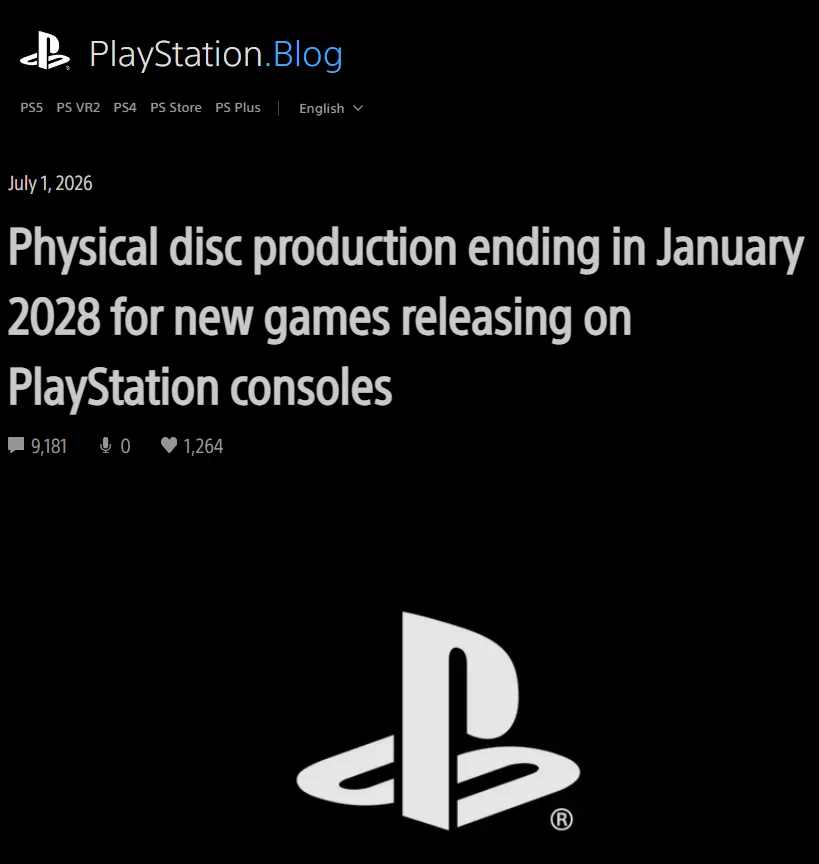
Sony cited the shift in consumer preference from physical to digital media as the reason for ending disc production. In the fiscal year ending March 2026, digital downloads accounted for 78 percent of total PlayStation game sales. From a corporate perspective, digital distribution reduces the costs of inventory, manufacturing, and logistics, while allowing sales to be managed within a single platform. Users also gain the convenience of buying games without waiting for delivery, along with automatic updates and frequent discounts.
However, the way a game is sold and what a user actually possesses after purchasing it are not the same question.
Online storefronts still display a button marked ‘Purchase’. Once payment is completed, the game is added to the user’s account library. Yet the notices beneath the button and the relevant terms of service describe the transaction not as a transfer of ownership, but as the granting of a licence to use the product.
California addressed this gap through legislation. AB 2426, which took effect in January 2025, requires sellers of digital goods that use terms such as ‘buy’ or ‘purchase’ to clearly inform consumers before payment that they are receiving a revocable licence rather than unrestricted ownership. Ahead of the law’s implementation, Valve added a notice to Steam’s checkout page in October 2024 stating that the transaction grants a licence to the product.
This does not mean the issue can be reduced to the claim that physical packages represented ownership while digital games amount to rental. Buyers of packaged games did not acquire the copyright to the game either. Discs and cartridges were also governed by licences restricting reproduction, distribution, and modification.
What has changed is not the existence of the licence, but how directly the user can control it.
The Licence Has Moved from the Object to the Account
In the era of packaged games, the licence was effectively tied to the physical medium. Possessing the disc meant being able to run the game, and lending or reselling it usually transferred that practical ability to another person. If the game did not require online authentication, there was no need to seek further approval from the seller or platform.
Digital game licences are primarily tied to accounts. The game files may be installed on a user’s PC or console, but the right to run those files is often recorded on servers managed by the platform holder or publisher. Even when the data remains on the user’s storage device, the game may not launch without account authentication or an online connection.
This difference is difficult to notice under normal circumstances. As long as the storefront and authentication servers remain active and the account functions normally, physical and digital games appear to work in much the same way. The distinction becomes visible when the game needs to be reinstalled, a service is shut down, or a distribution agreement expires.
For that reason, analysing digital game rights requires more than distinguishing between packaged and downloaded products. It is necessary to examine how dependent continued access is on external systems. This can be understood through the concept of ‘dependency’.
At the lower end of the dependency spectrum are downloadable games that can be run without online authentication. If users can retain the installation files themselves, they may still be able to reinstall and launch the game even after the store closes or the title is withdrawn from sale.
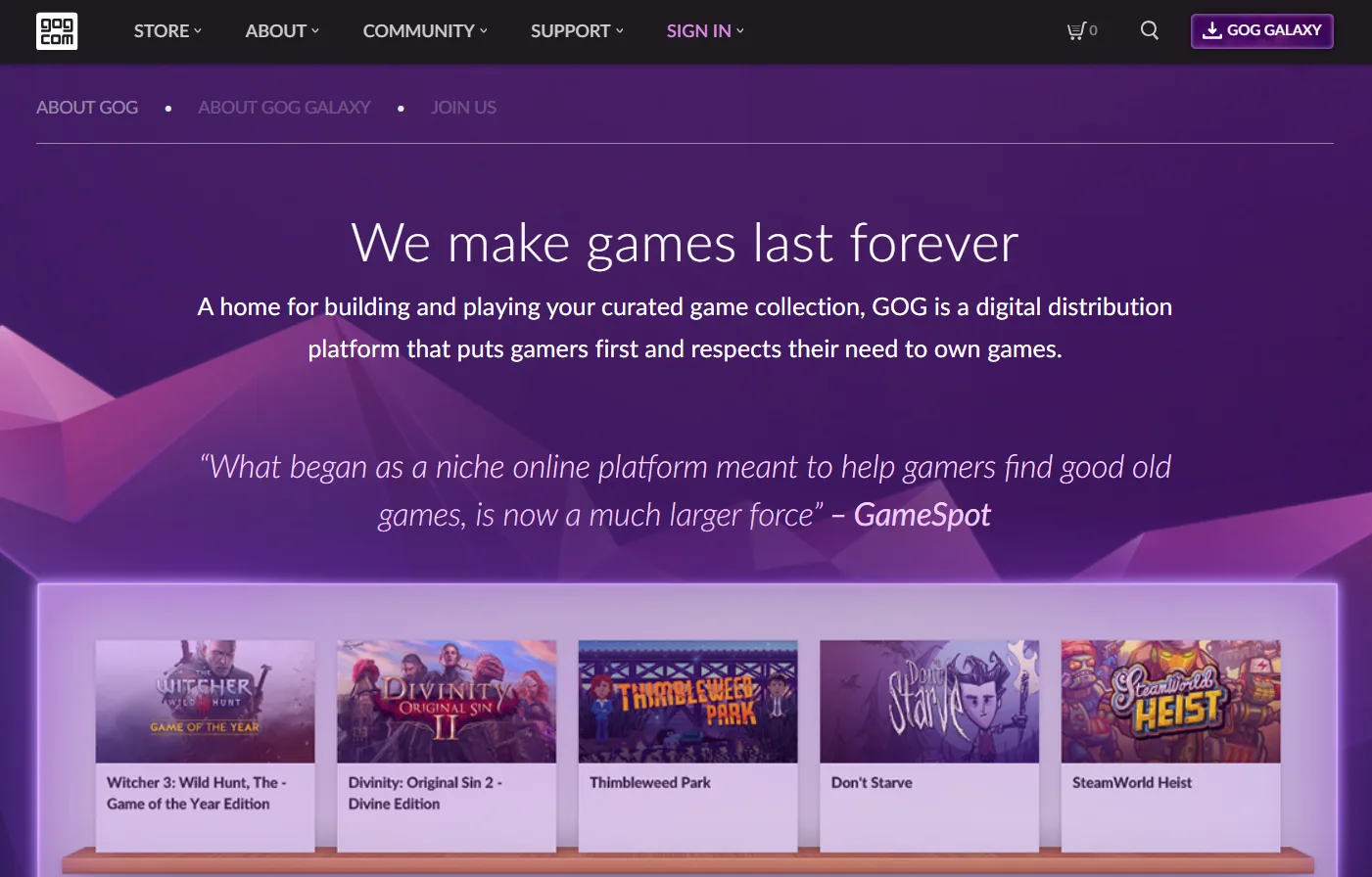
GOG is a representative example. GOG provides installation files without DRM, or Digital Rights Management, and operates a preservation programme that improves the compatibility and stability of older games on modern operating systems. Between 2024 and 2025, the programme added 267 games and applied 1,461 improvements.
The next category consists of games that require an initial authentication but can then be played offline. An account may be necessary during installation or the first launch, but an internet connection is not required afterwards. Even so, reinstalling the game on a new device or refreshing the authentication data may still depend on the continued operation of the platform.
Dependency increases when a game requires online authentication every time it is launched. Even if it includes single-player content, the game cannot begin without connecting to a server. In such cases, retaining the files on a user’s storage device does not guarantee long-term access.
Always-online games go further by relying on servers not only for authentication, but also for game rules, progression data, and core content. When the servers close, the result may be the loss of the entire game rather than only certain features.
Cloud gaming represents the most extreme form of this dependency. Both the game files and the execution environment are located in a company’s data centre, while the user’s device merely receives the video stream and sends back inputs. Cloud gaming is therefore best understood as a boundary case that makes visible how widely the degree of user control can vary even among games that have already been purchased digitally.
Physical Media Is Not Free from Server Dependency
Nintendo Switch 2 game-key cards demonstrate that this standard does not follow the physical form of the medium. The card is inserted into the console like an ordinary cartridge, but it does not contain the complete game data. The game must be downloaded over the internet before it can be played. The card can still be lent or resold like a traditional physical product, but the long-term ability to install the game depends on the continued availability of Nintendo’s download servers.
This reveals another dimension distinct from dependency: transferability, or whether a purchased game can be passed on to someone else.
Packaged games generally provided both qualities. As long as the disc remained functional and no essential server was required, the game could continue to be played over time and could also be lent or resold.
Digital games have separated these two rights. A DRM-free download is well suited to long-term preservation, but the account-based purchase licence cannot usually be officially transferred to another person. A product such as a game-key card may be transferable as a physical object, but still depends on the long-term availability of the server from which the game must be downloaded. One reason the end of disc production raised concerns across the industry was the likely contraction of the second-hand market, which is directly connected to this issue of transferability.
What is disappearing through digital distribution is not one unified concept called ownership. Rather, rights that were once provided together are being separated, with each product offering only some of them.
Dependency Becomes Visible When a Service Ends
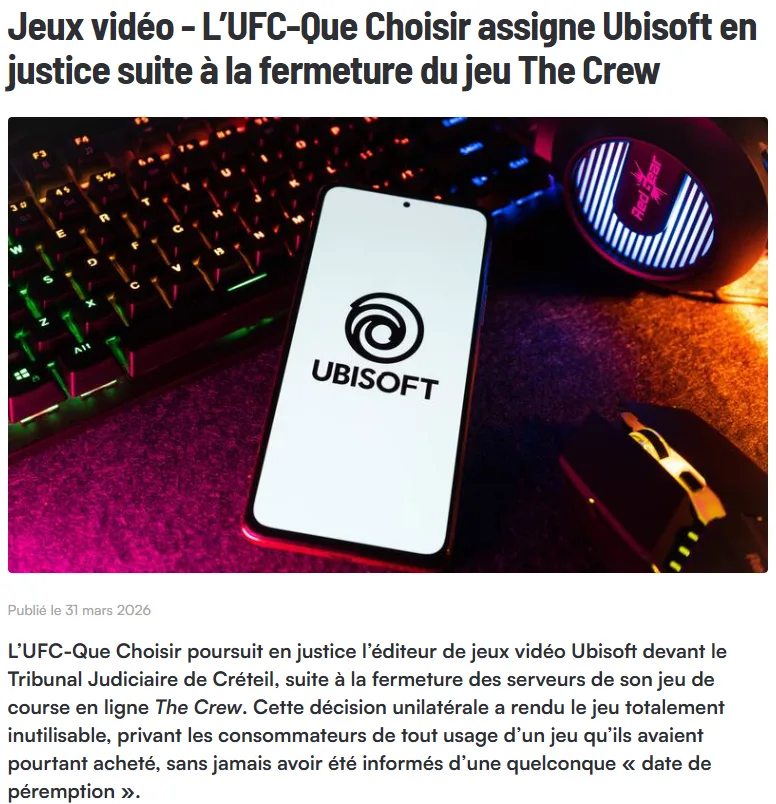
Ubisoft stopped selling ‘The Crew’ in December 2023 and shut down its servers in the spring of 2024. Although ‘The Crew’ contained content that could be played alone, it required a constant online connection. Once the servers were closed, the entire game became unplayable regardless of whether the user owned a digital or physical copy.
Two legal disputes followed. In a lawsuit filed in California, Ubisoft argued that the plaintiffs had already been able to use the game for ten years and had never possessed ownership rights in the first place. In March 2026, the French consumer group UFC-Que Choisir filed a case before the Créteil court. Its central argument was that the contractual clause defining the user’s rights as a licence that could be revoked at any time was itself unfair.
A later game in the same series took a different path. In October 2025, Ubisoft added a hybrid mode to ‘The Crew 2’ that allowed users to choose between online and offline play. While the servers remain active, players can continue using the existing online features. If the internet connection is unavailable or the online service eventually ends, the game’s core content can still be accessed offline.
The same company produced opposite outcomes within the same series. This suggests that the loss of an always-online game is not always technically unavoidable. At the same time, converting a game to offline play involves more than simply removing a server connection. External licences covering vehicles, music, brands, and other content, as well as the structure of data stored on servers, must also be resolved.
Store closures create a different problem. On July 1, 2026, the same day it announced the end of disc production, Sony also said that the PlayStation Store for PS3 and PS Vita would be closed. The shutdown is scheduled to begin in certain countries in August 2026 and to reach the remaining regions in July 2027. Sony’s notice stated that previously purchased content would remain available for download ‘for the foreseeable future’. It did not specify how long that period would last or under what conditions it might end. Sony had also announced plans to close the same stores in 2021 before reversing the decision. The fact that such a decision can be reversed benefits users, but it also shows that the outcome does not depend on them.
The closure of a store does not mean that every installed game immediately disappears. Games that can run offline will generally continue to work as long as they remain installed on the device. The problem emerges when a device is replaced or when a game must be deleted to free storage space and downloaded again later.
When a game is removed from sale because a publishing agreement or a licence for music, sports content, or vehicles expires, existing purchasers can usually download it again from their libraries. Yet users rarely know how long that ability will be guaranteed or whether authentication servers will remain available after the underlying agreements expire.
Account suspension is a disruption that affects an individual rather than an entire service. When access to an account is restricted because of a payment dispute, hacking incident, or violation of service terms, the consequences may affect the user’s entire library rather than a single game. Someone who owns one hundred discs does not lose the other ninety-nine if one disc is damaged. Someone who has accumulated one hundred games on a single account depends on one point of access for the entire purchase history.
Service shutdowns, store closures, contract expirations, and account problems are different events. What they share is that users do not participate in the decisions that determine the outcome.
There Are Reasons Why Digital Distribution Was Chosen
Digital distribution cannot be explained only as a decline in consumer rights.
Users can purchase and install games immediately without storing or changing discs. Updates and additional content are managed automatically. Regular sales and bundles have reduced the effective price paid by many consumers, while older games can remain available without being constrained by physical inventory.
For smaller studios and independent developers, digital distribution has effectively become a condition of market entry. It allows games to reach a global audience without requiring developers to decide on manufacturing volumes in advance or manage physical logistics and stock. Many games that exist commercially today would have struggled to reach the market without digital storefronts.
The decline of second-hand sales also involves competing interests. For users, resale offered a way to recover part of the purchase cost. For developers and publishers, however, money generated through second-hand transactions did not return to the original creators. A certain degree of platform dependency may also be necessary to support automatic updates, account integration, cloud saves, and anti-piracy measures.
The problem is not digital distribution itself. The problem is that games sold under the same label of ‘purchase’ can differ greatly in their dependency, while those differences are not sufficiently visible at the point of sale.
Conditions That Users Cannot Verify
Only some relevant information is available on store product pages. Users may be able to confirm whether an internet connection is required, whether a third-party account is necessary, and whether single-player or offline modes are supported. On PC stores, information about specific DRM systems or separate launchers may also be displayed.
However, many of the factors that ultimately determine the fate of a purchased game are not disclosed. Users generally cannot know how many years an authentication server will remain active, whether an offline patch will be provided when a service ends, when licences for music or vehicles will expire, or how long redownloads will remain supported after the game is withdrawn from sale.
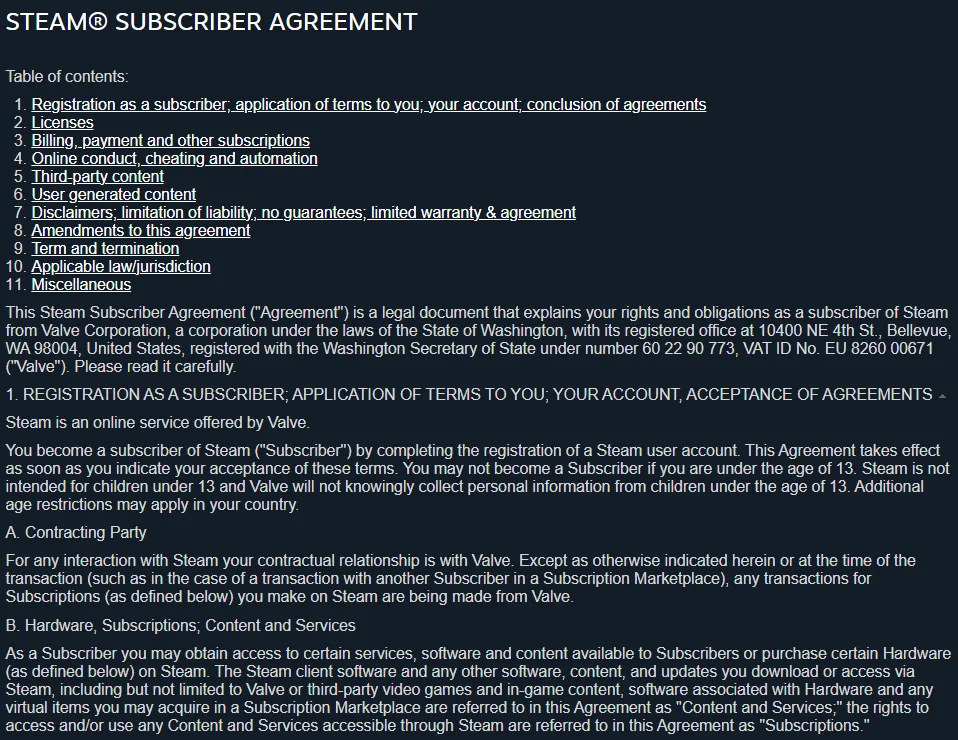
This is not simply a problem caused by consumers failing to read the terms. Even a complete reading of the terms does not reveal future server plans, the expiration dates of publishing agreements, or what measures will be taken after a shutdown. AB 2426 requires companies to state that users receive a licence rather than ownership, but it does not reach this level of detail.
In Europe, efforts have emerged to address the issue more directly. The European Citizens’ Initiative ‘Stop Destroying Videogames’ collected more than 1.29 million verified signatures and called for measures that would allow purchasers to continue using games after online services end. In June 2026, the European Commission responded that it was not prepared to propose legislation requiring games to remain operational indefinitely. Instead, it said that by the end of 2026 it would begin discussions involving the game industry and consumer organisations to develop a code of conduct for managing the end of a game’s service life.
It is unrealistic to expect every online game to operate forever. Servers are costly to maintain, and companies cannot reasonably be required to continue services indefinitely after user numbers have collapsed. In some cases, external copyright licences and technical contracts may also make an offline conversion impossible.
What is needed is not a universal obligation to operate every game permanently. It is greater transparency about the conditions that matter when consumers decide to make a purchase. This includes clear information about online authentication and server dependency, sufficient notice before a shutdown, and, where technically possible, options such as removing authentication requirements, providing an offline mode, or allowing data transfer.
After Discs, the Issue Is Less About Ownership Than Disclosure
When Sony announced the end of disc production, the debate focused on the decline of physical media. The change could affect package collecting, the second-hand market, retail distribution, and game preservation.
Yet describing the issue simply as the loss of ownership obscures the actual differences. Packaged games also involved licences, and some physical copies become unplayable when their servers are shut down. Conversely, some digitally purchased games can be preserved as installation files and run without authentication.
The more precise question is how much direct control users retain over a game they have purchased. Which accounts and servers does it depend on? Can it still be downloaded after it is removed from sale? Can it run offline if its authentication server disappears? Can it be transferred to another person? And can users know these conditions before payment?
The fact that digital distribution is becoming unavoidable does not mean that opaque purchase conditions are unavoidable as well. The more important change is not simply that discs are disappearing, but that the right to run a game is moving away from the user’s direct control and into invisible networks of servers and contracts. If storefronts continue to use the word ‘purchase’, users should at least be able to understand what they are receiving when they press that button—and what they are not.


