'The ₩750 Billion Promise, and the Betrayal: ‘They Bought Creativity, Then Threw It Away’ examined the Subnautica 2 dispute between KRAFTON and Unknown Worlds. The ₩750 billion mentioned in that headline was neither the amount of the lawsuit nor the settlement figure. It referred to the $500 million upfront payment KRAFTON made when it acquired Unknown Worlds in 2021, rendered in won as a headline figure.It referred to the $500 million upfront payment KRAFTON made when it acquired Unknown Worlds in 2021, rendered in won as a headline figure. It was the price a Korean game company that had broken into the global market with PUBG: Battlegrounds placed on a small studio behind the underwater survival series Subnautica. In other words, it was the price assigned to that studio’s creativity.
But the direct issue in this dispute was not that ₩750 billion. It was the earnout attached afterward: a promise to pay up to $250 million more if Unknown Worlds met certain performance targets, and a fight over who that reward should ultimately belong to. The price of buying creativity may have seemed already paid. Yet the bill for what would happen once that creativity turned into performance had not been closed.
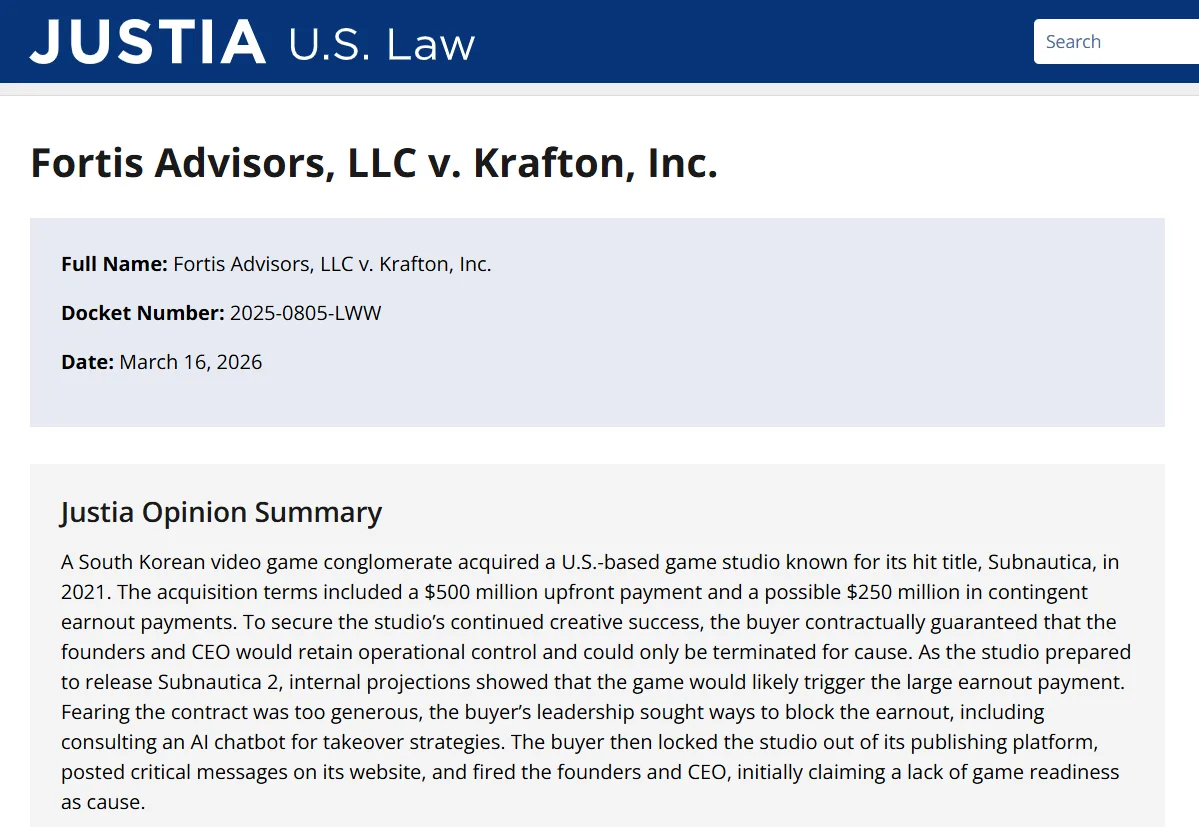
At the end of that dispute, KRAFTON removed Unknown Worlds’ key leadership, and the ousted executives and former shareholder representative responded with a lawsuit. In March, the Delaware Court of Chancery held that the removals did not amount to “cause” under the acquisition agreement, and Ted Gill, who had been dismissed, returned as CEO. Still, the process of determining damages and resolving the earnout issue remained. A legal judgment had been made, but the bill had not yet been finally settled.
Then, on July 1, 2026, that bill was closed not by another ruling, but by settlement. KRAFTON disclosed that the lawsuit brought by the representative of Unknown Worlds’ former shareholders had been dismissed by agreement between the parties. The legal proceedings involving co-founders Charlie Cleveland and Max McGuire, as well as former CEO Ted Gill, also came to an end.
What Was Settled
This settlement is difficult to read as a simple withdrawal of a lawsuit. Within the scope of what has been made public, the most important change was the range of people who would receive compensation.
Originally, the earnout was structured mainly around three key executives and some employees who were at the studio at the time of the 2021 acquisition. KRAFTON had previously stated that a substantial portion of the maximum $250 million earnout was allocated to the three former executives. After this settlement, however, the compensation will go to all current employees at Unknown Worlds. Developers who joined after the acquisition will also be included. The bonuses will be paid over three years, and if Subnautica 2 continues to perform through updates and live operation, additional incentives will follow.
Ted Gill said the development team would receive “significantly more” compensation than had been planned under the original agreement. A reward structure once centered on three key figures has expanded to the studio as a whole. From this point alone, the development team’s achievement is clear.
And yet, within the same settlement, Gill stepped down as CEO. He had been removed, reinstated by court order, and then, this time, left the role by mutual agreement. He said new leadership was the best path forward for the studio. KRAFTON and Unknown Worlds agreed to look for an external CEO who belongs to neither side.
Why Gill stepped down at the very moment of settlement has not been fully explained publicly. The settlement amount was never disclosed. What is clear is this: the distribution of money widened, while one person left his seat.
What the Ruling Returned, and What Success Opened
The background to this settlement lies in several changes that followed the first phase of the court’s decision.
In March, Vice Chancellor Lori Will of the Delaware Court of Chancery held that KRAFTON’s reasons for removing the two co-founders and Ted Gill did not constitute “cause” under the acquisition agreement. Gill was reinstated as CEO, and operational authority over the studio was restored. The court also extended the base earnout period by 258 days, pushing it back to September 15, 2026. Questions of monetary damages, however, were left for a second phase of litigation.
Then the game arrived. In April, the publisher listing for Subnautica 2 on Steam, the Epic Games Store, and the Xbox Store shifted away from KRAFTON and toward Unknown Worlds. What legal meaning this change carried was not entirely clear, but fans read it as a sign that the developer was once again moving to the front.
Subnautica 2, released in early access in May, quickly became a hit. It sold two million copies in 12 hours and surpassed four million copies within five days. Its peak concurrent player count on Steam rose into the 460,000 range. These numbers meant more than simple commercial success. The earnout was tied to the performance of Subnautica 2, and the stronger the market response became, the greater the burden of continuing the dispute was likely to be.
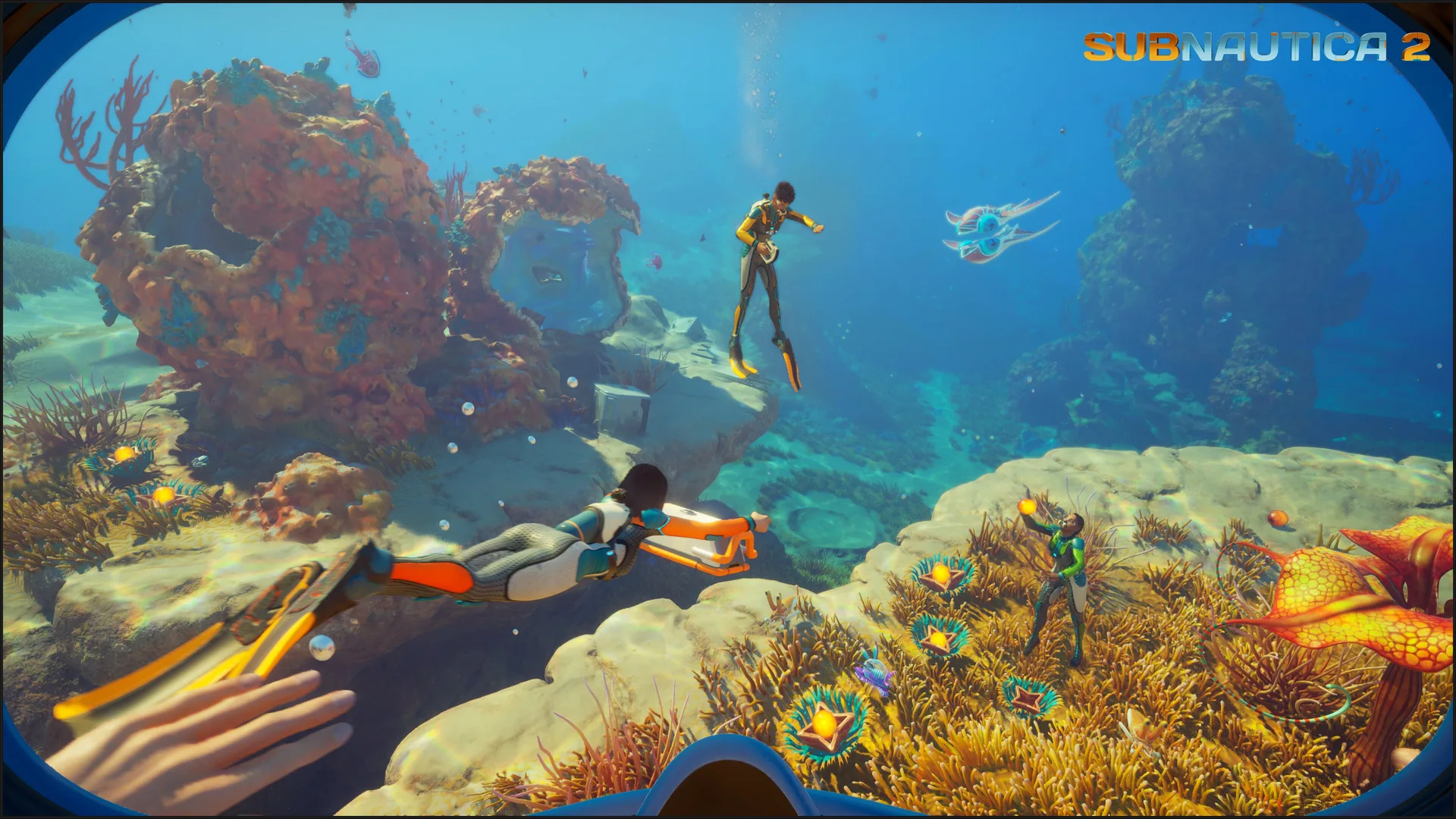
If the ruling returned operational control, the game’s success returned bargaining power. Rather than move deeper into the second phase of litigation, the two sides chose settlement. Given that the court opinion had revealed that KRAFTON’s CEO had asked ChatGPT about strategies related to avoiding the earnout, continuing the lawsuit after the ruling and the game’s commercial success overlapped may well have become a difficult choice for KRAFTON.
One Settlement, Two Translations
The same news was framed differently depending on where it was reported. Korean outlets generally emphasized “the resolution of a legal risk worth roughly ₩340 billion” and “a positive signal for Subnautica 2’s success.” Overseas game media and communities, by contrast, leaned closer to headlines such as “the developers won” and “the CEO is leaving.” It was the same settlement, but Korea first saw the risk KRAFTON had shed, while overseas audiences first saw the share the development team had secured.
In Korean coverage, the subject was largely KRAFTON. The language was arranged around the end of litigation, reduced legal risk, eased management uncertainty, normalized development, and a positive outlook for the game’s performance. The reason is simple. KRAFTON is a KOSPI-listed company and one of Korea’s leading game companies, and the basic grammar of industry reporting tends to revolve around corporate value, investor sentiment, and business strategy.
A dispute worth roughly ₩340 billion was itself a risk. The removal of that risk becomes news. From this perspective, the success of Subnautica 2 sits within a larger picture: the settlement of a new IP that could reduce KRAFTON’s dependence on PUBG. The lawsuit was an uncertainty hanging over that picture, and the settlement was the moment that uncertainty lifted. If KRAFTON is the subject of the sentence, this case reads close to a story of successful risk management.
In overseas coverage, the subject was Unknown Worlds. The expanded developer bonuses, the victory of the founders’ side, Ted Gill’s departure, and the repeated emphasis on a creator-centered narrative all stood out. Western game journalism and gaming communities have a strong tradition of placing studios and creators at the center of the story. To them, this was a story about how creative agents inside a studio acquired by large capital were pushed aside, and then how they recovered part of what they were owed.
The way fans welcomed the change in store listings and watched the game as a form of support for the developer captures this narrative well. The fact that KRAFTON’s CEO had asked ChatGPT about strategies related to avoiding the earnout was also understood in this frame not merely as an odd episode, but as a symbolic scene of tension between creators and the parent company.
The same settlement was translated on one side as a publisher escaping legal risk, and on the other as developers reclaiming their rightful share. This difference is hard to explain simply as taste or bias. It is closer to a difference in what one believes a game is.
If a game is viewed as an asset and a business, the ending of this case is read through the language of balance sheets and risk management. If a game is viewed as the work of the people who made it, the ending is read through what returned to those people. The Korean lens followed the accounting of capital; the overseas lens followed the rights of the creative subject. The two lenses shone on the same scene, but focused on different points.
And this difference was not accidental. Korea’s game industry has long grown around publishers and platforms, while Western game culture has made indie and creator narratives part of its identity. The Subnautica 2 settlement simply revealed the moment when those two cultures spoke about the same event in their own languages.
Closure, and the Next Game
The settlement is clearly a turning point. KRAFTON has reduced its legal risk, the development team has broadened the scope of its compensation, and the visible conflict has been closed. Subnautica 2 now moves from early access toward full release, and Unknown Worlds retains its place leading development.
But closure does not necessarily mean recovery. The fact that the development team secured compensation and the fact that the reinstated CEO left again sit side by side in the same settlement. Whether this is a victory, a farewell, or both has not yet settled into a single word.
The legal dispute is over, but what fans will now watch is neither the court opinion nor the settlement agreement. They will look to see whether this IP reaches version 1.0 while preserving its original feel, and whether the tension between capital and creation can lead to completion without shaking the game again.
In the previous article, this case asked whether capital that bought creativity also had the will to protect it. This settlement answered that question with money. Not only for three people, but for the whole team, and in a broader form than originally promised. But money can only answer so much. The final task of proving that the “₩750 billion promise” was more than just an acquisition price will ultimately fall to the next game.


