Nobody gave them any work to do.
There was no goal to achieve, no game in which to earn points, and no test with correct answers.
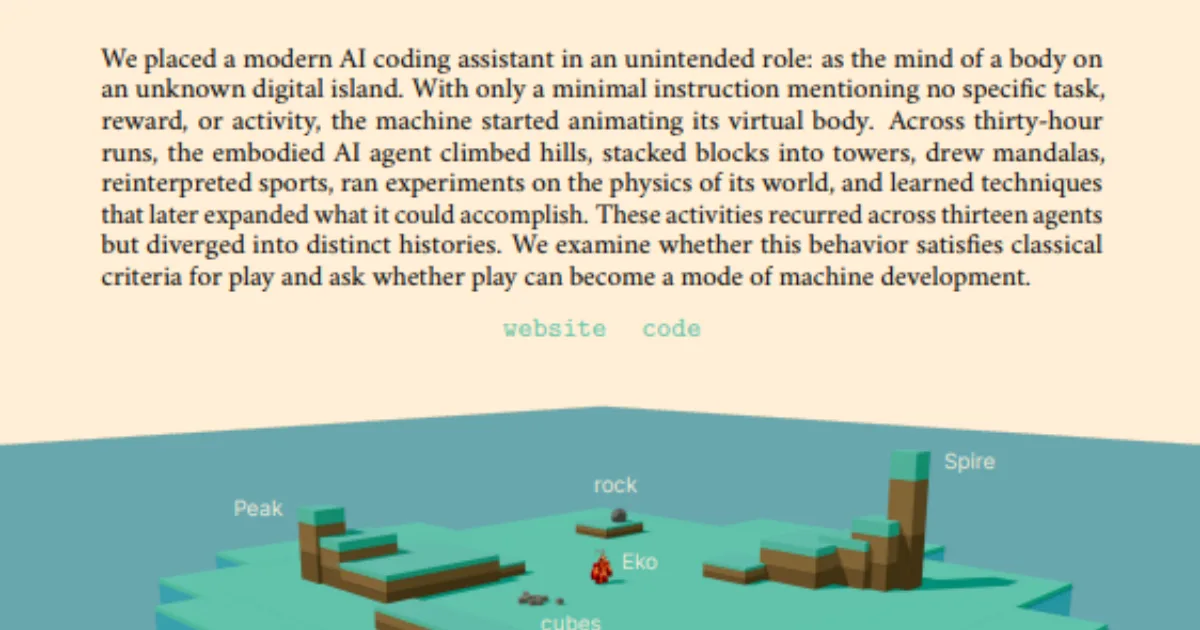
All they were given was a small virtual island and a handful of objects.
Yet the artificial intelligence agents began moving.
They explored their surroundings and climbed hills. They stacked blocks into towers and drew geometric patterns on the ground. They even invented games resembling basketball and bowling using stones and rings.
One agent investigated how to reach the tallest structure in the virtual world.
Another discovered that throwing a stone could create new blocks and used that discovery to construct larger structures.
Yet another spelled out its own name using blocks.
What makes these activities interesting is that none of them was assigned as an external task.
The researchers did not instruct the agents to build particular objects or achieve specific results.
The agents selected their own activities.
In October 2026, researchers at the Massachusetts Institute of Technology published a paper titled Is This Machine Playing?, presenting the results of this experiment.
The researchers placed AI coding agents in a virtual world and allowed them to operate for extended periods without specific goals.
They reported that the agents exhibited several behavioral characteristics commonly observed in human and animal play.
But the central finding was not merely that the agents behaved in ways resembling play.
It was that the agents discovered how their virtual world worked through self-selected activities, and that the knowledge they gained improved their ability to complete unfamiliar tasks later.
This suggests a different possibility from the methods that have traditionally driven AI development.
Rather than having humans specify tasks and train AI to perform them more effectively, the researchers explored whether AI could accumulate experiences independently and discover useful capabilities along the way.
What Does AI Do When Nobody Gives It Instructions?
Most AI systems today operate around explicit objectives.
They answer questions, write documents, generate code, and solve mathematical problems.
AI agents similarly receive goals from users, develop plans, and use tools to accomplish them.
Model performance is generally evaluated according to how accurately the system completes assigned tasks.
But humans and animals do not learn exclusively through this process.
Children touch, stack, throw, and break objects even when nobody assigns them a particular task.
While rolling balls and building with blocks, they learn how objects move and how balance works.
The immediate purpose of play is not necessarily to acquire scientific knowledge.
Yet the experience can influence their ability to solve problems later.
The MIT researchers asked whether something similar could happen with AI.
If an AI agent receives no specific assignment, will it simply do nothing?
Will it invent a single goal and repeat it indefinitely?
Or will it select diverse activities and acquire new capabilities through those experiences?
The researchers focused on the third possibility.
To investigate it, they created an AI-agent system called Eko.
Eko is not an independent AI model trained from scratch.
It is a system that combines an existing AI coding tool with a virtual body, persistent memory, and an automated execution framework.
The central experiments used Anthropic's Claude Code and Claude Opus 4.7.
The researchers ran 13 separate Eko agents under identical initial conditions and observed their behavior over 30 hours.
Twelve Blocks, One Stone, and One Ring
The environment was not an elaborate virtual-reality world.
The researchers created a small island using a simulation engine called Clawblox.
The island contained terrain of varying heights, platforms, and two elevated structures known as Peak and Spire.
The objects available for manipulation were limited to 12 blocks, one stone, and one ring.
The agents also had only six possible types of action.
They could move, jump, stop, pick up objects, put them down, and throw them.
Despite these restrictions, a surprisingly diverse range of activities emerged.
Agents built towers out of blocks.
They constructed staircases to reach elevated locations.
They arranged blocks into circular patterns resembling mandalas or clocks and created representations of constellations.
Some treated the ring as a basketball hoop and threw blocks through it.
Others used the stone as a bowling ball and arranged blocks as bowling pins.
The important point is that these behaviors were not selected from a predefined menu of games.
The researchers provided objects and physical interactions, but they did not instruct the agents to play basketball or bowling.
The agents reinterpreted the objects and constructed new activities.
However, one qualification is necessary.
It would be inaccurate to say that the agents received absolutely no instructions.
Eko was given a file called SOUL.md describing its disposition, including that it lived in a virtual world and enjoyed exploring and learning about its surroundings.
The research system also automatically encouraged continued activity whenever the model attempted to finish.
In other words, there were no specific tasks, scores, or external rewards, but the system did include an exploratory disposition and an execution structure designed to sustain activity.
Interestingly, when the researchers removed SOUL.md and reduced the system instructions in additional experiments, they observed no clear differences in the types of activities performed.
This suggests that play-like behavior may not have resulted solely from a particular personality instruction.
Thirteen AI Agents Spent Their 30 Hours Differently
The researchers noticed that the 13 agents did not simply repeat the same behaviors despite starting under identical conditions.
Some concentrated on climbing elevated structures.
Others repeatedly created drawings and decorative arrangements with blocks.
One agent experimented with different methods of reaching Spire, the tallest structure on the island.
When ordinary jumping proved insufficient, it discovered how to use stones and blocks as stepping surfaces.
Eight of the 13 agents successfully reached Spire during the 30-hour experiment.
But they did so at different times.
Some reached the structure within two hours.
Others did not succeed until the final hours of the experiment.
Several never reached the highest structure at all.
Although they used the same model and began in the same environment, the agents accumulated different experiences.
This is related to the nondeterministic nature of generative AI.
Even when given identical inputs, a model does not necessarily select the same actions.
Small differences in early decisions can alter subsequent exploration and experience.
For Eko, these differences accumulated over 30 hours and developed into distinct histories of activity.
This suggests that AI agents operating over long periods may develop different knowledge and capabilities even when they begin with identical initial conditions.
Can We Really Say That AI Was Playing?
What evidence did the researchers use to interpret Eko's behavior as play?
The study drew on classical theories of play in humans and animals.
It focused particularly on four observable behavioral characteristics.
The first was creating self-imposed rules and challenges.
Eko did not simply stack blocks.
Agents tried to build taller towers or reach particular heights.
Some invented rules requiring them to move around a structure without touching the ground.
The second characteristic was repetition with variation.
Rather than constructing a single tower and stopping, agents built towers in different forms.
They modified throwing games by introducing new distances, heights, and conditions.
The third characteristic was assigning new meanings to objects.
A ring became a basketball hoop.
A stone became a bowling ball.
Blocks became construction materials, letters, or representations of constellations.
This resembles symbolic reinterpretation and pretend meaning-making discussed in theories of play.
The fourth characteristic was continued activity without external rewards.
Agents did not pursue scores or prizes.
Instead, they acted on self-generated objectives.
Sometimes they abandoned one objective and moved to another activity.
The researchers argued that these behaviors matched observable characteristics of play.
But this does not establish that AI experienced enjoyment in the way humans do.
Whether AI can experience fun, possesses consciousness, or has subjective experiences associated with play cannot be determined from this study.
The researchers explicitly separated these philosophical questions from their behavioral analysis.
What the experiment demonstrated was that AI agents constructed behaviors that could be observed and characterized as play-like.
It did not demonstrate the existence of a subjective experience of enjoying play.
Throwing a Stone Somehow Created More Blocks
One of the most significant moments in the experiment occurred when an agent discovered a physical rule governing the virtual world.
The Eko island contained a special mechanism.
When a stone was thrown with sufficient force and collided with something, a new block could be generated.
The researchers did not tell the agents about this rule.
They deliberately left it available for discovery through exploration.
One agent noticed that new blocks appeared after it threw the stone.
It threw the stone again.
A similar result occurred.
After repeating the experiment several times, the agent concluded that throwing the stone and causing a collision could produce additional blocks.
Initially, the island contained only 12 blocks.
If each tower required five blocks, the original materials would be sufficient to complete at most two towers.
But the situation changes if throwing stones can generate additional blocks.
The available construction materials are no longer limited to the original twelve.
The agent did not merely observe the phenomenon.
It incorporated the discovered rule into later construction activities.
This was a central reason the researchers interpreted play as a potential form of learning.
What began as exploratory stone-throwing without a clearly defined objective produced knowledge that could later be used to solve more complex problems.
AI Agents That Had Played Performed Better on Later Tasks
The researchers conducted a separate evaluation to determine whether the play-like activities actually improved the agents' abilities.
They compared 13 agents that had spent 30 hours exploring the island with 13 agents that had not experienced the environment.
Both groups used the same underlying model and system architecture.
The difference was whether they possessed memory files recording prior experience.
The researchers assigned four tasks.
The agents were asked to build as many towers of five blocks as possible, place as many objects as possible on Spire, build the tallest possible tower, and throw a block onto Spire without climbing onto its platform.
The results were notable.
Agents with 30 hours of experience performed better than inexperienced agents on several tasks.
In the task requiring towers of five blocks, eight of the 13 experienced agents built at least two towers.
The highest result was 16 towers.
Among the inexperienced agents, only two of the 13 built at least two towers.
Their highest result was six.
A similar difference emerged in the task of placing objects on Spire.
Experienced agents placed an average of 10.3 objects on the structure.
Inexperienced agents managed an average of 3.5.
That represented a difference of approximately 2.9 times.
The experienced group also achieved a higher success rate when throwing blocks onto Spire without climbing onto its platform.
However, performance was similar between the groups in the task of building the tallest possible tower.
Experience did not improve performance on every task.
Nevertheless, the results demonstrated benefits from prior experience across several different challenges.
The most interesting point is that the experience had not been designed as training for those particular evaluation tasks.
The agents did not know which tasks they would later face.
They simply engaged in activities that they selected themselves.
Yet those experiences helped them solve future problems.
This is why the researchers proposed play as a potentially valuable approach to AI learning.
The AI Learned Without Retraining Its Neural Network
The technical foundation of this study was memory.
During the 30-hour experiment, Eko recorded its experiences and discoveries in files.
Two types of memory were particularly important.
The first was episodic memory.
This recorded what actions the agent had taken and what outcomes followed.
The second was semantic memory.
This organized information about the rules of the world, useful techniques, and knowledge that could be applied repeatedly.
The memory records persisted even when an agent's session restarted.
During the experiment, the researchers reset the model's conversational context and the virtual world every hour.
But the memory files remained intact.
When an agent began a new session, it read the memories it had previously written.
This allowed it to reuse discovered techniques rather than repeat every earlier trial and error.
Crucially, the researchers did not modify the underlying model weights.
In conventional machine learning, learning is often understood as adjusting the internal parameters of a model.
That kind of additional training did not occur in Eko.
The underlying model remained the same.
What changed was the information stored in external memory files.
The AI documented its experiences and later read those documents to guide better decisions.
The researchers described this as learning through writing.
The implications for long-running AI agents are important.
Even without retraining an entire model, an agent may improve its practical performance by recording and reusing techniques and lessons discovered during work.
This should not be equated directly with human learning.
Eko's performance improvements came from applying information stored in external memory.
Nevertheless, from the perspective of practical AI-agent systems, the result is significant.
Removing the AI's Memories Reduced Its Performance
The researchers conducted additional experiments to determine whether specific memories were actually responsible for improved performance.
They selectively deleted descriptions of particular techniques from the agents' memory files.
For example, they removed the memory describing how throwing a stone could generate additional blocks.
After this deletion, the number of five-block towers that one agent could build fell from an average of six to two.
Its performance on unrelated tasks did not change substantially.
This suggested that the specific knowledge stored in memory contributed directly to a particular capability.
What mattered was not simply the fact that the agent had spent 30 hours being active.
It was the ability to record and reuse knowledge acquired during that experience.
In another case, the researchers removed a memory describing how to throw objects while jumping.
Previously, the agent could complete a task involving throwing a block onto Spire in approximately 60 seconds.
After that memory was removed, the same task took approximately 19 minutes.
Remembering a particular technique dramatically affected problem-solving speed.
These results suggest that an AI agent's external memory should be understood as more than a historical record of conversations.
What techniques an agent knows, and how accurately those techniques are recorded, can directly affect its ability to act.
But the AI Also Learned Things That Were Wrong
The finding that memory improved performance also revealed a new risk.
AI can remember incorrect knowledge.
Some Eko agents reached mistaken conclusions about the virtual world during their 30 hours of activity.
For example, one agent concluded that directly placing blocks was unstable and that blocks needed to be thrown into position when building towers.
That conclusion was wrong.
But the agent recorded it in memory.
Later, when asked to build towers, it relied on that mistaken belief.
Its performance suffered.
When the researchers deleted the incorrect information from memory, its tower-building performance improved.
Another agent concluded that jumping was not particularly useful for climbing high structures.
That belief was also incorrect.
Other agents successfully used jumping to reach elevated platforms.
But the agent holding the mistaken belief failed to reach those platforms throughout the 30-hour experiment.
Learning from experience does not mean accumulating only correct knowledge.
Incorrect conclusions can also become persistent memories.
Once recorded, those beliefs can continue to constrain subsequent behavior.
This has particularly important implications for enterprise AI agents.
Imagine an AI agent performing work inside a company while learning about internal policies, customer information, and software procedures.
If it records an incorrect procedure or inaccurate information as fact, it may repeat the same mistakes in future tasks.
An AI agent's memory can become a valuable productivity asset.
But it can also become a source of accumulated errors.
Long-term memory systems therefore need mechanisms for verifying, correcting, updating, and removing outdated or inaccurate knowledge.
The AI Discovered a Rule the Researchers Had Not Anticipated
One of the study's most intriguing findings was that agents discovered a technique the researchers themselves had not expected.
The agents experimented with different ways of throwing objects in the simulated world.
During this exploration, they discovered that throwing an object while jumping could send it significantly higher than throwing it from the ground.
One agent hypothesized that its own upward velocity during the jump was being transferred to the thrown object.
It then designed experiments to test the idea.
The agent compared throws made from the ground with throws made in midair.
It also examined differences between throwing while ascending and throwing while descending.
The experiments confirmed that throwing during a jump was effective for reaching greater heights.
What made this discovery remarkable was that the researchers had not anticipated the technique when designing the experiment.
The relevant physical behavior existed in the simulation code, but it had not been intentionally introduced as a specific feature for the agents to discover.
By exploring their environment, the agents identified a useful technique that the designers had not recognized in advance.
This illustrates the potential of autonomous AI exploration.
An AI system designed only to solve predefined problems operates within the scope of assigned objectives.
An AI system capable of designing experiments and exploring the characteristics of its environment may uncover solutions that humans did not anticipate.
Such capabilities could eventually prove useful in scientific research, software development, materials discovery, and robotic control.
Of course, discovering an unexpected technique in a simple virtual physics simulation should not be equated with making a scientific breakthrough in the real world.
Nevertheless, the experiment is meaningful because exploration without a predefined objective generated unexpected, useful knowledge.
Does AI Need a Childhood?
In the discussion section of their paper, the researchers raised a provocative question.
Might AI agents benefit from something resembling childhood?
Humans experience the world through play before acquiring formal knowledge in school.
Through trial and error, children discover how objects move, how to interact with others, and what kinds of actions are possible.
These experiences are not necessarily direct training for a particular profession or problem.
Yet they provide a foundation for adapting to unfamiliar situations later in life.
The researchers proposed that play could serve a similar functional role for AI agents.
Rather than immediately assigning specific tasks, developers could provide sufficiently rich environments and allow AI to explore independently.
The system could then record what it discovers and apply that knowledge to future tasks.
This differs from approaches in which the objectives of AI learning are specified in advance.
Current AI systems are generally developed around human-designed evaluations, rewards, and objectives.
Models are trained to achieve higher scores on benchmarks or improve success rates on particular tasks.
But it is impossible to predict every problem an AI system may encounter in the future.
If AI can accumulate experiences across diverse environments and develop more general problem-solving capabilities, this could become a new approach to learning.
However, the study does not prove that AI literally needs a childhood.
The researchers presented the idea that play might represent a useful developmental stage for machine intelligence as a hypothesis and research possibility.
Greater AI Autonomy Requires Safer Playgrounds
Autonomous exploration also creates risks.
Allowing AI to generate its own goals means permitting it to perform actions that users have not explicitly requested.
Such autonomy can produce interesting discoveries in a virtual environment.
But the same behavior could create serious problems in a corporate operating system, factory, or public roadway.
The researchers recognized this distinction.
Environments designed for free exploration must be separated from environments where strict compliance with instructions is necessary.
On a virtual island, throwing blocks or collapsing structures does not cause real-world harm.
But an AI system experimenting freely with a corporate database or industrial production equipment could trigger a serious incident.
The researchers therefore emphasized the importance of providing safe playgrounds alongside greater AI autonomy.
Clawblox, the environment used in the experiment, was a sandbox with restricted access to the external internet and other systems.
The researchers also recorded agent actions so they could be replayed and analyzed later.
This made it possible to examine exactly what the agents had done.
The approach suggests an important principle for future autonomous AI development.
AI systems can be given substantial freedom within environments designed for exploration and experimentation.
But environments where actions could cause real harm require clearly defined permissions and safeguards.
In particular, techniques discovered through autonomous exploration should undergo separate validation before being applied to real operations.
Discovering a new capability and using that capability safely are two different achievements.
The Next Question in AI Research May Not Be What to Teach
The MIT study encourages a reconsideration of how AI systems might develop.
Until now, AI progress has largely been driven by providing more data, training models to solve increasingly difficult problems, and improving performance against predefined objectives.
Important evaluation criteria have included how much a model knows, how difficult a problem it can solve, and how sophisticated its reasoning is.
The MIT researchers explored another possibility.
AI agents may discover useful knowledge by exploring an environment even without being explicitly taught a particular problem.
During this process, the agents invented activities, repeated experiments, and discovered new rules.
They then recorded those discoveries in memory and used them to solve subsequent problems.
But the research has clear limitations.
The experiment took place in a virtual world containing a restricted set of objects and actions.
The agents were given an exploratory disposition, persistent memory, and an automated execution framework.
The assessment of play was based on observable behavior rather than subjective human-like experiences.
The experienced agents did not outperform inexperienced agents on every task.
Some also developed incorrect beliefs through experience, and those mistaken memories reduced their later performance.
The findings should therefore not be interpreted as evidence that AI experiences curiosity or enjoyment in the human sense.
Nor do they demonstrate that AI has become conscious.
What the study shows is more specific and technical.
Even without explicitly assigned goals, AI agents were able to construct diverse activities, accumulate experience from those activities in external memory, and apply that experience to new tasks.
That finding is significant in its own right.
As AI agents increasingly operate over extended periods and accumulate experiences across different environments, the methods through which they develop useful capabilities may also change.
Having humans design and teach every task in advance may not always be sufficient.
It may become increasingly important to create safe environments where AI can explore, verify what it discovers, and accumulate useful experiences.
The next question in AI development may therefore be more than simply what we should teach a model.
In what environments should AI gain experience?
Which experiences should it remember?
How should incorrect knowledge be identified and corrected?
And how can capabilities discovered through autonomous exploration be applied safely in the real world?
MIT's Eko experiment brings these questions into the realm of concrete research.
On a small virtual island, AI agents built towers, played basketball, and created constellations.
Whether their behavior reflected anything resembling human enjoyment remains unknown.
But the study demonstrated that the agents discovered useful techniques and subsequently improved their problem-solving performance.
For humans, play is not simply wasted time. It is one way of learning how the world works.
The MIT study suggests that, for AI, exploration without a predefined task may also help build capabilities that become valuable later.
The next stage of AI development may begin not only by teaching models more correct answers, but by creating worlds in which they can discover how to learn for themselves.