Patreon is cutting 20% of its workforce.
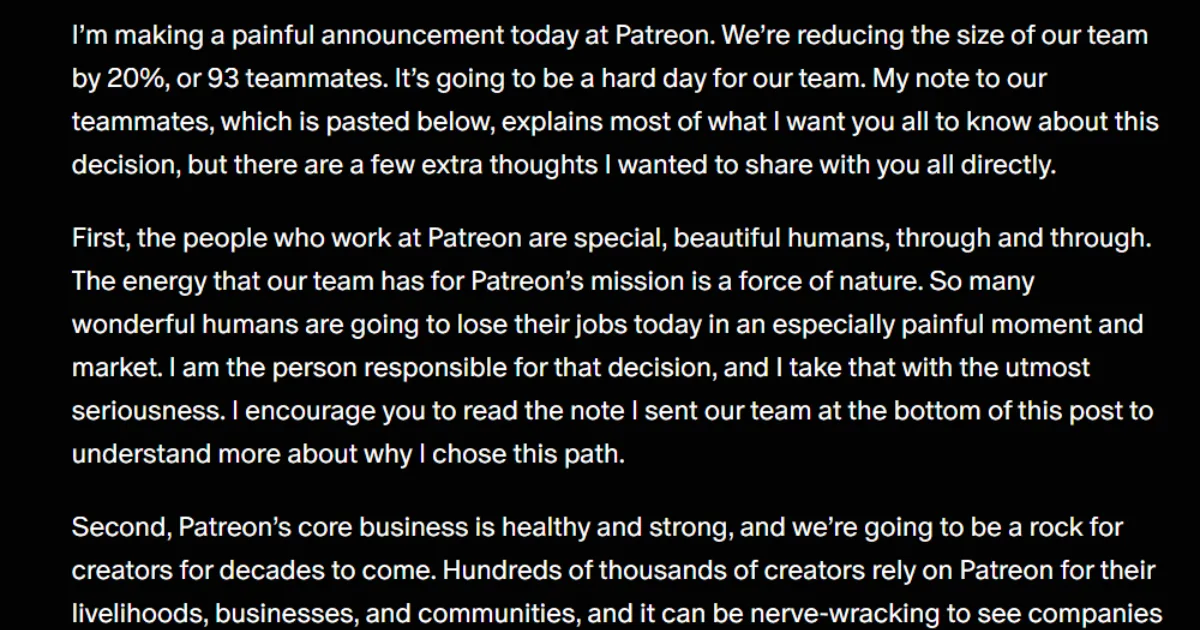
The layoff affects 93 employees. Jack Conte, Patreon’s chief executive, described the decision as a “painful announcement” in a public note to creators. He said the employees leaving the company are special people who have been deeply committed to Patreon’s mission, and he took responsibility for the decision.
The announcement is especially sensitive because Patreon is not just another technology company.
Patreon is one of the representative platforms of the creator economy. It helps YouTubers, podcasters, writers, musicians, illustrators, educators, independent journalists and other creators earn recurring income from fans. Fans support creators through monthly memberships, while creators provide exclusive content, early access, private communities and direct communication spaces.
In simple terms, Patreon is not a social network dependent on advertising algorithms.
It is a membership-based creator monetization platform that helps creators build direct relationships with fans and generate recurring revenue.
That is why this layoff means more than a normal headcount reduction.
Many creators have built their livelihoods and communities on top of Patreon. If the platform appears unstable, employees are not the only ones who become anxious. The creators earning money through the platform also become anxious. That is why Conte did not explain the decision only to employees. He addressed creators directly.
He emphasized that Patreon’s core business remains healthy and strong. According to the company, more than 300,000 creators in nearly every country earn money on Patreon, and creators earn billions of dollars each year through the platform. Patreon also says creators, members, revenue and payment-processing volume continue to show steady monthly growth.
And yet the company is cutting jobs.
This is not a simple restructuring caused by collapsing performance. If Patreon’s explanation is taken at face value, its core business has not broken down. It is still growing. But the need to adjust its cost structure shows that even a leading platform in the creator economy must reduce organizational weight in order to survive a long transition.
Patreon’s layoff is not only a story about one company.
It is a collision between the ideal and reality of a maturing creator economy.
Why Patreon Matters to Creators
Patreon exists because of creator independence.
Most creators meet fans on large social platforms such as YouTube, Instagram, TikTok and X. But those platforms are governed by algorithms. Even creators with many followers cannot always reach their audiences. A policy change or recommendation-system shift can quickly disrupt views, revenue and audience engagement.
Patreon grew as an alternative to that problem.
Creators can invite fans to Patreon and build direct membership relationships. Fans pay creators directly instead of simply watching ads. Creators are not limited to revenue-sharing models controlled by large social platforms. They can earn recurring income from the people who value their work.
This structure is important in the creator economy.
Ad-based platforms favor content that attracts attention. Content that keeps users watching longer, clicking more often and seeing more ads tends to win. Patreon’s membership model is different. It is based on depth of relationship. A creator does not always need millions of views. A smaller group of loyal fans can still support a sustainable creative business.
That is why Patreon is not just a payment service.
It is infrastructure that helps creators escape some of the volatility of algorithmic platforms and build their own fan communities and income foundations.
This is also why the layoff is sensitive.
If Patreon looks unstable, creators may worry that their own revenue base is unstable. Conte’s message that the core business remains strong, the roadmap is unchanged and Patreon will remain a long-term foundation for creators was designed to address that fear.
Why Cut Jobs While Growing?
Patreon’s explanation looks contradictory on the surface.
The core business is strong.
Creator earnings are growing.
Members, revenue and payment volume continue to rise.
The company’s network transition is beginning to work.
And yet Patreon is cutting 20% of its workforce.
To understand the contradiction, it is necessary to look at what Patreon is trying to become.
Patreon no longer sees itself only as a support or membership platform. The company is trying to transform into a “media and community network.” In its earlier form, Patreon helped creators monetize existing fans through paid memberships. Now it wants to become a network where creators can discover new fans, build communities and grow their businesses inside Patreon itself.
Conte said Patreon’s network now sends 1.5 million new members to creators every month. He also said creators have added about 200 million free memberships over the past three years, and that feed-attributed memberships have increased more than fivefold since the network launch.
In other words, Patreon is trying to move from payment infrastructure to a platform for discovery and relationship-building.
The problem is that this transformation takes time.
The core business may be healthy, but the new network strategy is still a long-term investment. At the same time, the company says its market has changed significantly over the past six months. That means Patreon has concluded that its previous cost structure and organizational size may not be suitable for a prolonged transition.
Patreon is not saying it is shrinking because it is collapsing.
It is saying it is shrinking so it can last longer.
Patreon’s Dilemma: Becoming the Alternative to Social Platforms
Patreon’s criticism of the attention economy is clear.
The company argues that today’s attention economy optimizes for addiction rather than long-term relationships. Creators are finding it harder to reach followers and build strong communities. Legacy social platforms keep creators locked into their systems instead of helping them become independent.
Many creators understand this problem.
A YouTube algorithm change can reduce views.
Instagram reach can fall without warning.
A creator may go viral on TikTok but still struggle to own the relationship with fans.
Policy changes on X can destabilize a creator’s communication channel.
Large platforms can help creators grow, but they can also make creators dependent.
Patreon wants to be the alternative.
But that creates a dilemma.
To give creators independence, Patreon must help them build direct fan relationships. At the same time, creators still need discovery and growth. To provide discovery, Patreon needs network effects, feeds, recommendations and platform-level distribution.
In that process, Patreon itself becomes another platform power.
That is the paradox.
Patreon wants to help creators escape dependence on social platforms. But to do that, it must become a stronger platform itself.
The layoff and reorganization are part of Patreon’s attempt to execute this difficult strategy with a smaller team.
The Shift to a Media and Community Network
The most important phrase in Patreon’s strategy is “media and community network.”
Patreon was originally strong in payments and memberships. Fans paid creators regularly, and creators provided exclusive content or community access. That model remains powerful, but it has a limitation.
Creators usually need an audience before Patreon becomes useful.
In its earlier model, Patreon was strongest at monetizing existing fans. It was less powerful as a discovery engine. Creators often had to build their audience on YouTube, Instagram, podcasts, newsletters or X, then bring those fans to Patreon.
That is why Patreon now talks about becoming a network.
Creators need to find new fans inside Patreon. They need to start relationships through free memberships and convert those relationships into paid memberships over time. Feeds, recommendations, community tools and media experiences become more important.
This may be essential for Patreon.
If it remains only a payment platform, competition becomes intense. Substack, YouTube memberships, Instagram subscriptions, Discord communities, newsletter platforms and independent payment tools all compete for creator monetization.
Patreon must offer something beyond payment.
That is why it wants to become a network.
But networks are harder to operate. They require recommendation systems, free-to-paid conversion design, community moderation, media consumption experiences, creator growth tools, spam control and product velocity.
The layoff does not mean Patreon is abandoning that transformation.
It means the company is trying to focus and reorganize around it.
Flattening the Organization Is a Bet on Speed
Patreon is not only cutting jobs.
It is also changing its organizational structure and how it works.
The company says it will flatten the organization, refocus teams on top priorities and evolve operations so it can adapt faster to change. With a smaller team, Patreon says it needs a new structure to keep executing effectively.
This language has become common across the technology industry.
Reduce costs.
Flatten management.
Move faster.
Focus on fewer priorities.
Adapt to AI-era work.
Patreon is now part of that pattern.
Conte said AI has fundamentally transformed the technology industry, and that the pace of change has never been more intense. He expects it to get even faster. He also said everyone at the company will play a role in redefining how they work as the nature of work changes.
This is not just a layoff rationale.
It signals a new operating standard.
During the growth era, companies could hire more people, build more teams and run more experiments simultaneously. When capital was cheaper and markets were expanding, organizational growth felt natural.
That environment has changed.
Now companies are under pressure to run with smaller teams, use AI tools to raise productivity and concentrate on the most important projects.
Patreon’s reorganization reflects this broader shift.
Creator economy companies are not exempt from it.
AI Does Not Replace Human Creativity, but It Changes the Company Around It
The most delicate part of Patreon’s message is about AI.
Conte clearly stated that the company is not making these changes because it believes AI replaces humans. He said the more Patreon has learned to use AI tools, the clearer it has become that they do not substitute for human creativity, judgment, attention to detail or craftsmanship. He also said AI does not replace the desire for human connection.
That statement matters.
Patreon is a creator economy company. It exists because of the relationship between creators and fans. If Patreon said AI can replace human creativity, it would contradict its own identity.
So Conte emphasized that AI does not replace human creativity or human connection.
But at the same time, he said AI has fundamentally transformed the technology industry.
That is the tension.
AI does not replace human creativity.
But AI changes how work is done, how products are built, how teams communicate and how organizations operate.
Patreon’s message is therefore double-edged.
AI does not destroy the value of human creativity. But the industry shaped by AI demands faster, smaller and more agile organizations.
This is the reality of technology companies in 2026.
They may avoid saying that AI replaces people.
But they are still reorganizing around the productivity pressures AI creates.
A Trust Message to Creators
Conte’s decision to publish the note directly to creators is also important.
A layoff announcement is usually an internal matter. But for a platform company, especially one like Patreon, the message must also reach customers, partners and ecosystem participants.
Patreon’s customers are not ordinary users.
They are creators who may depend on Patreon for income.
Conte therefore added a direct message for creators.
Patreon’s core business is healthy and strong.
The company will remain a foundation for creators for decades.
The change allows Patreon to keep building from a position of strength.
The roadmap and priorities are not changing.
These statements are a protective layer around the layoff.
The greatest fear for creators is platform instability. If a creator’s income, memberships, community and fan relationships depend on Patreon, a layoff naturally raises the question:
Is my revenue foundation safe?
Patreon tried to answer before creators asked.
The core business is strong.
The long-term strategy remains intact.
The product roadmap continues.
This was both a layoff announcement and an ecosystem-stability message.
Severance Is Also a Cultural Signal
Patreon also disclosed the severance package for departing employees.
The package includes 16 weeks of pay, continued payroll through the August 20 vesting date, one additional week of pay for every full year worked at the company, additional cash payments for certain recent hires and more-tenured employees, healthcare coverage through the end of the year for eligible employees and families, and a $1,500 stipend to replace the company laptop.
This has two meanings.
First, it is a form of responsibility to employees.
Layoffs are painful, but the company is giving departing employees time and support for transition. The references to vesting, recent hires and long-tenured employees show that Patreon is not treating all cases mechanically.
Second, it is reputation management.
Patreon is a company that speaks about people, creativity and community. If such a company handles layoffs in a cold or opaque way, the damage is not only internal. It affects brand trust.
How a company conducts a layoff is itself a message.
Patreon said departing employees would retain access to their laptops and Slack until 5 p.m. Pacific Time, while access to other internal systems would be removed to protect creators and their businesses. It also created a Slack channel for gratitude and farewells.
This is an attempt to balance security with human consideration.
That balance matters, especially for a company whose public identity is built around community and human connection.
The Romantic Era of the Creator Economy Is Giving Way to Operations
For years, the creator economy was described in romantic language.
Anyone can become a creator.
Fans can support creators directly.
Creators can escape middlemen.
Personal creativity can become a business.
Patreon was one of the symbolic companies of that movement.
But the creator economy is now entering a more mature stage. Growth alone is not enough. Platforms must manage costs, product priorities, network effects, platform stability, AI-era productivity, regulation and market shifts.
This layoff shows that transition.
Creator economy companies face the same pressures as other technology companies. When markets change, they must reduce costs, reorganize teams and move faster. A strong mission does not exempt a company from business reality.
In fact, the stronger the mission, the more important long-term survival becomes.
Patreon’s message is essentially this:
We are making a painful decision now so that we can remain a long-term foundation for creators.
Whether that message holds will depend on execution.
After the layoff, Patreon must continue shipping product improvements, strengthen creator growth, and prove that its network transformation can deliver real value. Otherwise, the decision may be remembered as ordinary cost-cutting.
Patreon’s Challenge Is Moving From Monetization to Growth
Patreon’s larger challenge is moving from monetization to growth.
The old strength of Patreon was helping creators with existing fans earn money. But going forward, creators need more than a payment tool. They need to meet new fans, convert free followers into paid members, maintain community and grow their content businesses.
That changes Patreon’s product requirements.
A payment button is not enough.
It needs feeds.
It needs discovery.
It needs community tools.
It needs media consumption experiences.
It needs creator-growth analytics.
It needs a bridge between free and paid memberships.
This is what Patreon means by network transformation.
But this is a harder business. Payment infrastructure is relatively focused. Network operations are complex. They require recommendation systems, user experience design, content quality management, spam control, community safety, creator competition management and fan retention.
Patreon must now pursue this harder strategy with a smaller organization.
That is why the layoff is both cost reduction and strategic focus.
The roadmap and priorities may not be changing.
But the organization executing them is.
Lessons for Korean Creator Platforms
Patreon’s layoff also matters for Korean platforms.
The creator monetization market is growing in Korea. YouTube memberships, Naver Premium Content, Kakao’s creator ecosystem, fandom platforms, newsletters, class platforms, sponsorship communities and personal-brand businesses are all expanding.
But the underlying questions are the same.
Can creators reach fans directly?
Can they depend less on platform algorithms?
Can free followers become paid members?
Can communities be sustained?
Can platforms remain stable over the long term?
Can human creativity remain valuable in the AI era?
Patreon’s case shows that creator platforms cannot remain simple payment tools.
Payment is only the baseline.
The next layer is discovery, community, media consumption, fan management, growth analytics and content distribution.
At the same time, platform companies must manage costs carefully.
A platform tied to creators’ livelihoods cannot afford to look unstable. Fast growth matters, but long-term trust matters more.
Korean creator platforms will face the same questions.
How can a platform claim to support creator independence while controlling recommendations and visibility?
How can it strengthen fan communities without becoming another dependency trap?
How can it use AI while preserving the value of human creativity?
Patreon’s layoff shows that these questions are no longer theoretical.
They are operational realities.
Patreon’s Layoff Is Both a Sign of Weakness and a Bid for Durability
Patreon’s 20% workforce reduction is painful.
Ninety-three employees are leaving. Jack Conte says he is responsible for the decision. The company says its core business is healthy, but it must adjust its cost structure because of market changes and a long-term strategic transition.
The essence of the event is not merely headcount reduction.
It is a signal that even a leading company in the creator economy has entered a stage where ideals alone are not enough.
Creator independence, human creativity and direct fan relationships still matter.
But to protect those values, the platform itself must be financially stable, organizationally agile and able to adapt to AI-era speed.
Patreon says AI does not replace human creativity.
But AI is already changing how platform companies operate.
The issue is not a simple story of machines replacing people. It is the pressure for smaller teams to work faster with new tools.
That is why the layoff carries a contradictory message.
A company built on belief in human creativity is reducing people to match the speed of a market transformed by AI.
This contradiction is not only Patreon’s problem.
It is the reality now facing the creator economy.
Creation must remain human.
Platforms must become more efficient.
Fan relationships must deepen.
Organizations must become lighter.
To help creators stay independent, the platform must first survive.
Patreon’s layoff exposes that difficult balance.


