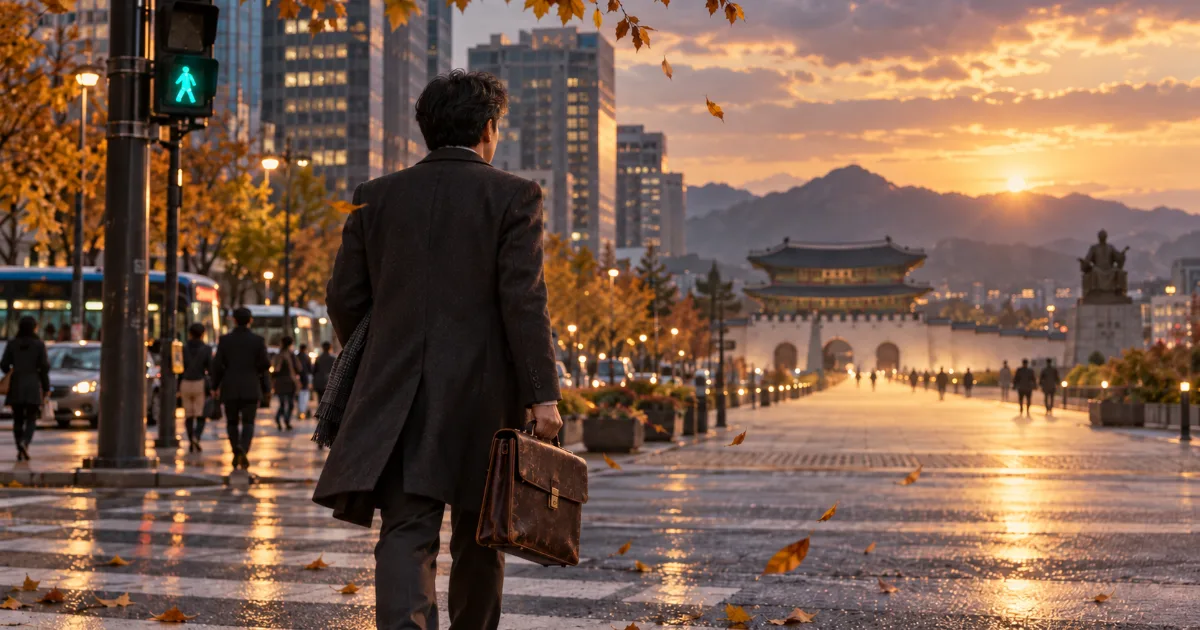
It was ten o’clock on a Sunday morning.
For once, I woke later than my alarm. On most days, that extra sleep might have felt like a small luxury. But not that morning. Even half-awake, I could feel that the air trapped in the room was strangely hot. The fan had pushed air from the same spot all night long, but it seemed to have done little more than move the heat from one corner of the room to another.
I threw back the blanket and lay there for a moment, staring at the ceiling.
It is only June.
The moment I opened the curtains, light poured into the room with the force of midday. The sunlight no longer tapped gently against the window. It scorched its way through the glass, bleaching the floor white. The gray walls of the apartment building opposite mine gleamed so fiercely that my eyes hurt. Even the asphalt below seemed to be giving off the smell of heat that should have faded overnight.
I stood by the window for a while.
“It is only June.”
This year, June had become summer far too quickly.
The late Junes I remember used to stand at the threshold of the monsoon season. Humidity clung to the collars of our shirts. We hesitated at the door, wondering whether to bring an umbrella to work. When rain came, the day somehow loosened its grip a little. And after the monsoon, there was always the quiet anticipation of summer vacation.
But somewhere along the way, that order seems to have fallen apart.
The old rhythm—monsoon rains in late June, holidays in July, scorching heat in August—now survives only on the calendar. The seasons no longer keep their place. They rush ahead, and we notice only after we have fallen a step behind. We wait for the rains, but the heat arrives first. Before we have time to prepare for summer, we find ourselves pushed straight into its center.
And really, what use are dates?
The calendar still pointed to some space between the rainy season and summer vacation, but my body had already entered the heart of midsummer. Sweat formed lightly on my back before I had even put on a shirt. The instant I opened the front door, the air outside pressed against my face.
It was not air.
It was heat.
I took the elevator down to the first floor to sort through the remnants of the past week—cardboard boxes, empty bottles, the small refuse of daily life. In the elevator mirror, I caught sight of a face that felt unfamiliar. A face that looked tired before it had gone anywhere. A face that, despite it being a Sunday morning, looked as though it had already lived through half the day.
Perhaps getting older is, in part, learning to notice the seasons before everyone else does.
When I was young, summer meant vacation. The sound of cicadas, cold watermelon, evenings when the sun set late, long afternoons spent playing with friends—those were summer.
Now, summer arrives with a different face.
I think first of electricity bills from running the air conditioner. Of sweat spreading across a shirt collar. Of the heaviness that settles into the body by midafternoon. Of a bottle of water left in the car, warm by the time I return.
After finishing the recycling, I headed toward the walking path with Uni, my elderly dog.
The sun was already there.
It was not yet as high as it would be at noon, but it was firm enough in its presence. The shadows beneath the trees were shorter than I expected. People walked with their eyes slightly narrowed. Someone carried a parasol. Someone wiped sweat from their forehead with the back of a hand. Someone held an iced coffee whose ice had already begun to melt.
At the entrance to the path, Uni slowed down.
Once, he would have welcomed the outside air at this hour more eagerly than anyone. Now, he seemed to be testing the temperature of the sunlight before deciding whether to keep going.
I loosened the leash a little.
“Okay. Let’s take it slow.”
I was speaking to Uni, but somehow the words sounded as though they were meant for me as well.
Standing beneath the sun on that hot summer morning, I suddenly thought of the film Project Hail Mary.
The sun we know now is something we complain about because it is too hot. It sends us searching for shade, reaching for ice water, slowing the steps of an old dog on his morning walk.
But what about a distant future?
Or perhaps not such a distant future after all.
Could there come a day when, instead of complaining that the sun is too hot, we worry that it can no longer send us enough light and warmth? What happens when something that once felt too close becomes, one day, terrifyingly far away?
As a doctoral student in virtual convergence at Sogang University, I often think about the double edge of imagining the future before it arrives. Technology usually promises a more convenient life. Virtual reality expands the limits of the physical world. Artificial intelligence helps us judge, create, and decide. New interfaces transform the ways in which we connect with one another and with the world.
But imagining the future always brings a quiet anxiety with it.
It is the anxiety that something we have worried about for a long time—something we have tried to warn against—may one day cross the threshold of reality and arrive before us no longer as imagination, but as ordinary life.
Science-fiction films often borrow that anxiety in order to make the present feel unfamiliar.
In Mad Max: Fury Road, water becomes power. Water, which everyone once believed they could drink, falls under someone’s control, and survival itself becomes a transaction. In WALL-E, the waste humanity leaves behind covers the Earth, and people can no longer set foot on the ground. They live instead inside a spacecraft drifting through space. In Interstellar, crops no longer grow on Earth, forcing humanity toward the stars. In a world where food has become scarce, space is no longer a romantic frontier. It becomes the final refuge people must seek in order to survive. In Snowpiercer, endless cold drives the world into a single train. Inside it, warmth becomes power, and the distance between train cars becomes the distance between social classes.
Air, water, soil, sunlight.
The things we enjoy every day without thinking are often the first things threatened in science fiction. Perhaps this is not because science fiction predicts the future with perfect accuracy. Perhaps it is because we are too quick to treat the present as permanent.
Project Hail Mary takes one of those assumptions—our faith in the sun—and places it at the center of its story.
Could the sun really be dying?
The film begins with that question.
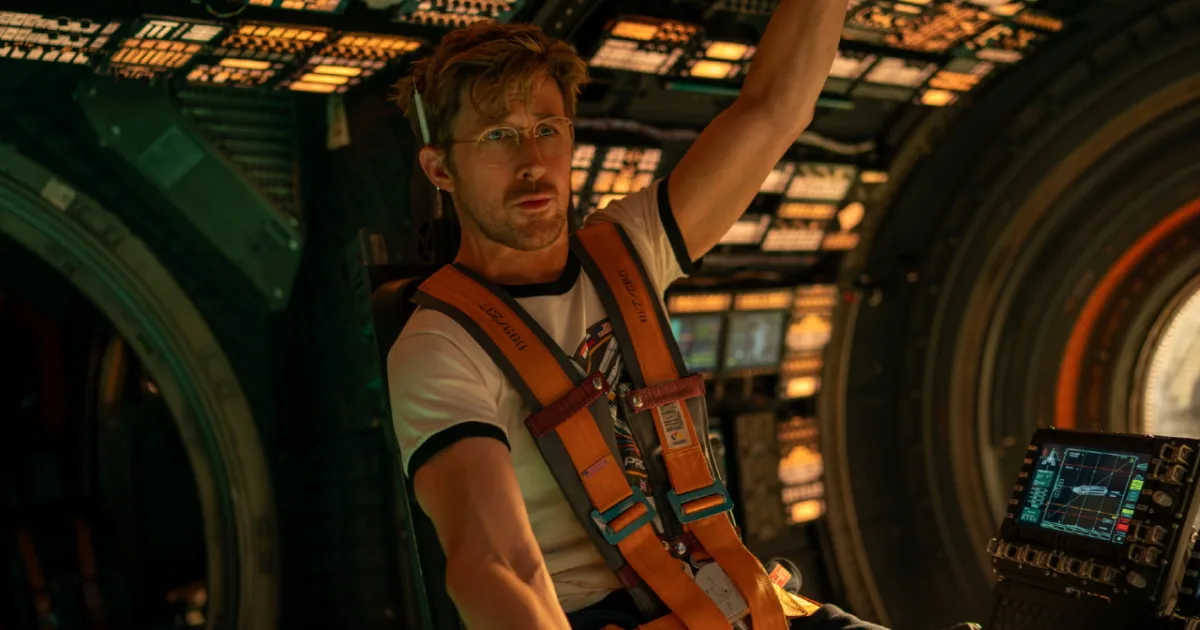
Image: Naver Movie, Project Hail Mary
Project Hail Mary is not a film about exploding spaceships or lasers cutting across space. Ryland Grace, played by Ryan Gosling, wakes alone aboard a spacecraft with no memory of who he is or why he is there. He is not a superhero. He is an ordinary man who once taught science at a school.
And the way he tries to save humanity is not through combat.
He observes. He forms hypotheses. He experiments. He fails. He calculates again.
The film introduces unfamiliar scientific terms: astrophage, the Petrova line, time dilation, artificial gravity, echolocation.
But its central question is simpler than it first appears.
What would happen if the sun slowly began to lose its strength?
And what could human beings do in the face of such a problem?
In the film, humanity fears a future in which the sun grows weaker. Astrophage, an extraterrestrial microorganism that consumes solar energy, steals away light and heat. Earth begins to freeze.
For the people in the story, the sun is a problem because it has become too weak.
Of course, the sun I encountered in Seoul in June 2026 was the opposite. It was a problem because it was too hot.
In the film, people build a spacecraft to stop the sun from dying. In reality, on days when the sun feels almost too close, we look for shade, turn on air conditioners, drink cold water, and endure the day.
One is an imagined catastrophe.
The other is an everyday discomfort.
Yet the two scenes resemble each other in a strange way.
The moment something once taken for granted is no longer guaranteed.
The moment something that has always been near becomes either too distant or too close.
Only then do we ask:
How are we supposed to live through this?
I would recommend this film to anyone who has grown so accustomed to the ordinary that even gratitude has begun to fade.
There are, in truth, very few things that are truly guaranteed. The water we drink in the morning. The air we breathe. The food that grows from the soil. The sun that rises every day. We live as though the things that have been with us for so long have been promised to us forever.
But science fiction strips those certainties away one by one.
It shows us worlds without water. Worlds where the soil has died. Worlds where the air has been damaged. And now, a world where the sun itself grows weaker.
Science fiction often pretends to speak about the end of the world.
But in reality, it invites us to look again at the world we are already living in.
Before watching Project Hail Mary, I would like to introduce several scientific ideas that can make its tension and emotions easier to follow. Even for readers who are not familiar with science, I hope these explanations will make the film feel a little closer.
One. Astrophage
The Hypothesis of a Microorganism That Eats the Sun
The most important presence in the film is astrophage.
The name can be understood as something close to “that which eats stars.” In the story, astrophage is a fictional extraterrestrial microorganism that multiplies by absorbing energy near the sun. As it consumes solar energy, the amount of light and heat reaching Earth gradually declines.
Put simply, imagine this:
The sun is a giant heater warming the entire planet.
Astrophage is a tiny organism secretly stealing heat from that heater.
“Would it really matter if things got just a little darker?”
It may seem like a small problem. But Earth’s climate responds very sensitively to changes in solar energy. Less sunlight means lower temperatures. Oceans cool. Crop yields decline. And over time, the entire planet may begin moving toward a colder state.
What is more frightening is what follows.
As Earth cools, more snow and ice form. Ice reflects far more sunlight than dark oceans or soil. That means the planet absorbs even less heat from the sun. A colder Earth becomes colder still. And as it grows colder, even more ice begins to form.
Less sunlight → lower temperatures → more snow and ice → greater reflection of sunlight → less absorbed heat → further cooling.
Science calls this kind of structure a positive feedback loop. “Positive” does not mean good. It means that once a change begins, it creates conditions that amplify the same change, strengthening itself over time.
In the world of the film, cold creates more cold.
A slightly colder Earth produces more ice. More ice reflects more sunlight. And the planet becomes colder again. Cold is no longer merely the result. It becomes the cause of the next wave of cold.
There is a concept in economics that is often compared to this kind of dynamic: Gresham’s law. It is usually summarized as “bad money drives out good.” When money with higher real value and money with lower real value circulate at the same face value, people tend to save the more valuable currency and spend the less valuable one.
Of course, Gresham’s law and climate feedback are concepts from completely different fields. One describes money and market behavior. The other describes how changes in nature can become amplified.
Yet both bring to mind a familiar scene.
Once a change begins, it rarely remains alone. It alters the next choice. It changes the next environment. And eventually, it produces a current much larger than the one that began it.
In the world of the film, one could say that “cold drives out warmth.” Not because cold pushes warmth away, but because cold creates the conditions for even greater cold. It is closer to a structure in which bad conditions breed even worse ones.
What is interesting is that the same principle works in the opposite direction in the real world of global warming.
Rising temperatures → less ice → less reflective surface area → more heat absorbed by land and sea → further warming.
This time, heat creates more heat.
As ice melts, darker oceans and land are exposed. Unlike white ice, they absorb far more sunlight. The heat they absorb warms the ocean and the atmosphere. That higher temperature melts more ice. Climate science calls this the ice-albedo feedback.
Albedo refers to how much light a surface reflects. White snow and ice send much of the sun’s light back into space, almost like mirrors. Dark oceans and soil absorb more of it. As Earth gradually becomes darker in color, it also becomes better at absorbing heat.
This is something I often think about while studying virtual convergence. Technology, the environment, and human choice never move separately. One small change alters the user experience. The altered experience changes behavior. And changed behavior transforms the structures of society and the environment.
This is true of the virtual worlds we build.
It is also true of the real world we inhabit.
Once a change begins, it often calls forth another change larger than itself.
That is why the fear of an ice age in the film and the heatwaves we experience in reality may seem like opposites, yet they share the same structure. One world grows colder and makes itself colder. The other grows hotter and makes itself hotter.
Astrophage itself is, of course, not a real organism.
But the premise that changes in the energy emitted by the sun can dramatically affect Earth’s environment is scientifically understandable.
If the sun falls ill, Earth falls ill with it.
That sentence belongs to the setting of the film. But it also reveals how deeply connected we are to the sun.
Two. The Astrophage Engine
The Paradox of Turning Humanity’s Threat into Humanity’s Fuel
One of the most fascinating ideas in the film is that the very thing threatening humanity also becomes the fuel that allows humanity to travel farther than ever before.
Astrophage is portrayed as a life-form capable of absorbing and storing solar energy, then releasing an unimaginable amount of energy when needed. The spacecraft Hail Mary uses astrophage as its source of propulsion, allowing human beings to cross the distance between stars at speeds previously beyond imagination.
Behind this idea lies one of Einstein’s most famous equations:
E = mc²
Most of us have seen it at least once in a middle-school science textbook. Yet when it comes time to explain it, we often pause.
In very simple terms, it means this:
Mass can become energy.
And when mass is multiplied by the square of the speed of light, even a tiny amount of matter can contain an astonishing amount of energy. A mass as small as a grain of sand could, in theory, become the source of immense power.
The way the sun shines is connected to the same principle. Inside the sun, hydrogen nuclei combine, and a small portion of their mass is converted into energy. That energy spreads across space as light and heat. Nuclear power plants and nuclear weapons also operate on the relationship between mass and energy.
But human beings cannot yet handle that energy as safely or efficiently as the film imagines. Converting mass almost completely into energy remains, for our technological civilization, a distant and dangerous possibility.
The film, however, places that physical question in the hands of a living organism.
What if there were a creature that could store solar energy within its body and release it almost perfectly whenever necessary?
Would it be a life-form?
Would it be fuel?
Or would it be both?
This blurring of boundaries is something I often feel while studying virtual convergence.
Today’s technologies continually force us to reconsider the line between objects and tools, humans and data, reality and virtuality. Is AI merely a program, or can it become a collaborator in thought? Is an avatar only an image on a screen, or another form of social self? Is data merely a collection of numbers, or the trace of a person’s life?
Project Hail Mary sends these old questions all the way into space.
Human beings have always taken energy from nature. We burned wood to make fire. We dug coal from the ground. We transformed wind and sunlight into electricity.
But astrophage asks us to reconsider what disappears when we call something in nature a “resource.” When does life become fuel? Where do ethics go when survival is at stake?
Where is the boundary between life and resource?
And when humanity begins using another being as fuel in order to survive, can we continue to respect that being as life until the end?
Three. The Petrova Line
Finding the Invisible Through the Traces It Leaves in Light
Early in the film, an unusual line is observed between the sun and Venus. In the story, it is called the Petrova line. It becomes the first clue revealing the existence of astrophage.
The scene may seem unfamiliar, but it is rooted in one of the fundamental principles of astronomy.
Astronomers cannot travel directly to distant stars. They cannot touch the atmosphere of a distant planet or collect samples from the surface of a faraway star. Yet they can still determine the temperature and composition of stars, and even learn about the gases in the atmospheres of distant planets.
Their clue is light.
When starlight is spread out like light passing through a prism, it is no longer a simple white line. Hidden within it are patterns of color and brightness. Different elements and molecules absorb or emit light in their own distinctive ways. This pattern is called a spectrum.
Just as every person has a different fingerprint, elements and molecules leave their own signatures in light. By reading those signatures, astronomers can infer what exists within a star, which gases are present in a planet’s atmosphere, and where a particular light source came from.
The Petrova line in the film is built upon that real scientific imagination. Scientists discover the unique energy trace left behind by astrophage as it moves through space, and that trace appears as a strange line.
In the language of virtual convergence, this resembles the act of reading an invisible interface.
We look at a single icon on a screen and infer the state of an entire system. Algorithms infer our interests and behavior from small traces: clicks, scrolling speed, the amount of time we linger on a page. Astronomers read the condition of worlds they cannot physically visit through faint traces left in light.
Science often begins not with discovery, but with the feeling that something is strange.
Someone notices a small trace in the light and refuses to dismiss it. They keep looking until they understand whether it is an error or a signal.
And human knowledge often moves forward because someone chose not to ignore that small moment of strangeness.
Four. Time Dilation
Time Is Not Fair in Space
The destination in the film, Tau Ceti, lies about twelve light-years away.
Even traveling at the speed of light, the journey would take twelve years.
Yet for Grace aboard the spacecraft, time passes much more quickly—or rather, much more slowly—than it does on Earth. While decades may pass on Earth, only a few years seem to pass for those inside the ship.
The answer lies in Einstein’s theory of special relativity.
For objects moving at extremely high speeds, time passes more slowly relative to objects that are moving more slowly. This is called time dilation.
Inside a spacecraft traveling close to the speed of light, like the Hail Mary, time can move differently from the way it does on Earth. While the person aboard the ship experiences only a few years, much more time may pass on Earth.
Put simply:
The clock inside the spacecraft moves more slowly.
The clock on Earth moves more quickly.
This is not merely a fictional device invented by science fiction. In reality, the clocks aboard GPS satellites move at slightly different rates from clocks on the ground. Without correcting for this difference, location data would become significantly inaccurate every day. The reason we can turn on navigation and find our way is that Einstein’s theory of relativity is quietly being calculated in the background.
There is, in fact, space physics inside the navigation apps we use every day.
But time dilation reaches us emotionally before it reaches us scientifically.
For me, it may have been a journey of only a few years.
For someone who stayed on Earth, it may have been more than a decade of waiting.
For me, it may have been a brief decision.
For someone else, it may have been time enough to change an entire life.
Time also often feels different in virtual spaces. Several hours spent in a virtual world can vanish like a few minutes in reality. Conversely, a few seconds outside the screen can stretch into something that feels like an old memory. Of course, that is not physical time dilation. It is psychological time.
But both remind us of the same truth.
Time does not always flow evenly, like the hands of a clock.
For someone, it is waiting.
For someone else, it is farewell.
For another, it is a distance from which there is no return.
That is why space travel is not simply the act of traveling far away. It is also the act of living in a different time from the people you love.
After turning forty, I began to understand that the time of life is not distributed equally. The days I struggled through seemed as though they would never end. But the years in which my child grew up, and the years in which my parents grew older, seem, looking back, to have passed far too quickly.
Five. Artificial Gravity
Why People Can Walk Inside a Rotating Spaceship
Space is, in essence, an environment close to weightlessness.
Yet in the film, Grace walks through the spacecraft, eats meals, and conducts experiments. Cups remain on tables. People stand firmly on the floor. There are none of the floating scenes we usually associate with space.
The reason is rotation.
The living space inside the Hail Mary is designed to spin rapidly. As the spacecraft rotates, the people and objects inside feel as though they are being pushed outward toward the outer wall. There is no real gravity in the same sense as Earth’s gravity, but the floor pushes back against the body, creating a sensation similar to gravity.
This is commonly called artificial gravity.
It is easier to understand if you think of a spinning cylindrical ride at an amusement park. As the ride turns rapidly, your body feels pressed against the wall. Your body wants to continue moving in a straight line, but the spinning wall keeps you in place. As a result, you feel as though you are being pushed outward.
The spacecraft in the film rotates not merely because it looks visually impressive.
It rotates because human beings need to remain human in space.
Walking. Eating. Sleeping. Holding water in a cup. Putting something down on the floor.
On Earth, these actions feel ordinary.
In space, none of them can be taken for granted.
From the perspective of virtual convergence, artificial gravity resembles the problem of designing a sense of reality. In virtual reality, users do not simply see a space with their eyes. They believe in that space with their bodies. When their gaze moves, the screen must respond naturally. When they reach out, the distance must feel right. The sense of having solid ground beneath their feet must remain intact.
A sense of reality is not created by high-resolution graphics alone.
There must be physical rules that make the body feel, This is a place I can trust.
The rotation of the Hail Mary is therefore not only a technological feature of spacecraft design. It is also a small Earth built to protect the human body in an unfamiliar environment.
Six. Rocky and Echolocation
How to Become Friends with a Being That Sees the World Differently
The character who touches many viewers most deeply in the film is the extraterrestrial being Rocky.
Rocky does not perceive the world through light as humans do. He understands the surrounding space through sound and vibration. This is called echolocation.
Echolocation is a way of reading the environment by producing sound, then analyzing the time and direction in which that sound returns after striking nearby objects. Bats and dolphins are well-known examples. Even in dark caves, bats emit sound and read minute differences in returning echoes to distinguish walls, insects, and the direction of travel.
Rocky can be understood as a being who has developed that ability to an extraordinary degree.
What matters is that Rocky is not simply “an alien who cannot speak English.” He has a different body. He understands the world through different senses. He lives in a different environment.
That is why the process through which Grace and Rocky grow close is not merely a problem of translation.
They do not begin by translating one another’s language. They begin with mathematics and physics. One plus one equals two on Earth, and it is likely to equal two somewhere else in the universe as well.
Slowly, they learn each other’s worlds.
This process touches on a question that virtual convergence has long considered. In digital spaces, people meet through different avatars, interfaces, languages, and cultures. Even when looking at the same screen, they may read entirely different contexts. Even when using the same words, they may be carrying entirely different emotions.
The development of connection technologies does not automatically create deeper understanding.
Connection is only the beginning.
Understanding comes afterward.
The relationship between Grace and Rocky is not simply about translation. It is the story of two beings who exist in completely different ways, yet choose to connect anyway.
They do not become friends because they speak the same language.
They become friends because they learn the world of someone who lives differently.
That, more than the science itself, is what stayed with me after the film ended.
Seven. Taumoeba and Selective Breeding
Saving the Universe by Finding a Predator
The key to the latter half of the film is Taumoeba, an organism that consumes astrophage.
This idea draws upon one of the most basic principles of ecology.
When one organism grows too abundant, another organism that feeds on it may emerge. In the real world, people use natural predators to reduce crop pests. Scientists study viruses that attack certain bacteria. Human beings have long searched for another relationship within nature to solve a problem created by nature.
But it is not enough for Taumoeba merely to eat astrophage.
It must survive, reproduce, and perform its role in the environment humanity needs it to inhabit.
This is where the concept of selective breeding appears.
It sounds complicated, but it is already familiar to us. We cultivate certain varieties of fruit because they are sweeter. We breed cows that produce more milk. We continue growing crops that are more resistant to drought and disease.
The film applies this principle to microorganisms. Individuals that survive well in a desired environment are repeatedly selected. Those with useful traits are allowed to leave the next generation. Over time, they evolve in the direction humanity needs.
This is where Darwin’s natural selection meets human choice.
Nature allows the organisms that survive to continue.
Human beings allow the organisms with the traits they desire to continue.
The same question appears again in the age of virtual convergence and AI. Which data will algorithms learn more frequently? Which results will they show more often? Which behaviors will they reinforce?
Whenever we design technology, whether consciously or unconsciously, we are making choices.
And those choices alter the environment of the next generation.
The story of Taumoeba is therefore not simply the story of “a tiny microorganism saving the world.”
It asks who chooses which forms of life should survive, which direction evolution should take, and who bears responsibility for the consequences.
Perhaps what saves humanity will not be the strongest weapon, but the evolution of the smallest life-form.
And that possibility asks us another question.
Are human beings the ones who save nature?
Or are we the ones who change nature’s direction?
The science of Project Hail Mary is not the language of a genius who already knows every answer. It is the language of people who observe what they do not understand, form hypotheses, fail, and calculate again.
Grace is not someone who knows everything from the beginning. He panics. He makes mistakes. He wants to give up. And then he experiments again.
The answers he finds are not the isolated achievements of a single genius. They are answers reached through the sharing of knowledge and experience among different beings.
That may be why the true protagonist of this film is not astrophage, not the enormous spacecraft, and not the engine capable of traveling close to the speed of light.
Perhaps the true protagonist is the human attitude that continues to think even after saying, I do not know.
That attitude matters in the study of virtual convergence as well. New technologies often arrive first as questions, not answers.
How far can AI replace human work?
How do actions in virtual worlds connect to ethics in the real world?
When data allows us to understand people more deeply, what must we become more careful about?
Good questions always arrive before technology does.
If the sun is dying, what can we do?
The film’s answer is unexpectedly simple.
Someone observes.
Someone calculates.
Someone experiments.
Someone reaches for the hand of a person who has failed.
And beings who are completely different from one another become friends in the face of the same problem.
That evening, I took Uni out for another walk.
The sun that had been so unyielding all day was finally sinking slowly behind the buildings. The sky shifted from white light to pale orange, then to blue-gray. The shadows that had clung tightly to our feet during the day now stretched long across the path, walking ahead of us.
Uni walked beside me with a noticeably easier step. The sun that had felt so harsh in the afternoon looked strangely beautiful in the evening.
For a moment, I looked up at the sky.
“Still, you gave us light for the whole day.”
I could not tell who I was speaking to.
The sun, perhaps.
Or perhaps myself, for having endured the day.
Could the sun really be dying?
The film does not answer that question immediately.
Instead, it returns a quieter, firmer question.
If that were true, what could I do?
And what could you do?
In June 2026, on a day when the hot sunlight seemed determined to hold Seoul in its grip, I found myself asking the question in a different way.
When we feel that the sun is becoming too hot, what can we do?
Perhaps what we should fear is not the complete disappearance of the sun, but the gradual transformation of the seasonal order we once believed to be permanent.
Heat arriving before the monsoon.
Asphalt that refuses to cool even after sunset.
Morning sunlight strong enough to make us hesitate before taking a walk.
That is why I look at the evening sky again today.
I watch the light that exhausted us all day slowly disappear, knowing that the sun will rise again tomorrow.
And I say, in a very small voice:
“I hope tomorrow will be just a little less hot.”
But somewhere inside, I know something else.
Even beneath that harsh light, we will eat meals. We will meet someone. We will be hurt. We will laugh again.
Perhaps even our complaints that the sun is too hot are proof that we are still here, living inside this season.