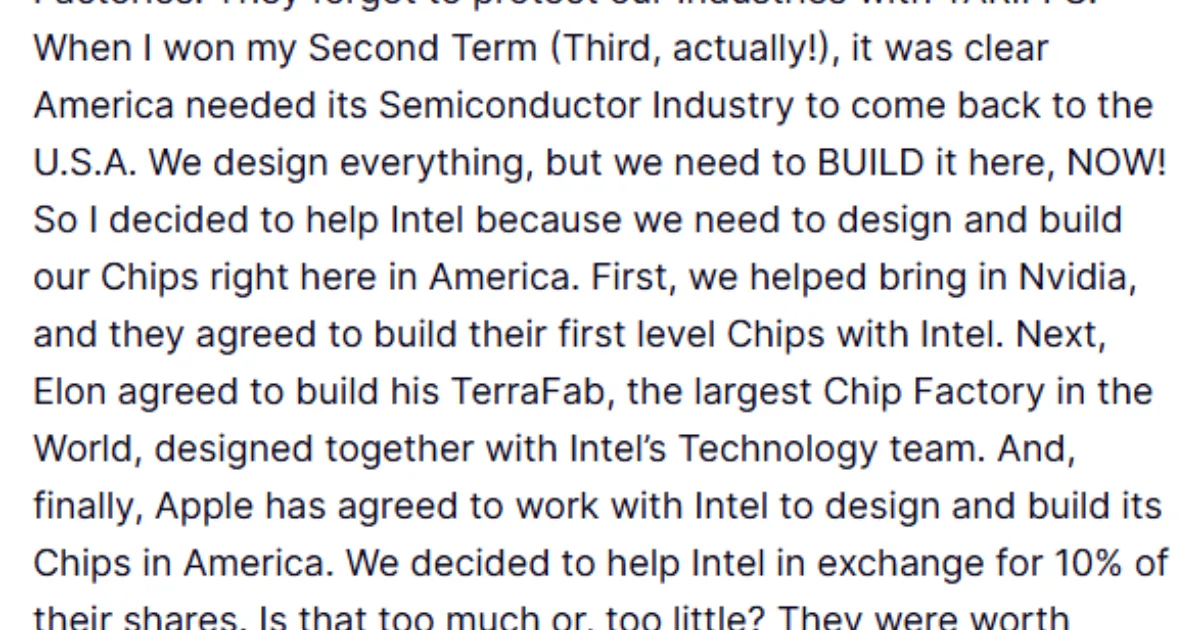
U.S. President Donald Trump has once again placed Intel at the center of his industrial policy agenda. In a recent Truth Social post, Trump claimed that the U.S. government’s acquisition of roughly 10% of Intel had sharply increased the company’s value. He also pointed to Intel’s cooperation with Nvidia, Elon Musk’s Terafab project and the possibility of Apple designing and producing chips in the United States as evidence of a broader revival in American manufacturing.
The political language is expansive. But the industrial reality behind it is significant.
The U.S. government has become one of Intel’s largest shareholders, and Intel’s recovery is no longer simply a question of corporate turnaround. It has become closely tied to America’s semiconductor manufacturing strategy, AI supply chain ambitions and technology competition with China.
Recent developments surrounding Intel show that U.S. industrial policy is changing in character. Washington is no longer only supporting factory construction through grants and tax incentives. It is moving toward direct ownership in strategic companies and presenting potential gains in corporate value as a national achievement.
From Subsidies to Equity: $8.9 Billion for a 9.9% Stake
In August 2025, the U.S. government invested approximately $8.9 billion in Intel by acquiring 433 million common shares at $20.47 per share. The transaction gave the government a 9.9% stake in the company.
The funding did not come from a completely new budget allocation. Instead, it was structured by converting previously awarded but unpaid CHIPS and Science Act subsidies and funding from secure semiconductor programs into equity.
The government did not seek board seats or ordinary management control. It agreed to participate as a passive shareholder and to generally follow the recommendations of Intel’s board of directors.
Even so, the symbolic significance is substantial.
The U.S. government is no longer treating Intel merely as a recipient of public support. It is treating the company as a strategic asset tied to national security, supply-chain resilience and the rebuilding of domestic semiconductor manufacturing.
In the past, U.S. government ownership in major corporations was usually associated with financial crises or corporate rescue efforts. Intel represents a different model. The company is not simply being saved. It is being positioned as a manufacturer that the United States believes must recover if the country is to regain a stronger role in advanced chip production.
The United States already has world-leading semiconductor design companies, including Nvidia, AMD, Apple and Qualcomm. But it remains heavily dependent on Taiwan’s TSMC and South Korea’s Samsung Electronics for large-scale production of the most advanced chips.
For the United States to secure reliable domestic access to chips used in AI, defense, telecommunications, automobiles and space technology, Intel’s foundry business must become globally competitive again.
A Government Stake Worth $67.4 Billion — but Paper Gains Are Not Cash Profits
Trump has claimed that the government’s stake in Intel has produced gains worth tens of billions of dollars. Based on Intel’s market capitalization of about $681.1 billion on June 19, 2026, the government’s 9.9% stake would be worth roughly $67.4 billion at market prices.
Compared with the original $8.9 billion investment, that implies an unrealized increase in value of around $58.5 billion.
But this should not be described simply as the U.S. government having “earned” nearly $60 billion. The government has not sold the stake, and the current figure is a market-based paper valuation. Any large sale of shares would also have to account for its possible effect on Intel’s stock price and the wider market.
More importantly, Intel’s increase in value cannot be attributed only to the government’s investment. The stock has also benefited from expectations surrounding collaboration with Nvidia, Tesla’s plan to use Intel’s 14A process, possible Apple cooperation and broader demand for a U.S.-based AI semiconductor supply chain.
Trump’s claim that Intel’s value rose from roughly $100 billion to more than $600 billion should therefore be viewed as a political narrative rather than an independently verified measure of industrial-policy success.
Nvidia Partnership Signals Ecosystem Integration, Not Full GPU Production
Trump said Nvidia had agreed to produce chips with Intel. But interpreting that statement as meaning Nvidia will manufacture all of its most advanced AI GPUs in Intel factories would be an overstatement.
Intel and Nvidia have agreed to jointly develop data-center and personal-computing products. In the data-center segment, Intel is expected to develop custom x86 CPUs designed to work within Nvidia AI infrastructure. In personal computing, the cooperation centers on integrating Nvidia RTX GPU chiplets into Intel x86 systems-on-chip.
The significance of the partnership extends beyond joint product development.
In the AI era, semiconductor competition is no longer only a contest between CPUs and GPUs. It is increasingly a competition across memory, networking, advanced packaging, power efficiency and system software.
For Intel, the goal is not necessarily to replace Nvidia. It is to become an indispensable CPU, packaging and systems partner within an Nvidia-centered AI ecosystem.
The fact that two companies once viewed primarily as PC-market competitors are now working together on AI infrastructure and AI PCs illustrates Intel’s strategic shift.
Terafab Is Not Yet the World’s Largest Factory — but It Could Be Intel 14A’s First Major Test
Elon Musk’s Terafab project may have a more direct impact on Intel’s foundry ambitions. Tesla has outlined plans to use Intel’s next-generation 14A manufacturing process to produce chips for its Terafab project in Austin.
Terafab is envisioned as a large-scale AI semiconductor effort aimed at producing chips for Tesla vehicles, humanoid robots and potentially space-based data centers. Musk has set a long-term target of producing one terawatt of computing capacity annually.
But it is still premature to describe Terafab as the world’s largest semiconductor factory. Key conditions remain unclear: who will fund expensive equipment, who will operate the fab, when volume production will begin and what level of orders has actually been committed.
Even so, the project matters because it could become Intel 14A’s first major external customer.
For Intel to grow its foundry business, outside customers must trust its manufacturing process, yields, delivery schedules and security standards. Tesla’s and Musk-affiliated companies’ plans could signal that Intel is beginning to gain that trust.
The real market test, however, will not be the announcement. It will be volume production. Intel must demonstrate that it can achieve strong yields, secure long-term orders and deliver quality and lead times competitive with TSMC.
Apple Could Be Intel’s Biggest Prize — and Its Toughest Validation Test
The most closely watched part of Trump’s post concerns Apple. Trump claimed that Apple would work with Intel to design and produce chips in the United States.
If Apple were to use Intel Foundry, it would represent a major victory for Intel in both symbolic and economic terms. Apple moved away from Intel processors in its Mac product line beginning in 2020, shifting to its own M-series chips. Manufacturing for those chips has remained heavily dependent on TSMC.
A new Apple-Intel relationship would not likely mean Apple returning to Intel-designed CPUs. Instead, it would likely involve a foundry agreement in which Intel manufactures chips designed by Apple.
For Apple, such a deal could reduce some reliance on TSMC and strengthen access to a U.S.-based supply chain. For Intel, securing Apple as a customer would dramatically improve the credibility of its foundry business.
However, the details remain unconfirmed. Specific products, process technologies and mass-production schedules have not been formally announced by both companies. Reports in May suggested that Apple and Intel had reached a preliminary understanding regarding chips for some Apple devices, but both companies declined to comment at the time.
Trump’s post presented the possibility as an established accomplishment. In reality, any actual supply agreement and manufacturing timeline still require separate verification.
From a Subsidy State to a Shareholder State
The biggest question raised by Intel’s case is the changing role of the U.S. government.
For decades, the United States emphasized free markets and private-sector innovation. But in industries tied to national security and supply chains — including AI, semiconductors, batteries, rare earth materials and defense technology — the government is no longer acting only as a regulator or grant provider.
It is providing capital, imposing tariffs, controlling exports and now acquiring stakes in strategic companies.
This suggests that the United States is choosing more direct forms of industrial intervention in response to China’s state-led industrial strategy.
There are clear advantages to this approach. Governments can provide long-term funding for large manufacturing infrastructure projects that private markets may consider too risky. They can also connect national economic interests more directly to the success of strategic industries.
But there are risks as well.
If a company’s stock price and operating performance become closely connected to a president’s political achievements, industrial policy may become overly shaped by symbolism rather than technological competitiveness. Government ownership could reassure some customers by signaling stability. But it could also make Intel appear less like an independent private foundry and more like a strategic instrument of the U.S. government.
For allied companies, this may be seen as a sign of supply-chain security. For companies in China and some nonaligned markets, it could create new commercial and political complications.
Intel’s Real Recovery Will Be Decided by Manufacturing, Not Market Capitalization
The recent headlines around Intel all point toward future expectations: U.S. government ownership, system-level cooperation with Nvidia, Tesla’s potential use of the 14A process and possible foundry cooperation with Apple.
Markets have responded by rapidly reassessing Intel’s value. But in the semiconductor industry, true competitiveness is not proven through announcements. It is proven through production.
There is a major difference between a customer saying it plans to adopt a manufacturing process and a customer actually placing large orders after production yields have been proven.
Intel now needs to demonstrate three things.
First, it must show that its 18A and 14A processes can compete with TSMC on performance, power efficiency and manufacturing yield.
Second, it must meet the long-term quality and delivery requirements of major customers such as Apple and Tesla.
Third, it must build enough independent business competitiveness that customers would choose Intel even without government ownership or political support.
Trump’s post frames Intel as a symbol of American manufacturing revival. But Intel’s future will be decided not by White House declarations or stock-market charts. It will be decided by factory yields, real customer orders and Intel’s ability to supply the chips required for the AI era with consistency and reliability.
The true return on the U.S. government’s investment will not be measured only in unrealized stock gains. It will be measured by whether Intel can once again manufacture world-class advanced semiconductors in the United States, whether American chip designers can trust those factories, and whether the country can rely on domestic manufacturing capacity during future supply-chain disruptions.
Only then will the government’s 9.9% stake in Intel be seen as more than an investment. It will become a defining example of modern industrial policy.


