The U.S. government is moving to bring autonomous vehicles without brake pedals into the regulatory framework.
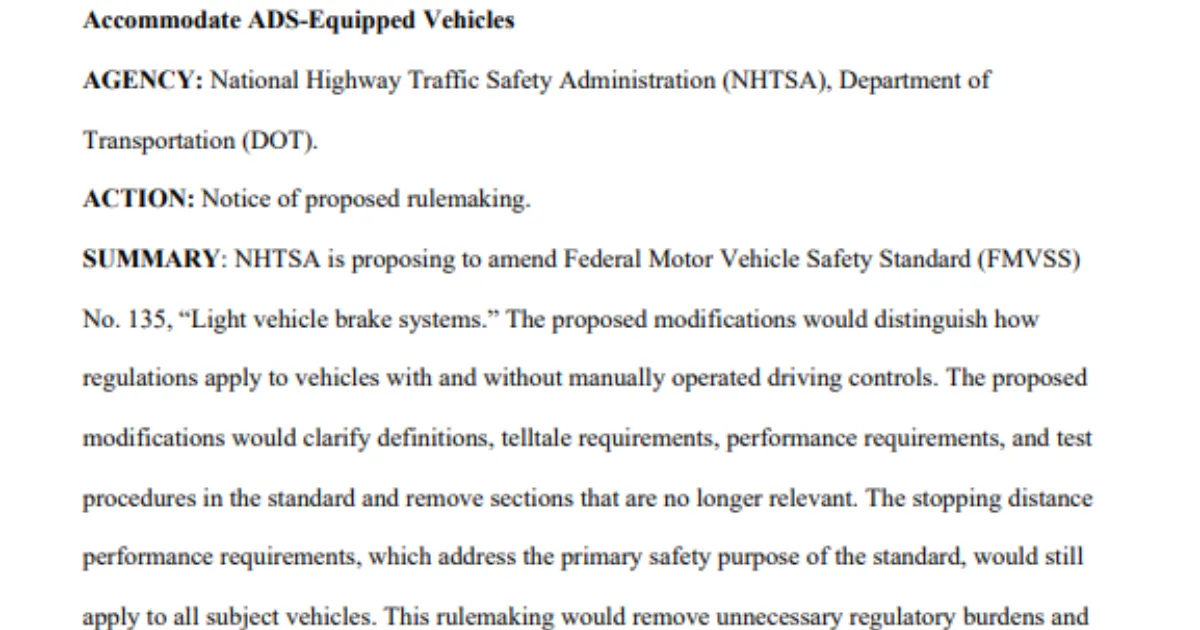
In June, the National Highway Traffic Safety Administration proposed changes to Federal Motor Vehicle Safety Standard No. 135, the rule governing light-vehicle braking systems. The existing standard was built around a human driver: a foot-operated brake pedal, a hand- or foot-operated parking brake and dashboard warning indicators positioned for the person behind the wheel.
But fully autonomous vehicles may not have a driver’s seat at all.
Robotaxis and autonomous shuttles designed from the beginning for passenger-only travel may not need steering wheels, accelerator pedals or brake pedals. Under the current rules, however, manufacturers can still face requirements built for a human operator even when no human is expected to drive the vehicle.
NHTSA’s proposal does not seek to weaken braking standards. It seeks to modernize the way those standards are applied.
The central principle is straightforward: a vehicle without a human driver may not need a brake pedal, but it must still stop safely.
That means the future of autonomous-vehicle regulation may be less about whether a person can physically press the brakes and more about whether an electronic command can produce the same reliable stopping performance.
A Brake Rule Built for Human Drivers
FMVSS No. 135 sets braking-performance requirements for passenger cars, light trucks and light buses.
Under the current rule, service brakes — the brakes used to slow and stop a moving vehicle — are assumed to be activated by a foot control. Parking brakes are also expected to be operated by hand or foot.
That logic makes sense for conventional vehicles. It becomes less practical for a vehicle designed never to be operated by a human.
A fully autonomous shuttle or robotaxi does not need a steering wheel or pedals because the people inside are passengers, not drivers. Requiring such a vehicle to include a brake pedal or manual parking-brake lever could force manufacturers to install equipment that has no meaningful role in normal operation.
NHTSA argues that this type of requirement can constrain vehicle design without improving safety.
In some cases, manual brake controls may even introduce new risks. If a passenger in an autonomous vehicle can override the automated driving system by pressing a brake control unnecessarily, the vehicle could stop abruptly in a way that creates danger for passengers or nearby traffic.
A robotaxi passenger, for example, might activate a brake control without a genuine emergency. The vehicle could then stop unexpectedly, potentially creating a collision risk for vehicles behind it or disrupting traffic flow.
NHTSA’s core message is not that braking matters less in autonomous vehicles. It is that a human-operated brake device should not be mandatory in a vehicle that is not designed for human driving.
From a Foot Pedal to an Electronic Command
The proposed rule distinguishes between vehicles with manual driving controls and vehicles without them.
Vehicles that retain steering wheels, brake pedals and other manual controls would continue to follow the existing requirements. But for vehicles designed without manually operated driving controls, the braking system could be activated by the vehicle’s internal electronic systems.
The key issue is no longer who applies the brake.
It is whether the vehicle stops within the required distance.
Under the traditional standard, stopping distance is measured from the moment force is applied to the brake pedal until the vehicle comes to a complete stop. But a pedal-free autonomous vehicle has no moment when a human foot presses down.
NHTSA therefore proposes redefining the measurement point for such vehicles. For an autonomous vehicle without manual controls, stopping distance would begin when an electronic brake command is first transmitted to the service-brake control system.
In other words, the human foot is replaced by a digital signal.
But the physical performance requirements would remain.
For example, under the cold-brake performance test, a vehicle must still stop from 100 kilometers per hour within 70 meters. Separate stopping-distance requirements would also continue to apply in degraded conditions involving reduced brake performance, anti-lock braking system failures, hydraulic-circuit problems or power-supply issues.
This is the critical point.
The U.S. government is not taking the position that autonomous vehicles should face lower standards because no driver is present. Instead, it is changing the testing method to fit electronically controlled braking while preserving the real-world requirement that the vehicle must stop safely.
Autonomous safety will not depend only on whether AI can detect danger. It will also depend on whether the braking system responds quickly and reliably once the AI decides that the vehicle must stop.
Warning Lights Must Work for Passengers, Not Drivers
Another significant part of the proposal concerns brake warning indicators.
In traditional vehicles, brake warnings are displayed on the instrument panel in front of the driver. But a vehicle without a steering wheel or conventional driver’s seat has no single person responsible for monitoring a dashboard.
NHTSA is therefore proposing that brake-system warnings be visible to occupants in all designated seating positions.
The agency’s reasoning is important. In an autonomous vehicle, safety information cannot be known only to the vehicle’s software. Passengers may need to decide whether to begin a trip, request a stop, exit the vehicle or report a system issue.
Warnings about brake-system faults, reduced braking performance or power problems may directly affect those decisions.
This suggests that the user experience of autonomous vehicles is becoming part of the safety system itself.
Removing the driver does not eliminate the human role. It changes it.
Passengers may no longer steer, accelerate or brake. But they may still need to understand the vehicle’s condition and respond appropriately when something goes wrong.
That means screens, voice alerts, mobile notifications and in-vehicle warning systems may become safety features rather than simple convenience tools.
NHTSA has also pointed to the value of multiple communication channels, including in-vehicle displays, mobile-app alerts and other means of informing passengers about vehicle conditions.
Parking Brakes May No Longer Need to Rely on Friction
The proposal also modernizes the treatment of parking brakes.
Existing rules require parking brakes to operate through a friction-based mechanism. In simple terms, the system must physically apply force to keep the vehicle from moving.
That requirement reflects an earlier era of vehicle design, when parking brakes were expected to serve as a separate emergency safeguard against more frequent failures in the main braking system.
Modern vehicles use more advanced designs. These include split brake circuits, electronic braking systems, automatic emergency braking, electronic parking brakes and powertrain-locking mechanisms.
NHTSA’s proposal suggests that the parking-brake system does not necessarily have to rely on a traditional friction-based method.
What matters is the outcome.
A vehicle must still remain stationary when parked. The existing performance requirement would remain: the vehicle must hold its position for five minutes on a 20% grade in both forward and reverse directions.
The technology may change. The safety result may not.
This reflects a broader trend in autonomous-vehicle and electric-vehicle regulation. Older rules often specify the physical form of a safety device. Newer rules are increasingly focused on performance.
The question is shifting from “Does the vehicle have a brake pedal?” to “Can the vehicle stop within the required distance?”
The Real Test of Autonomous Safety Is Not Only Whether a Vehicle Can Stop
The proposed update does not solve every autonomous-driving safety problem.
NHTSA has made clear that FMVSS No. 135 addresses the braking system’s ability to produce sufficient stopping performance. It does not determine whether an automated driving system can correctly decide when to brake, how hard to brake or how to respond to complex real-world traffic conditions.
That distinction matters.
A vehicle could have an excellent braking system and still crash if its automated driving system fails to identify a stopped car, detects a pedestrian too late or miscalculates stopping distance on a wet road.
Autonomous-vehicle safety ultimately depends on two separate but connected questions.
First, can the vehicle correctly recognize danger?
Second, once it recognizes danger, can it stop safely?
The proposed brake-rule update addresses the second question.
The first question — how autonomous systems perceive, predict and make driving decisions — will require separate safety-performance requirements and testing frameworks.
A vehicle must not only be capable of stopping. It must know when stopping is necessary.
A Regulatory System Designed for a Driverless Future
The proposal illustrates that autonomous-vehicle deployment is not simply an AI challenge.
For driverless vehicles to operate on public roads, regulators must reconsider dozens of standards created over many decades around the assumption that a human driver is present.
That includes not only brakes, but also steering systems, warning lights, seat layout, crash protection, doors, windshield wipers, defrosting systems, tire-information labels and transmission controls.
NHTSA has already been reviewing and updating several federal safety standards to account for vehicles equipped with automated driving systems and no manually operated driving controls.
The proposed brake-rule update is part of that wider effort.
The real question is no longer, “Can a vehicle operate without a brake pedal?”
The more important question is, “Who guarantees safety when no driver is present?”
In conventional vehicles, the driver presses the brakes, reads the warning lights, applies the parking brake and makes decisions in abnormal conditions.
In a fully autonomous vehicle, those responsibilities are divided among artificial intelligence, electronic control systems, remote operations, vehicle design, manufacturer safeguards and government performance standards.
A human foot is replaced by an electronic signal.
A driver’s dashboard is replaced by passenger-facing warnings.
A driver’s judgment is replaced by automated-driving algorithms.
NHTSA’s proposal is one of the first steps in translating that shift into the language of regulation.
The challenge is not simply removing the brake pedal.
It is proving that a vehicle can stop more accurately, more consistently and more safely even when no human is there to press it.