A study of 100 adults found greater presence with 360-degree video, but no clear additional relaxation benefit when it was added to guided breathing meditation.
Watching a beach on a screen feels different from sitting in a scene where the sea remains in view as you turn your head. When the landscape surrounds you, it may feel as though you have briefly arrived somewhere else. But does making a relaxation video more lifelike also make it more effective?
A paper by Saskia Seel and colleagues, published in Virtual Reality on September 5, 2026, examined this question experimentally. Its findings call for a distinction between feeling present in a place and becoming more relaxed.
The same breathing meditation, three viewing conditions
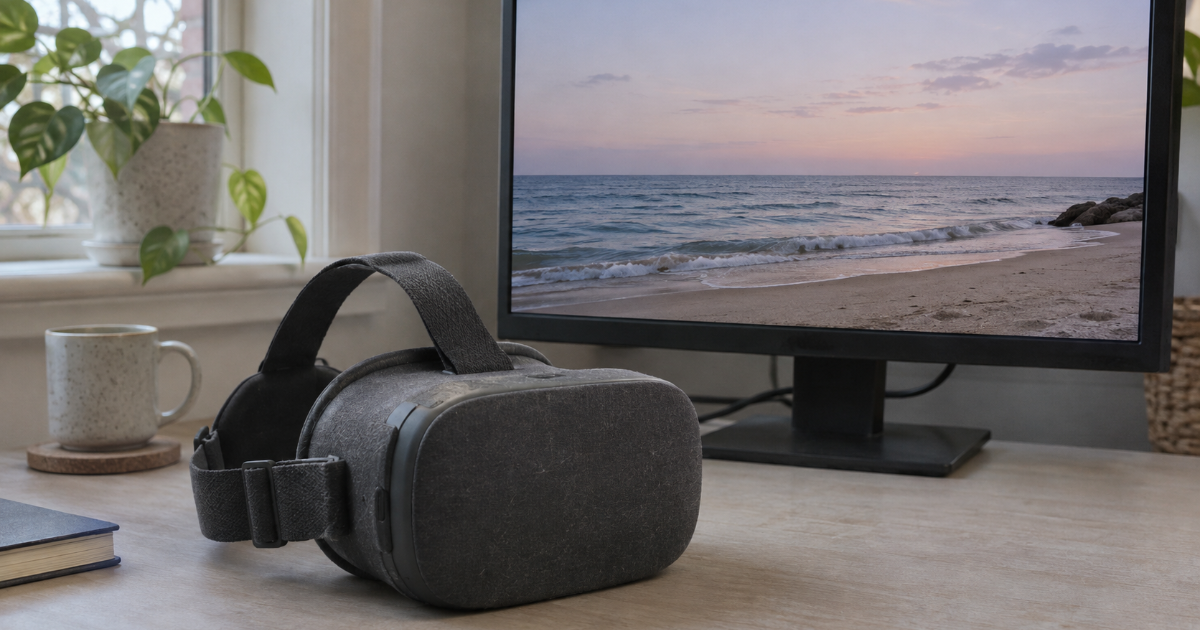
The researchers randomly assigned 100 adults to three groups. One listened to a 10-minute guided breathing meditation. The other two followed the same audio while watching a beach video, either on a monitor or through a VR headset.
The monoscopic 360-degree video showed waves and a beach at sunset, without scene changes. In VR, participants could look around by turning their heads, but could not interact directly with the environment. The researchers collected questionnaire responses and physiological measures, including heart rate, heart rate variability, skin conductance and respiration.
The experiment did not compare watching a VR beach with doing nothing. It examined whether adding beach imagery to breathing meditation offered an extra benefit, and whether presenting that imagery as a surrounding environment added more.
Feeling there did not mean relaxing more
Participants in the VR group reported greater immersion and presence than those watching on a monitor. Yet the study found no clear evidence that adding VR increased the relaxation benefit. Relaxation-related changes occurred over time, but the expectation that greater immersion would produce greater benefits was not supported.
Presence describes the experience of feeling that you are in a particular space. Relaxation concerns a reduction in tension. A vivid impression of the sea unfolding before you does not, by itself, establish that your body has become correspondingly more relaxed.
A response such as “It felt as if I were there” matters when evaluating how well a video conveys a sense of place. For content intended to support rest, however, that impression and the relaxation outcome need to be assessed separately. An enthusiastic reaction immediately after viewing does not necessarily mean the content has fulfilled its purpose.
Questions for makers of relaxation videos
For video producers, the findings raise a practical question: what makes a good relaxation video? Clear imagery and a wide field of view can be production goals. If the aim also includes helping viewers release tension, the evaluation needs to address that purpose.
When images and spoken guidance play together, for example, producers can examine where viewers are expected to direct their attention. Does looking around the landscape fit naturally with focusing on one's breathing? These are questions to consider when designing content. The experiment did not establish the effectiveness of any particular production technique.
Saying that a video is better because it is presented in 360 degrees may not provide a sufficient reason to choose that format. Producers need to explain what viewers gain from it. For relaxation content, evaluation could consider how comfortably people begin and end the experience, alongside the strength of their sense of presence.
The findings do not apply to every VR relaxation experience
Participants were predominantly young, healthy university students, and many had previous experience with relaxation techniques. The researchers did not induce stress before the intervention. Missing physiological data may have limited the detection of small effects, and the reliability of the relaxation questionnaire was another limitation.
The findings should therefore not be restated as “VR does not help people relax.” The study examined a single session combining a particular beach video with breathing meditation. It does not settle what happens with other audiences, different content or repeated use.
The ability to bring a beach into view and the ability to help someone rest need separate evaluation. To explain the value of immersive video, we need to ask both how lifelike it feels and what difference that experience makes in everyday life.