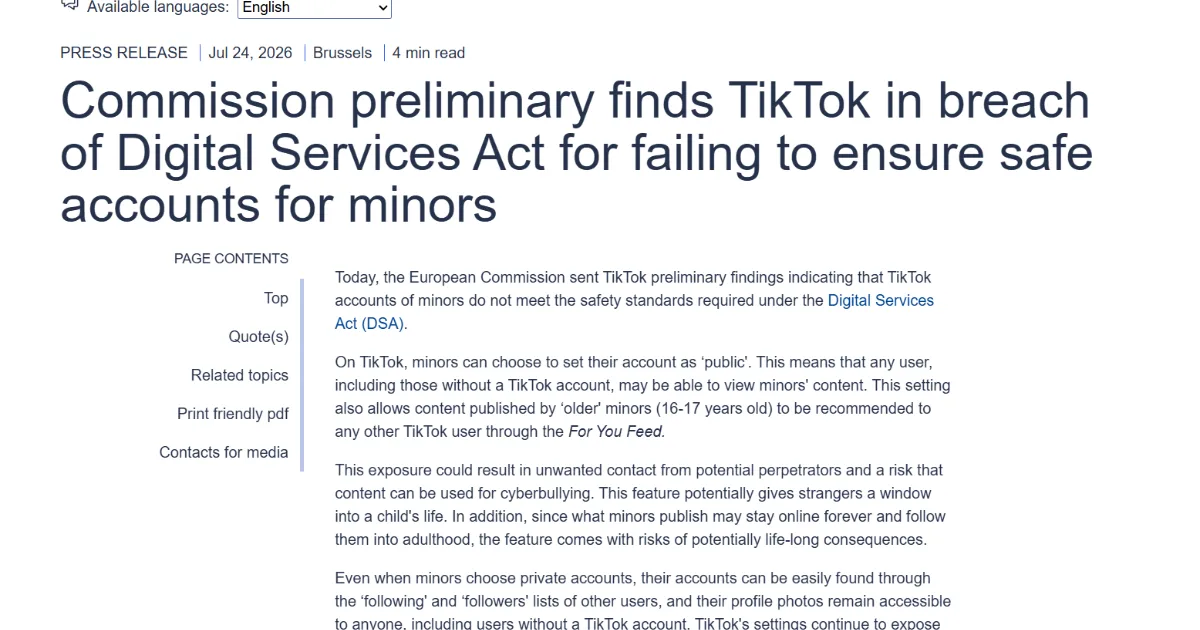
The European Commission has sent TikTok preliminary findings under the Digital Services Act.
The issue is minor accounts.
According to the Commission, minors on TikTok can set their accounts to “public.” When they do, their content may be visible not only to other TikTok users, but also to people who do not have TikTok accounts. The Commission also found that content posted by “older minors,” meaning users aged 16 and 17, may be recommended to other TikTok users through the For You Feed.
On the surface, this looks like a dispute over account settings.
But the meaning is larger.
The European Union is not only asking whether TikTok removed harmful content after it appeared. It is asking how minor accounts are configured, who can see children’s content, how profile information remains discoverable and how recommendation systems amplify that content.
In other words, platform regulation is moving from content to design.
The question is no longer only what children post.
It is how the platform is designed to show children’s posts to others.
How easily can strangers discover minors?
How widely can a child’s content travel?
Are profile photos, follower lists and recommendation feeds part of the safety system?
The EU’s preliminary finding against TikTok is important because it treats child safety as a product-design problem, not merely a moderation problem.
A Public Account Is Not Just a User Choice
On TikTok, minors can choose to make their accounts public.
For TikTok, a public account is part of expression and discovery. Teenagers may want their videos to be seen by a wider audience. Dance clips, music edits, vlogs, humor, fan videos, school-life posts, fashion clips and gaming content can all become part of social identity and peer recognition.
The platform also benefits from public content.
Public videos increase engagement, discovery and time spent on the app. TikTok’s growth model depends heavily on users posting content that can travel beyond their immediate social circle.
But the EU sees this structure differently when minors are involved.
A public minor account can become a window into a child’s daily life. It can enable unwanted contact, cyberbullying, grooming or predatory behavior. Content posted by a teenager may remain online long after the teenager understood the consequences of sharing it.
A minor’s choice is not the same as an adult’s choice.
Teenagers may not fully understand the long-term risks of public exposure. The immediate reward of attention, likes and comments can feel more important than future privacy, reputation or safety risks.
That is why the EU does not treat public account settings for minors as a simple matter of individual preference.
The default design matters.
Privacy Protection Starts With Defaults
The Digital Services Act requires platforms accessible to minors to provide a high level of privacy, safety and security.
The Commission’s preliminary view is that TikTok’s account settings fall short of that standard because minor accounts and content can be too widely exposed. The Commission stated that platforms should provide the strongest privacy, safety and security settings by default for minors.
This changes the direction of platform responsibility.
In the past, many platforms relied on users to change settings themselves. A user might begin with a public account and then switch to private if they wanted more protection.
For minors, the EU is pushing the opposite logic.
The safest setting should be the default.
If a minor expands visibility, the system should still remain designed around safety.
This is the principle of privacy by default.
Children should not be expected to avoid risks on their own. Platforms should reduce exposure from the first moment of account creation. Safety should not be hidden deep inside settings menus.
The EU’s concern is that TikTok’s design puts too much of the burden on children.
Even Private Accounts May Not Be Safe Enough
One of the notable parts of the Commission’s finding is that the concern does not end with public accounts.
The Commission said that even if minors choose private accounts, their profiles can remain discoverable through other users’ following and follower lists, and profile pictures can still be accessible to anyone, including people without TikTok accounts.
This shows a more granular approach to platform safety.
A private account does not automatically eliminate exposure. A username, profile photo, follower relationship, comment trail, recommendation connection, friend list, tag or shared link can all create discoverability.
The EU is treating the surrounding account architecture as part of child safety.
A child’s video may be private, but the profile photo may still be visible.
The account may be private, but the child may still be found through follower lists.
Social relationships may reveal context.
These pieces of information can become starting points for cyberbullying or unwanted contact.
Platform safety cannot be judged only by whether the main video content is public.
The entire exposure structure of the account matters.
The For You Feed Turns Visibility Into Amplification
TikTok’s core product is recommendation.
The For You Feed shows users content from accounts they may not follow. TikTok’s growth, virality and addictive experience are built around this recommendation system.
The EU’s preliminary finding specifically targets the possibility that content posted by 16- and 17-year-old users may be recommended to others through the For You Feed.
This is a major point.
A recommendation algorithm is the growth engine of a platform. But for minor content, that same engine can become a risk amplifier.
A teenager may think they are posting to friends, peers or a general TikTok audience. But algorithmic recommendation can push that content to strangers, adults, malicious users or potential predators.
The EU’s position suggests that minor content should not be treated like ordinary platform content.
Even if a teenager posts publicly, algorithmic amplification creates a different level of risk. There is a difference between someone visiting a profile and an algorithm pushing a minor’s content to an unknown audience.
This distinction may become central to future child-safety regulation.
Public does not necessarily mean recommendable.
Why Global Public Access Is Risky
The Commission was especially concerned that minor content could be accessible to a global audience outside the platform.
That is a strong position.
The EU appears to accept that older minors may have some ability to share with a wider audience inside TikTok. But it says this content should not be accessible to the global audience beyond the platform.
This distinction matters.
Being visible to TikTok users is different from being accessible on the open web without an account. The latter increases risks of search, copying, screenshots, external sharing, archiving and reposting in other contexts.
A child’s content can leave the platform environment.
It can move into forums, hostile communities or other websites.
It can be used for mockery, harassment, sexualization, doxxing or coercion.
And once content spreads, it is hard to recover.
For minors, online content is not merely a temporary post.
It can become a long-term trace.
The EU is treating that permanence as part of the safety risk.
Platform Regulation Is Looking at Design, Not Just User Choice
TikTok can argue that users choose whether to make their accounts public.
But the EU’s approach is different.
For minors, user choice does not erase platform responsibility. The platform must design choices in a way that keeps children within safer boundaries.
That is one of the most important directions of the Digital Services Act.
Platforms are not neutral containers. They set defaults, design interfaces, operate recommendation systems and decide how far content can travel. User behavior is shaped by these design choices.
If children choose public accounts, regulators may still ask:
Did they understand the risk?
Was the risk clearly explained?
Was the safer setting the default?
Did the platform minimize exposure?
Did the recommendation system unnecessarily amplify a child’s content?
Under this approach, “the user chose it” is no longer a sufficient defense.
That is especially true for minors.
The TikTok Investigation Is Not Over
The Commission’s announcement is not a final decision.
It is a preliminary finding. TikTok can examine the Commission’s investigation file and respond in writing. The European Board for Digital Services will also be consulted. If the Commission ultimately confirms non-compliance, it can issue a decision and impose fines of up to 6% of TikTok’s total worldwide annual turnover, depending on the nature, gravity, duration and recurrence of the infringement.
This finding is part of a broader formal investigation into TikTok opened on February 19, 2024. The investigation covers multiple issues, including protection of minors, addictive design, research data access, advertising transparency, recommender-system risks and age-assurance concerns.
That matters because TikTok is not being examined only for isolated pieces of content.
The EU is examining the structure of the platform.
Account settings.
Addictive design.
Advertising transparency.
Researcher access.
Recommendation algorithms.
Age verification.
Minor safety.
All of these issues are being addressed within the same regulatory framework.
The DSA’s Target Is the Default Setting
This case shows how the Digital Services Act regulates platforms.
The DSA is not simply a law requiring platforms to delete illegal content. It requires very large online platforms to assess and mitigate systemic risks, including risks to minors. Algorithms, advertising systems, interfaces, account settings, transparency tools and risk assessments all become regulatory subjects.
In the TikTok preliminary finding, the key issue is the default.
Platforms must design minors’ accounts with the highest level of privacy, safety and security by default.
Even if public sharing is possible, the scope of exposure should be limited.
Minor content should not be open to the global internet by default.
It should not be pushed to strangers through the For You Feed.
This sends a message to the entire platform industry.
Safety is no longer only an after-the-fact process.
Deleting harmful content after reports is not enough.
Suspending accounts after harm occurs is not enough.
Telling parents where to find settings is not enough.
Telling children to be careful is not enough.
Platforms must be designed to be less dangerous from the beginning.
Child Safety Conflicts With the Platform Growth Model
TikTok’s success is based on openness and recommendation.
Users post short videos. The algorithm distributes them quickly. Even an account with few followers can suddenly go viral through the For You Feed. That is one of TikTok’s most powerful attractions.
For teenagers, the reward is strong.
A video spreads.
Likes arrive.
Comments appear.
Followers increase.
The feedback loop feels exciting.
But from a child-safety perspective, the same mechanism is risky.
A child’s content can reach strangers easily.
Teenagers may post more attention-seeking content.
Comments and sharing can lead to harassment.
Algorithmic spread is hard for the child to control.
Once the content travels, it is difficult to take back.
This is where platform growth and child protection collide.
The EU is saying that, in this collision, child protection must come first.
If that principle is enforced, TikTok will not be the only affected platform. Instagram, YouTube Shorts, Snapchat, X, Twitch, Discord, gaming communities and metaverse platforms may all need to reconsider how minor accounts, recommendation systems and profile visibility work.
The question will be the same everywhere:
How far can a child’s content travel by default?
This Is Not Only TikTok’s Problem
The EU’s finding matters for platforms outside Europe as well, including Korean platforms.
Korean teenagers actively use short-form video, social networks, gaming communities, fandom platforms, livestreaming, open chat services and metaverse platforms. In all of these environments, account visibility, profile exposure, friend lists, recommendation feeds, comments, direct messages and search visibility are directly connected to minor safety.
Korean platforms should ask the same questions.
Are minor accounts private by default?
Who can see profile photos?
Are follower and friend lists exposed?
Can minor content appear in recommendation feeds?
Can people without accounts view children’s content?
How are comments and direct messages restricted?
How is false age declaration handled?
Can adults easily discover minors through the platform design?
These questions are especially urgent for short-form and live services, where content spreads quickly and contact can happen immediately. By the time a harmful clip is reported and removed, screenshots and reuploads may already exist.
Platform regulation in Korea may also move from content deletion to design responsibility.
Minor protection cannot depend only on user reports and after-the-fact monitoring.
It must include defaults, recommendation limits, visibility controls, search restrictions and external-sharing rules.
Parental Controls Are Not Enough
Platforms often emphasize parental-control features.
Parents can connect to a child’s account, limit screen time, filter content or restrict messaging. These tools are useful.
But the EU’s approach suggests that parental controls are not enough.
Not every parent understands platform settings.
Not every parent understands digital risk.
Teenagers may bypass controls.
Users may lie about their age.
Settings may change over time.
Therefore, the platform itself must be safe for minors.
Even when parents do nothing, a child’s content and account information should not be overly exposed by default.
That is the core of the EU’s child-safety logic.
A high level of privacy, safety and security should not depend on parental technical literacy.
It should be built into the platform.
What TikTok May Need to Change
If the EU’s preliminary finding is confirmed, TikTok may need to change how minor accounts work.
The most important change would be the default visibility of public accounts held by minors. The Commission suggests TikTok should adjust the default settings of minors’ public accounts so that their content is visible only to TikTok users the minor has chosen to share it with.
The EU also suggests that content posted by minors should not be recommended to other users through the For You Feed. For older minors, a wider TikTok audience may be allowed, but global access outside the platform should not be allowed.
If implemented, this would significantly change the TikTok experience for minors.
Public accounts would become more limited.
Recommendation amplification would be reduced.
External web access would be restricted.
Profile and follower visibility could be redesigned.
Minor content would become less discoverable.
Some teenage creators may find this frustrating. They may lose opportunities to be discovered and grow.
But the EU is prioritizing safety over exposure.
The message is that minors should not be folded into the same platform-growth logic as adult creators.
Children’s Accounts Are Not Platform Growth Assets
The EU’s preliminary finding against TikTok shows where digital platform regulation is heading.
The issue is not merely that harmful content exists on TikTok. The issue is that minor accounts and content may be too easily visible to strangers, amplified through recommendation systems and discoverable even through surrounding profile information.
The standard for minor protection is changing.
Children should not have to find private settings themselves.
Parents should not have to change every setting manually.
Reporting and deleting harmful content after the fact is not enough.
Platforms must be designed to reduce risk from the beginning.
Minor accounts should receive the strongest protection by default.
Content visibility should be limited.
Recommendation algorithms should not push children’s content to unknown audiences.
Profile photos, follower lists and discoverability should all be treated as part of the safety architecture.
TikTok grew through openness and recommendation.
But children’s accounts should not be treated as raw material for platform growth.
Minors should be able to express themselves and participate online, but not through designs that expose them unnecessarily to strangers and the open internet.
The EU’s message is clear.
Platforms should not make more exposure the default for children.
Safety for minors should not be a feature hidden in settings.
It should be the design.