X is changing how it rewards creators.
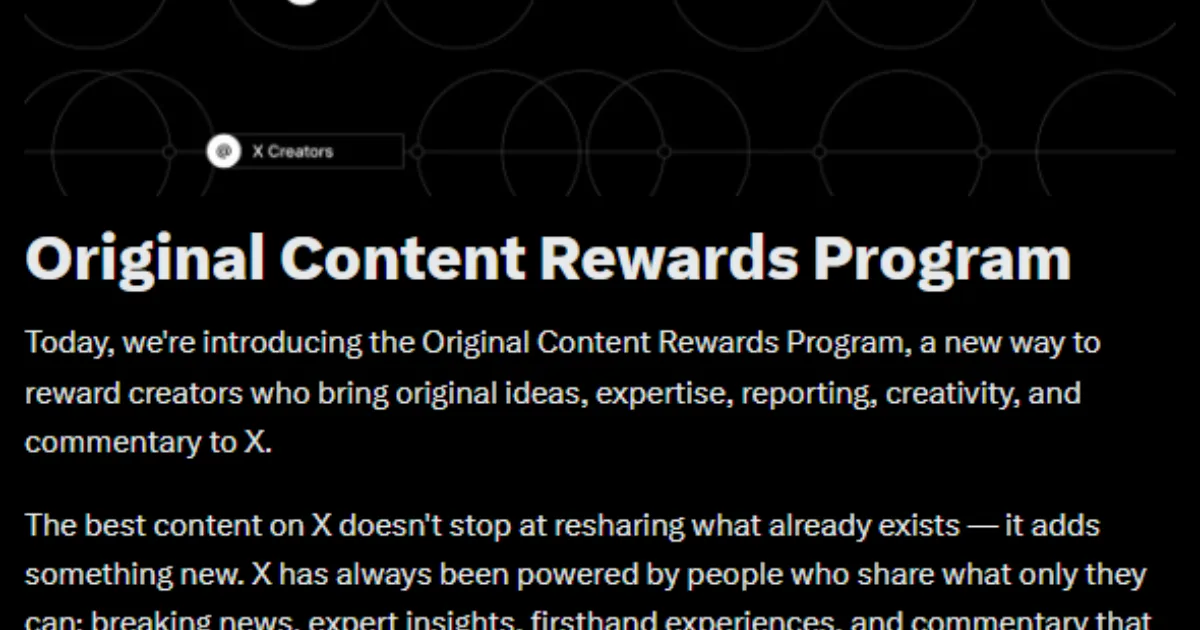
X Creators has introduced the Original Content Rewards Program, a new monetization structure designed to reward creators who bring original ideas, expertise, reporting, creativity and commentary to X. The company’s message is clear: the best content does not merely reshare what already exists. It adds something new.
That sentence captures the direction of the change.
X no longer wants simple reposts, copied videos, reuploaded content and view-hunting posts to sit at the center of its creator economy. Instead, it wants to reward content that only the creator can add: breaking news, expert insight, firsthand experience, commentary and creative interpretation.
The biggest change is the end of new enrollment in the old Revenue Sharing program.
X is no longer accepting new applications for Revenue Sharing. Existing participants can continue earning through the old program until September 7, 2026. After three final payout cycles, they will be able to apply for the new Original Content Rewards Program beginning September 8.
This is not merely an administrative update.
It is X redefining what kind of content it considers valuable.
For years, social platform rewards often centered on views and engagement. If a post was seen widely, received many replies and drove interaction, it could make money. But that structure created predictable side effects: accounts that copied other people’s content, reuploaded viral videos, summarized trending issues without adding value, begged for engagement or posted misleading content that attracted Community Notes.
X’s new program can be read as a response to that problem.
Views still matter.
But views alone are no longer enough.
The Limits of Revenue Sharing
X’s previous Revenue Sharing program paid creators based on platform activity around their content.
Such systems can energize a platform. Users post more often, respond more frequently and stay longer. Creators convert influence into income. Platforms attract content and strengthen advertising and subscription ecosystems.
But view-based rewards are easy to distort.
The fastest route to money may not be original creation. It may be copying someone else’s video, reuploading a viral image, repackaging a trending post, adding a shocking headline or producing a simple summary that triggers reactions.
On a real-time platform like X, speed can easily overpower originality.
The result is lower platform value.
People open X to see new information, fast analysis, firsthand experience, expert interpretation, original humor, memes and live reporting. But if the reward structure favors copying and reuploading, the platform fills with duplicates and low-quality engagement content.
That is why X says it wants to reward creators who make X worth opening every day.
The platform does not merely want traffic.
It wants original contribution.
How the Original Content Rewards Program Works
Under the new program, creators earn based on qualified impressions generated by their original content.
The definition of qualified impressions is important.
X defines them as unique impressions from Premium users, including X Premium Basic, Premium, Premium+, and Premium Business subscribers, in the Home Timeline. At least 50% of the post must be visible on screen.
Certain impressions are excluded.
Repeated views of the same post by the same account do not count multiple times. Paid promotion, artificial impressions and fraudulent impressions are excluded as well.
This structure has several implications.
First, the program is not based on total views. It is based on visibility among Premium users. X is trying to tie creator payouts to value inside its paid subscriber ecosystem rather than to raw attention from all users.
Second, the Home Timeline matters. Reply impressions are not central to eligibility. This suggests X wants to reward posts that stand on their own in the main feed, not accounts that farm exposure by replying under larger accounts.
Third, artificial manipulation is being pushed out. Bots, automation, engagement farming and paid manipulation become more directly opposed to the reward logic.
The new system narrows the reward criteria.
Who saw the content?
Where did they see it?
Was it actually visible?
Was the content original?
These questions become central.
The Eligibility Bar Is Higher
The Original Content Rewards Program also raises the entry bar.
Creators must be at least 18 years old and live in a country where the program is available. Their account must be in good standing, without repeated violations of X’s Monetization Standards or Terms of Service. The account must be either a personal or business account and must subscribe to X Premium, Premium+, or Premium Business.
There is also a follower requirement.
Creators need at least 500 verified followers. They also need at least 500,000 Home Timeline impressions from verified users over the previous 90 days, excluding reply impressions. They must also regularly post original content.
These are not small conditions.
X is not creating a system where anyone can immediately monetize. It is requiring account credibility, Premium-user exposure and ongoing original content production. After application, X reviews the account and provides a result. If rejected, creators can appeal once and may reapply later if the appeal fails.
This raises the monetization threshold.
Some creators will object, especially smaller accounts or emerging creators. But from the platform’s perspective, the goal is to reduce abuse and identify accounts that consistently add original value.
X is not widening the monetization door.
It is narrowing and reorganizing it.
What Does X Mean by “Original Content”?
The most important part of the announcement is the definition of original content.
X describes original content as content created by the creator that reflects their own voice, perspective, expertise and creativity. The format can vary. It may include written threads, Articles, reporting, analysis, firsthand photos and videos, original memes and graphics, or commentary that adds meaningful perspective to an existing conversation.
The core question is:
What did the creator add?
Using existing material is not automatically disqualifying. X emphasizes that commentary counts. Because X is built around real-time reaction and interpretation, existing posts, videos, images, screenshots and cultural moments can be the starting point.
What matters is whether the creator adds meaningful value: perspective, expertise, humor, context, analysis, reporting or creative transformation.
This definition is important.
X is not saying only entirely new subject matter counts as original. It recognizes that interpretation and recontextualization are central to the platform.
But simple reuploading does not qualify.
Downloading someone else’s content and posting it as one’s own is not enough. Adding subtitles, borders, watermarks, speed changes or crops generally does not create meaningful transformation. Simple explanatory summaries or minimal reactions may also lack originality.
This will affect the content ecosystem.
Copy-paste accounts become weaker.
Simple reupload accounts become weaker.
Analysis, commentary, firsthand experience, expert interpretation and original memes become more valuable.
X wants creators who add, not merely creators who bring.
“Commentary Counts”
X’s emphasis on “commentary counts” reveals the platform’s identity.
X is not only a place where traditional news organizations publish original reporting. It is a place where users react to events, analyze them, explain them, interpret them, satirize them and turn them into memes.
Commentary is core content.
That creates an opportunity for creators.
Not everyone can do original reporting. Not everyone can break news. But many people can interpret existing events through expertise, experience or perspective. A technology expert can explain an AI announcement. A finance expert can analyze market news. A lawyer can explain a court ruling. A developer can interpret a security incident. A writer can unpack a cultural moment.
X is saying that this can count as original content.
But the contribution must be meaningful.
Writing “this is huge” above a screenshot is not enough. Posting a screenshot with a short reaction is not enough. The value must come from the creator’s contribution, not mainly from the original material being reused.
This change favors creators with expertise and interpretive ability.
If the platform rewards perspective and context rather than speed alone, deeper content may gain more value.
Engagement Bait and Monetization Coaching Become Riskier
X also identifies categories that may be excluded from the program.
Copied or substantially reproduced content, downloaded and reuploaded content, automated content, inappropriate or sexually explicit content, and content that may harm viewers can be excluded.
One particularly interesting category is monetization coaching and monetization discussion.
X says content focused mainly on monetization tactics, payout maximization or how to game the reward system may be excluded. This appears designed to prevent the monetization program from feeding a self-referential economy of content about monetization itself.
When a reward system exists, content about how to earn more from the system quickly follows. Creators begin posting about algorithm tricks, engagement prompts, tactics for Premium impressions, reply strategies and payout screenshots. From the platform’s perspective, such content may optimize the reward system without adding real value to the broader conversation.
X appears to be trying to prevent that.
It also restricts engagement solicitation. Repeatedly asking people to like, reply, bookmark, follow or repost can damage program integrity.
In other words, X wants creators to be rewarded for the content itself.
It does not want creators to be rewarded for manipulating the reward system.
Community Notes Can Hurt Monetization
X also says content with a helpful Community Note may be ineligible.
This is significant.
Community Notes are one of X’s core mechanisms for correcting misleading or false content. By making posts with helpful Community Notes potentially ineligible for rewards, X is trying to prevent creators from monetizing misleading content.
That is a positive direction.
False or misleading content often generates high engagement. Shocking claims and biased interpretations can spread quickly. If monetization rewards that behavior, the platform ends up paying misinformation creators.
Still, implementation will be difficult.
Community Notes are not perfect. In politically or socially sensitive topics, Notes themselves can be contested. The process for determining whether a Note is helpful must be fair and transparent.
Even so, X’s decision to link monetization with information quality is meaningful.
The message is clear:
misleading content should not become a revenue strategy.
The Algorithm Problem Remains
For the new program to succeed, one problem is central.
X must be able to algorithmically identify originality and meaningful contribution.
User reactions to the announcement already point to this issue. Some users criticized the platform for repeatedly promoting the same large aggregator accounts that collect breaking news. Others noted that copied versions of X’s own announcement appeared under the original post.
This exposes the difficulty of the new policy.
A platform can say it wants to reward originality. But actual visibility is determined by the feed algorithm. If the algorithm continues to favor large aggregator accounts and sensational repackaged content, original creators may still struggle.
The success of the Original Content Rewards Program depends on three things.
First, X must identify original content accurately.
Second, it must exclude copying, reuploads and low-value summaries effectively.
Third, the Home Timeline recommendation system must actually give original creators exposure.
A reward program cannot be separated from the algorithm.
Money follows visibility.
Visibility is created by the algorithm.
The Meaning of Premium-User Impressions
The focus on Premium-user qualified impressions is also important.
X is tying creator rewards more closely to its paid subscriber ecosystem than to raw public view counts. If creators are paid based on unique Home Timeline views from Premium users, they have an incentive to create content that Premium users value.
This has advantages and risks.
The advantage is that it may raise payout quality. Premium users pay for the platform, so their attention can be treated as a stronger signal of platform value. It may also help reduce bot-driven or fraudulent impressions.
The risk is that the reward ecosystem may become biased toward Premium-user demographics.
If Premium adoption is lower in certain countries, languages or communities, creators in those areas may be disadvantaged. Content that matters deeply to free users may not translate into rewards.
Creators may also begin favoring topics and formats that perform well among Premium users.
Technology, finance, policy, U.S.-centered issues and English-language analysis may become more advantaged if those areas have higher Premium density. Local communities, minority languages, cultural content and public-interest information may be less favored.
If X wants to reward original content broadly, it will need to consider how to address these biases.
What Creators Need to Do
The new program makes the creator strategy clearer.
First, creators need a point of view. Sharing is not enough. They must add interpretation, analysis, experience or judgment.
Second, creators need original formats. Threads, Articles, videos, graphics, memes, reporting, photos and explainers should become recognizable parts of their identity.
Third, when using existing content, they must transform it meaningfully. Subtitles, summaries, watermarks and cropping are not enough. Context, expertise, humor, criticism or analysis must be added.
Fourth, engagement begging should be avoided. Repeatedly asking for likes and reposts is risky.
Fifth, creators should avoid exaggeration and misleading claims that could attract Community Notes. Monetization now connects more directly to information trust.
Sixth, automation and bots should be avoided. Artificial impressions and engagement manipulation can remove a creator from the program.
The central question for creators is simple:
What value did I add to this post?
If that question cannot be answered, the post may struggle under the new reward program.
Is This Also a Cost-Control Strategy?
Some users see the change as a cost-control move.
That suspicion is not unreasonable.
Ending new Revenue Sharing enrollment and applying stricter eligibility and originality requirements could reduce the number of creators who receive payouts. Requiring existing participants to move into a new program also gives X more control over who remains eligible.
Platforms want to reward creators.
But they cannot pay unlimited amounts. If payouts flow to low-quality content, copied posts or manipulated impressions, the system becomes unsustainable. Narrowing the criteria is therefore both a quality strategy and a cost-control strategy.
X presents the change as a move toward original content.
Creators will judge it by outcomes.
Who gets approved?
Who is rejected?
How much is paid?
Does the algorithm change?
The stated principle is originality.
Trust will be decided by payout results.
Lessons for Korean Creators
The change matters for Korean creators as well.
Creators hoping to monetize on X may find that simple translation, summaries of foreign posts, video reuploads and screenshot sharing become less viable. Those covering AI, technology, finance, politics or culture will need to add clear perspective and analysis.
Korean-language creators may face a challenge because Premium-user impressions may be lower than in English-speaking markets. That creates two possible strategies.
One is to build deep Korean-language expertise. A creator can become a trusted account for Premium users in a specific field.
The other is to produce English or bilingual content to reach global Premium users. Topics such as AI, semiconductors, K-content, Korean politics, Korean markets and platform industries may benefit from English-language explanation.
The key is not repackaging.
It is perspective.
A creator can use global news as a starting point, but should add Korean context, industry analysis, policy implications, investment perspective or firsthand experience. Simple translation and summary alone may not be viewed as meaningful original contribution.
For Korean creators, the change is both a burden and an opportunity.
Copy-paste accounts may struggle.
Analysts and interpreters may gain more room.
Can X Really Identify Originality?
The biggest question remains unresolved.
How will X identify originality?
It is difficult to determine whether content was created by the user, copied from elsewhere, meaningfully transformed, summarized too lightly or creatively interpreted. Memes, reactions, commentary, quotations and parody often sit near ambiguous boundaries.
AI-generated content adds another complication.
X says content generated or posted through automated means may be ineligible. But what about analysis written with AI assistance and edited by a human? What about a human-edited thread drafted with AI? What about AI-generated graphics with original human commentary?
The announcement does not fully answer those edge cases.
Originality is also distinct from copyright. X states that the Original Content Rewards guidelines are separate from its intellectual-property policies. A post may qualify as original for the program while still creating intellectual-property issues if the creator lacks rights or permissions.
That distinction matters.
Originality is a monetization standard.
Copyright is a legal standard.
They overlap, but they are not the same.
Creators need to understand both.
X Is Trying to Move Beyond the Copy-Paste Platform
X’s Original Content Rewards Program is a significant shift in creator monetization.
New enrollment in the old Revenue Sharing program is ending. Existing participants can earn under the old system until September 7, 2026, then apply to the new program beginning September 8. The new program rewards qualified impressions from Premium users in the Home Timeline and requires ongoing original content production.
X’s definition of original content is not limited to entirely new work.
Analysis, commentary, reporting, expertise, experience, humor and creative transformation can all count. But simple copying, downloading and reuploading, low-value summaries, automated posting, engagement bait and misleading content may be excluded.
The direction makes sense.
If a social platform pays for copy-paste posts, reuploads and low-quality viral content, its information quality can deteriorate quickly. Rewarding creators who add original value is necessary if X wants to remain worth opening every day.
But execution will be difficult.
X must identify originality.
It must avoid overrewarding large aggregator accounts.
It must make Premium-user-based payouts fair across language and region.
It must operate review and appeal processes that creators can trust.
It must apply Community Note-related exclusions fairly.
X wants a platform where people add ideas, information and creativity rather than simply importing other people’s work.
That is the right ambition.
But creators will watch the results.
Do original creators really earn more?
Or does originality become a justification for reducing payouts?
Does the algorithm surface new voices?
Do copy-paste accounts actually decline?
The Original Content Rewards Program is an opportunity for X’s creator economy to mature.
It is also a test of whether X can prove originality, reward and algorithmic trust at scale.
Saying that a platform rewards creators is easy.
The hard part is deciding fairly what real creation is.