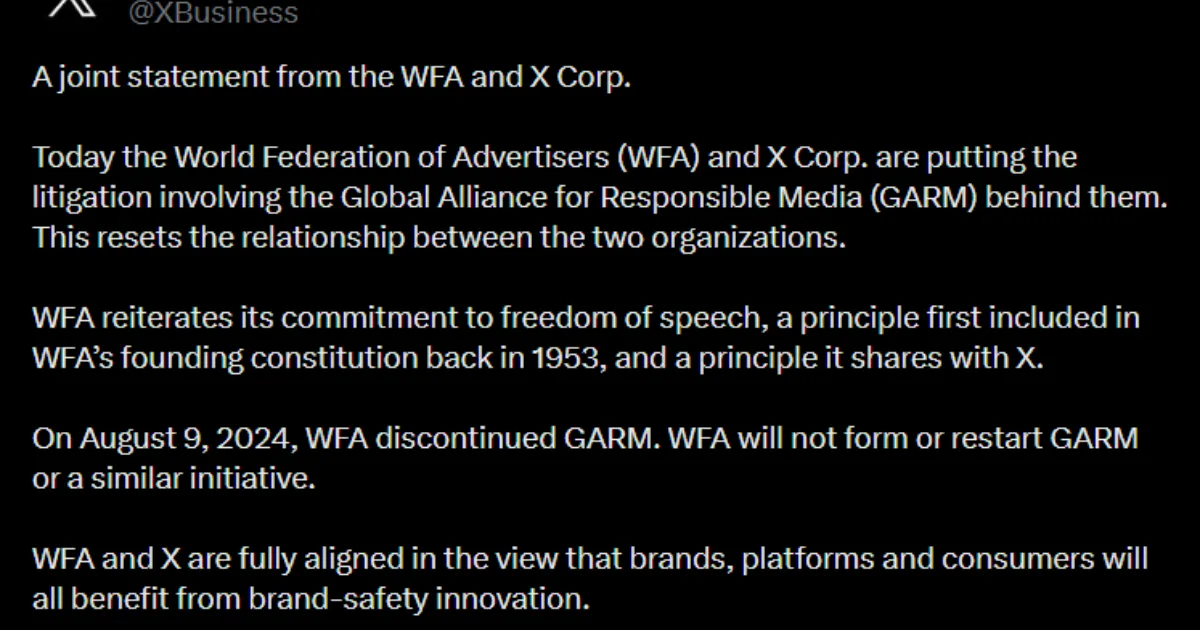
X Corp. and the World Federation of Advertisers have agreed to end their litigation over GARM.
On July 29, 2026, the X Business account published a joint statement from X Corp. and the World Federation of Advertisers, or WFA. The statement said the two sides would put the litigation related to the Global Alliance for Responsible Media, known as GARM, behind them and reset their relationship.
The statement was short.
But its meaning is significant.
The WFA reaffirmed its commitment to freedom of expression, a principle first included in its 1953 founding charter and described as one it shares with X. The WFA also stated that it had discontinued GARM on August 9, 2024, and that it would not create or restart GARM or any similar initiative.
The final line may be the most important.
The WFA and X said they were fully aligned that brands, platforms and consumers will all benefit from innovation in brand safety.
On the surface, this is a joint statement about ending litigation and restoring a business relationship.
But the deeper issue is the changing power structure around brand safety.
Advertisers do not want their ads to appear next to hate speech, violence, misinformation, extremism, sexual content or harmful content involving children. Platforms want to protect advertising revenue while also maintaining their own rules around speech and content moderation. Consumers want platforms to take responsibility for harmful content.
GARM was an attempt to address this complex issue at the level of the advertising industry.
Now GARM has been discontinued, and the WFA has said it will not revive or recreate a similar initiative. X has gained an important political and business victory.
But the brand safety problem has not disappeared.
The problem remains.
What is changing is how it will be handled.
What Was GARM?
GARM stood for the Global Alliance for Responsible Media.
As its name suggested, it was a global advertising industry initiative intended to create a more responsible media environment. Advertisers, agencies, platforms and industry groups participated in an effort to reduce the risk of digital ads appearing next to harmful or inappropriate content.
Brand safety is a very real issue for advertisers.
Companies spend enormous resources building brand trust. If their ads appear next to hate speech, terrorist propaganda, child exploitation, misinformation, violent content or extremist material, that trust can be damaged. Consumers may ask why a company is funding or appearing beside such content.
Advertisers therefore demand stronger controls and transparency from platforms.
For platforms, the issue is difficult. If they restrict content too aggressively, they face criticism over censorship and free expression. If they are too permissive, advertisers may leave. In an environment filled with algorithmic recommendations, user-generated content, live posts, comments, videos and short-form media, perfect ad placement control is extremely difficult.
GARM tried to address this problem through industry standards and common frameworks.
What content should be considered unsuitable for advertising?
How should platforms manage ad placement?
What level of risk should advertisers accept?
How should measurement and reporting work?
These were necessary questions for the advertising industry.
But GARM also became controversial. Critics argued that a coordinated advertiser initiative could become a form of collective pressure that excluded certain platforms or viewpoints from the advertising market.
The dispute between X and the WFA sat directly on that line.
X Objected to Advertiser Collective Action
In its GARM-related lawsuit, X focused on what it saw as collective action by advertisers.
From a platform’s perspective, if advertisers coordinate through shared standards and pressure a platform by reducing or stopping ad spending, that can look like more than ordinary brand management. It can look like a collective action that threatens the platform’s revenue base.
This mattered especially because X has positioned freedom of expression as a core part of its identity.
From X’s point of view, if an advertiser organization uses brand safety to influence platform content policy, that can conflict with freedom of expression. Advertisers have the freedom not to spend money on a platform. But if an industry alliance effectively coordinates pressure or encourages an advertising boycott, X’s argument is that the issue becomes more serious.
That is why the joint statement’s reaffirmation of freedom of expression is symbolic.
The WFA said the principle has been part of its founding charter since 1953 and is shared with X. This gave both sides a common basis for ending the litigation. The message is that brand safety and freedom of expression should not be framed only as opposing principles, but as values that must be considered together.
Still, the underlying tension remains.
Advertisers do not want their ads beside risky content.
Platforms do not want advertisers to control content policy too strongly.
Freedom of expression matters.
Brand protection also matters.
Consumers expect platforms not to ignore harmful content.
These four demands do not easily fit together.
What It Means That the WFA Will Not Restart GARM
The strongest sentence in the joint statement is the WFA’s commitment not to create or restart GARM or a similar initiative.
This is more than an organizational decision.
It means the industry-alliance model for brand safety has been weakened. It may become much harder for the WFA to gather advertisers and platforms under a similar framework to set and enforce common standards.
That creates a burden for advertisers.
Individual companies still need brand safety. But without a shared initiative, each advertiser must develop its own platform-by-platform standards, relying on agencies, ad-tech vendors and direct platform tools. Large global brands may have the internal capacity to do this. Smaller advertisers may struggle without common frameworks.
For platforms, the shift is favorable.
It reduces collective pressure and increases individual negotiation. A platform such as X can speak directly with advertisers and explain its own brand safety tools, policies and reporting systems. Platform-specific solutions become more important than shared industry standards.
For consumers and civil society, however, there is also a concern.
If common standards become weaker, transparency around harmful-content management may decline. If large platforms resolve issues through private contracts with individual advertisers, outside observers may find it harder to understand the standards and outcomes.
The end of GARM is not the end of brand safety.
It is a move from public standards toward private negotiation.
Brand Safety Still Matters
Brand safety will not disappear because GARM has ended.
In fact, the issue is becoming more complex as AI, recommendation algorithms, real-time content, short-form video and the creator economy expand. Ads are more precisely targeted. Content is produced faster. Platforms distribute massive volumes of user-generated material in real time.
Brand risk appears in many forms.
An ad appears beside hate content.
It runs before a misinformation video.
It appears on the same screen as extremist content.
It is connected to harmful content involving children.
It appears beside AI-generated manipulated media.
It is linked to politically inflammatory content.
A brand becomes involved in an influencer controversy.
Advertisers want to avoid these risks.
Global brands need especially fine-grained controls because culture, law and political sensitivity differ by region. Content that may be legal in one country may still be unsuitable for a specific brand. But excessive blocking can reduce ad reach and efficiency.
Brand safety is ultimately a balancing problem.
If controls are too loose, brands are exposed.
If controls are too strict, free expression and advertising efficiency suffer.
If common standards are created, collective-pressure concerns arise.
If everything is handled individually, transparency and consistency decline.
The X-WFA agreement does not solve this dilemma.
It changes the battlefield.
The New Language: Brand Safety Innovation
The joint statement ends with the phrase “brand safety innovation.”
That language matters.
The two sides are moving away from the language of litigation, boycott and collective pressure. They are reframing brand safety as a matter of technology and product improvement.
This framing is favorable to platforms.
Platforms can tell advertisers that they will provide better ad placement controls, content classification, keyword exclusions, contextual targeting, AI-based risk detection, transparent reporting and third-party verification tools. Brand safety then becomes a quality feature of the advertising product, not a demand imposed by an external organization.
Advertisers do not necessarily oppose this.
If brand safety tools become more precise, advertisers can reduce risk without blocking too broadly. Instead of avoiding all news content, for example, they may be able to avoid only content that is truly unsuitable for the brand. That can improve advertising efficiency.
The unresolved question is who sets the standard.
If AI judges content risk, is the standard transparent?
If the platform provides its own reports, can advertisers trust them?
Is third-party verification possible?
Who decides the line between free expression and brand safety?
Brand safety innovation is necessary.
But innovation should not replace accountability.
X’s Advertising Recovery Strategy
For X, the agreement is important for advertising recovery.
X emphasizes freedom of expression, but its advertising business depends on brand trust. If major global advertisers do not feel safe, advertising revenue is difficult to restore.
That means X needs to do more than end litigation with the WFA. It needs to send a signal to advertisers that its relationship with the advertising industry is normalizing.
The joint statement serves that purpose.
The WFA and X have reset their relationship.
The WFA has reaffirmed freedom of expression.
GARM will not be restarted.
Both sides agree on brand safety innovation.
This allows X to tell advertisers that it is no longer in direct conflict with a major advertiser industry body.
But a statement alone will not bring advertisers back.
Advertisers look at data. They want to know where their ads appear, how often they are placed near risky content, whether brand lift and conversion results are strong, whether advertiser controls are sufficient and whether the platform responds quickly during crises.
If X wants to lead in brand safety innovation, it must prove it through products and outcomes.
Trust is not restored by ending a lawsuit.
It is restored through advertising performance and verifiable safety.
Advertisers Still Have Questions to Answer
The WFA’s decision not to restart GARM does not reduce advertiser responsibility.
It may increase it.
Advertisers must now make more direct decisions.
Which platforms will they use?
Which content categories will they exclude?
What level of risk will they accept?
How will they verify platform brand safety tools?
How will they explain ad placement decisions to consumers, executives and shareholders?
When an initiative like GARM existed, advertisers could point to an industry-level framework. Without it, each advertiser must define its own principles and internal decision process more clearly.
This is especially important for global companies.
Advertising is money. Advertising budgets sustain platform ecosystems. Choosing where to advertise is not only a media-efficiency decision. It can be interpreted as a decision about which information environments a company is willing to fund.
Advertisers therefore need their own standards for the balance between free expression and brand protection.
A platform may allow certain content.
A brand may still decide not to appear next to it.
Advertisers must be able to explain that distinction.
Freedom of Expression and Advertiser Freedom
The joint statement emphasizes freedom of expression.
But the issue is complicated. Freedom of expression is usually about the user’s ability to speak on a platform. Advertisers also have a form of freedom: the freedom to decide where they place their money.
A platform can allow certain speech.
An advertiser can decide not to advertise beside it.
Consumers can criticize or support the platform.
Industry groups can set standards, but coordinated action may raise competition concerns.
These freedoms and responsibilities collide.
From X’s perspective, advertiser coalitions that economically pressure a platform can look like a threat to free expression. From an advertiser’s perspective, avoiding risky content environments is a legitimate brand-protection decision.
The issue is not simply whether advertisers leave.
The issue is how the decision is made.
Is it an independent decision by individual companies?
Or is it coordinated through an industry body?
Are brand safety standards objective and transparent?
Or are they being used to exclude certain platforms or viewpoints?
The X-WFA agreement moves this debate out of court.
But the social debate will continue.
AI Will Make Brand Safety Harder
Brand safety is likely to become even more difficult.
The reason is AI.
AI dramatically increases content production. Text, images, videos, memes, synthetic voices, deepfakes, automated comments and bot accounts can be generated at scale. Platforms must classify more content faster. Ad systems must decide which brands should appear beside that content.
AI-generated content is especially risky.
It can look normal while containing misinformation, hate, manipulated imagery, fake people or persuasive propaganda. Simple keyword filters may miss it because the danger depends on context. Overly aggressive filters may block legitimate content.
This is why brand safety innovation is needed.
Block lists and keyword exclusions are no longer enough. Platforms must understand context, analyze the meaning of images and videos, detect real-time risk signals and adjust exposure according to each advertiser’s sensitivity.
But saying AI will solve brand safety is also risky.
AI classifiers make mistakes. They may misunderstand political or cultural context. They may over-block certain groups or expressions. Platforms may use AI judgments to avoid responsibility.
AI-era brand safety is not only a technology problem.
It is a governance problem.
Lessons for the Korean Advertising Market
The X-WFA agreement also matters for the Korean advertising market.
Korean companies advertise on global and domestic platforms, including X, YouTube, Instagram, TikTok, Naver, Kakao, online communities, short-form platforms and influencer channels. Brand safety risks continue to emerge across politics, gender conflict, hate speech, misinformation, cyberbullying and harmful content involving minors.
Korean advertisers need more precise standards.
They should compare platform-level brand safety policies.
They should demand transparent ad-placement reporting.
They should prepare standards for AI-generated content and deepfake environments.
They should require responsible media-buying practices from agencies and platforms.
They should create response processes for cases where ads appear beside socially controversial content.
At the same time, collective action by advertiser groups must be handled carefully.
Common standards for brand safety may be necessary. But collective exclusion of a specific platform or content category can raise competition and free-expression concerns. In Korea as elsewhere, industry standards must be transparent, procedural and objective.
Brand safety is not a minor feature of advertising efficiency.
It is central to corporate reputation and social responsibility.
GARM Is Over, but the Brand Safety War Is Not
The joint statement from X and the WFA is short but important.
The two sides have agreed to move past GARM-related litigation and reset their relationship. The WFA reaffirmed its commitment to freedom of expression and said it would not recreate GARM or any similar initiative. X and the WFA said brands, platforms and consumers will all benefit from brand safety innovation.
This is a meaningful victory for X.
It ends a legal conflict with a major advertiser industry body, blocks the return of GARM and places freedom of expression inside the shared statement. It also creates a symbolic moment for rebuilding advertiser relationships.
But the fundamental brand safety problem remains.
Advertisers still need to protect their brands.
Platforms still need to balance harmful-content management and free expression.
Consumers still watch where companies spend their advertising money.
AI will make content production and risk classification more complex.
GARM is over.
But the brand safety war is not.
The battlefield has changed.
It is moving from collective initiatives and public pressure to platform technology, individual advertiser judgment, contract terms and transparency tools.
The question will no longer be only who talks about brand safety.
It will be who can make it verifiable.
The X-WFA reconciliation is not the end of the conflict.
It is the beginning of the next phase of brand safety governance.


