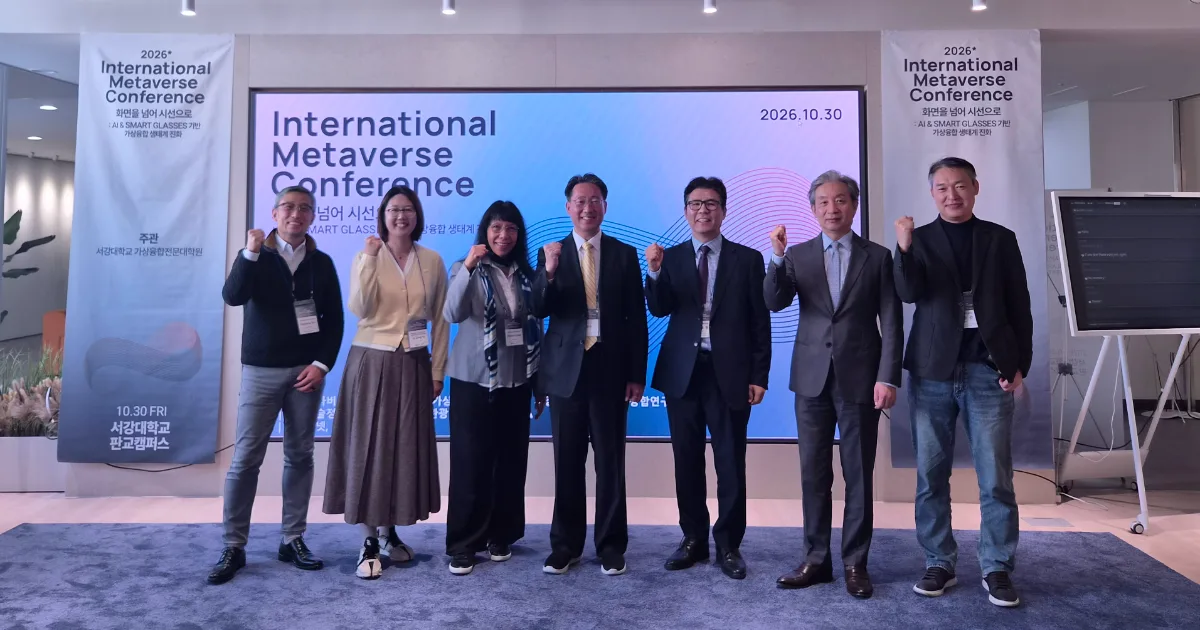
Hyun Dae-won, president of the International Metaverse Society and dean of Sogang University's Graduate School of Virtual Convergence, has identified smart glasses as the third major computing paradigm after personal computers and smartphones.
Hyun predicted that smart glasses would reach the point of replacing smartphones before 2030, while AI agents would emerge as a new intermediary layer connecting people with content, information, and services.
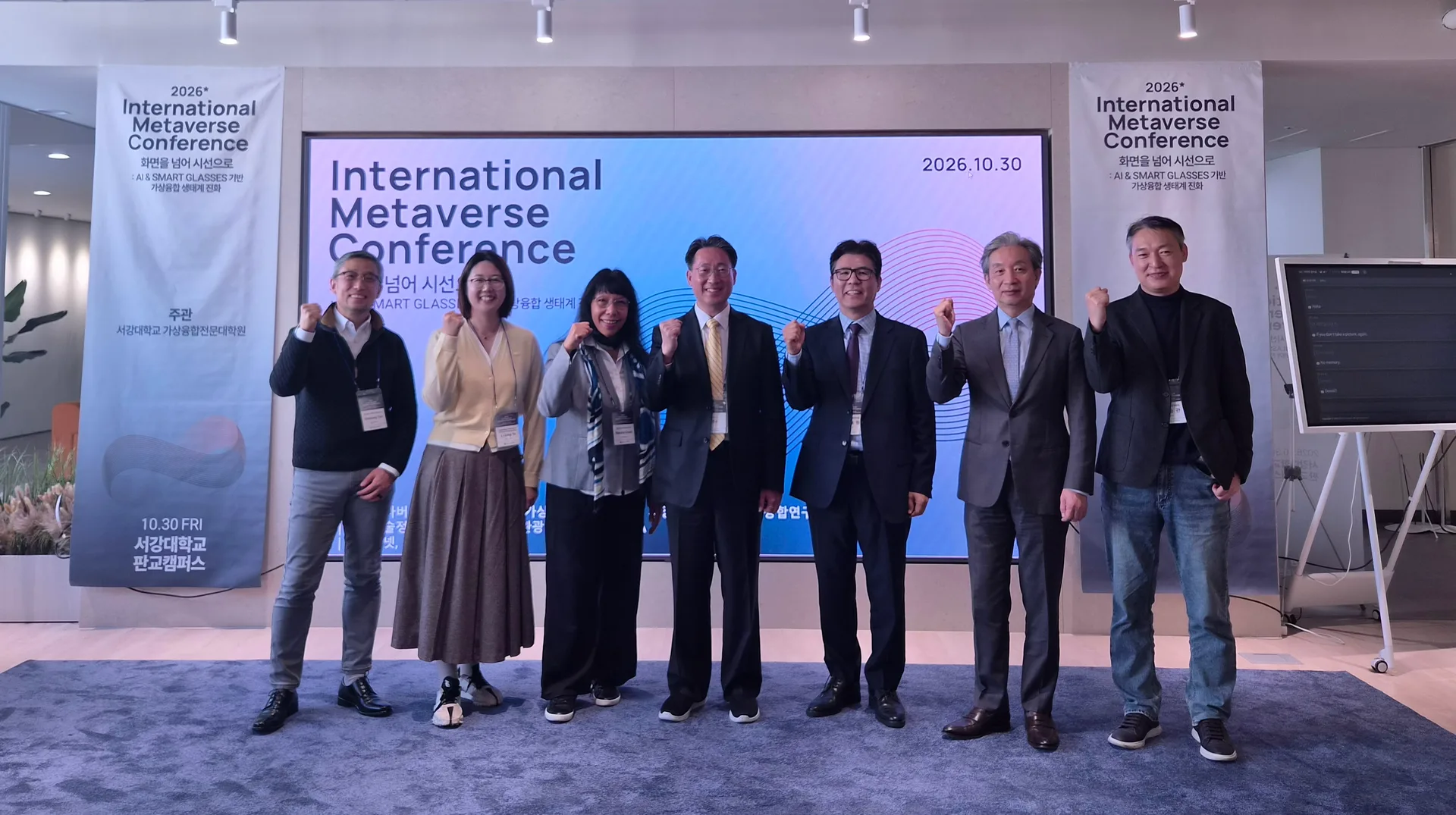
Speaking on October 30 at the 2026 International Metaverse Conference, held at Sogang University's Pangyo Digital Innovation Campus in Seongnam, Gyeonggi Province, Hyun delivered a keynote address titled "Smart Glasses and the AX Media Paradigm."
The conference was jointly organized by Sogang University's Graduate School of Virtual Convergence, the International Metaverse Society, and the Metaverse Convergence Research Institute.
This year's theme was "Beyond Screens, Through Our Gaze: The Evolution of the Virtual Convergence Ecosystem Powered by AI and Smart Glasses."
Before turning to the future of smart glasses, Hyun highlighted the growth of the graduate school.
"Our graduate school welcomed its first students in 2022 and has since grown into the largest organization of its kind, with 300 master's and doctoral researchers," he said.
"We began with the metaverse, but have now become a center for interdisciplinary research where AI and virtual convergence intersect."
After the Mouse and Touchscreen Comes the Gaze: Everyday Space Becomes the Internet
Hyun divided the evolution of computing into three stages: the PC, the smartphone, and smart glasses.
The PC era was defined by keyboards and mice.
Smartphones introduced touchscreens and mobile applications, allowing people to access digital services without being tied to a particular location.
In the smart glasses era, those interfaces will increasingly give way to more natural forms of interaction, including voice, gestures, and eye movements.
Hyun pointed to the mouse as an example of how interface innovation can transform access to technology.
"Before the mouse, only people who understood machine commands could access information," he said. "But after 1992, anyone who knew how to use a mouse could reach an enormous repository of information."
Just as web browsers helped bring the internet revolution into mainstream use, Hyun argued that smart glasses are now creating the conditions for another major transition.
"We are undergoing a complete paradigm shift in which everyday physical space itself becomes a new internet," he said.
Hyun drew parallels between the early smartphone market and the emerging smart glasses industry.
After Apple introduced the iPhone in 2007, he noted, the market took several years to gain significant momentum.
Samsung Electronics entered the market in 2009, while app stores and Android's application marketplace helped establish the services and ecosystems that accelerated growth.
By 2010, the smartphone market had entered a period of rapid expansion.
Hyun expects smart glasses to follow a very different development path from head-mounted displays, or HMDs.
The key difference, he argued, is the technology driving adoption.
Unlike earlier HMD products, whose commercial success depended on compelling immersive experiences, smart glasses are being propelled by AI.
"The moment you put on smart glasses, a conversation with AI begins," Hyun said.
"Listening to and viewing information retrieved by AI is a completely different experience from putting on a heavy HMD and entering a virtual environment."

Shipments Surge 263% as Prices Fall: Chinese Optical Companies Could Reshape the Market
Citing statistics from Counterpoint Research and IDC, Hyun presented market figures indicating rapid growth in AI glasses.
According to the figures he referenced, AI glasses shipments increased 263% year over year in 2025.
Display-equipped AR AI glasses recorded growth of approximately 450%.
At present, however, roughly 96% of AI glasses are display-free devices.
Hyun attributed this market structure partly to Meta's strong position in the category and the availability of predominantly display-free models in South Korea.
Prices, meanwhile, are expected to move in the opposite direction from shipments.
Hyun cited forecasts suggesting that device prices could fall from around $400 to approximately $230 by 2030, a reduction of about 40%.
"As we experienced with PCs and smartphones, an environment in which functionality increases exponentially while prices actually decline will accelerate adoption," he said.
Hyun also identified Chinese companies as a potentially important force in the emerging competitive landscape.
Meta, Google, Samsung, and Apple have previously competed in the HMD market.
In Hyun's assessment, Samsung withdrew relatively early because of limited commercial prospects, Apple has effectively stepped back, and Meta has continued competing despite significant challenges.
He predicted that Chinese companies with strong optical technologies could contribute substantially to the expansion of the smart glasses market.
"The rapid progress of Chinese companies built around optical technology will make an important contribution to the growth of the smart glasses market," he said.
From Companion Device to Smartphone Replacement to Computing Platform
Hyun outlined three stages through which he expects smart glasses to evolve.
He said he personally uses four different types of smart glasses, including Meta products with and without displays and devices manufactured by Chinese companies.
The first stage is the companion phase.
At this stage, smart glasses provide smartphone functions without requiring users to take their phones out of their pockets.
AI queries, photography, music playback, navigation, and translation are already possible.
Hyun considers the current market to be in this phase.
The second stage is substitution.
Smart glasses begin replacing smartphones by supporting calls, information searches, content consumption, and content creation.
With multimodal AI and AI agents integrated into the devices, users will be able to carry out increasingly complex tasks without relying on a smartphone screen.
The third stage is the emergence of a new computing platform.
Spatial computing and context-aware AI become central capabilities, and new platform businesses develop around smart glasses.
Hyun predicted that if these developments continue over the next two to three years, smart glasses could reach smartphone-replacement capabilities before 2030.
Users might still carry a small auxiliary device for connectivity, he suggested, but they may no longer need to purchase a conventional smartphone.
He also acknowledged that the transition would not happen overnight.
Just as feature phones and smartphones coexisted for five to ten years, smart glasses and smartphones are likely to remain in use alongside one another for a considerable period.
“Mass Adoption Is Multiplication, Not Addition. If Trust Is Zero, the Result Is Zero.”
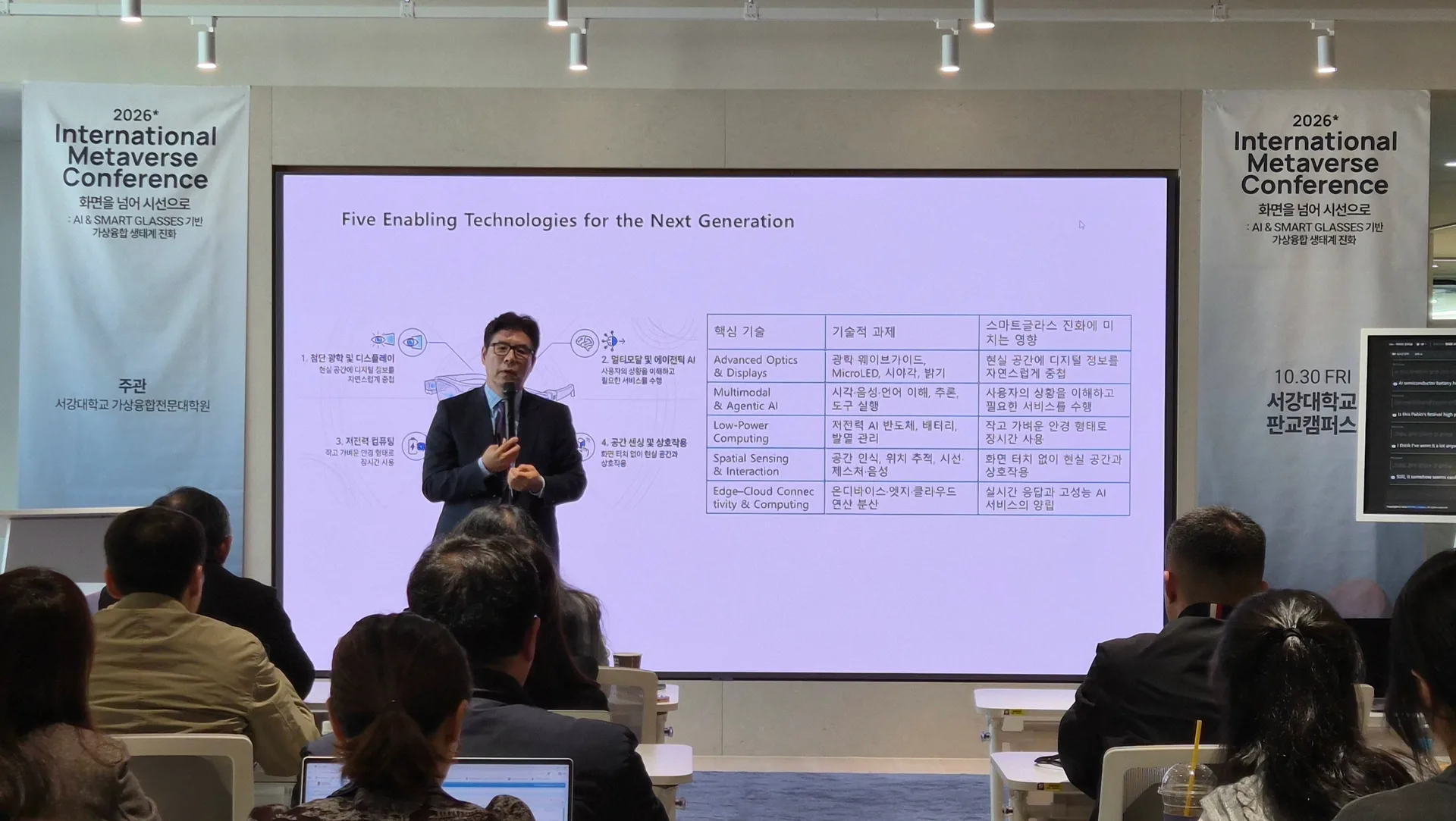
Hyun identified five essential technological foundations for smart glasses.
He argued that the technology is closer to commercialization than many people expect, although significant improvements are still needed.
The first foundation is optics.
Optical systems allow digital information to be overlaid naturally onto physical environments.
The technology has advanced enough to support applications such as displaying navigation directions within a user's field of view or presenting speech scripts through a built-in teleprompter.
The second is multimodal and agentic AI.
By combining perception, speech, language understanding, and reasoning, AI systems can interpret users' circumstances and perform relevant services.
The third is low-power computing.
Hyun said low-power AI semiconductors, batteries, and thermal management have improved considerably.
"Even after wearing them for around three hours while moving around, they feel little different from ordinary glasses, without headaches or dizziness," he said of his experience.
He added that products released in the second half of the year are approaching the appearance of conventional eyewear.
The fourth is sensing and interfaces.
This includes spatial awareness, location tracking, eye tracking, gesture recognition, and voice recognition.
Hyun considered this the area requiring the most urgent improvement.
He described repeatedly practicing Meta's wristband-based gesture interface, but said the present experience remained too difficult for straightforward mass adoption.
The fifth is edge-cloud integration.
Smart glasses must be able to move seamlessly between on-device processing and large-scale cloud computing.
Beyond these technical foundations, Hyun identified four conditions necessary for widespread adoption: utility, usability, trust, and ecosystem development.
For utility, the central requirement is a compelling killer application.
Hyun argued that HMDs struggled commercially because they never developed an application with enough appeal and repeat value to make people want to use an uncomfortable device again and again.
Usability requires further improvements in weight, battery life, and price.
But Hyun regarded trust as the most fundamental challenge.
Cameras built into smart glasses have already triggered substantial privacy concerns.
He cited a recent parliamentary audit in South Korea, during which a lawmaker demonstrated the recording process by having an aide wear smart glasses, even though the relevant market had not yet reached full-scale commercialization domestically.
Hyun acknowledged the importance of recognizing potential harms.
However, he cautioned that excessive concern could delay early adoption.
He argued that governments must strike a balance between promoting technological development and establishing appropriate regulation.
Hyun rejected proposals to solve privacy concerns simply by removing cameras from smart glasses.
"Smart glasses without cameras are like people walking around with their eyes closed," he said.
Instead, he argued, the industry must find ways to overcome privacy and ethical barriers while retaining camera capabilities.
He described the relationship between the four adoption conditions as a multiplication rule.
"Even if utility, usability, and the ecosystem are excellent, if trust is zero, the result is zero," he said.
"The formula for mass adoption is multiplication, not addition."
“The Metaverse Is No Longer a Place You Enter, but Intelligence You Experience”
Hyun emphasized that although the metaverse and smart glasses may appear closely related, their underlying experiences are different.
The traditional metaverse is often associated with entering a virtual world.
Smart glasses, by contrast, add new services and digital intelligence to the physical environments in which people already live.
In a conventional virtual environment, users navigate and explore directly.
With smart glasses, AI increasingly mediates the experience by interpreting the user's context and intention.
"Once you put on the glasses, global frontier models are operating in the background, and AI agents are available 24 hours a day," Hyun said.
"It's like having the genie from the magic lamp constantly waiting beside you."
He connected this development to the original vision of Sogang University's Graduate School of Virtual Convergence.
"From the beginning, our graduate school did not define the metaverse simply as a three-dimensional space that people enter," he said.
"We defined it as extended reality in which the physical and virtual worlds are connected and integrated. That vision is now being realized through smart glasses."
From Webpages to Physical Reality, From Search to Context, From Apps to Agents
Hyun predicted that smart glasses would transform the internet in three fundamental ways.
The first is the transition from webpages to physical reality.
When users look at a building, relevant information could appear within their field of view.
When they look at a museum exhibit, explanations and related content could be presented directly alongside the object.
"The world seen through your glasses becomes the webpage itself, rather than a space contained within a screen," Hyun explained.
The second is the transition from search to context.
Rather than requiring users to enter search terms and inspect results, AI will increasingly interpret their intentions, retrieve relevant information, and assemble content for them.
Hyun described this approach using the concept of a "semantic outcome," meaning a composed result.
"If you ask AI to find news articles, it may not simply retrieve an article from a particular media outlet," he said.
"Instead, it will read multiple articles and reconstruct the information. Readers will be able to understand the flow of news without reading the individual articles themselves."
The third is the transition from applications to agents.
People will no longer need to locate and operate every application or content service directly.
AI agents will increasingly act as intermediaries.
Hyun illustrated the idea through Chunhyangjeon, a classic Korean literary work.
In the story, Chunhyang and Lee Mong-ryong communicate through intermediaries, including Hyangdan and Bangja.
Hyun suggested that AI agents would assume a similar role in the digital world.
"The intermediary roles once played by Bangja and Hyangdan will now be performed by AI," he said.
"The way we communicate, the way we conduct business, and the way we interact with media will all change."
The First Audience for Content Will Be AI: From SEO to AIO
Hyun predicted that spatial media, context-aware media, and interactive media would become increasingly important.
As more content becomes connected to physical locations and environments, he argued, both content businesses and related commercial activities could undergo fundamental change.
At the center of this transition is a new intermediary layer between people and media: the personal AI agent.
Until now, people have searched for, explored, and selected content themselves before consuming a finished product.
In the emerging model, AI agents will increasingly discover, curate, and compose content.
Hyun warned that this could fundamentally change the relationship between media producers and audiences.
"People will think they have seen the original content, but what they are actually consuming may be an AI-reconstructed result presented as though it were the original," he said.
He called on media companies to rethink how they plan, produce, and distribute content.
"In the past, the primary target audience for content was human beings," Hyun said.
"Now, it is AI agents."
He argued that media companies must move beyond search engine optimization, or SEO, and understand AI optimization, or AIO.
The objective is no longer simply to make content visible to search engines.
It is increasingly important to make content discoverable and usable by AI agents that select, interpret, and assemble information on behalf of users.
"If content providers do not understand how to attract the attention of AI agents, their content strategy may be misguided from the planning stage," he warned.
Hyun described AI transformation as affecting the entire media value chain, from production and distribution to consumption and monetization.
In production, the industry is moving from creator- and studio-centered workflows toward collaboration between humans and AI.
AI will participate throughout planning, preproduction, production, and postproduction.
In distribution, AI will acquire substantial influence as an intermediary responsible for discovery and curation.
In consumption, contextual experiences will become increasingly important, moving beyond ordinary personalization toward hyper-personalization.
In monetization, these changes will create opportunities for entirely new business models.
Hyun expects smart glasses to accelerate this transformation.
"When people put on smart glasses, the first thing they will do is call the AI agent connected to them," he said.
"They will discuss their schedules, the weather, major news stories, and trending topics on social media with AI. Their dependence on AI will inevitably increase."
“The Frontier Model Race Is Already Over. Korea Must Compete Through Applications and People.”
Hyun concluded his keynote by outlining a strategy for South Korea.
He argued that the country has an opportunity to establish a globally competitive smart glasses ecosystem.
However, he expressed skepticism about Korea's prospects in the competition to develop the world's most advanced frontier foundation models.
"The frontier model game is already over," he said.
"No matter how hard we try, the gap is widening rather than narrowing."
Hyun argued that the capital and human resources being committed to frontier AI development have reached a scale that South Korea cannot realistically match.
At the same time, he acknowledged the importance of the government's efforts to develop independent foundation models and sovereign AI capabilities.
"AI is central to global competition for technological dominance and national sovereignty," he said.
"If the United States were to cut off AI supplies and we had no alternative, that could become a threat to national security."
However, Hyun argued that domestically developed models should complement global frontier models rather than attempt to replace them entirely.
His preferred strategic focus was the application ecosystem.
South Korea already possesses substantial strengths in semiconductor manufacturing, smartphones, and other advanced devices.
Korean consumers are also highly capable of adopting and using emerging technologies.
Hyun argued that the combination of device manufacturing capabilities and rapid technology adoption could become a major competitive advantage.
"When technological adoption capabilities and device capabilities come together, Korea has every opportunity to lead the global market in applications," he said.
"Smart glasses are precisely the market that can drive that ecosystem."
Ultimately, Hyun emphasized that people would remain the country's most important source of competitiveness.
"South Korea's greatest competitive advantage is its people," he said.
"And developing people should be the government's most important policy."
He ended the keynote on a humorous note.
"So, the conclusion is that you should continue giving Sogang University's Graduate School of Virtual Convergence your full support."
Conference Examines Smart Glasses, AI Copyright, and AX Healthcare
The 2026 International Metaverse Conference continued with a series of discussions examining the convergence of AI, smart glasses, digital rights, and healthcare.
The morning program included opening remarks by Professor Makana Chock of Syracuse University in the United States, a keynote presentation by South Korea's Ministry of Science and ICT, Hyun's keynote address, and a panel discussion moderated by Professor Seokkeun Lee of Sogang University.
Three thematic sessions followed in the afternoon.
AX Media and Smart Glasses
The first session examined how the adoption of smart glasses could transform media and industrial applications.
Professor Makana Chock discussed how cultural differences influence privacy concerns during the adoption of AI-powered smart glasses.
Professor Li Zong Ya of Huazhong University of Science and Technology in China explored the transition from anthropomorphic appearance toward anthropomorphic identity.
Kyung-seok Jung, a director at Episode Company, examined changes in content production and marketing in the AI era.
Joon-hee Cho, CEO of Innosimulation, discussed the factors required for extended reality to move beyond demonstrations designed to impress audiences toward practical, widely used applications.
The session also examined the evolution of AI agents in real-world settings, connecting developments in agent technology with ontology-based data platforms and neural processing units.
Professor Taehoon Kim of Sogang University moderated the discussion.
Copyright and Digital Rights in the Generative AI Era
The second session focused on copyright protection technologies and policy challenges arising from the spread of generative AI.
Professor Giwoong Yun of the University of Nevada, Reno, presented an approach to improving AI literacy through competition-based learning.
Sogang University researchers introduced several technical approaches to copyright protection and digital content identification.
Jihoon Kim presented technology for protecting copyright in 3D Gaussian Splatting models.
Jawon Kang discussed research on identifying generative AI video engines through traces left in generated videos.
Dongheon Cho presented techniques for retrieving and identifying original footage from edited videos.
Kiyoon Kim of Sungkyul University outlined policy approaches for expanding the adoption of safe AI guidelines in schools.
The discussion was moderated by Professor Seunggwan Choi of Sogang University.
AX Healthcare
The third session explored the intersection of virtual convergence technologies with AI applications in healthcare and defense.
Taehoon Kim, a research director at Infmedics, introduced a medical AI-agent platform within the virtual convergence technology ecosystem.
Jonghyung Park, CEO of Meninblocks, discussed hospital electronic medical record automation and potential paradigm shifts in clinical environments during the era of medical superintelligence.
Jukyung Lee, a principal researcher at the Korea Research Institute for Defense Technology Planning and Advancement, presented an AI platform designed to manage soldiers' mission performance capabilities using biomedical signals.
Professor Sanghoon Park of Sogang University moderated the discussion.
The conference concluded with the International Metaverse Society sharing publication updates and future plans for its academic journal, Journal of Virtual Convergence.