Wu, E.-H., Liu, Y.-Q., Xu, T.-C., Ren, L.-X., Qin, Y.-M., Wei, M.-Y., He, X.-W., Yuan, D.-Y., Hou, W.-C., Ma, Z.-W., & Sheng, B. (2026). Physical AI: Evolution, progress, challenges, and prospects. Journal of Computer Science and Technology, 41(1), 271–288.
10.1007/s11390-026-6258-x
Physical AI is an integrative AI paradigm that enables intelligent systems to understand physical laws, generate physically plausible worlds, and perceive, reason, and act in real environments.
Artificial intelligence is moving beyond the generation of text and images toward systems that can understand physical laws and act in real-world environments. Wu et al. (2026) explain this transition through the concept of Physical AI. In their account, Physical AI does not simply mean placing an AI model inside a robot. Instead, it represents an emerging paradigm that integrates physics-based perception, causal reasoning, physically consistent generation, and embodied interaction within a unified intelligent system.
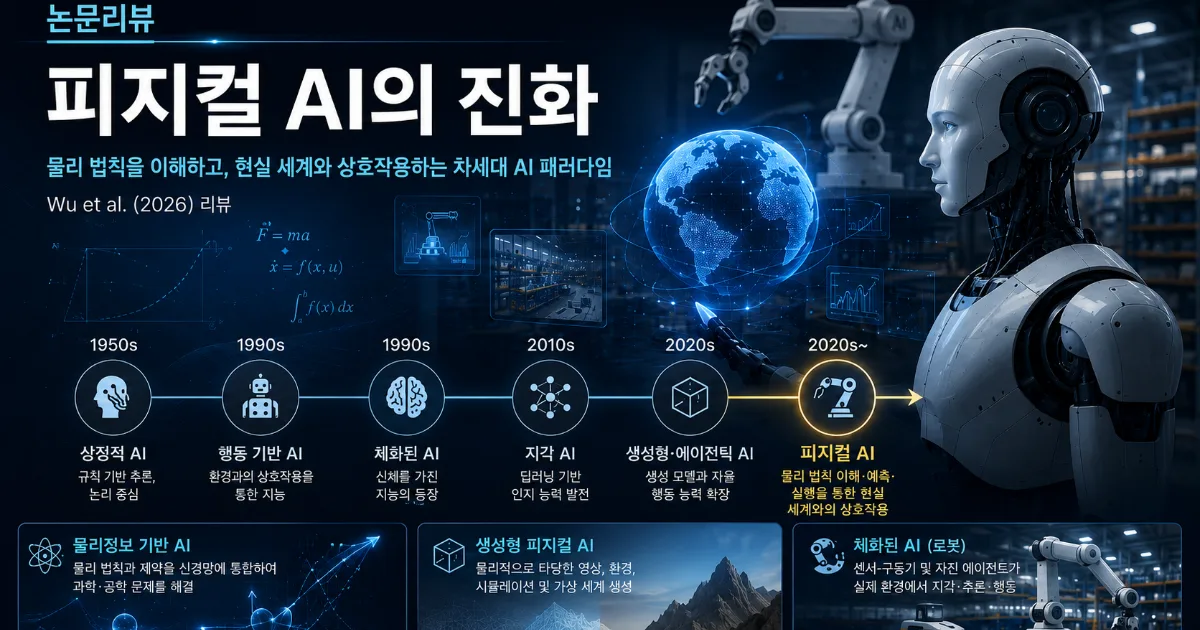
The authors present the development of AI as a progression from Symbolic AI to Statistical AI, Perceptional AI, Generative AI, Agentic AI, and finally Physical AI. Symbolic AI relied primarily on logic and rule-based reasoning, whereas Statistical AI introduced data-driven inference and probabilistic reasoning. Perceptional AI, supported by deep learning, enabled machines to recognize visual and auditory information. Generative AI expanded these capabilities by producing text, images, videos, and simulated environments. Agentic AI added a perception–reasoning–action loop and autonomous tool use. However, such systems often remain limited to simulated or constrained environments and do not possess a sufficiently grounded understanding of real-world physics. Physical AI is presented as the next stage, in which intelligent systems perceive, reason, and act under actual physical dynamics.
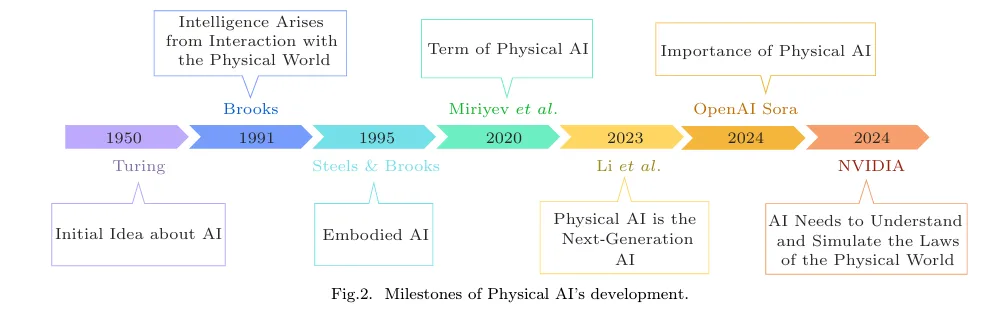
The paper traces the conceptual roots of Physical AI to behavior-based and embodied approaches developed in the 1990s. Brooks argued in 1991 that intelligence emerges through interaction with the physical world, and the subsequent work of Steels and Brooks contributed to the development of Embodied AI. The term “Physical AI” was formally introduced by Miriyev and Kovač in 2020. It was later discussed as a next-generation AI paradigm, while recent advances in text-to-video generation, world models, robotics, and NVIDIA’s Physical AI ecosystem further expanded its scope.
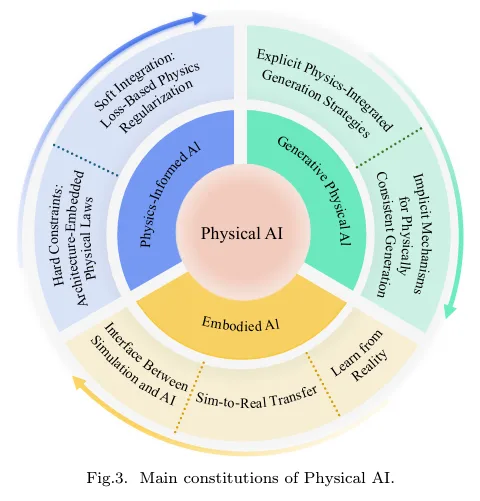
A major contribution of the paper is its classification of Physical AI into three interconnected domains. The first is Physics-Informed AI, which incorporates physical laws and constraints into neural networks to solve scientific and engineering problems. The second is Generative Physical AI, which produces physically plausible images, videos, simulations, and virtual environments. The third is Embodied AI, which enables physical agents equipped with sensors and actuators to perceive, reason, and interact within real environments. These domains correspond to three fundamental capabilities: understanding the physical world, generating physically consistent worlds, and interacting with the physical world.
The authors also identify several unresolved challenges. Research on Physical AI remains fragmented across physics-informed learning, generative modeling, and embodied intelligence, and a unified theoretical framework has not yet been established. High-fidelity simulation and real-time physical control require substantial computational resources. In addition, the field lacks standardized benchmarks for assessing physical reasoning, physical realism, embodied interaction, and real-world safety. For embodied systems, the sim-to-real gap remains particularly significant because sensor noise, actuator imperfections, and unmodeled environmental dynamics can substantially reduce performance after deployment in the real world.
The main strength of this paper is that it brings together several previously fragmented research traditions—including physics-informed learning, world models, generative simulation, robotics, and embodied intelligence—within a single conceptual map of Physical AI. It therefore provides a useful starting point for researchers seeking to define the field or explain its historical development. Nevertheless, the article should be understood as a conceptual and narrative survey rather than a systematic literature review. Its genealogy represents an author-constructed synthesis of selected milestones, not a universally established or exhaustive history of Physical AI. Moreover, the inclusion of Physics-Informed AI, Generative Physical AI, and Embodied AI under one umbrella may make the conceptual boundaries of Physical AI overly broad.
Despite these limitations, the article provides an important framework for understanding Physical AI as more than a form of advanced robotics. It defines the field through the integration of physical understanding, physically plausible generation, and real-world interaction. For research involving digital twins and manufacturing robots, this framework is particularly relevant because it connects virtual physical modeling, prediction of robot behavior, real-world execution, and feedback-based correction. The authors ultimately envision Physical AI as a future paradigm that unifies world models, generative models, and Embodied AI to create systems capable of robust and reliable interaction with the physical world