Title: Sleep chart of biological ageing clocks in middle and late life
Authors: The MULTI Consortium, Cliodhna Kate O’Toole, Zhiyuan Song, Filippos Anagnostakis, Zhijian Yang, Ye Ella Tian, Michael R. Duggan, Chunrui Zou, Yue Leng, Yi Cai, Wenjia Bai, Cynthia H. Y. Fu, Michael S. Rafii, Paul Aisen, Gao Wang, Philip L. De Jager, Jian Zeng, Hamilton Se-Hwee Oh, Xia Zhou, Keenan A. Walker, Daniel W. Belsky, Andrew Zalesky, Eleanor M. Simonsick, Susan M. Resnick, Luigi Ferrucci, Christos Davatzikos, Junhao Wen et al.
Journal: Nature
Published: 13 May 2026
DOI: 10.1038/s41586-026-10524-5
Can the number of hours we sleep be linked to how quickly our body ages?
Chronological age is simple. Two people born in the same year are the same age on paper.
Biologically, however, they may be very different.
One person's brain, heart or metabolic system may show characteristics expected in a younger individual, while another person's organs may appear older than their chronological age. Modern ageing research attempts to quantify these differences using biological ageing clocks, which estimate ageing from features such as medical imaging, circulating proteins and metabolites.
A 2026 Nature paper from the MULTI Consortium asked a deceptively simple question:
How is habitual sleep duration related to biological ageing throughout the body?
Its answer challenges the idea that only sleep deprivation matters. The researchers found that biological-ageing signals tended to rise at both extremes of sleep duration.
Instead of one biological age, the researchers examined 23 ageing clocks
The study did not focus exclusively on the brain.
Using large-scale datasets centred on the UK Biobank, the researchers examined 23 multi-organ and multi-omics biological ageing clocks derived from MRI, plasma proteomics and metabolomics.
Baseline sleep information was available from approximately half a million UK Biobank participants, although imaging and molecular analyses necessarily relied on subsets of participants for whom those specific data were available.
Participants reported how many hours they typically slept during a 24-hour period. For the primary analyses, the researchers restricted sleep duration to between four and ten hours and used generalized additive models, or GAMs, to detect nonlinear relationships without requiring the data to follow a predetermined linear or U-shaped pattern.
This is an important methodological point: the researchers did not simply assume that seven or eight hours would be optimal and then test that assumption. They allowed the shape of the relationship to emerge from the data.
Finding 1: Biological ageing followed a U-shaped pattern
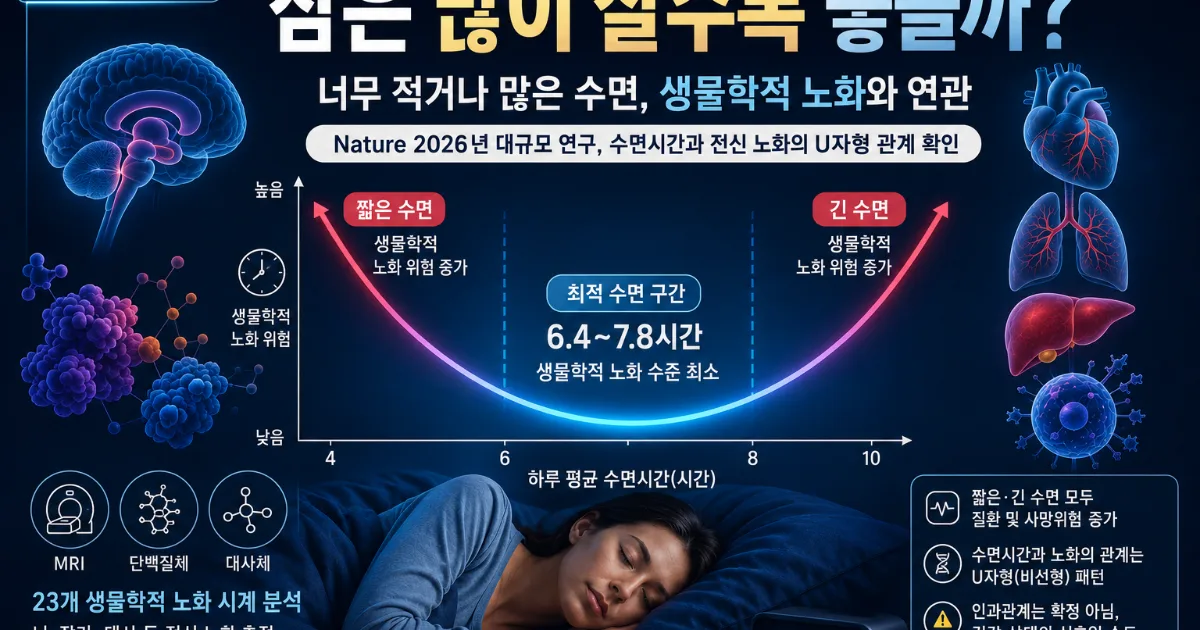
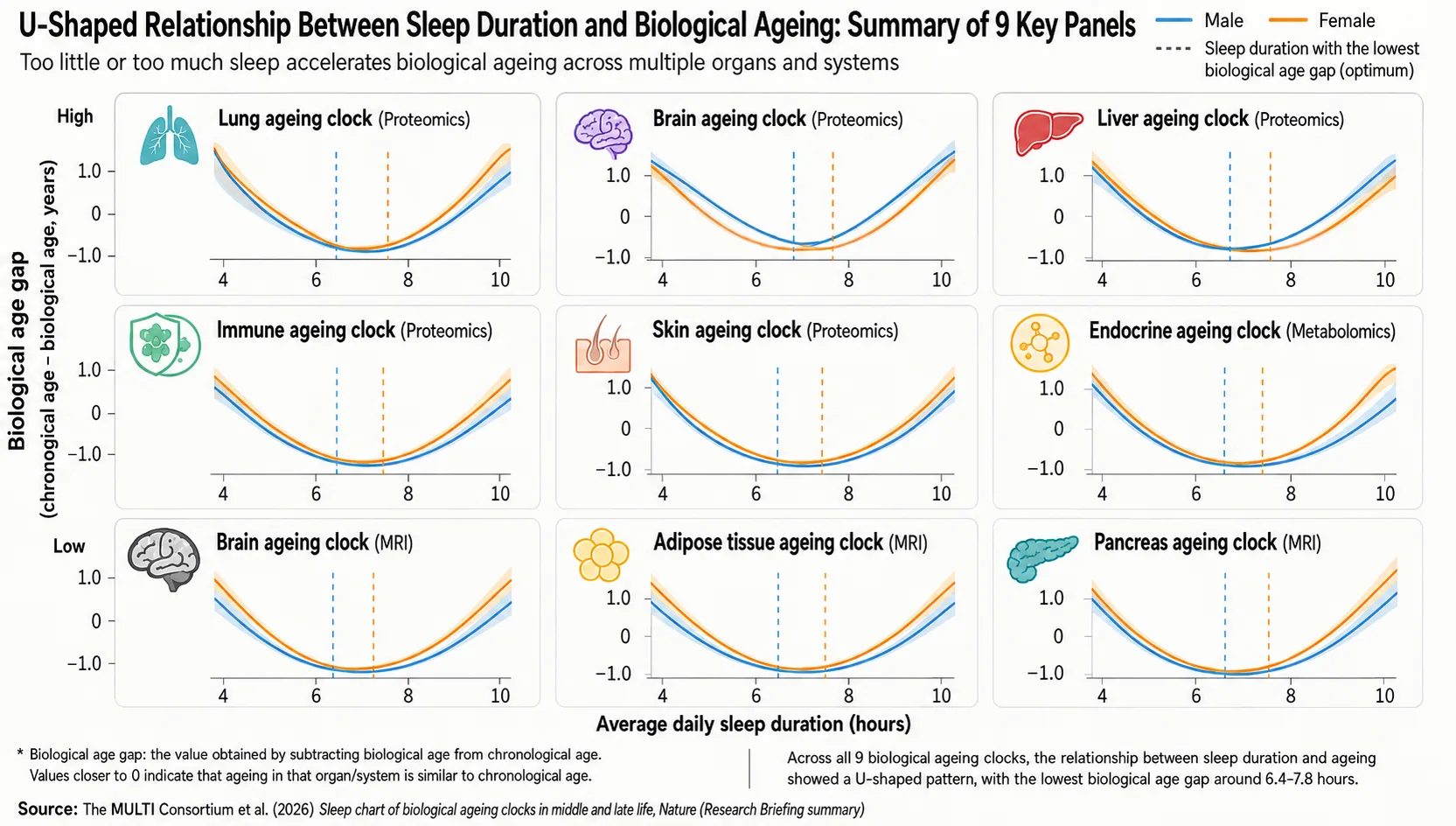
Of the 23 biological ageing clocks, nine showed statistically significant nonlinear associations with sleep duration.
A broadly U-shaped pattern emerged.
Biological ageing signals increased at shorter sleep durations, declined around the middle of the sleep range, and then tended to rise again among longer sleepers. Across the significant clocks, the estimated sleep durations corresponding to the lowest biological-age gaps ranged from approximately 6.5 to 7.8 hours in women and 6.4 to 7.7 hours in men.
There was no single universal optimum for every organ.
For example, a proteomics-based brain ageing clock reached its lowest ageing burden at around 7.7 hours, whereas an MRI-derived brain ageing measure had an inflection point closer to 6.5 hours. The authors suggest that structural and molecular ageing measures may capture different biological processes and recovery timescales.
The result therefore should not be interpreted as identifying an exact number of hours that everyone needs to sleep.
A more defensible conclusion is that extremes of sleep duration are associated with less favourable biological-ageing profiles across several physiological systems.
Finding 2: Short sleep was associated with effects across the body
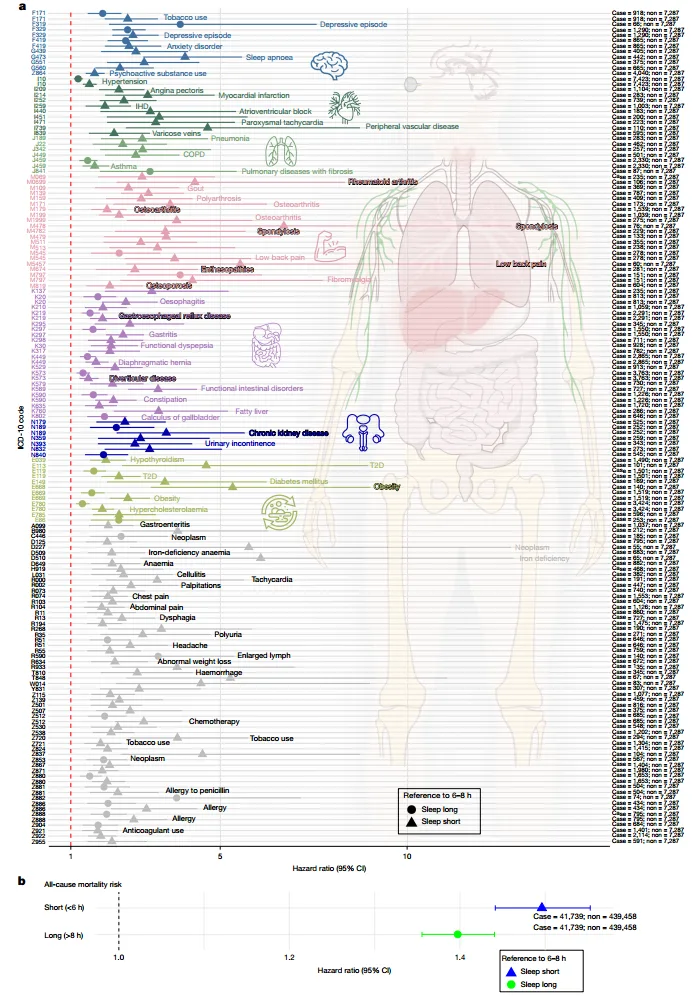
The researchers then compared people sleeping less than six hours or more than eight hours with a reference range of six to eight hours.
Short sleep showed particularly broad associations.
Genetic-correlation analyses linked short sleep with cardiovascular conditions such as ischaemic heart disease and heart failure, metabolic disorders including type 2 diabetes, and a range of neurological, psychiatric, respiratory, gastrointestinal and musculoskeletal conditions.
Across the broader analyses, abnormal sleep duration showed positive associations with more than 150 disease endpoints, with short sleep accounting for much of the systemic pattern.
This finding reframes sleep deprivation as more than a problem of daytime fatigue or reduced concentration.
Sleep appears to be related to biological processes spanning cardiovascular regulation, metabolism, immune function, endocrine signalling and brain health.
Finding 3: Long sleep may tell a different biological story
Long sleep was also associated with poorer health outcomes, but its pattern differed from that of short sleep.
Whereas short sleep showed broad systemic associations, long sleep had a more concentrated genetic relationship with brain and psychiatric traits, including major depressive disorder, schizophrenia, bipolar disorder, ADHD and migraine.
This distinction raises an important possibility.
Long sleep might not always be causing poor health. It may sometimes be signalling it.
People with emerging disease, neurobiological ageing or other subclinical health problems may sleep longer because their bodies require more recovery or because the disease itself alters sleep.
The authors therefore propose that prolonged sleep could in some cases reflect compensation for underlying pathology rather than function as a simple independent risk factor.
This is why the study should not be reduced to the headline “sleeping more than eight hours is unhealthy.”
Finding 4: Short and long sleep may reach depression through different pathways
The researchers explored this possibility further using late-life depression.
For short sleep, much of the relationship with late-life depression appeared to operate through relatively direct pathways rather than through measurable organ ageing. The authors discuss mechanisms including sympathetic activation, immune disruption and neuroendocrine stress responses.
The pattern was different for long sleep.
Ageing in organs including the brain and adipose tissue played a larger mediating role. In one model, the brain MRI-derived biological ageing measure accounted for approximately 62% of the total mediated relationship between long sleep and one subtype of late-life depression.
The implication is significant: two people can both have an unusual sleep duration while the biological processes underlying their sleep patterns may be quite different.
Finding 5: Both sleep extremes were associated with higher mortality
Longitudinal survival analyses produced another striking result.
Compared with the six-to-eight-hour reference group, short sleep was associated with an all-cause mortality hazard ratio of 1.50, with a 95% confidence interval of 1.44–1.55. Long sleep was associated with a hazard ratio of 1.40, with a 95% confidence interval of 1.36–1.44.
These numbers should be interpreted carefully.
They do not mean that deliberately reducing one's sleep below six hours causes an exact 50% increase in mortality. Sleep duration is intertwined with many other factors, including existing illness, employment patterns, mental health, medication use and sleep disorders.
The study identifies associations rather than a simple experimental cause-and-effect relationship.
Does this mean seven hours of sleep slows ageing?
No.
That is perhaps the most important qualification in interpreting the paper.
The authors explicitly acknowledge that the study cannot establish causality. Sleep duration was largely self-reported, which introduces potential measurement error. Most participants were of European ancestry, limiting generalizability. The study also did not directly measure several dimensions of sleep that could matter just as much as duration, including sleep fragmentation and circadian misalignment.
Reverse causality remains particularly important for long sleep.
An underlying disorder may cause someone to sleep longer, rather than long sleep causing that disorder. Although the researchers conducted Mendelian-randomization and sensitivity analyses to investigate directionality, they conclude that bidirectional and reverse effects cannot be fully excluded.
The range of 6.4 to 7.8 hours should therefore be understood as a pattern observed in this population, not as a personalized prescription.
Why this study matters
The most important contribution of the paper is not the identification of a perfect number of sleep hours.
It is the shift from thinking of sleep primarily as rest for the brain to viewing it as a behaviour associated with whole-body ageing.
Similar nonlinear patterns appeared across imaging, proteomic and metabolomic measures. The convergence of these different types of biological data suggests that the relationship between sleep and ageing may operate across multiple physiological layers rather than through a single brain-based mechanism.
The study also leaves us with a particularly interesting question:
When someone sleeps unusually long, is sleep itself the problem—or is the body already trying to tell us something?
Future longitudinal studies incorporating objective sleep measurements, sleep quality, circadian timing and repeated biological-age assessments will be required to answer that question more confidently.
For now, the strongest takeaway is not that everyone should aim for one exact sleep duration.
It is that sleep duration may function as a measurable signal of ageing and health across the entire body, not simply as a measure of how rested we feel the next morning.