So now, we are in Yonago.
To be honest, when we decided on this trip, I knew almost nothing about Yonago.
All I vaguely knew was that it was a city in the western part of Tottori Prefecture in Japan, that we could fly there from Incheon, and—most importantly—that the Onyado Nono we had been looking for was located nearby in Sakaiminato.
This was not a trip we planned after choosing a destination first.
Yonago became our destination because we were looking for a place where I could finally keep the promise I had made to my son.
Paradoxically, I liked that.
A place neither my son nor I knew well.
Perhaps, I thought, that was exactly why this trip might stay with us longer.
Still, until just before the trip began, my mind was still at work.
The night before departure, after finishing the last of my proposal PM duties, I got home around 10 p.m. My son had been waiting for me to come home.
By the time I washed up and sorted a few things out, it was already close to 11 p.m. We were leaving for Japan the next day, and only then did my son and I sit side by side in front of the computer.
For the first time, I properly looked through the four-night, five-day itinerary he had made.
A yakiniku restaurant.
Mizuki Shigeru Road.
Kappa Spring.
The Yokai Food Laboratory.
Restaurants and cafés.
A supermarket.
And the hotel.
One by one, I saved the places my son wanted to visit on Google Maps. He had been far more meticulous than I expected. He had organized not only restaurants, but even train times.
“Did you look this up too?”
“Yeah.”
I looked down at the itinerary again for no particular reason. I realized that my son had grown enough to search for and organize all of this on his own.
But something felt strange.
The more I looked at the itinerary, the less excited I felt. Worry came first.
A father-and-son trip abroad.
Can I handle this without my wife?
What if I forget something?
What if there’s a problem at the airport?
For someone about to leave on a trip, there were too many worries in my head.
And I was already exhausted.
Nearly a month of proposal PM work still clung to my body. My body had come home, but my mind still seemed to be hanging somewhere inside the proposal room. Even after I lay down in bed, the words from meetings and the slides I had been working on would not leave my head.
In the end, I could not sleep properly.
At 5:50 a.m., I opened my eyes.
The day of the trip had begun.
I left home with my son and got on the airport bus. It was just the two of us. The feeling was strange.
I am finally on my way to keep the promise I made to my son two and a half years ago.
Even then, I think I still believed this trip was something I was doing for him.
I imagined myself as the father who would plan everything, take my son around, and solve problems if they came up. Because I was his father, I thought that was what I was supposed to do.
But from the beginning, the trip did not go according to my expectations.
We arrived at the airport early. After completing departure procedures, my son and I entered the lounge. With a card discount, we paid about 64,000 won for the two of us.
As we entered, I told my son,
“Let’s eat properly here this morning.”
Inside, I was making a more practical calculation.
We paid 64,000 won, so we should eat as much as we can.
I took a plate and brought food back several times. But a person’s stomach does not expand in proportion to the amount paid. After a few plates, I could not eat anymore.
I said to my son,
“Do you think we ate about 64,000 won’s worth?”
He laughed.
I laughed too.
It was such a trivial conversation, but I liked it.
At work, I talk to people all day. But most conversations at work have a purpose. We need to hold a meeting, decide something, ask someone to do a task. There has to be a conclusion.
But small talk with my son did not need a conclusion.
We could talk about useless things and laugh. We could keep talking about something meaningless for a long time.
That was why I liked it.
The plane flew toward Yonago.
And then we arrived at Yonago Airport.
So far, everything was fine.
The problem began at immigration.
I had not registered through Visit Japan Web. Since Japan allows visa-free entry, I had vaguely assumed that such a process was unnecessary.
I had been careless.
Looking back, I was still full of blind spots when it came to travel preparation. I had grown used to trips where my wife took care of the details.
If my wife had been here, she would have prepared all of this.
As soon as that thought came to me, I felt sorry for my son.
Why didn’t I do this?
For a moment, my mind became complicated.
I opened Papago and tried to ask the staff around immigration for help. But the voice recognition did not work as smoothly as I had hoped. Sometimes it recognized my words incorrectly, and sometimes the translated sentence did not mean what I had intended. Typing the sentence directly worked better.
In the end, I typed the situation into GPT as well and got help.
I thought, with some relief, that it was fortunate AI was there.
In fact, thanks to my wife booking seats near the front and checking us in in advance, we got off the plane quite quickly. But because of my fumbling, getting off early meant nothing.
As I wandered around holding my phone and trying to complete the immigration process on the spot, we eventually became the last people to leave the airport.
I felt like a beginner traveler.
Once, I had traveled abroad as a journalist. Even now, at work, I solve problems far more complicated than this. And yet here I was, flustered in a small regional airport, clutching my phone.
My son waited silently beside me.
I felt both sorry and grateful.
Still, we eventually got through.
And then a thought occurred to me.
Maybe what matters in travel is not that problems never happen. Maybe what matters is solving them one by one when they do.
At work, when a problem occurs, you have to find the cause, identify responsibility, and prepare measures to prevent recurrence.
On a trip, if you solve the problem, you can simply move on.
That simplicity felt unexpectedly comforting.
The next mission was cash.
Before the trip, I had visited a Hana Bank branch, made a Hana debit card called Travelog, and exchanged won into yen through the Hana Money app. I planned to pay by card whenever possible, but I thought cash might be necessary in a small city.
The problem was that I had never withdrawn cash from an ATM in Japan.
Once again, with GPT’s help, I went to the Seven Bank ATM inside the airport’s 7-Eleven.
I inserted the card.
Thankfully, the screen displayed Korean.
And yet I still felt strangely tense.
I selected withdrawal and entered the amount.
At the final stage, I hesitated again. For a moment, I could not decide whether I should proceed in Korean won or Japanese yen. I took out my phone again and asked GPT.
I needed to proceed in yen.
A moment later, I heard the machine inside the ATM.
Then the bills came out.
15,000 yen.
It was nothing special. And yet, the moment I held the bills in my hand, I felt strangely relieved.
Done.
Only then did it truly feel like I had arrived in Japan.
We left the airport and headed to JR Yonago Airport Station. To get to Sakaiminato, we needed to take the JR Sakai Line.
I stood in front of the ticket machine to buy tickets. To my relief, there was a Korean menu on the screen. I selected the destination and inserted the money. A moment later, a small paper ticket came out.
190 yen.
It was just one train ticket. But it felt as if I had completed another mission.
We waited for the train on the platform.
A train soon pulled in.
But something felt strange.
No one got on.
Suddenly, I became anxious.
Are we not supposed to take that one?
I looked back and forth between the train and my phone. Once again, I began to panic. My expression must have stiffened without me realizing it.
Then my son tapped me lightly and said calmly,
“Dad, ours is the 4:03 train.”
“Really?”
“Yeah. I wrote it down.”
I checked the itinerary he had made.
It was written there exactly.
A little later, the train we were waiting for arrived, and the two of us got on.
The doors closed.
The Sakai Line began to move slowly.
Even after getting on the train, I was still a little anxious. I opened Google Maps and checked several times whether the train was moving in the right direction.
My son was right.
I let out a small laugh without realizing it.
Why have I become so foolish?
When we left Korea, I had still thought of this trip as one where I was taking my son abroad. But only a few hours after arriving in Japan, it was my son who was telling me which train to take.
The scenery outside the window was a little different from the Japan I was used to.
It was not Tokyo.
It was not Osaka.
There were hardly any tall buildings. No giant electronic billboards. No flashy shops, no crowded streets. The train moved slowly between low buildings and quiet neighborhoods.
It stopped at a small station.
A few people got off.
Then it moved again.
It stopped at another small station.
The closer we got to Sakaiminato, the quieter the scenery became. Old buildings came into view, as did shops that seemed to have closed long ago.
At first, it felt unfamiliar.
It was different from the Japan I had known through travel.
But strangely, I did not dislike it.
Rather, I liked the unfamiliar slowness.
For the past month, I had gone to work before dawn and returned home late at night. I had not even had time to feel how quickly each day passed. After one meeting ended, another began. After one slide was finished, another had to be revised. After I replied to one message, another arrived.
I had to keep moving on to the next thing.
But the train carrying me now stopped faithfully at every small station.
No one hurried it.
The train moved at its own pace.
Looking out the window, I suddenly thought,
So you can still arrive even if you go this slowly.
We arrived at Sakaiminato Station.
We got off the train and stepped outside.
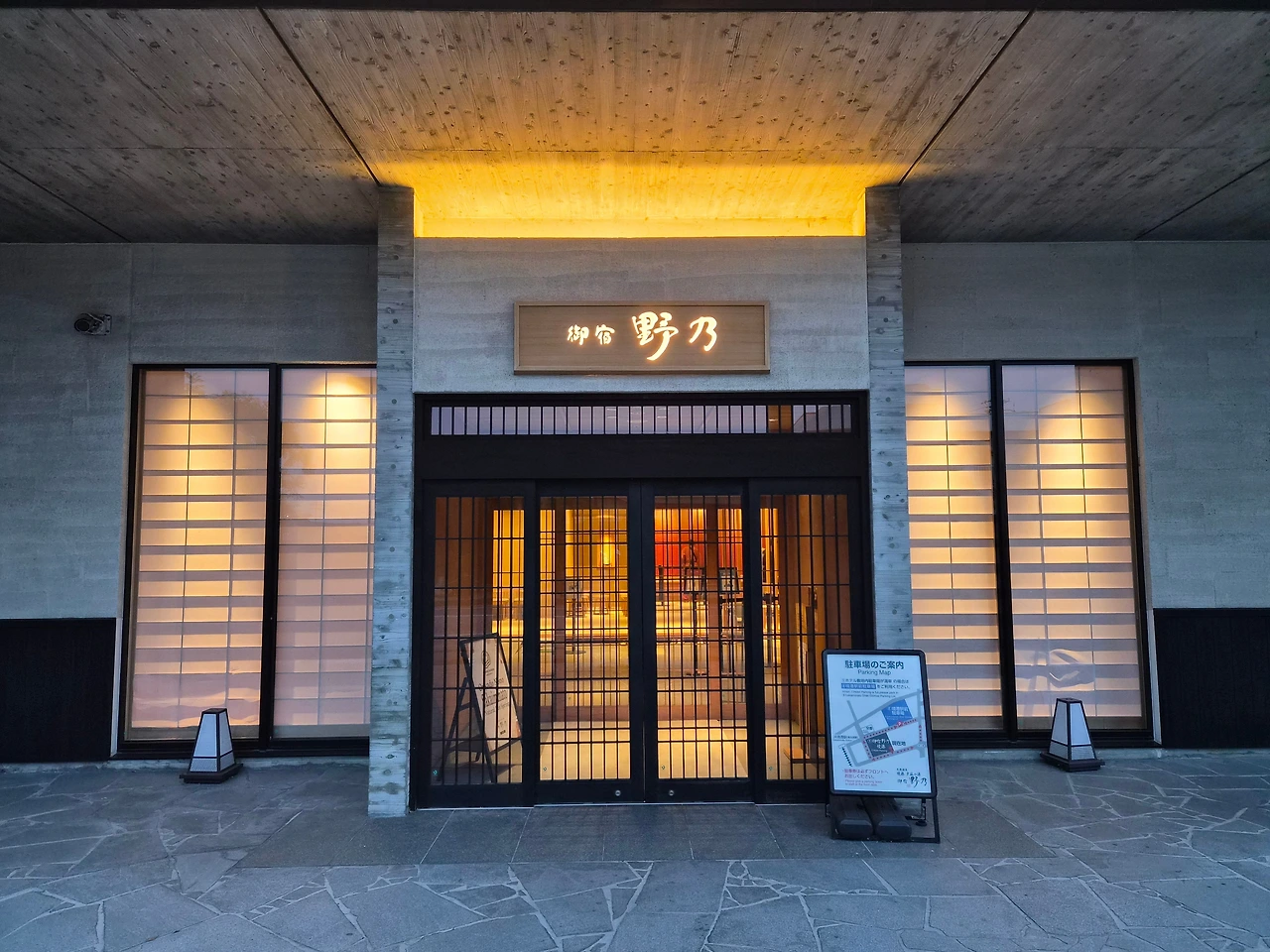
And right in front of us was the hotel we had been looking for.
Onyado Nono Sakaiminato.
“Son, there it is.”
We pulled our suitcases toward the hotel.
We had finally arrived.
I thought of the promise I had made to my son two and a half years earlier.
A place with a hot spring.
A place where you could eat ice cream after bathing.
A place where ramen was served at night.
It was not the same hotel in Osaka.
And yet, strangely, it felt like we had arrived at the promised place.
Perhaps a promise is not attached to a place.
Perhaps it is attached to the person you share it with.
After putting down our luggage, we went out for dinner.
Our first dinner was yakiniku.
YAKINIKU ICHI-SAKAIMINATO.
It was a restaurant my son had found while preparing for the trip.
We opened the menu.
And then another small obstacle appeared.
Shiitan.
Kainomi.
Wagyu harami.
Uchi-harami.
The menu was filled with unfamiliar Japanese words, and my eyes went blind in front of it.
I took a picture of the menu and uploaded it to GPT.
“What should we order here?”
On this trip, GPT had already become our interpreter and travel guide.
My son and I looked at the screen together and went through the menu one item at a time.
First, shiitan.
It was beef tongue seasoned with salt and grilled. I had eaten beef tongue in Korea before, but in a Japanese yakiniku restaurant, it seemed like a classic first order. My son was intrigued by the name alone.
We also ordered a recommended three-cut assortment.
One of the cuts was kainomi. It comes from around the ribs and is said to be tender, with a good balance of lean meat and fat.
Another was wagyu harami. Harami is often categorized as a cut near the diaphragm, and it is popular in yakiniku restaurants for its deep beef flavor and tender texture, somewhat different from ordinary lean cuts.
The remaining cut, as I remember, was something I read on the menu as “fundoshi.” It was a name I had never heard before, so my son and I stared at the screen for a while. That day, what mattered was not knowing the exact cut, but the fun of learning about unfamiliar meats one by one and choosing them together.
We also ordered uchi-harami separately. It was introduced as an inner cut from the harami family.
In front of me was a draft Asahi beer.
In front of my son was a cola.
We placed the meat on the grill.
Sizzle.
The meat began to cook.
We started with the shiitan.
My son put one piece into his mouth and immediately said,
“Dad, this is the best.”
Even after the trip ended, he kept talking about the shiitan we ate on the first night.
I deliberately waited until he had finished all of it before telling him it was beef tongue. If I had told him from the beginning, I thought he might be startled and refuse to eat it.
When he learned that what he had eaten was tongue, he seemed a little surprised. But he remained consistent.
It was still delicious.
For me, the uchi-harami was the best.
At the time, I was wearing braces, so chewing tough meat was not easy. The uchi-harami, however, was especially tender. I had reached an age where it mattered not only whether the meat was delicious, but whether I could eat it comfortably.
Even though we were eating the same meat from the same grill, my son and I chose different favorites.
That was interesting.
Even when we saw the same thing and spent the same time together, we felt it differently.
This trip will probably remain that way for us too.
I will remember the Yonago I saw.
My son will remember the Yonago he saw.
Years from now, when we talk about the same trip, we may each recall completely different scenes first.
And that would not be a bad thing.
The bill was 7,854 yen.
I started tapping on my phone calculator to see how much that was in Korean won, then simply turned the phone off.
Rather than thinking it was expensive, I thought first,
We ate well.
Back at the hotel, we went up to the 12th floor where the sauna was located.
My son and I washed and soaked in the indoor hot bath. It felt as if the fatigue that had clung to my body for the past month was slowly dissolving into the hot water.
Then we went out to the open-air bath.
After warming myself fully in the bath, I stepped outside and sat in a chair.
I had nothing on my body.
Then the wind blew.
A cool breeze wrapped around my bare skin.
It felt good.
Not simply because it was cool.
The fact that I had nothing on my body felt strangely comforting.
There was no job title from the company.
No role called proposal PM.
No slides to write.
No messages to answer.
No need to persuade anyone.
I was simply a person sitting in the wind.
In that moment, I even thought,
Maybe this is why you are supposed to be naked in an open-air bath.
With nothing on my body, it felt as if I could briefly take off the many names and roles attached to me as well.
Office worker.
Father.
Husband.
Proposal PM.
Someone’s superior and someone’s subordinate.
When I set all those names down for a moment, only “me” remained.
Is it because I’m getting older?
In the past, going to a hot spring simply meant enjoying the feeling of soaking in hot water. But now, I felt as if I was finally beginning to understand the beauty of an open-air bath.
The wind blew again.
I closed my eyes.
Then we returned to the room.
There were still about two hours left before 10 p.m., when the hotel served its complimentary yonaki soba, a kind of late-night ramen.
“Let’s rest for a bit.”
I lay down on the bed.
After that, I remember nothing.
I fell asleep as if I had fainted.
When I opened my eyes, it was already night.
My son and I got dressed again and went downstairs to eat the yonaki soba served nightly at Onyado Nono.
Although the name includes “soba,” it is a little different from the buckwheat noodles we usually imagine. It is closer to a light Japanese ramen with noodles in a clean soy-sauce broth.
I quickly finished the first bowl.
I remembered eating it two and a half years earlier at Onyado Nono in Osaka. Back then, there were hardly any people. After finishing one bowl, we could immediately get another.
This time was different.
There was a long line.
After finishing one bowl, we waited for a while. Once the crowd thinned, we lined up again.
In the end, we ate two bowls.
My son and I sat side by side, eating ramen.
And just like that, the first day of a promise delayed for two and a half years came to an end.
The next morning, around 6:30 a.m., I stepped out of the room into the hallway.
The moment I looked out the window, I wondered if I had gotten the time wrong.
The sunlight was too strong.
It was still morning, but the world looked as bright as midday.
The previous evening had felt similar. This city did not have many neon signs or flashy store lights, and yet it was strangely bright.
In Seoul, there is so much artificial light that we almost stop noticing the sky.
Here, it was the opposite.
Before the light made by the city, the light coming down from the sky entered my eyes first.
My son and I went down for breakfast.
The price was 3,000 yen per person. My son, now a middle school student, was charged as an adult. For the two of us, it was 6,000 yen.
At first, I thought,
Breakfast is pretty expensive.
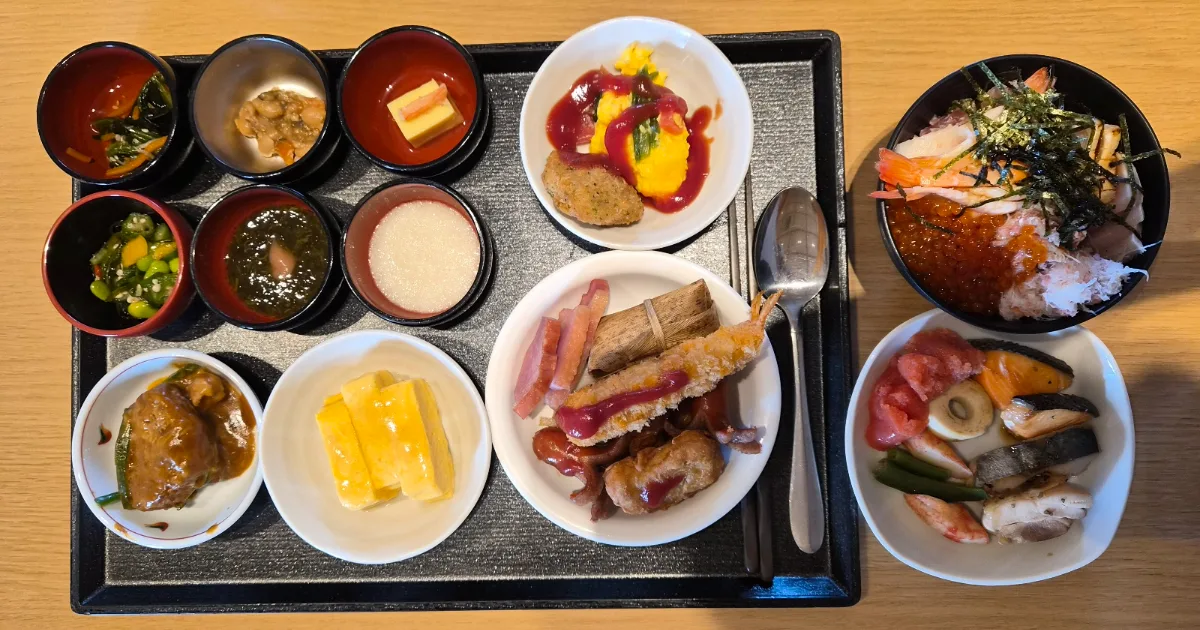
But as I looked around at the food, my mind changed a little. There was fresh seafood and a wide variety of Japanese side dishes. My son and I took our plates and began filling them.
As we ate, there was one thing on which our thoughts matched exactly.
“Dad.”
“Yeah?”
“This would be really good if they had cho-gochujang.”
I had been thinking the same thing.
“I know.”
We both laughed.
We had come all the way to Japan, sat in front of fresh seafood, and were looking for Korean red chili-vinegar sauce.
That, too, was us.
After breakfast, we went back up to the hot spring.
From the morning, I soaked myself in hot water. Then I sat in a chair outside by the open-air bath.
I closed my eyes.
It was quiet.
I could hardly hear people’s voices. I could not hear cars. The countless artificial sounds that had become so familiar in Seoul that I no longer even noticed them were absent here.
The wind passed by.
At that moment, my life suddenly felt like a car.
For the past few years, I had been driving on a highway nonstop. In the fastest lane whenever possible.
Faster.
Better.
Trying to produce even slightly more results.
I kept pressing the accelerator.
If I slowed down, I felt I would fall behind. If I stopped, I felt I might not be able to start again.
So I kept driving without even realizing how hot the engine had become.
But here, there was no reason to press the accelerator.
I could simply stay still.
No one told me to hurry.
I did not have to produce anything today.
Time passed even as I sat still with my eyes closed.
And yet that time did not feel wasted.
Strangely, in that moment, this thought came to me:
Later in life, it might be nice to live like this.
To wake up in a quiet place.
To write.
To walk.
To write again.
To write not because I need to show it to someone, but because I want to write.
To live a life in which doing nothing does not feel like a waste.
How noisy a place have I been living in all this time?
There had always been sound around me.
Voices moving across meeting rooms.
Messenger notifications.
Phone vibrations.
Subway announcements.
Cars.
Someone’s request.
And perhaps louder than all of those was the voice inside me, constantly urging me to do something.
But when no sound could be heard, another voice buried beneath all that noise began to emerge little by little.
Maybe I can live a little more slowly now.
I opened my eyes.
The morning sunlight was dazzling.
And suddenly, I became curious.
What will happen on the next day I spend with my son in this quiet city?
Our second day in Yonago was just beginning.