Alabama has reached a major settlement with TikTok.
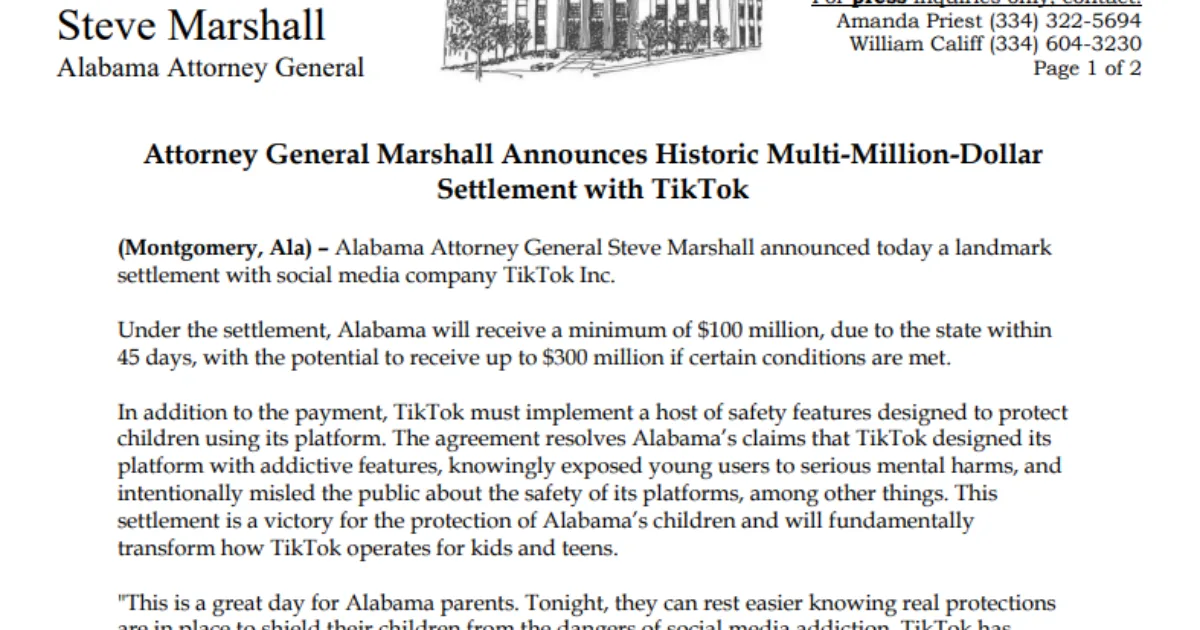
On September 25, 2026, Alabama Attorney General Steve Marshall announced a historic settlement with TikTok. Under the agreement, Alabama will receive at least $100 million, with the amount potentially rising to $300 million if certain conditions are met. But the payment itself is not the only issue. TikTok must also implement a range of safety features designed to protect young users.
The core of this case is not money.
What matters more is how TikTok must change the experience it provides to teenage users. The settlement does not stop at a broad declaration that teen safety should be strengthened. It addresses specific elements of platform design: daily screen time, nighttime access, push notifications, personalized recommendations, cosmetic filters, parental controls, age assurance and contact between adults and teenagers.
This shows that the focus of social media regulation is shifting.
The issue is no longer only which content should be removed. The question is now how the platform itself is designed.
Alabama’s claims were based on allegations that TikTok designed its platform with addictive features, exposed young users to serious mental harms and misled the public about the safety of the platform. TikTok did not admit liability or wrongdoing in the settlement, but agreed to a final judgment and consent order to resolve Alabama’s claims.
The safety measures announced by Alabama are unusually concrete.
TikTok must apply a default two-hour daily time limit for teen users. Parents can further reduce the amount of time their children spend on the app. TikTok must also provide “productive pauses” after 15 minutes of continuous use and again at the 60- and 90-minute marks to interrupt endless scrolling.
Nighttime access restrictions are also included.
The agreement requires nighttime access limits for children from midnight to 6 a.m., along with restrictions on messaging and push notifications during nighttime hours and school hours. Emergency alerts, account security messages or platform integrity notifications may be treated differently, but ordinary engagement prompts are restricted.
This provision is important.
One of the most frequently discussed issues in social media addiction debates is sleep. A design that encourages teenagers to keep scrolling through short-form videos late into the night can affect sleep, study and emotional regulation. The Alabama settlement treats this not merely as a matter of individual willpower or parental discipline, but as a matter of platform defaults.
Push notification limits follow the same logic.
TikTok must restrict push notifications for teen users overnight and during school hours. Parents may be able to modify certain settings, but the default posture is restriction.
The key word is default.
Platform companies have often said that users can change settings if they want to. But in actual user behavior, default settings are powerful. Many users simply keep the default. This settlement demands that teen protection be built into the default design, not buried as an optional feature.
The feed design also changes.
The settlement requires TikTok to provide teen users with a default non-personalized feed. This is a direct intervention into the architecture of recommendation.
TikTok’s strength has been personalized recommendation. The longer users stay, the more the algorithm learns their preferences and reactions, and the more precisely it can serve content that keeps them watching. But from the perspective of teen safety, that same personalization has become one of the most contested issues. Teenagers may be repeatedly exposed to stimulating, emotionally intense or harmful content because the algorithm has learned what keeps them engaged.
The Alabama settlement does not ban algorithmic recommendation entirely.
Instead, it requires a non-personalized feed for teen users. This can be read as a move toward giving young users a path away from full personalization — a kind of depersonalization option built into the core experience.
The ban on cosmetic filters is also notable.
The settlement requires TikTok to prohibit teen users from using cosmetic filters. Alabama’s announcement describes this as a blanket prohibition on the use of cosmetic filters by teen users.
This provision connects directly to debates about teen mental health.
Beauty filters and appearance-altering effects on social media have long been criticized for encouraging distorted self-image, appearance anxiety and social comparison. Teenagers are especially sensitive to appearance evaluation and peer response. The Alabama settlement treats cosmetic filters not merely as playful decoration, but as a design feature relevant to teen safety.
Age assurance is another central pillar.
The settlement requires TikTok to implement robust age assurance measures to more effectively verify the age of young users. This reflects a broader recognition that teen safety features cannot work if the platform cannot reliably identify which users are teenagers.
This means that simply asking users to enter a birth date is no longer seen as enough.
If teenagers misstate their age, or if the platform fails to classify them properly, the entire safety system weakens. Time limits, nighttime restrictions, cosmetic filter bans, non-personalized feeds and parental controls all depend on whether the user is recognized as a teen in the first place. Age assurance is therefore the starting point of teen safety design.
At the same time, age assurance creates privacy concerns.
To determine age more accurately, platforms may need to examine more signals and data. That creates another risk. Protecting teenagers may require knowing who is a teenager, but identifying teenagers may require data collection that itself must be limited and secured. This is one of the hardest tensions in online safety regulation.
Parental controls are also strengthened.
TikTok must provide stronger and more user-friendly parental controls. Alabama’s announcement describes the settlement as giving parents more control over what children see and how much time they spend on the app.
This provision places platform responsibility and parental responsibility together.
The platform must provide the default safety architecture. Parents then adjust the child’s environment on top of that architecture. The important point is that parental control is no longer treated merely as a hidden setting that parents must find on their own. It becomes part of the platform’s required safety design.
The settlement also addresses suspicious contact between adults and teens.
TikTok must implement stronger content moderation provisions, including limits on the discoverability of teen accounts by adults and parental notification of suspicious interactions between teen users and adults.
This shows that social media safety is not only about what content teenagers see.
The issue is also who can find whom.
Who can message whom?
Which adult accounts can approach teenagers?
When risk signals appear, how are teenagers and parents warned?
The settlement brings this contact structure into the scope of regulation.
The payment structure is also important.
According to Alabama’s announcement, the state will receive a minimum of $100 million within 45 days, with the potential to receive up to $300 million if certain conditions are met.
This structure suggests that the Alabama case may become more than a single-state settlement.
Alabama described the deal as a first-in-the-nation settlement. The case had been scheduled to go to trial the following Monday, and Alabama would have been the first state to bring its claims against TikTok to trial.
The timing matters.
Had the case proceeded to trial, TikTok’s internal design choices, algorithms, teen-user policies and internal communications could have become part of courtroom proceedings. The settlement avoided that public trial while still securing a large payment and detailed operational changes.
Still, a settlement is not a conviction.
The agreement resolves Alabama’s claims, but TikTok did not admit wrongdoing. Therefore, this case should not be described as a court-confirmed finding that TikTok violated the law. More precisely, it is a case in which Alabama’s allegations, TikTok’s denial of wrongdoing and a detailed settlement structure came together.
Even so, the settlement may become a reference point for future social media regulation because it requires concrete changes in platform design.
The case reveals three larger trends.
First, the standard for protecting teenagers is expanding from content management to time and design management.
Removing harmful content is no longer considered enough. Infinite scrolling, personalized recommendation, push notifications, nighttime use, cosmetic filters and adult-teen contact structures are all becoming regulatory targets.
Second, parental controls are moving from optional features to platform responsibility.
Instead of forcing parents to search through app settings on their own, platforms are being pushed to provide clearer and more practical tools. The Alabama settlement requires TikTok to give parents more meaningful control over time, content exposure and risky interactions.
Third, age assurance is becoming core infrastructure for social media regulation.
Teen safety rules work only if a platform can identify teen users. But age assurance also raises issues of privacy, misclassification, fairness and access. The challenge is to identify young users accurately without creating new forms of data risk.
This case is not only about TikTok.
Alabama’s attorney general also pointed to recent settlements and actions involving Meta and Roblox, as well as an investigation involving OpenAI. The Meta settlement announced in August 2026 requires safety features such as two-hour daily limits, nighttime blocks, school-time notification limits, age assurance, parental controls and restrictions on social comparison features.
This shows that state attorneys general are expanding a broader enforcement strategy centered on child and teen safety across social platforms, gaming platforms and AI companies.
For platforms, a new era is opening.
In the past, user engagement time was a key performance metric.
Recommendation algorithms that kept users watching were a competitive advantage.
Push notifications were a tool to bring users back.
Filters and challenges increased participation and creation.
But for teenage users, those same features are becoming regulatory targets.
The message to platform companies is clear.
Defaults for teenagers must be different.
Call them less at night.
Stop them when they scroll too long.
Give them a non-personalized feed.
Limit filters that alter appearance.
Manage adult contact more strictly.
And prove through age assurance, auditing and documentation that those protections actually work.
For TikTok, the settlement is a burden. But it may also reduce some regulatory uncertainty by setting out concrete obligations.
The agreement points toward a possible future in which similar design standards are applied not only to TikTok, but to other major social platforms as well.
Ultimately, the essence of this case is not how much TikTok pays.
It is that the standard for what kind of default environment social media platforms must provide to teenagers is changing.
The industry is moving from an era in which platforms said, “Users can change the settings if they want,” to an era in which regulators say, “Teenagers must receive safer defaults first.”
The Alabama-TikTok settlement is one example of that transition.
Teen safety is no longer a phrase written on a separate safety-center page.
It is a product design question involving feeds, notifications, time limits, nighttime access, filters, messaging, account discoverability, age assurance and parental controls.
TikTok’s next task is not merely to comply with a legal settlement.
It is to prove whether a platform designed to hold teenagers’ attention can also become a platform designed to let their time stop.