The Battle Begins the Moment You Need Gas
While we visit gas stations to buy anywhere from 10,000 won to 100,000 won worth of fuel, oil refiners are constantly asking themselves one question.
“How do we make drivers choose our gas station?”
That question no longer stops at a difference of a few won per liter.
How simple is the payment?
How easy is it to earn and use points?
Does the driver have to open an app?
Can payment be completed inside the car?
And will the driver choose the same brand again the next time they need fuel?
Inside the brief act of refueling, which takes only a few minutes, a surprisingly fierce competition is taking place.
It is late September. At midday, traces of summer still remain, but once the sun begins to tilt, the texture of the air changes. When I lower the window slightly, a cool breeze slips in. Along the roadside, ginkgo trees quietly change seasons somewhere between green and yellow.
The road home from work is crowded again. The red brake lights of the car ahead blink on and off. The traffic signal seems unusually slow, and cars move a few meters, stop, then move again. Then a familiar yellow light appears on the dashboard.
The fuel warning light.
“Oh, I need to get gas.”
I search for nearby gas stations on the navigation screen. Gasoline prices appear in a list. They differ by a few dozen won per liter. If I drive a little farther, there is a cheaper place.
I hesitate for a moment.
“How much would I really save?”
In the end, I turn toward the nearby S-OIL station.
I am not a FIFA person. I am not an aespa person. I am not an onion or a scallion person either. If I had to define myself, I would say I am an “S-OIL person.”
Of course, I did not have any special affection for S-OIL from the beginning. The S-OIL station near my home had the cheapest premium gasoline, so I naturally began going there often. Then my membership points started accumulating there. Rather than scattering points across several gas-station brands, I thought it would be better to concentrate them in one place.
I even made two plastic membership cards. One went into my car, the other into my wife’s car. I also set S-OIL as the eligible gas-station brand for discounts on my Shinhan Deep Oil credit card.
Looking back, it began simply.
Premium gasoline was cheapest near my house.
But on top of that price-based choice, points accumulated. Then card discounts were aligned with S-OIL. Gradually, the reasons to visit other gas stations began to disappear.
Now, when I need fuel, I naturally search for S-OIL first.
At first, it was price.
Then came points.
Then discounts were added on top.
At some point, it became familiarity.
Perhaps brand loyalty is made this way. I never decided, “I will only go to S-OIL,” but my actual behavior was already moving that way.
The Battle Begins the Moment You Need Gas
Under bright white lights, fuel dispensers stand in a row. Behind them, the car wash keeps pounding vehicles with strong streams of water.
I get out of the car, open the fuel cap and stand in front of the dispenser. On the screen, two large buttons appear: “Start” and “Quick Refueling.”
Every time, my eyes go to “Quick Refueling.”
But I always press “Start,” as I usually do.
I select premium gasoline, enter 60,000 won, and apply my membership points.
I still like this process.
There is a certain pleasure in pressing the screen step by step and making each choice myself. If I had to describe it, I would call it a kind of tactile satisfaction. Maybe I belong to a generation that has not fully let go of analog feelings.
After payment, I lift the red nozzle. I like the heavy sensation that comes through my fingertips. I could pre-register everything and finish it all at once, but for now, I am more familiar with doing each step myself.
So whenever I see the “Quick Refueling” button, I say to myself:
“Not yet.”
And I enjoy my own small ritual, as usual.
Then a thought suddenly occurred to me.
“Why are oil refiners trying so hard to remove these few hand movements?”
For a moment, I felt pleased.
I had found another topic for Brunch.
When I got home, I wanted to look into it properly. Why are oil refiners trying to make the refueling process more convenient? What services are they actually offering? And do consumers really experience those services as convenient?
It turned out this was not only an S-OIL story.
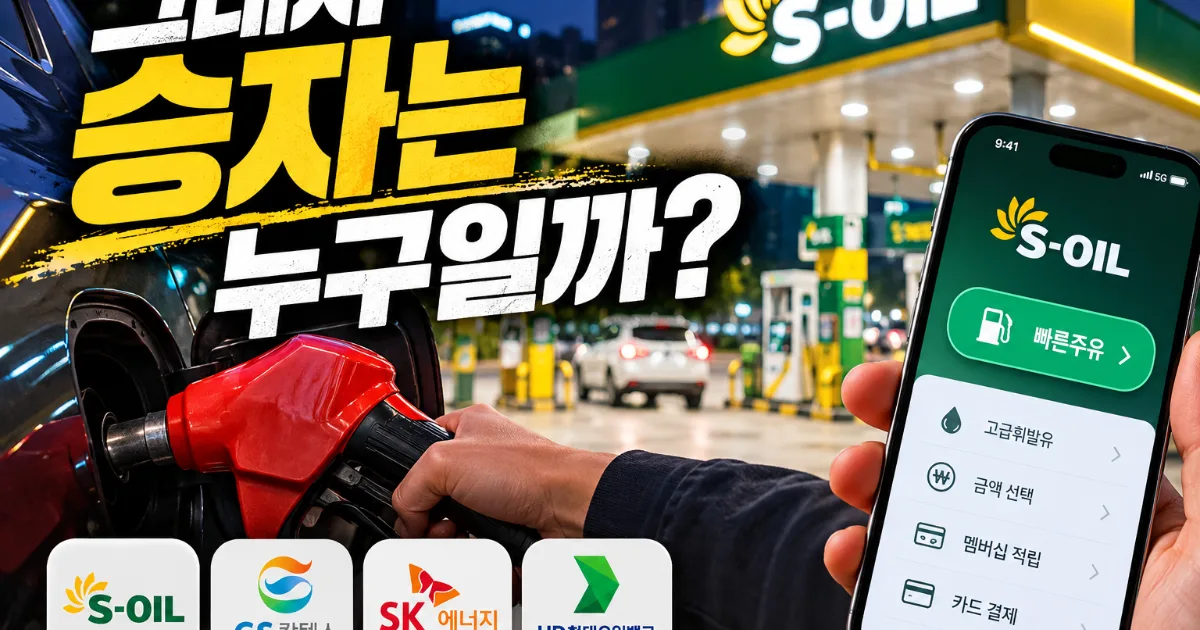
S-OIL offers “Quick Refueling” through the MY S-OIL app. GS Caltex operates “Baro Refueling” through its Energy Plus app. HD Hyundai Oilbank also has a “Smart Refueling” feature in its Car& app.
The names differ, but the direction is similar.
Reduce what drivers have to do in front of the fuel dispenser.
S-OIL’s Quick Refueling is designed to let users register cards, points and coupons inside the app. Fuel type and payment amount can also be set in advance. GS Caltex’s Baro Refueling also focuses on simplifying payment, point accumulation and discounts. GS Caltex describes the service as allowing users to pre-register their fuel type, amount and payment method, then complete ordering, payment and point accumulation through a barcode scan or PIN entry.
It is clearly convenient.
But one question remained in my head.
Is simplified refueling really attractive to consumers?
So I began looking at the numbers.
From 41.3% Cash to 15.9%: Payment Has Changed
Before looking at gas-station apps, I first looked at how people pay.
According to the Bank of Korea’s 2024 survey on payment methods and mobile financial service usage, the share of cash in everyday payments fell from 41.3% in 2013 to 15.9% in 2024, measured by number of transactions. In 2024, credit cards accounted for 46.2%, debit cards for 16.4%, and mobile cards for 12.9%.
Of course, this data is not limited to gas stations.
So it would be wrong to interpret the fall in cash usage as proof that gas-station app payments have increased. The data does not say that.
Still, one large change is visible.
The way we pay has changed significantly over the past decade.
If we trace that shift back a little further, we arrive at the spread of smartphones in Korea. After the iPhone launched in Korea in November 2009, the so-called “iPhone shock” began. Smartphones were no longer devices only for early adopters. Mobile phones quickly changed from devices for calls and texts into computers in the hand — devices for accessing the internet, installing apps and using all kinds of services.
People began using phones to find directions, order food, buy train tickets and do banking.
Eventually, the act of paying also entered the smartphone.
People who once took out cash began taking out cards.
People who once took out cards began taking out smartphones.
As the tool of payment changed, the standard of convenience consumers expected also rose.
Reducing a few taps.
Not having to take out a card.
Having points and coupons applied automatically.
Once these experiences become familiar in coffee ordering, shopping, transportation and finance, gas stations cannot remain exceptions.
Seen this way, oil refiners’ effort to bring the refueling process into apps looks different.
It is not simply a matter of saying, “We should make an app too.”
It can be seen as the refueling experience being absorbed into the mobile habits that consumers have accumulated for more than 15 years since the iPhone.
But there is an important difference.
People becoming used to smartphone payments and people choosing to install and use a specific oil refiner’s app are not the same thing.
That is where the question appears.
Do consumers want easier payment?
Or do they want an oil refiner’s app?
So I looked at the numbers behind the apps.
The Number More Interesting Than Two Million: 250,000
In January 2024, GS Caltex said its Energy Plus app had 1.08 million registered users and 250,000 monthly active users, or MAU. At the time, Baro Refueling was available at 1,366 gas stations.
The number of users continued to grow. GS Caltex later said in a February 2026 press release that Energy Plus had surpassed 2 million registered users in 2025.
S-OIL also announced in May 2025 that cumulative downloads of its MY S-OIL app had surpassed 2 million. The company said the app’s Quick Refueling feature allows users to make simple fuel payments using registered cards, points and coupons without needing a physical card.
Looking only at the headline number, both companies have “2 million.”
But they are not the same 2 million.
GS Caltex disclosed registered users.
S-OIL disclosed cumulative downloads.
Because the counting standards differ, it is hard to simply say which company is ahead.
Instead, two other numbers disclosed by GS Caltex were more interesting to me.
1.08 million registered users.
250,000 monthly active users.
A simple division gives about 23%.
Of course, this should not be called an app payment rate or reuse rate. MAU, or monthly active users, simply means the number of people who used the app at least once during a given month. It does not necessarily mean they actually paid for fuel through the app.
But it leaves one important question.
People who sign up for an app and people who continue using it are different.
You can understand this easily by looking at your own smartphone.
How many apps have you installed because they seemed useful, used once or twice, and then forgotten?
From a company’s perspective, the truly important person is probably not the person who installed the app.
It is the person who opens it again next time.
The gas-station app competition is ultimately moving toward that point.
It is not a download competition.
It is a habit competition.
7,000 Won for First-Time Users, 2,000 Won for Existing Users
From this perspective, one S-OIL promotion was interesting.
From April 21 to May 9, 2025, S-OIL offered fuel coupons to customers who paid at least 40,000 won using Quick Refueling.
First-time users received 7,000 won.
Existing users received 2,000 won.
That difference caught my eye.
Why give a larger benefit to first-time users than to people already using Quick Refueling?
From the perspective of consumer behavior, one reasonable inference is possible.
Using a new app for the first time requires work.
You install the app.
You sign up.
You register a card.
You learn how to use it.
Moving from conventional card payment to a new method requires time and effort. It is a kind of switching cost.
So offering a larger benefit to first-time users can be interpreted as an incentive to overcome that cost and create the first action.
But the real competition begins after that.
Will a person who tried the service once because of a 7,000-won coupon use Quick Refueling again after the coupon disappears?
Will they continue using it simply because it is convenient?
That is when the competitiveness of the app itself becomes visible.
I divide the conditions for repeat use into three parts.
Can I use it?
Is it less troublesome?
Is there a reason to use it again?
In one sentence:
Availability × Convenience × Reason to repeat.
If the app cannot be used at the gas station I frequently visit, it is hard for it to become a habit.
If it is more complicated than using my existing card, I will take out the card next time.
But if there is a reason to use it again, whether because of benefits or convenience, the second use becomes more likely.
Of course, this is not a statistical model estimated from actual user data.
It is an analytical framework for understanding repeat use. The real size of each effect would need to be confirmed through user behavior data.
Then Why Did SK Energy Leave the App?
Up to this point, it may seem as if all oil refiners are moving in the same direction: build their own app and bring customers into it.
But one company chose a different path.
SK Energy launched its digital refueling service Muffin in 2020, but ended the app-based service in July 2025 and shifted its membership system to an OK Cashbag points-based structure.
I find this interesting.
If GS Caltex, S-OIL and HD Hyundai Oilbank are trying to bring customers into their own digital spaces, SK Energy appears to have chosen a path connected to a broader points ecosystem.
Why it made that decision cannot be determined from public materials alone.
But the strategic difference can be compared.
One side seems to say:
“Come into our app.”
The other side seems to say:
“We will meet you inside the ecosystem you already use.”
Then the question changes slightly.
What must an oil refiner really own?
Its own app?
Or the customer’s habit?
When the Hassle Costs More Than a 1,000-Won Discount
Suppose a gas-station app gives you a 1,000-won discount.
You open the app.
You log in.
You register a card.
You look for the coupon.
You cannot remember your password.
You try verification again.
The problem is that another car is waiting behind you.
At that moment, a thought may come:
“I’ll just insert the card.”
Consumers do not calculate only the benefit.
They also calculate the time and effort required to obtain that benefit.
In simple terms:
Perceived value = benefit gained − cost felt during use.
Even if the user can save 1,000 won, if the process of saving that 1,000 won is too annoying, the user may not move. Conversely, even if the discount is not large, if almost nothing requires attention, it can naturally become a habit.
So the question should change.
Instead of asking, “How do we make people install our app?”
Perhaps oil refiners should ask, “How do we let customers use our service with the least possible effort?”
The outcome of the gas-station app competition may be decided there.
The Real Competitor May Be Outside the Gas Station
The deeper I looked, the more it became clear that the competitors are not only other oil refiners.
According to the Bank of Korea, the daily average transaction value of simplified payment services in Korea reached 1.2264 trillion won in the first half of 2026, up 16.8% from a year earlier.
Again, this is not gas-station-only transaction data.
But it shows the background: people are becoming accustomed to payment experiences in which the procedure keeps getting shorter across daily life.
And that payment experience is already entering the car.
Hyundai Motor and Kia operate CarPay, an in-car simplified payment service. Hyundai Motor Group said in December 2023 that, at the time, the service had about 4,000 partner locations nationwide, including gas stations, EV charging stations and parking lots.
This shift matters because it can change the starting point of payment.
Until now, we took out a card at the fuel dispenser.
Then we opened a smartphone.
But if the driver can find a gas station and pay through the car screen, the first screen the driver encounters may not be an oil refiner’s app.
It may be the car’s navigation screen.
Or it may be the simplified payment service the driver already uses.
Then the nature of competition changes.
At first, it looked like a competition over which oil refiner could make a better app.
But one step further, it becomes a competition over which screen the driver sees first at the exact moment they need fuel.
Perhaps the Most Convenient App Is the One You Never Have to Open
At this point, electric vehicle charging comes to mind.
In EV charging, systems such as Plug & Charge have emerged. In compatible environments, the driver connects the cable, and authentication and billing happen automatically through the vehicle, charger, contract and payment system.
The core idea is simple.
Reduce what humans have to do.
Payment has continued moving in this direction.
We took out cash.
Then we took out cards.
Then we took out smartphones.
Now we are trying not to take out even the smartphone.
If so, the most convenient refueling service may paradoxically be one that does not require opening an app at all.
A car knows when fuel is low.
It guides the driver to a suitable gas station.
When the driver arrives, authentication occurs.
Payment follows naturally.
Of course, this is not yet a reality available in all vehicles. As vehicle data and payment data become more connected, privacy protection and user control must also be considered.
Even so, the direction is interesting.
The end of payment competition may not be making payment more flashy.
It may be making the act of payment almost disappear.
So Who Wins?
Let us return to the gas station where we began.
I still see the “Quick Refueling” button and press “Start.”
I choose premium gasoline, enter the amount, apply membership points, insert the card and lift the red nozzle.
I still like that tactile ritual.
But after following the data, I arrive at a slightly different question.
The important thing may not be whether I use Quick Refueling right now.
For oil refiners, the more important question is whether they can make me choose the same method next time without much thought.
With the publicly available data, it is difficult to declare a winner among Korea’s four major oil refiners.
GS Caltex’s 2 million refers to registered users, while S-OIL’s 2 million refers to cumulative downloads. Core metrics such as actual app payment rates by refiner, reuse rates and changes in gas-station visit frequency before and after app use are not sufficiently public.
But the conditions for winning are becoming visible.
The winner may not be the company with the most features.
It may not be the company offering the largest coupons.
It may not be the company with the biggest sign-up number.
Perhaps the winner will be the company that creates an experience drivers think of first, and can choose with the least effort, at the precise moment they need fuel.
When I think about myself, that sounds right.
I look for S-OIL stations.
At first, it was because the premium gasoline near my home was cheapest there. Then I made a membership card. Points accumulated. I set my fuel discount card to S-OIL. After a few repeated choices, I stopped comparing.
So I go again.
The phrase I initially wrote as a joke — “I am an S-OIL person” — begins to look different.
Perhaps that is exactly the state companies want to create.
A choice so familiar that customers no longer feel it as a choice.
But there is still one gap.
I have become familiar with the S-OIL brand.
I have not yet become familiar with Quick Refueling.
The next threshold oil refiners must cross may be right here.
They must move beyond making customers return to the same brand, and make the payment experience they designed into a habit.
The battle unfolding in front of the fuel dispenser is ultimately that kind of battle.
I finish refueling and get back into the car. The fuel warning light that had been on a moment ago is gone, and the fuel gauge has climbed. I switch on the left turn signal to leave the station and rejoin the road. When I lower the window slightly, the autumn wind comes in. The bright lights of the gas station shrink in the side mirror.
Suddenly, I remember a sentence that used to be exchanged at gas stations long ago.
“How much would you like?”
“Fill it up, please.”
It was a simple exchange.
But inside that short conversation, there was a process: asking what the customer wanted, doing the necessary work and sending the customer on their way.
Now, part of that role is performed by machines.
Part of it is performed by apps.
In the future, the car may do even more.
I do not dislike that.
If it becomes more convenient, I will gladly use it.
But I hope oil refiners remember one thing.
Companies want customers to remember them.
But customers may want services that require them to remember nothing at all.
Which app to open.
Which card to take out.
Which coupon to find.
A natural experience in which they do not even need to think about such things.
Perhaps the true winner of the battle that begins the moment fuel is needed will be the company that understands that paradox first.
The car returns to the road.
The fuel tank is filled.
I do not think about when I will need gas again.
I simply drive toward my destination.
I remember the old farewell from the gas station.
“Thank you. Have a safe drive.”
The battle begins the moment you need gas.