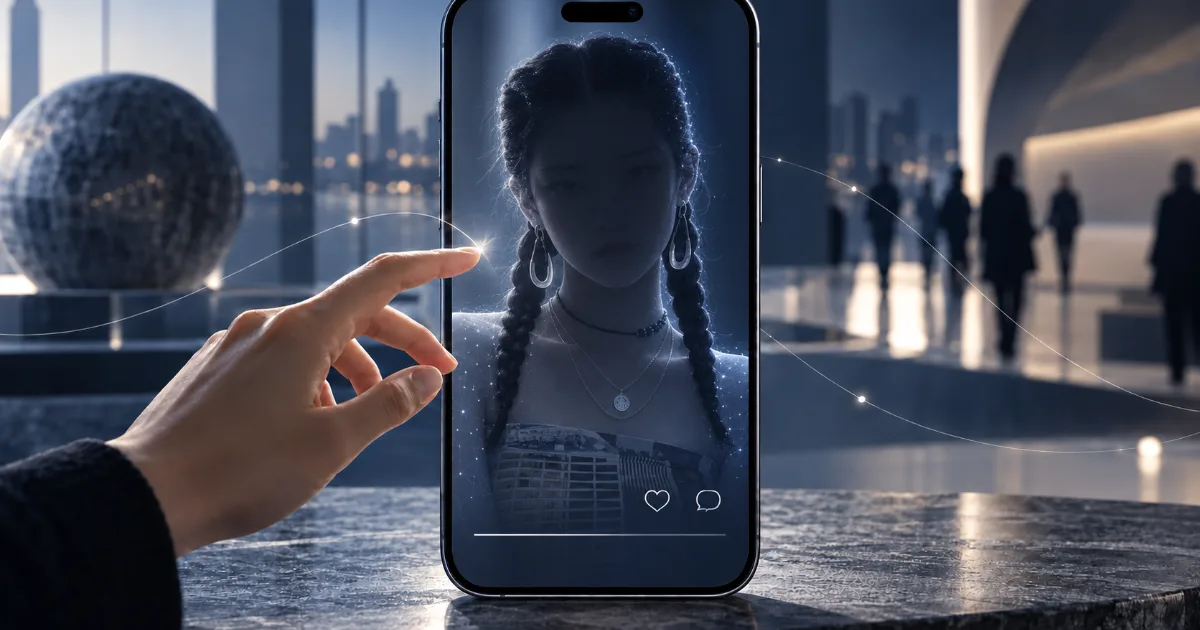
“Effects of SNS Marketing Characteristics Utilizing Virtual Influencer on Consumers’ Willingness to Purchase — Consumers Aged 18–34”
Seo Yeon Lee and Ja Joon Koo, 2022
Journal of Basic Design & Art, Vol. 23, No. 4, pp. 273–289
DOI: https://doi.org/10.47294/KSBDA.23.4.19
Why Would Consumers Want Products Promoted by a Virtual Persona?
An influencer shares everyday moments on social media, collaborates with brands, and speaks about social issues. But what if that influencer is not a real person? Would consumers still want to buy the products they promote?
Discussions about virtual influencers often focus on appearance and technology: how realistic they look, how naturally they move, and what new possibilities they offer. Marketing, however, raises another question. Are the qualities that attract attention also associated with purchase intentions?
A 2022 study by Seo Yeon Lee and Ja Joon Koo examines this question through four characteristics: attractiveness, interest, trustworthiness, and social contribution. Its focus is on how consumers perceive social media marketing featuring virtual influencers, rather than the technical sophistication of the characters themselves.
Examining Appeal, Entertainment, Trust, and Social Contribution
The researchers reviewed relevant literature and examined social media marketing involving Lil Miquela, Rozy, and Rui. They then conducted an online survey from April 12 to 26, 2022, analyzing responses from 123 consumers aged 18–34. Participants received brief examples of virtual influencer marketing before completing the survey.
In this study, attractiveness extends beyond physical beauty. It includes whether consumers find the marketing appealing and feel familiarity or attachment. Interest concerns whether the marketing feels entertaining, innovative, and capable of arousing curiosity.
Trustworthiness measures whether consumers perceive the marketing as reliable, free from exaggeration, professional, and objective. Social contribution concerns perceptions of its active involvement in social causes, its efforts to contribute, and its role in publicizing those activities.
These distinctions reflect the idea that virtual influencer marketing cannot be understood through appearance or publicity alone. Consumers may enjoy the content while also evaluating the credibility of its messages and the social meaning of its activities.
Trustworthiness Had the Largest Regression Coefficient
All four characteristics showed statistically significant positive associations with purchase intentions. In a regression model accounting for the characteristics together, the standardized coefficients were 0.325 for trustworthiness, 0.252 for attractiveness, 0.252 for interest, and 0.187 for social contribution.
Trustworthiness had the largest coefficient. Within this sample and model, perceiving the marketing as trustworthy showed the strongest association with purchase intentions. However, the coefficient sizes alone do not establish that trustworthiness was statistically more important than the other characteristics.
It is also important to clarify what participants were being asked to trust. The study did not measure whether consumers believed the virtual influencer was a real person. It asked whether the marketing featuring that influencer conveyed information that was professional, objective, and free from exaggeration.
Recognizing a persona as fictional and considering its message credible are separate judgments. Even when a character does not exist as a real person, consumers can evaluate the quality of the information it communicates.
Familiarity and Entertainment Also Matter
Attractiveness and interest were also positively associated with purchase intentions. Consumers who viewed the marketing as familiar, appealing, entertaining, or curiosity-provoking tended to report stronger intentions to purchase.
For practitioners, this suggests that developing a virtual influencer involves considering the character and the content experience alongside visual appearance. What personality does the character have? What aspects of everyday life does it share? What gives audiences a reason to anticipate its next post?
However, the study did not test a sequence in which attractiveness first draws attention, entertainment then creates engagement, and trust finally leads to purchase. It examined the relationships between four characteristics and purchase intentions, without establishing the order in which consumer responses develop.
The findings are therefore better understood as factors to consider together during planning, rather than a fixed formula for success.
Can a Virtual Persona’s Social Contribution Matter?
Social contribution also showed a significant positive association with purchase intentions. Respondents who perceived virtual