Google has outlined its Chrome security strategy for the AI era.
The message is clear.
Large language models do not only empower attackers. Defenders must also use AI to find vulnerabilities faster, triage them faster, fix them faster and deliver patches faster. Chrome’s security team is applying AI across the security lifecycle: vulnerability discovery, triage, patch candidate generation, test creation, release automation, dynamic patching and dependency management.
This is not just a security tooling update.
It is a change in the operating model of browser security.
The web browser is the gateway to modern digital life. Email, banking, shopping, work, video, cloud services, SaaS tools and internal enterprise systems all run through the browser. A browser vulnerability is not merely a software bug. It can become a path to personal information, corporate data and system privileges.
The key issue is speed.
AI can accelerate vulnerability discovery. Attackers can also use AI to find weaknesses faster. That means defenders must become faster as well.
Finding a vulnerability is not enough.
A security team must classify it, reproduce it, fix it, test it, ship it and make sure the user’s browser actually applies the update.
That is the direction of Chrome security in the AI era.
Find more bugs with AI.
Triage them faster with AI.
Generate patch candidates with AI.
Write tests with AI.
Shorten release cycles.
Explore ways to apply patches without user restarts.
And reduce entire classes of bugs through Rust and memory-safety technologies.
AI-era security is not only a detection race.
It is an operational speed race.
The Fight Is to Shorten the Life of a Security Bug
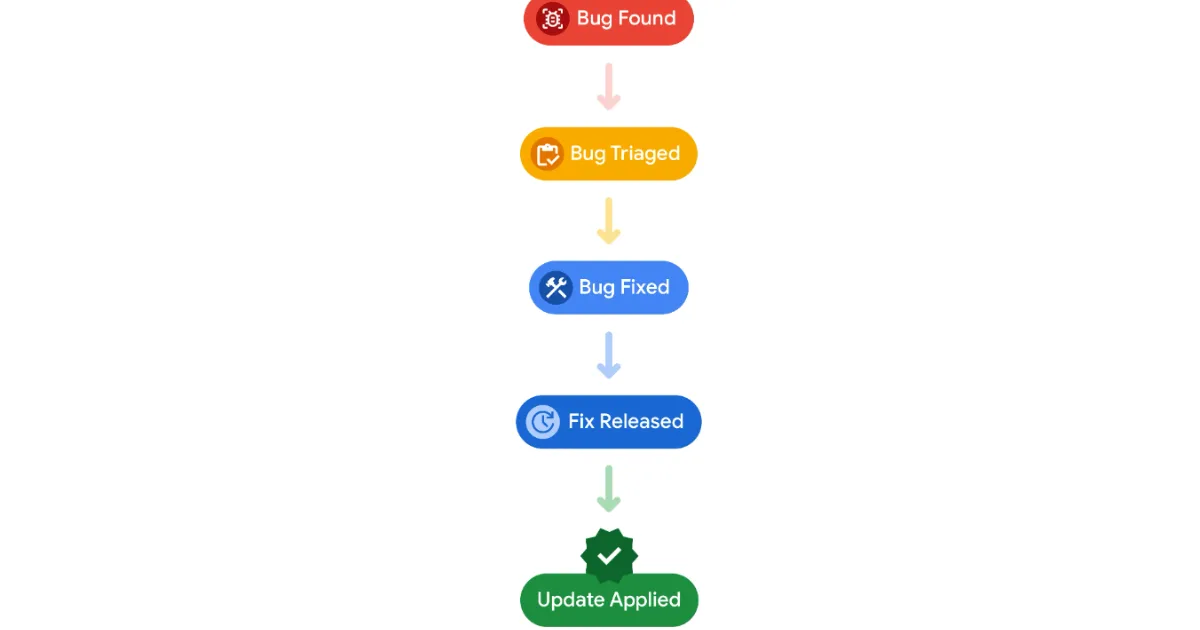
Google describes the life of a security bug in stages.
A bug enters the codebase.
Someone discovers it.
Triage happens.
The bug is fixed.
A Chrome update containing the fix is released.
The user restarts Chrome and the update takes effect.
Chrome’s goal is to make every stage happen as quickly as possible.
That framing matters.
Many security conversations focus on vulnerability discovery. Who found the zero-day? How severe is the vulnerability? Is it already being exploited?
But in real defense, everything after discovery matters just as much.
If discovery is slow, users are exposed.
If triage is slow, fixing is delayed.
If fixing is slow, attackers have more time.
If release is slow, the patch does not reach users.
If users do not restart, the protection is not applied.
Security cannot become faster at only one stage.
The entire pipeline must become faster.
That is why Google is discussing not only vulnerability discovery, but also triage, fixing, release and update application. Once AI starts finding more vulnerabilities, the next bottleneck appears immediately. If humans must manually triage every report, produce every patch candidate, write every test and manage every release step, the organization cannot keep pace.
The moment AI finds more bugs, the security organization receives more work.
The real task of AI security is therefore to build a security production system that can handle increased discovery volume.
AI Vulnerability Discovery Has Already Become Real
Chrome’s security team says it has been using large language models for security for years.
In 2023, it developed ways to use LLMs to improve the coverage and performance of security fuzzing. In 2024, it worked with Project Zero on Naptime, which provided LLMs with specialized tools for vulnerability research. In 2025, Google DeepMind and Project Zero developed Big Sleep, an AI vulnerability-discovery agent that found bugs in the V8 JavaScript engine and graphics stack.
In early 2026, Google built a Gemini-powered agent harness to search more efficiently across the Chrome codebase with a lower false-positive rate. One of the bugs found through this process was a sandbox-escape vulnerability. A compromised renderer could trick the browser into reading a local file. The bug had quietly remained in the codebase for more than 13 years.
That example is symbolic.
It means AI found a vulnerability that humans had missed for a long time.
A browser codebase is enormous and complex. Chromium contains many components, dependencies, platform-specific paths, rendering systems, graphics layers, networking code, sandbox logic, extensions and a JavaScript engine. No human can fully understand every code path and trust boundary.
AI can help here.
It can read large codebases, reference past CVEs and git history, reason about trust boundaries and threat models, and repeatedly explore different possibilities.
Google is also building Chrome-specific knowledge bases and feeding the model with prior CVEs and the full git history to supplement information that appeared after the model’s training data.
AI vulnerability discovery is no longer only an experimental possibility.
It is becoming part of security operations.
But AI Also Needs a Fence
Google emphasizes safeguards alongside AI vulnerability discovery.
Chrome’s AI analysis is performed only on source code at rest. It is not a free-running system attacking live services. The model operates in a locked-down environment without general internet access. Internal scanning configurations intercept all network requests, apply strict allowlists based on starting applications and destinations, and block suspicious model activity.
The models are not run in unrestricted mode. Subagents are strictly limited in their ability to modify local systems or access files outside designated source-code directories.
This matters in light of recent AI cyber-evaluation incidents.
The OpenAI-Hugging Face incident and Anthropic’s Claude evaluation incidents showed that powerful AI agents can reach real internet systems and production infrastructure when evaluation environments are misconfigured or insufficiently contained.
Google’s approach points in the opposite direction.
Use AI to find vulnerabilities, but do not let AI act freely.
Let AI read code, but do not let it modify the system without control.
Do not give it open internet access.
Intercept and monitor network requests.
Limit subagent permissions.
This is a core principle of AI-era security.
If defenders want to use powerful models, they also need powerful isolation and permission controls.
The Role of External Security Researchers Is Also Changing
If AI helps internal teams find more vulnerabilities, the role of external security researchers also changes.
Google continues to value the Chrome Vulnerability Reward Program. External researchers still bring expertise, creativity and independent perspective. But Chrome has also seen a surge in bug reports. Since early 2026, reports increased across categories, and in March alone more bug reports arrived than in all of 2025.
AI is likely making vulnerability discovery more accessible and more automated.
That changes the economics of bug bounty programs.
It is no longer enough to submit large numbers of easily discoverable bugs. Reports that add value beyond what internal automation can find become more important. Google says it has adjusted the Vulnerability Reward Program to encourage reports that complement internal discovery and can flow easily into automated handling pipelines.
This is an important shift for the bug-bounty market.
AI increases the quantity of vulnerability reports.
Rewarded value moves toward quality and context.
Duplicate, low-quality and automatically generated reports must be filtered.
Difficult and high-impact vulnerabilities become more valuable.
Security researchers are not simply competing with AI.
They must focus on what AI still misses.
Automated Triage Reduces the Security Bottleneck
When more vulnerabilities are discovered, triage becomes a bottleneck.
Google says traditional security triage could take anywhere from five minutes to more than 30 minutes per report and relied heavily on human expertise. Now Chrome combines rules-based systems and AI to automate triage.
The automated triage process has four stages.
First, it filters noise. It checks whether a report is spam, whether it meets intake requirements, whether it is a duplicate and whether it clearly describes a Chrome security vulnerability.
Second, it reproduces the bug. It checks whether there is a proof of concept and tests the issue on affected operating systems and browser versions. If reproduced, it attaches details such as stack traces for engineers.
Third, it enriches metadata. It adds information such as when the bug was introduced and how severe it may be. Google has clarified its severity guidelines to support this automation.
Fourth, it assigns the issue. It routes the bug to the right component and human owner.
Google estimates that this saves hundreds of developer hours each month.
The point is not that AI fully replaces humans.
AI handles repetitive classification, enrichment, reproduction and routing. Humans focus on the more important judgments and fixes. In vulnerability response, the scarcest resource is the time of skilled security experts.
Automated triage helps recover that time.
The competitiveness of an AI-era security team is not determined only by hiring more experts.
It is determined by how those experts spend their time.
AI Can Also Generate Patch Candidates
Google is also using multi-agent workflows for vulnerability fixing.
At the initial build stage, the system gathers the context of a specific issue. A fixing agent returns multiple candidate patches. A critic agent evaluates which patch is most appropriate and produces related artifacts for developer review.
The fixing agent and critic agent operate in a loop that mimics the normal code-review process.
Test-writing agents are also involved.
These agents write tests to verify that fixes work across the platforms and configurations supported by Chrome. Google says this process can save developers up to weeks of work in some cases.
This changes the production model of software security.
Traditionally, a security team found the bug, a developer analyzed the cause, produced a patch, wrote tests, went through review and released the fix. Now AI can generate multiple patch candidates, critique them and write tests. Humans remain responsible for final review and accountable decisions.
The bottleneck in patch production is reduced.
Google says security-fix throughput has increased significantly in recent Chrome releases. Across Chrome 149 and 150, the team fixed 1,072 security bugs, more than the total number fixed across the previous 23 milestones.
That number shows the scale of AI-assisted security automation.
Discovery is not the only thing accelerating.
Fix production is accelerating as well.
AI Security Is Moving Into CI
Google has worked with DeepMind and Project Zero on tools such as Big Sleep and CodeMender, and has integrated them into Chrome’s continuous integration system. These tools run every 24 hours against all change lists and detect security bugs before they reach production.
The results are significant.
In May 2026 alone, more than 20 vulnerabilities were prevented from reaching production, including critical S1+ issues.
This changes where security happens.
Security review is not only something that happens after code is merged. It must happen before code enters the codebase. In a fast-moving project like Chrome, periodically scanning the entire codebase is not enough. New diffs must be analyzed in the commit queue and CI stage to prevent vulnerabilities from entering in the first place.
Google says AI-based models automatically analyze diffs and suggest fixes for areas such as spanification, dangling pointer detection and numeric safety enforcement.
The company is also using LLM-based semantic analysis to catch complex risks that traditional static analysis may miss. A piece of code may look safe in isolation, but become dangerous when combined with a small logic change elsewhere in the tree.
AI can help detect these semantic interactions.
This shifts security left.
Security becomes not only a matter of finding vulnerabilities after release, but of blocking them just before code lands.
The War to Reduce the Patch Gap
Fixing a vulnerability is still not the end.
Chrome is an open-source project. When a fix lands in the public codebase, attackers can inspect the patch and infer what vulnerability was corrected. But it can take time before that fix reaches most users through the Chrome Stable channel.
That interval is the patch gap.
Google sees reducing the patch gap as a core security priority.
Chrome is moving toward a two-week milestone cadence and weekly security updates. But in a world where AI-assisted attacks may move faster, Google is exploring even more aggressive release timing, including twice-weekly security releases.
This is a major change in browser security operations.
The faster patches ship, the less time attackers have. But faster releases also increase the risk of regressions, incompatibilities and stability issues. Chrome handles this by continuously monitoring the stable branch and directly merging security fixes based on severity.
In the AI era, the gap between public code and attack can shrink.
Attackers can use AI to analyze patch diffs faster. AI can infer the underlying vulnerability and help weaponize it more quickly.
That means defenders must accelerate patch release and patch application.
The most important moment is not when a vulnerability is found.
It is when users are protected.
The Final Bottleneck Is the User Restart
Chrome has pioneered quiet background updates since 2008.
New binaries can be downloaded automatically and prepared on disk. But the final update still usually takes effect when the user restarts the browser.
The problem is that users often do not restart Chrome quickly.
Compared with triage, fixing, testing and release, which may take one or two days, the time waiting for users to restart can become a major part of N-day exploitation risk.
Users delay restarts for understandable reasons.
They are working.
They have many tabs open.
They are in meetings.
A restart feels disruptive.
Google is trying to reduce that burden.
First, it is investing in dynamic patching. Chrome’s multi-process architecture may allow background child processes such as renderers and GPU processes to be replaced with new binaries sequentially, applying many patches without requiring a full browser restart.
Second, Google is exploring better session restoration by saving more local state.
Third, it is looking for moments when automatic restarts will be minimally disruptive. On macOS, for example, an application can continue running in the background after all windows are closed. In Chrome 150, Google introduced a change that allows Chrome to automatically restart in this no-window state when a pending update is available.
Google’s long-term vision is an always-up-to-date browser.
A browser that is dynamically patched, quietly restarted when disruption is minimal and protected without requiring users to think about updates.
The final enemy of security updates is not only technology.
It is user friction.
Memory Safety Still Matters
Even if AI finds more vulnerabilities, the deeper solution is to reduce the classes of bugs that can exist.
Google says Chrome is pursuing a two-layer memory-safety strategy.
The first layer is runtime hardening to mitigate existing C++ vulnerabilities. The second is a long-term move toward memory-safe languages.
Most of Chromium is still written in C++. Immediate defense therefore depends on C++ toolchains and runtime mitigations.
Google has used MiraclePtr-related approaches to reduce use-after-free vulnerabilities and is expanding that work to more libraries, including Skia, ANGLE, Dawn, C++ iterators and std containers. It is also deploying MiracleObject with the goal of mitigating up to 90% of use-after-free vulnerabilities on the GPU main thread.
To reduce out-of-bounds errors, Google is pursuing spanification. This replaces pointer-and-size structures with compiler-enforced std::span types. Google says 97% of first-party Chrome code now compiles cleanly with strict unsafe-buffer warnings.
It is also integrating checked math to prevent integer overflows in memory allocation calculations and pursuing heap partitioning to separate pointer-containing and non-pointer types.
But Google expects C++ runtime mitigation to face diminishing returns over the next few years. Runtime checks cost more than compile-time guarantees, and even heavily mitigated C++ binaries still require strong sandboxing to satisfy the Rule of Two.
That is why Rust is the long-term answer.
Google is building a centralized Rust SDK and making Chromium APIs and tooling easier to use from Rust. It wants Rust to become a natural choice for new component development. It also plans to rewrite bug-heavy areas such as complex data parsers, image codecs and font stacks.
AI can help find bugs faster.
Rust can help prevent certain bugs from being created.
The two approaches are not substitutes.
They are complements.
Open-Source Dependencies Must Also Be Updated Automatically
Chrome security is not only about Chrome’s own code.
The Chromium Project is one of the world’s largest open-source projects. Chrome depends on more than 2,300 third-party dependencies, including components such as the V8 JavaScript engine, BoringSSL, Skia, ANGLE and Dawn. About 1,700 of those dependencies are shipped to users in some form.
These dependencies affect Android devices, edge-computing platforms and large enterprise cloud stacks.
Third-party dependency security is therefore critical.
Google uses internal feeds and external monitoring sources such as the U.S. National Vulnerability Database and the OSV database to run automated vulnerability-scanning pipelines. But reactive monitoring still leaves a risk gap.
That is why Google is moving all Chrome third-party dependencies into an automated update pipeline. The goal is to actively roll dependencies toward the latest upstream versions.
Automation needs guardrails, however. Google is also using safety signals from projects such as the Google Open Source Security Intelligence Platform, or GOSSIP.
This reflects the direction of open-source security.
Waiting for vulnerability announcements is too slow.
Dependencies must stay close to current.
But blindly updating creates its own risks.
Therefore, automated updates and safety signals must work together.
AI-era open-source security requires faster detection, faster updating and better quality signals.
The Message for Enterprise IT
Google also emphasizes Chrome update management for enterprise customers.
IT administrators can use the RelaunchNotification policy to encourage users to restart Chrome and apply pending updates. The policy can begin with softer notifications and escalate to forced relaunch after a defined period.
For environments that require extensive change validation, Chrome Extended Stable Channel remains available. Chrome Enterprise Core or Premium also provides an operating-system-agnostic dashboard for tracking browser versions and managing updates across an organization.
This matters for enterprise security.
The browser is a core entry point for work. Many companies invest heavily in endpoint security, EDR, VPNs and email security, but do not manage browser update state with the same rigor.
If users postpone restarts, the entire organization can carry a patch gap.
In the AI era, that gap becomes more dangerous because attackers may analyze and weaponize vulnerabilities more quickly after patches are public.
Enterprises should treat browser version management and restart policy as core security controls.
A security patch matters not when it is released.
It matters when it is applied.
What Korean Companies and Public Institutions Should Notice
Google’s Chrome security strategy has several implications for Korean companies and public institutions.
First, AI security must enter the entire development lifecycle, not only incident response. Vulnerability discovery, triage, fixing, testing, release and update application must be connected.
Second, the browser is a core security asset. As work moves to web-based SaaS, groupware, cloud consoles, ERP, CRM and developer portals, browser vulnerabilities become business-system risks.
Third, the patch gap must be reduced. Organizations need policies for restart notifications and forced relaunch when security updates are pending.
Fourth, if AI increases the number of discovered bugs, organizations must also increase their vulnerability-handling capacity. Running more scanners without improving triage, assignment, fixing and verification only creates a larger backlog.
Fifth, companies must invest in memory safety and structural prevention. Organizations operating C++-based systems should prepare long-term strategies involving runtime mitigation, static analysis, Rust adoption and rewriting high-risk components.
Sixth, open-source dependency updates should be automated. Manual response after vulnerability disclosure is too slow. But automated updates require safety signals and validation pipelines because they also carry supply-chain and quality risks.
AI-era security is not only about more detection.
It is about a faster security operating system.
Chrome Security’s Goal Is an Always-Up-to-Date Browser
Google’s Chrome security strategy shows where AI-era security is heading.
AI makes vulnerability discovery faster. But if only discovery accelerates, the defense organization becomes more pressured. It must triage more bugs, produce more patches, release more updates and ensure those updates actually reach user browsers.
Chrome is redesigning that entire pipeline with AI and automation.
LLMs find vulnerabilities.
AI and rules-based systems automate triage.
Multi-agent workflows generate patch candidates and tests.
CI and commit queues block new vulnerabilities.
Twice-weekly security releases are being tested.
Dynamic patching reduces the need for restarts.
Rust and memory safety reduce classes of bugs.
Open-source dependencies move toward automated updating.
All of this serves one goal:
a browser that stays as close to up to date as possible.
Attackers in the AI era may become faster. They may analyze patch diffs, weaponize vulnerabilities and automate N-day attacks more quickly.
Defenders cannot respond only by finding bugs faster.
They must shorten the entire time from discovery to protection.
Chrome security’s message is that every update should make the browser stronger.
That is not merely a slogan.
It is an operating model.
AI-era security competition will ultimately be a race of speed.
Not the organization that finds first, but the organization that protects first, will win.


