From understanding to influence: the interplay of AI literacy, self-efficacy, and trust in predicting communication students’ AI adoption and word-of-mouth
Daniel-Rareș Obadă, Camelia Gradinaru, Ioan-Alexandru Gradinaru
Front. Commun., 07 January 2026
Sec. Culture and Communication
Volume 10 - 2025 | https://doi.org/10.3389/fcomm.2025.1722464
In the AI era, the question shifts from “Will people use it?” to “How does it spread?”
Much of the discussion surrounding generative AI remains focused on whether people use it. Do students use AI? How often do they use it? Do they use it for assignments? Are they prepared to use it in professional settings? This paper, however, shifts the question. It asks why people who use AI come to talk about AI again. What kind of person recommends AI to others, and what kind of person quietly keeps their distance? The study does not treat AI adoption merely as an individual choice. It views it as an attitude that spreads within a communication environment.
The subjects of the study are communication and public relations students in Romania. They are students who use AI personally, but they are also future professionals who will soon handle messages between organizations and the public. In the fields of PR and communication, AI is already being used for content writing, customer response, data analysis, campaign planning, and public opinion monitoring. Therefore, how these students understand, trust, and talk about AI carries more significance than an ordinary student survey. They are future AI users, but also a group likely to shape and transmit social perceptions of AI.
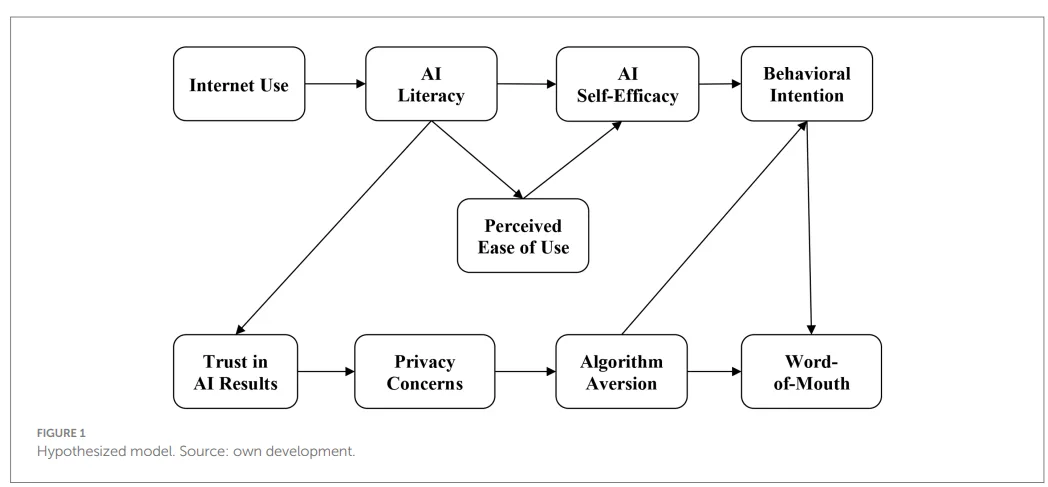
As the title of the paper suggests, the central movement is “from understanding to influence.” The ability to understand AI leads to confidence in using it. This confidence leads to the intention to use AI, and that intention, in turn, leads to the act of talking about and recommending AI to others. Conversely, privacy concerns and algorithm avoidance interrupt this flow. The paper organizes this process as a single psychological and communicative pathway.
AI literacy is not technical proficiency but a condition for judgment
The most important starting point of this study is AI literacy. The paper defines AI literacy as the ability to understand what AI is, identify AI products, evaluate AI-generated outputs, and use AI within ethical standards. Technical knowledge is included here, but what matters more is judgment. The core of AI literacy lies in the ability to assess when AI can be trusted and when one should stop, rather than simply accepting AI-generated results as they are.
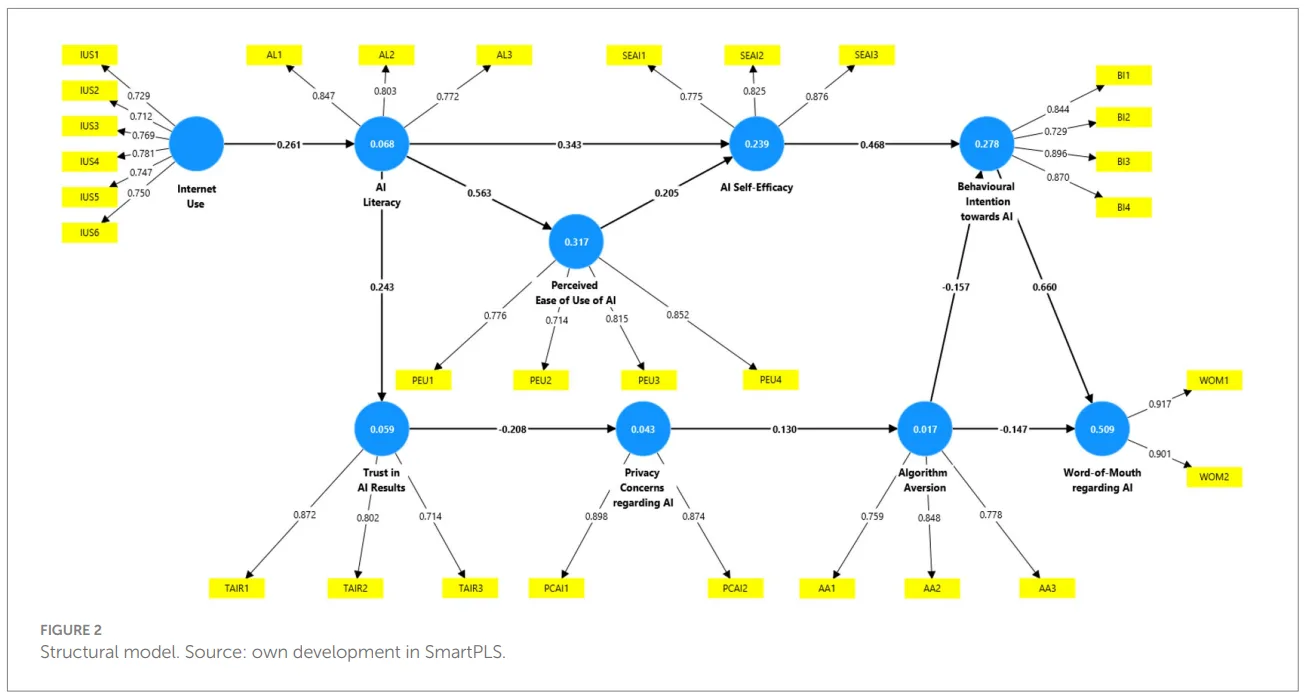
This point is especially important in university education today. Because many students grew up in digital environments, it is often assumed that they will naturally be good at using AI as well. The paper cautions against this assumption. Frequent internet use does not automatically mean a deep understanding of AI. The research findings also show that internet use has a positive effect on AI literacy, but the effect is not large. Internet use can serve as a starting point, but it cannot replace judgment.
The former may allow a person to turn a tool on and off with ease, but the latter allows a person to read the nature and limits of its results. When generative AI produces plausible sentences, one must distinguish whether this plausibility is evidence of accuracy or merely an effect of style. When a recommendation algorithm proposes a decision, one must examine whether it is a data-based judgment or a repetition of bias. The AI literacy discussed in this paper is close to the ability to draw this line.
The easier AI feels, the more confidence grows
One of the strongest relationships found in the study is the relationship between AI literacy and perceived ease of use. Students who feel they understand AI better are more likely to perceive AI-based apps and websites as easy to use. As AI feels easier to use, their self-efficacy also increases. Here, self-efficacy refers to the belief that “I can use AI to complete tasks” or “I can interact effectively with AI-based platforms.”
This flow resembles scenes often observed in educational settings. Some students remain anxious even when they use AI. They do not know whether the results are correct, how to revise their prompts, or where to make corrections when something is wrong. Other students, by contrast, know how to work with AI even if they do not trust it completely. They revise their questions, compare results, check sources, and edit the output according to their own purposes. The difference between these two students lies less in the amount of use than in the structure of understanding.
The paper demonstrates this structure through data. AI literacy has a strong effect on ease of use, and ease of use, in turn, affects AI self-efficacy. In other words, students do not use AI well simply because it appears easy. Rather, AI becomes easier because they understand it to some extent, and because it becomes easier, they handle it with greater confidence. This is where the direction of AI education becomes clear. Confidence in using AI develops when students are taught how the tool works, in which situations it is useful, and where it tends to fail.
Trust can increase, but it is not the same as blind faith
Another important axis of the paper is trust. According to the findings, AI literacy increases trust in AI-generated results. At first glance, one might think that the more people know, the more cautious they should become. But trust here is different from blind acceptance. The paper connects this finding to existing research suggesting that AI literacy enables “appropriate trust.” Those who know little about AI are more likely either to overtrust it or reject it entirely. Those who understand it to some degree can adjust the level of trust depending on the situation.
Trust in AI is not a value that is always better when it is higher. If trust is too low, use is blocked. If trust is too high, verification disappears. What is needed is balance. When the paper says that AI literacy increases trust, it does not mean that students accept AI-generated results more uncritically. Rather, it suggests that they gain criteria for interacting with AI.
However, this trust is also connected to privacy concerns. The study finds that the higher the trust in AI-generated results, the lower the level of privacy concern tends to be. This means that when users trust an AI system, they worry less about the possibility of personal information exposure or data misuse. This finding reflects actual AI use environments well. People often lower their sense of risk when faced with a technology they find convenient and useful. The more naturally AI responds, the more kindly it interacts, and the more effectively it helps with tasks, the less visible the data flows behind the system become.
Privacy concerns lead to algorithm avoidance
The paper does not examine only the positive pathway of AI adoption. It also shows that higher privacy concern leads to greater algorithm avoidance. Algorithm avoidance here refers to the tendency to avoid following decisions made by AI or algorithms. Even when people know that algorithms can be efficient, they distance themselves if they feel anxious about how their personal information is used or if they find it difficult to trust the system’s judgment.
This process reveals a realistic tension in today’s AI use. Many people acknowledge that AI is useful while also feeling uneasy about it. Chatbots are convenient, but users wonder where the information they enter goes. Recommendation systems are accurate, but they seem to know too much about what users watch, buy, and say. Generative AI provides fast assistance, but the data and criteria behind its results remain opaque. As these feelings accumulate, users begin to return to their own judgment rather than follow algorithmic suggestions.
In the study, algorithm avoidance lowers both intention to use AI and willingness to engage in word-of-mouth. In other words, students who avoid algorithms are less likely not only to use AI, but also to recommend AI to others. At this point, AI adoption becomes more than a matter of individual habit. It becomes a matter of social diffusion. When one person distrusts AI, not only does that person’s use decrease; the flow of talk about AI within that person’s network also changes.
The intention to use AI generates recommendation
The strongest relationship in the paper appears between behavioral intention and word-of-mouth intention. Students with a stronger intention to use AI in the future are more likely to recommend it to others and speak positively about it. This result may seem obvious, but it becomes more important because the study focuses on communication students. In PR and communication, word-of-mouth is a practical force that shapes the reputation of technology, organizational messaging, and the public climate of acceptance.
Within the model of the paper, intention to use AI results from the combined operation of self-efficacy and algorithm avoidance. When users feel that they can handle AI, their intention to use it increases. Conversely, when algorithm avoidance grows stronger, intention to use decreases. In the end, recommendation of AI does not arise from technological performance alone. It is shaped by how users perceive their own abilities, how easy they think AI is to use, how much they trust its results, and how they sense the risks surrounding personal information.
This perspective is useful for understanding the diffusion of AI. People interpret tools while using them. They experience convenience, regulate anxiety, observe the responses of others, and connect the technology to their own expertise. The spread of AI in society is not only a matter of technological distribution. It is also a matter of meaning formation.
Communication theory can no longer remain limited to human-to-human interaction
The paper also presents an important shift in its theoretical background. Communication research has long developed around interactions between humans. But AI is no longer a simple medium of transmission. It generates, recommends, translates, and revises messages, and at times communicates on behalf of users. Unlike the period when technology remained a channel, AI has entered the process of meaning production.
To explain this change, the paper brings together the Technology Acceptance Model, Theory of Planned Behavior, Uses and Gratifications Theory, Innovation Resistance Theory, the CASA approach, and the concept of AI-mediated communication. The point at which these theories converge is clear. AI is experienced as both a tool and an interaction partner. When people engage with chatbots or AI recommendation systems, they bring with them some of the expectations and norms they use in human relationships. For this reason, AI adoption is deeply shaped not only by convenience but also by socio-psychological elements such as trust, anxiety, familiarity, and resistance.
The strength of this study lies in the way it organizes these complex elements into a single pathway. The flow from internet use to AI literacy, from AI literacy to ease of use, self-efficacy, and trust, from privacy concern to algorithm avoidance, and finally to use intention and word-of-mouth shows what communication education in the AI era needs to address. AI education should help students read, regulate, and explain the ways in which they form relationships with AI.


