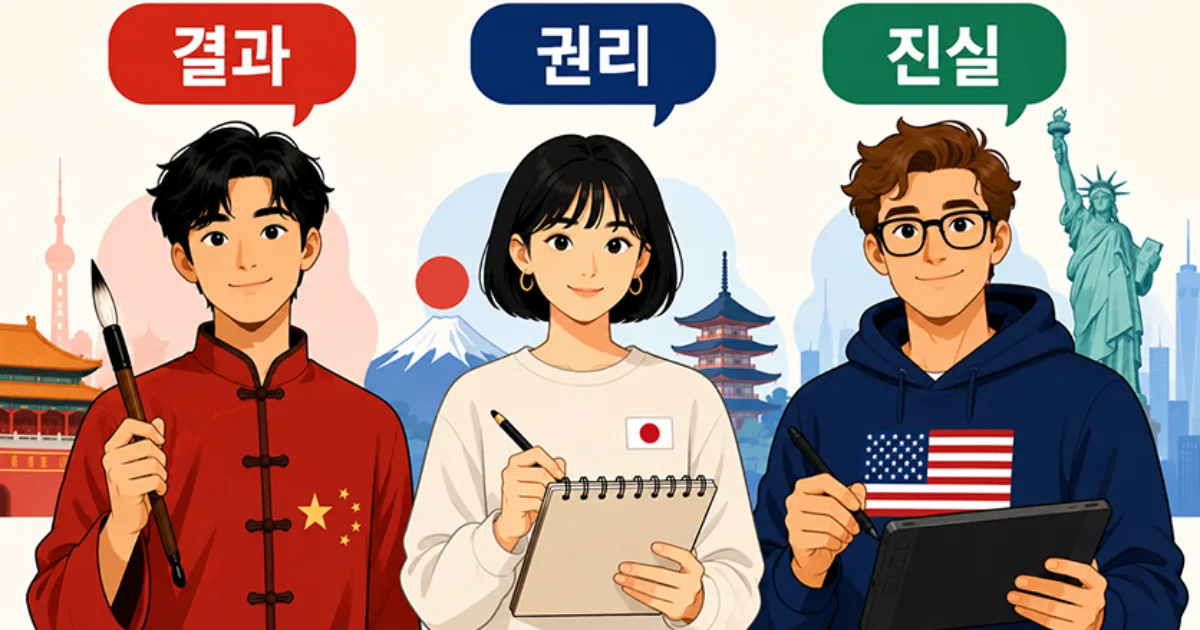
Suomiya Bao’s paper, “Cross-cultural attitudes toward generative AI in Art,” does not frame the debate around generative AI art as a simple matter of support versus opposition. What the author pays attention to is the actual criteria people use when they accept or reject AI art. These criteria differ by country, by artistic genre, and even by the direction of ethical concern. The study surveys 416 respondents from the United States, Japan, and China, examining their attitudes toward literature, visual art, and auditory art, as well as their ethical concerns. The research design is relatively straightforward, but the differences it reveals are quite clear. When looking at the same AI-generated artwork, one society first asks, “Is the final output good?” Another asks, “Does the human role remain?” Another asks, “Are rights and legal order properly protected?”
The Core Question: Where Does the Value of AI Art Come From?
The most interesting point of this paper is that it shows how the value of AI art does not reside only inside the artwork itself. Debates around AI art often remain focused on whether the work is beautiful, creative, or distinguishable from human-made art. But this study shifts the question slightly. Under what conditions do people perceive AI art as valuable? Is it the quality of the output, the effort of the human creator, the appropriateness of AI’s role, ethical safety, or productivity?
This shift in the question matters. Even when people encounter the same image, music, or text, their evaluation changes depending on the explanation surrounding it. Who made it, how much the human was involved, whether copyright issues have been settled, and whether there is a risk of producing misinformation all influence the criteria of reception. The author connects these differences in evaluation criteria to cultural attitudes. The acceptance of AI art is not merely a matter of aesthetic taste. It is a matter of how a society arranges creativity, labor, technology, rights, and truth.
China: An Attitude Centered on the Quality of the Output
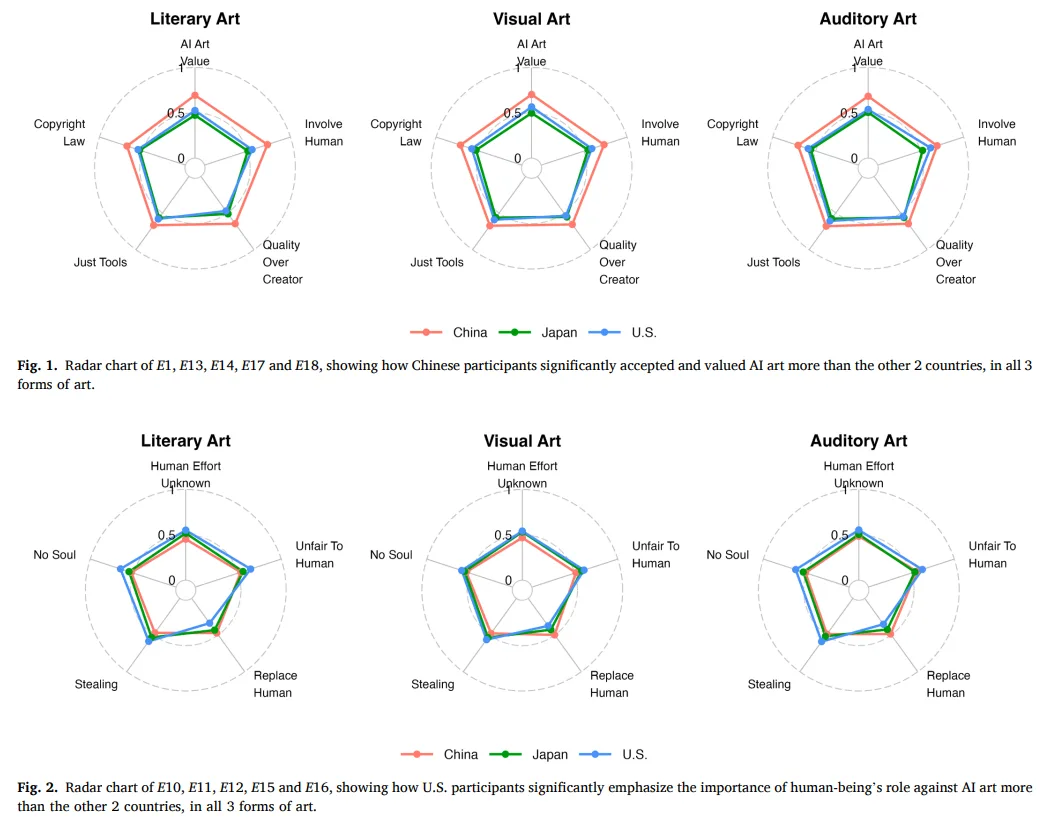
In the paper, Chinese respondents are the most optimistic about generative AI art among the three countries. They have the highest level of experience using AI tools and are more willing to recognize the value of AI-generated literature, visual art, and music. Their attitude becomes especially clear in their agreement with the idea that as long as the content is good, it does not matter whether it was made by a human or AI. In the ranking question about what makes AI art more valuable, Chinese respondents choose “good quality” as the most important factor.
This attitude is closer to a performance-oriented mode of evaluation than to unconditional technological optimism. Chinese respondents do not necessarily believe that AI will completely replace human creators. Rather, they tend to think that AI art can be properly valued if a solid copyright system is in place. What is interesting is that they do not completely ignore the human creative role. Especially in the field of literature, Chinese respondents strongly agree that AI should take over repetitive and boring tasks, but should not replace the creative part of human work. In other words, their attitude is not simply “AI can do it.” It is closer to “If AI can produce good results and a proper institutional framework exists, it can be accepted.”
This point can be read against the background of China’s technological environment. The author suggests that in China, AI is closely connected to national strategy, industrial development, and everyday infrastructure, and that high exposure to technology and strong institutional promotion may have increased acceptance of AI. When technology is not an unfamiliar outsider but already part of everyday life, people tend to judge its use in creative fields more pragmatically.
The United States: An Attitude That Defends the Role of Human Creators
American respondents react along a different axis from Chinese respondents. They do not completely reject AI art, but they are highly conscious of the role of human creators. They are sensitive to whether AI art seems to appropriate the labor of human creators, whether an artwork whose human effort is unknown can be considered valuable, and whether using AI is unfair to creators who work by hand. The paper summarizes this tendency by saying that U.S. respondents are the most active in defending the “human share” within AI art.
American respondents are especially more likely to see AI art as a form of appropriation or theft of human creativity. They also show relatively stronger agreement with expressions such as AI art having “no soul.” Here, “soul” does not need to be understood as a mystical concept. It can be read as a public language that refers to the time, training, intention, and lived experience behind the work. When people look at an artwork, they do not see only the final result. They also imagine the path that led to that result. For American respondents, the problem of AI art lies in the opacity of that path.
The American pattern is also clear in ethical concerns. The issue U.S. respondents worry about most is misinformation and fake content. This connects to a view of AI art not merely as an image-generation technology, but as a media technology that can manipulate reality and disturb public judgment. The issue of art thus expands into the issue of the public sphere.
Japan: Low Experience and a Cautious Middle Ground
Japanese respondents have the lowest level of experience using generative AI for artistic creation among the three countries. Yet their attitude does not appear as simple rejection. In the paper, Japanese responses are often positioned between those of the U.S. and China. The author also connects this to the cultural tendency of Japanese respondents to choose midpoint answers in surveys. Therefore, Japan’s neutrality is closer to a way of withholding a fixed position than to indifference or lack of judgment.
What deserves particular attention in the Japanese responses is concern over intellectual property and copyright. In the ranking of ethical concerns, Japanese respondents identify intellectual property and copyright as the most important issues. This resonates with a cultural environment in which the rights system around creative works is industrially crucial, as in Japan’s manga, animation, game, and character industries. In Japan, AI art is perceived first not as an ontological threat to the creator, but as a disturbance to the order of rights.
This difference is important. If the United States asks, “Can AI blur the truth?” Japan asks, “Can AI blur the boundaries of rights?” China first asks, “Can AI produce good results?” The same technology activates different sensitivities in different societies.
The Feeling of AI Art Changes by Genre
The paper divides its survey into literature, visual art, and auditory art. This distinction is not merely a formal classification. Attitudes toward AI art change depending on genre. For instance, attitudes toward visual art appear relatively more consistent across the three countries. In contrast, differences become clearer in literature and auditory art. Chinese respondents tend to view literature more as an art form than as a consumable product, while American respondents strongly recognize auditory art as an art form. Japanese respondents show lower scores overall in general art appreciation and immersion.
This result points to something often missing from debates on AI art. People do not respond to “AI art” as one single mass. AI writing a poem, generating a realistic image of a person, composing game music, or creating environmental sound are not the same issue. In literature, intention and narrative responsibility may feel more important. In visual art, authenticity and copyright may become more sensitive. In music, human performance and emotional traces may matter more. Depending on which genre AI enters, people draw different boundary lines.
Things More Important Than Productivity
One particularly notable result in the ranking of value factors is that none of the three countries considers “improved productivity” the most important factor. In discussions of AI, the most frequently repeated words are speed, convenience, and efficiency. But when evaluating AI art, respondents do not place productivity at the center. The U.S. and Japan consider ethical concerns, sufficient humanness, and appropriate role more important. China values quality most highly, but it also does not place productivity first.
This result makes us reconsider the conditions under which AI can be accepted in the arts. What people want is not simply faster production. In the U.S. and Japan, the boundary of “how far AI should go” matters. In China, the question of whether the final result is good enough matters. Across all three countries, productivity does not become the decisive justification. When AI enters creative practice, the explanation that it allows us to make things faster is not enough. Before speed, people demand a basis for value.
The Actual Meaning of Sustainable Creativity
The “sustainable creativity” in the paper’s title does not refer only to environmental sustainability. Here, sustainability means whether the creative ecosystem can maintain social trust, economic survival, and cultural diversity amid technological change. The author argues that generative AI should be integrated not as a replacement for human artists, but as a collaborative tool. AI art should also be designed and taught differently according to each culture’s ethical concerns and institutional sensitivities.
This perspective connects directly to art education. Teaching AI does not end with teaching prompt techniques. It must also include where students use AI in the creative process, where human judgment intervenes, how the sources and rights of the output are explained, and how the risks of falsity and manipulation are handled. China’s quality-centered acceptance, America’s defense of human roles, and Japan’s cautious concern with rights are not mutually exclusive answers. Rather, AI art education needs to pass through all three sensitivities. It should produce good results while leaving traces of human judgment, clarifying rights and sources, and avoiding the distortion of reality.
The Question This Paper Changes
The greatest insight of this study is that the future of AI art will not be determined by technical performance alone. Even if images become more refined, music more natural, and writing smoother, the issue of acceptance will remain. When people look at the result, they also look at the network of relations in which that result is placed. Human effort, legal rights, social truth, cultural trust, and institutional stability are evaluated together.
Therefore, the central question around AI art does not stop at “Can AI make art?” The more important question is, “Under what conditions do people accept works involving AI as art?” This paper argues that those conditions are not universal. The United States, Japan, and China are all experiencing generative AI, but what each society fears and expects is different. One society accepts AI art through quality, another through the trace of human involvement, and another through the boundaries of rights.
The debate around AI art will continue. But after reading this paper, the position of the debate shifts slightly. Rather than asking whether we should support or oppose AI art, we begin to ask under what social conditions AI art can become a trustworthy creative practice. This question is slower, but more accurate.