
How Freely Conversing Characters Change the Structure of Play
When generative AI enters a game, non-player characters no longer need to repeat lines written in advance. They can respond immediately to questions entered by the player. Technical demonstrations tend to emphasize this conversational freedom itself. The University of Bristol research team, however, asks a different question. Rather than measuring how naturally an NPC speaks, the researchers examine what players actually do, think, and find satisfying when they encounter such a character.
The attached document presents preliminary findings released ahead of the study’s final publication. The wider project involved 100 participants and 122 one-hour play sessions. The results discussed here concern 68 participants who played an early demonstration version of Dead Meat. The researchers combined questionnaires with observations of think-aloud play, interviews, transcripts, and game logs. Their focus was not limited to players’ judgments after the game. They also examined how players reasoned, hesitated, tested hypotheses, and changed strategies while playing.

Turning Dialogue from a Menu into an Action
Dead Meat is a murder-mystery game built around the interrogation of a suspect. Instead of selecting from predetermined dialogue options, players type whatever questions they want. They can read both the suspect’s spoken responses and private thoughts, allowing them to investigate the difference between outward statements and concealed emotions.
The game uses a large language model at runtime, but the character remains within boundaries established by the game’s authors. Meaning Machine describes this approach as “Authored AI”: generative responses operate inside a designed character, fictional world, and narrative structure.
AI is therefore not used merely to increase the number of possible lines. In conventional dialogue systems, asking a question means selecting one of the options permitted by the designer. In Dead Meat, formulating the question becomes part of the gameplay. Players manage not only what they ask, but also the wording, order, tone, and degree of psychological pressure. Dialogue moves from being a channel for receiving information to becoming a space in which strategy is performed.
This change expands the range of possible player identities. One player may behave like a detached investigator who presents evidence methodically. Another may try to build trust and reassure the suspect. Others threaten the character, introduce false evidence, or temporarily abandon the investigation to test how far the AI can be pushed. The player does not merely perform a fixed role. Through conversation, the player decides what kind of investigator to become.
Is More Freedom Always Better?
One of the study’s central findings is that expressive freedom increases satisfaction while also producing uncertainty. On the Game User Experience Satisfaction Scale, 90 percent of participants rated creative freedom at five or above. Players responded positively to being able to formulate their own questions and move the conversation in directions that the game did not explicitly prescribe.
Yet an open input box makes it difficult to determine not only what is possible but also what matters. Players must decide whether a failed response means that they asked the wrong question, phrased a good question badly, encountered a limitation of the AI, or simply have not yet discovered the necessary evidence. As the number of possible actions increases, the criteria for evaluating those actions can become less visible.
Some participants became anxious about whether they were asking sufficiently intelligent questions. They worried that the system might fail to recognise a relevant idea if it were expressed in the wrong terms. The laboratory setting, in which a researcher observed their performance, intensified this feeling. Players were simultaneously trying to solve the case and demonstrate that they were competent players.
The researchers consequently describe a kind of Goldilocks zone between expressive freedom and authorial guidance. An NPC must accept a wide variety of questions, but the game must also communicate direction through clues, objectives, records, emotional reactions, and devices such as access to the character’s thoughts. Players should feel neither that they are merely following instructions nor that they are throwing sentences into an empty space.
The design challenge, then, is not to maximise freedom. It is to make freedom produce consequences that the player can recognise and interpret.
When an AI Character’s Emotions Become Game Rules
The qualitative analysis identifies seven broad strategies used by players. These include the methodical investigator who accumulates facts, the “good cop” who builds trust, the “bad cop” who applies pressure, the rule-bender who uses small deceptions, the player who prioritises winning over honesty, the show-off who tries to expose weaknesses in the AI, and the uncertain newcomer who begins with broad questions while trying to understand the game’s rules.
The important point is that players did not remain within one strategy. When a suspect resisted pressure, a player might switch to reassurance. If reassurance failed, the player might present evidence. If that also failed, the player could try deception. Strategy was not a stable personality category. It was repeatedly revised in response to the NPC.
Players also interpreted the character’s emotional responses as information about the state of the game. If the suspect became nervous or frightened, players assumed that they were approaching something important. If the character became calmer or more cooperative, they interpreted this as evidence that a trust-building strategy was working. Instead of consulting an explicit health bar, suspicion meter, or relationship score, players read language and emotion as feedback.
The character’s apparent humanity therefore did not arise only from visual realism or natural sentences. Agency emerged when the character changed in response to the player and when that change altered the player’s next decision. Players did not need to believe that the AI genuinely possessed emotions. It was enough for fear, evasion, trust, and resistance to operate consistently enough to support strategic interpretation.
This also explains why the researchers treat emergent strategies as features rather than errors. The authors may not have written every solution in advance, but players can invent new forms of play when a character responds coherently to different approaches. The generative value of an AI NPC lies less in the unlimited production of sentences than in the production of unforeseen but workable strategies.
Different Players Pursue Different Forms of Success
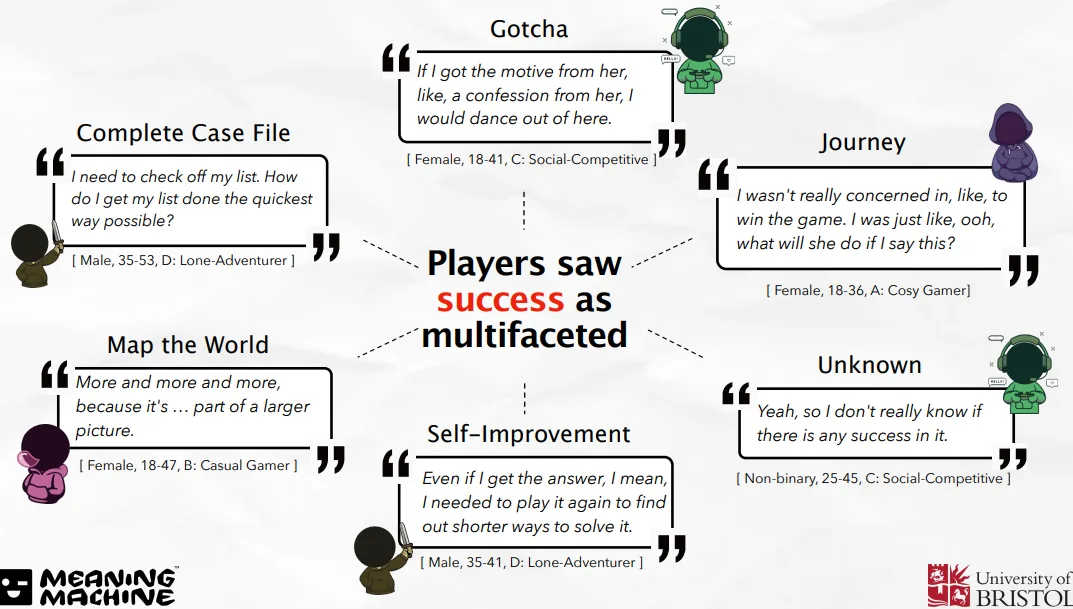
A diagram in the report categorises several forms of success that players pursued. The first is the decisive “gotcha” moment in which the player secures a confession or revealing reaction. The second is completion: filling every section of the case file or exhausting all available evidence. The third involves mapping the fictional situation as fully as possible by learning about the crime, relationships, and background. The fourth places value on the journey itself, including unexpected dialogue and the pleasure of the exchange. The fifth concerns mastery, as players try to solve the same case more efficiently on a later attempt. Finally, some players remain uncertain about what the game counts as success.
The diagram matters because it shows that a single victory condition cannot adequately describe an AI conversation game. The solution to the mystery may remain the same, but the ending that players seek can differ substantially. One person wants a confession, another wants psychological understanding, and another wants to discover how the system can be manipulated.
A game of this kind therefore needs more than one final outcome. It also needs intermediate feedback that helps players recognise what kind of progress they are making. The question is not only whether the case has been solved, but whether the player has built trust, exposed a contradiction, uncovered a hidden relationship, or discovered a new conversational possibility.
The study’s four player profiles point in the same direction. The researchers identify Cosy Gamers who favour social and narrative experiences, Casual Gamers more familiar with mobile and life-simulation play, Social-Competitive Gamers motivated by winning and action, and Lone-Adventurer Gamers drawn to solitary exploration and story. All four groups responded positively to the game. AI dialogue did not appeal only to players already predisposed toward narrative games. Different player types found different routes to satisfaction.
Immersion Did Not Depend on Low Cognitive Demand
Players were not immersed because the game required little effort. NASA Task Load Index results show a mental-demand score of 64.7 and an effort score of 63.2, both near the upper end of the moderate range. Frustration, by contrast, scored 25.5, while physical demand was only 10.
The experience demanded substantial thought, but participants did not generally experience that thought as wasted effort. They had to formulate questions, interpret ambiguous responses, evaluate emotions, recall evidence, and modify their approach. Because the character responded and the case gradually developed, cognitive effort was converted into a sense of progress.
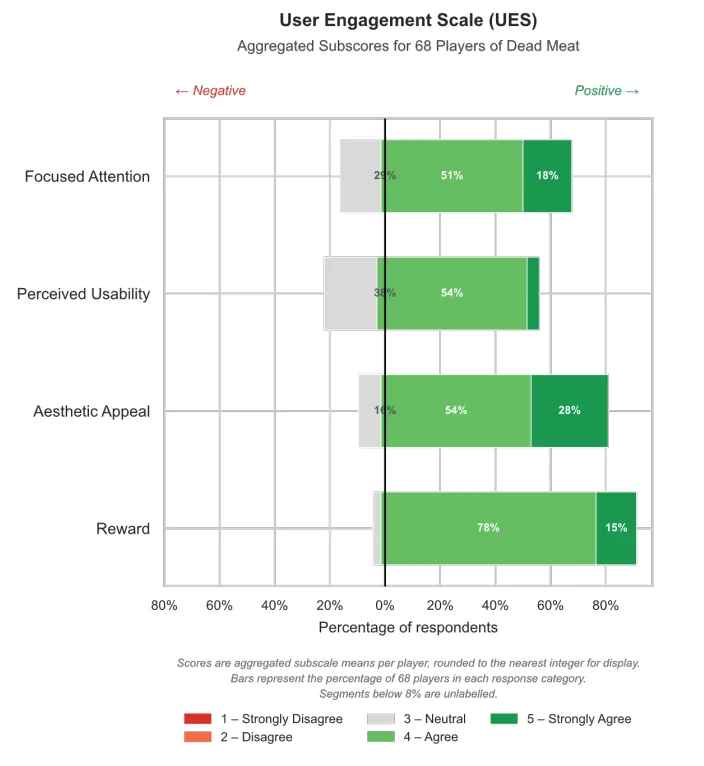
The User Engagement Scale produced positive average results across every measured dimension. Ninety percent of the engagement ratings fell within positive territory. Reward was positive for 97 percent of participants, and focused attention for 94 percent. On the broader game-experience scale, 96 percent rated enjoyment at six or above, while 87 percent rated engrossment at five or above.
Participants repeatedly described losing track of time. More than half felt that they needed longer to explore the game adequately. Immersion, in this case, did not emerge from reducing difficulty or removing uncertainty. It emerged because uncertainty could be investigated and because effort produced perceivable consequences.
Another unexpected result concerns the difference between voice and text. The researchers had anticipated that a voiced character might generate stronger reactions than a text-based one, but the player responses were broadly similar. The appeal of the NPC appeared to depend less on vocal realism than on the sense that the player’s words affected what happened next. Causal responsiveness mattered more than the surface form through which the conversation was delivered.
A Mystery Worth Replaying After the Answer Is Known
Mystery games often lose replay value once the culprit is known. Participants in this study nevertheless expressed an interest in playing again. On a second attempt, they wanted to become more aggressive, more sympathetic, more deceptive, or simply ask questions in a different order.
The object of replay was no longer only the mystery. It was the range of behaviours available to the player. On the first playthrough, the central question may be “What happened?” On a later attempt, it becomes “What happens if I behave differently?”
Players can adopt a new role, test another method, and construct a different conversational history around the same underlying event. A second playthrough may reach the same factual conclusion while producing a different emotional and strategic trajectory.
Replayability does not automatically follow from an AI’s ability to generate unlimited sentences. The character must respond differently enough to changes in attitude and strategy for those differences to matter. Even when the destination remains fixed, players can feel that they have co-created another story if the route preserves the consequences of their choices.
Where the Value of AI NPCs Comes From
This study does not judge AI NPCs solely by linguistic naturalness or response variety. It asks whether the game creates a loop in which the player forms a hypothesis, acts through language, interprets the character’s response, and then revises the next action. When that loop works, conversation becomes a central game mechanic.
Freedom and authored narrative do not naturally remain in balance. Allowing an AI to answer almost anything expands expressive possibilities, but it can also make the direction of the game less visible. Excessive authorial control, however, reduces the AI NPC to an enlarged dialogue menu. This tension is one reason the researchers intend to compare Dead Meat with the later game Blood Will Out, which uses stronger authorial direction.
The usefulness of an AI NPC does not end with its ability to speak like a person. Dialogue becomes play when the player’s words alter the character’s state and when those alterations reshape the player’s reasoning. The next design question is therefore less about how much an NPC should be allowed to say and more about how long the game should remember the player’s words—and what lasting differences those words should create.


