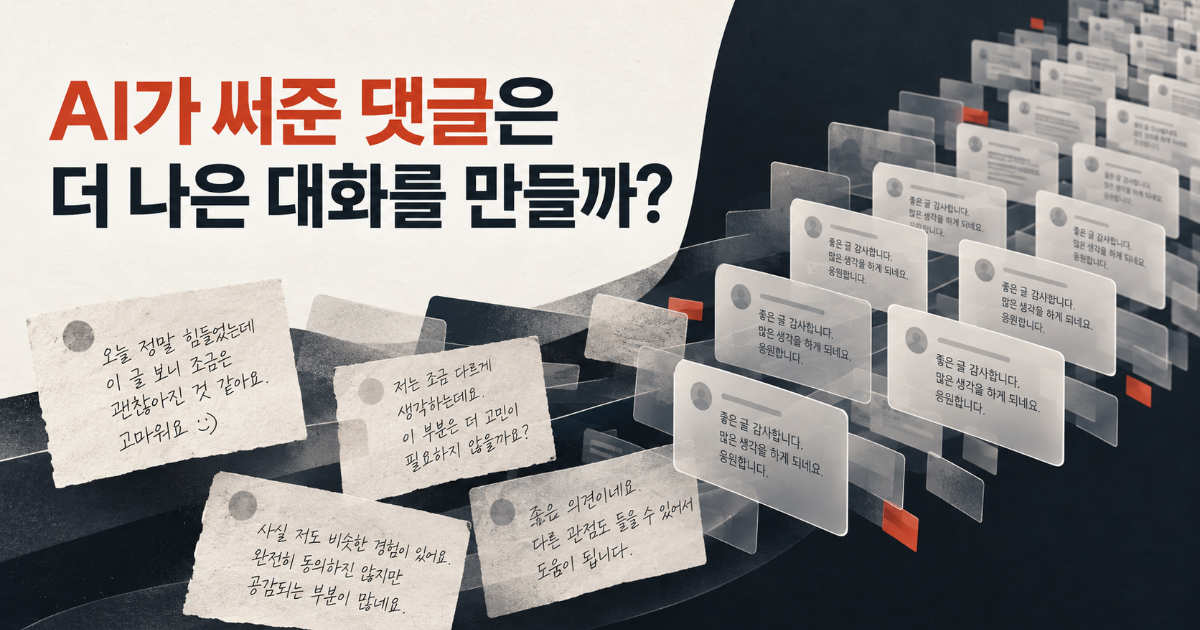
Generative AI is no longer limited to answering questions. It now suggests replies, revises drafts, and even offers opening lines for online conversations.
These features can be useful when people struggle to find the right words. With a little help from AI, those who normally hesitate to express their opinions in public may find it easier to join a discussion.
But does AI assistance actually lead to better online conversations?
More comments and longer sentences do not necessarily mean higher-quality dialogue. The person writing a comment may appreciate the convenience, while those reading it may have a very different experience.
Published in Scientific Reports in 2026, “The impact of generative AI on social media: an experimental study” explores this gap. Rather than focusing solely on whether users enjoyed working with AI, the researchers also examined how other participants perceived and responded to AI-assisted comments.
The results reveal a striking paradox.
AI encouraged people to participate and helped them write longer comments. Yet readers did not necessarily find those comments more informative, authentic, or valuable.
A Controlled Experiment Designed to Resemble Social Media
The study involved 680 adults recruited to represent the U.S. population. The researchers built a custom online discussion platform inspired by forum-based services such as Reddit. Participants could post comments and replies or react with emojis such as “like,” “love,” “dislike,” “angry,” and “funny.”
Participants were placed in groups of five. Each group consisted of strangers and was randomly assigned to either a control condition without AI or one of four AI-assisted conditions.
They discussed three topics: whether cats or dogs make better pets, the health benefits of oats, and universal basic income. Each conversation lasted 10 minutes, with the order of the topics randomized.
Why choose such different subjects?
A light conversation about pets, a scientific discussion requiring factual information, and a politically sensitive debate may prompt very different uses of AI. The value and consequences of the same AI feature can shift depending on the context in which it appears.
Four Ways AI Entered the Conversation
The first feature was an open-ended Chat assistant. Participants could ask questions about the topic, search for supporting information, or use the assistant to organize their thoughts before writing a comment.
The second was a Conversation Starter. Instead of waiting for the user to request help, the AI proactively suggested questions or ideas that could serve as an entry point into the discussion.
The third feature offered Feedback on a user’s draft. It reviewed the structure, clarity, and content of a comment and suggested ways to improve it. This intervention was closer to revising a user-written text than generating an entire comment from scratch.
The final feature presented AI-generated reply Suggestions. Participants could choose among responses that agreed with, remained neutral toward, or disagreed with an existing comment.
Although all four tools supported writing, they did so in different ways. Some required users to request assistance, while others offered help proactively. Some generated new content; others refined what the user had already written.
The researchers therefore looked beyond the amount of content produced. They examined the length of comments, the balance of participation within each group, the likelihood of receiving a reply, users’ satisfaction, perceived quality and informativeness, and reactions from other participants.
AI Helped More People Speak
From the writer’s perspective, AI provided several clear benefits.
Participants using the Chat and Suggestions features became more likely to say that AI could encourage them to participate in online discussions. When they lacked information or did not know how to begin, AI gave them a point of entry.
Comments also became longer. Every AI-assisted condition produced longer comments than the control condition. In the Chat condition, comments averaged 28.59 words, compared with 18.76 words in the control group.
Conversation Starters helped distribute participation more evenly across group members. Rather than allowing a few highly active users to dominate, the feature encouraged a broader range of people to contribute. Comments supported by Conversation Starters were also significantly more likely to receive a reply (β = .300, p = .021).
Viewed only through engagement metrics, these outcomes appear promising. More people joined the conversation, their comments grew longer, and participation became more evenly distributed.
The readers, however, told a different story.
Longer Comments Did Not Receive Better Ratings
Although AI made writing easier, participants did not consider AI-supported discussions more valuable.
Comments in the Chat and Conversation Starter conditions were rated as less informative and lower in quality than comments in the control condition. A similar pattern emerged when participants evaluated replies to their own posts. With the exception of Suggestions, most AI-assisted conditions received lower ratings.
Emoji reactions made the response even more visible. Every AI condition generated a significant increase in “dislike” reactions. Suggestions also produced somewhat more “love” reactions, but the overall pattern remained mixed rather than consistently positive.
The participants’ written feedback helps explain why. AI-assisted content was frequently described as robotic, generic, and impersonal.
AI clearly made comments longer. But did it give readers more to think about? The evidence points in the opposite direction. More words did not necessarily bring greater depth. Instead, polished but familiar expressions often made the conversation feel less personal.
This distinction challenges the way platforms typically define successful engagement. If success is measured by comment volume and length, AI performed well. If authenticity, informativeness, and perceived value are included, the assessment changes.
One AI-Assisted Comment Can Shape the Entire Thread
The effects may extend beyond the individual comment written with AI assistance.
Online comments do not exist in isolation. An opening comment influences the replies that follow, and each reply changes the direction of the thread. When a generic or impersonal AI-generated sentence becomes the starting point, subsequent users may respond within the same narrow frame.
The authors connect this possibility to the accumulation of “semantic garbage”: large quantities of text that contain little new or useful meaning.
What happens when this pattern moves from a small experiment to a major social platform? AI can generate enormous amounts of content within seconds. Platforms may record more comments and longer sessions, while distinctive human contributions become harder to find among thousands of similar sentences.
More people may appear to be talking, even as fewer memorable ideas remain.
That is the larger risk highlighted by this research.
Users Preferred Agreement on Sensitive Topics
The Suggestions feature also revealed how people select among AI-generated responses.
Overall, 48.6% of selected suggestions expressed agreement. Neutral responses accounted for 30.0%, while disagreement represented only 21.4%.
The preference for agreement grew as the topic became more sensitive. Agreeing responses made up 43.3% of selections in the cats-versus-dogs discussion. The proportion rose to 51.1% in the oats discussion and 51.3% in the universal basic income debate.
When disagreement carried a greater social cost, participants became more likely to choose an agreeable AI-generated response.
One interpretation is optimistic: AI may reduce unnecessary conflict and encourage more civil communication. Yet the same pattern may weaken the disagreement and critical exchange that meaningful public debate requires.
The options provided by AI are not a neutral menu. Which responses appear, how they are phrased, and which position seems easiest to select may influence both user behavior and the direction of a discussion.
Readers Often Recognized the Signs of AI Assistance
Participants were also asked whether they believed other members of their group had used AI.
In the control condition, where no AI support was available, 13.8% still suspected that others had used AI. In the AI-assisted conditions, however, that figure rose to between 37.7% and 43.6%.
No technical detector was involved. Participants relied entirely on the language in front of them. Highly polished phrasing, a lack of individual voice, and general statements that did not fully match the context made AI assistance seem more likely.
Grammatical precision and human authenticity are not the same thing. Readers may respond more strongly to a distinctive experience or viewpoint than to a perfectly structured sentence.
Would more sophisticated personalization solve the problem? Not necessarily. As AI becomes better at imitating an individual’s writing style, its involvement may become harder to recognize. A feature designed to increase authenticity could therefore create a new transparency problem.
Not All Forms of AI Assistance Are Equivalent
The authors do not suggest treating every use of AI in exactly the same way.
When a user copies and publishes an AI-generated sentence with little or no modification, disclosure may be important. Direct AI involvement can affect how readers judge the authenticity and responsibility behind the post.
But what if someone writes an original draft and uses AI only to refine a few phrases? What if AI provides background information or helps the user generate ideas, while the final comment remains their own?
Participants in this study did not simply copy everything the AI produced. They often used Chat to collect information or organize their thoughts. They ignored Conversation Starters that did not match their intentions and selectively applied only parts of the feedback they received.
The relevant question is therefore not limited to whether AI was used. We also need to ask how deeply it shaped the final content and how much of the user’s own judgment and expression remained.
Future disclosure policies may need to distinguish among direct text generation, partial revision, information retrieval, and idea support. Placing every form of assistance under a single “AI-generated” label would fail to reflect how people actually use these tools.
Should Good AI Speak for Us?
Participants did not reject AI altogether. Many valued it when they ran out of ideas, needed to check a fact, or wanted help organizing a complicated argument. For users who felt “lost for words,” AI offered a first step into the conversation.
At the same time, they wanted assistance that better reflected their own tone, intention, and context. A response could be convenient without feeling personal or authentic.
The researchers propose four design directions. AI features should remain optional, while directly generated content may require transparent disclosure. Tools should adapt to individual voices and intentions, recognize the difference between casual and high-stakes discussions, and remain accessible through simple, familiar interfaces.
Personalization, however, is not a complete solution. The more accurately AI imitates a user’s voice, the harder it becomes for others to identify its involvement. Greater personalization may improve perceived authenticity while reducing transparency.
This tension leads to a more fundamental question. Should good social media AI produce the most convincing sentence on a person’s behalf, or should it help that person express their own thoughts more clearly?
The findings point toward the latter.
Would the Same Pattern Appear on Real Social Platforms?
The study offers a valuable controlled comparison of four AI features within a realistic discussion environment. Still, its findings cannot be applied to every social media platform without qualification.
All participants were U.S. adults. They interacted with strangers in five-person groups, and each discussion lasted only 10 minutes. Real social media conversations are shaped by far more complex factors, including follower networks, anonymity, recommendation algorithms, political identity, influence, and the history between users.
Each experimental condition included roughly 130 to 140 participants. That number was not large enough to determine with confidence whether the effects differed by age, gender, education, employment, or political affiliation. The absence of clear demographic differences does not mean that all users respond to AI in the same way.
The short duration raises another question. Participants may have judged AI-generated language more negatively because it felt unfamiliar. Over time, users could become more comfortable with such content. The opposite outcome is also possible: repeated exposure may normalize generic AI writing and weaken users’ motivation to question it.
Long-term changes in online communication norms will emerge through repeated use, ongoing exposure, and feedback loops that a single short experiment cannot capture.
More Comments Do Not Necessarily Create Better Conversations
The central message is clear.
AI helped hesitant users enter online discussions. It increased comment length, lowered the burden of writing an opening sentence, and distributed participation more evenly. Yet greater participation did not automatically produce better dialogue. AI-assisted comments sometimes felt generic and impersonal, received lower quality ratings, and attracted more negative reactions.
For a platform, an increase in comments and time spent on the service may look like success. From the perspective of public discourse, however, volume is not enough. The value of a conversation also depends on whether it introduces new ideas, encourages genuine responses, and earns the trust of its participants.
As generative AI becomes a built-in layer of social media, the most important question is no longer how much content it can produce.
The real question is what kind of conversation remains after AI has helped everyone speak.