The competitiveness of a performing arts venue is not determined solely by how many outstanding performances it presents.
The ability to plan and operate performances matters, but so does the capacity to build relationships with audiences and connect with the local cultural and artistic ecosystem.
Using limited resources efficiently while establishing a foundation for sustainable growth is another challenge that performing arts institutions must address.
Against this backdrop, Bucheon Arts Center is turning to academic research to assess its operations and explore new growth strategies.
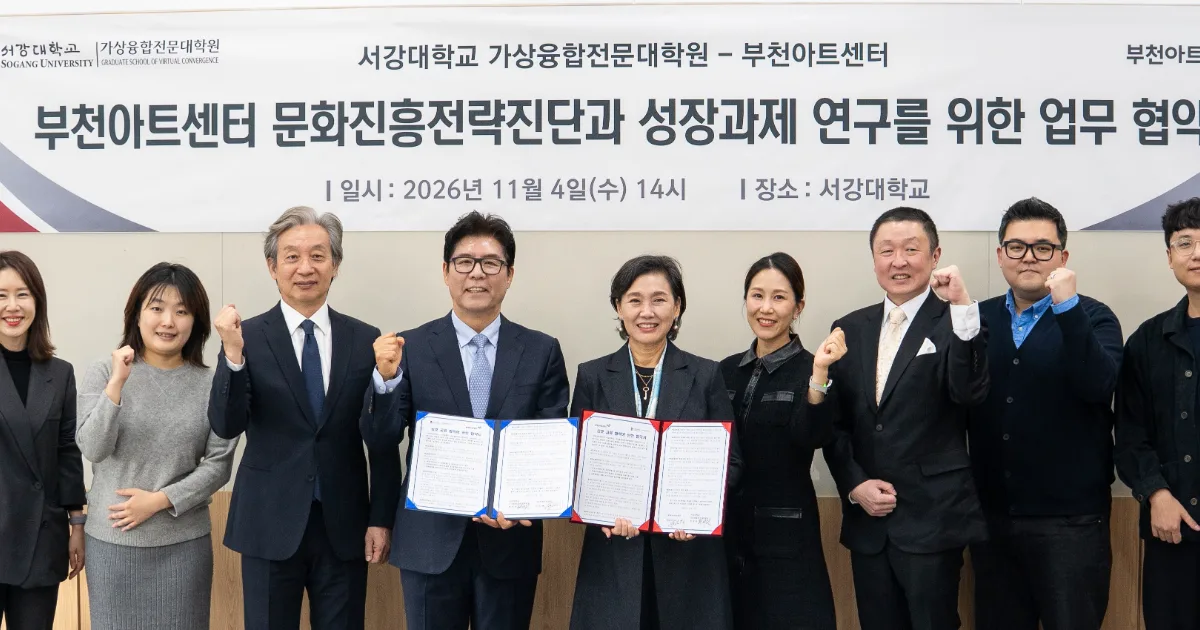
Bucheon Arts Center, led by CEO Park Eun-hye, announced on November 5 that it had signed a memorandum of understanding (MOU) with Sogang University's Graduate School of Virtual Convergence (BVI Lab) on November 4.
The agreement establishes a framework for research into the center's cultural development strategy and future growth opportunities.
The partnership aims to examine Bucheon Arts Center's operations and management performance from multiple perspectives while identifying ways to strengthen its competitiveness and long-term sustainability.
It is particularly significant because it seeks to combine practical expertise from the performing arts sector with the university's research capabilities to identify improvements that can be applied to actual institutional operations.
Growth Strategies for Performing Arts Institutions Begin with Performance Assessment
The starting point of the partnership is an objective assessment of Bucheon Arts Center's current operations.
Performing arts institutions undertake a wide range of responsibilities beyond planning and presenting performances.
These include organizational management, financial administration, customer services, and cultural development initiatives.
Such institutions face management challenges that differ from those of conventional commercial enterprises.
While pursuing artistic value and public-service objectives, they must also consider operational efficiency and long-term sustainability.
Developing an effective growth strategy therefore requires a comprehensive understanding of how existing systems are performing and where improvements may be needed.
Under the MOU, Bucheon Arts Center and Sogang University's Graduate School of Virtual Convergence plan to collaborate on evaluating operational conditions and management performance, as well as identifying opportunities to improve organizational efficiency and institutional development.
The institutions also intend to explore sustainable growth strategies for the performing arts through academic-industry collaboration.
Additional areas of cooperation include sharing research findings and providing training and educational opportunities for employees.
This approach can be understood as an effort to examine the development of a performing arts institution not simply through business expansion, but through broader improvements in organizational management and operational systems.
Connecting Academic Research with Practical Experience in the Performing Arts
The signing ceremony took place at Sogang University's Samsung Gabriel Hall.
Attendees included Park Eun-hye, CEO of Bucheon Arts Center; Hyun Dae-won, dean of Sogang University's Graduate School of Virtual Convergence; Distinguished Professor Lee Seok-keun; and representatives from both institutions.
In his welcoming remarks, Hyun expressed hope that the agreement would create opportunities for new collaborative projects extending beyond the initial research partnership.
He also emphasized the importance of sharing the institutions' respective expertise and capabilities while expanding opportunities for continued exchange and cooperation.
Distinguished Professor Lee Seok-keun, who will oversee the research, outlined the proposed direction of the project.
Lee explained that once the project is formally initiated through the appropriate procedures, the research team plans to examine Bucheon Arts Center's operations from multiple perspectives.
The process is expected to include interviews with staff members and a range of research and analytical activities.
He emphasized that the research would incorporate the experiences and perspectives of employees working directly in the field.
The objective, he said, is to produce accurate and substantive findings that can provide practical assistance to institutional management and be applied in actual operating environments.
Lee's remarks illustrate an important aspect of the proposed research.
Rather than simply conducting an external evaluation, the project seeks to reflect the experiences and opinions of employees responsible for day-to-day operations.
The performance of a cultural institution cannot always be fully explained through quantitative management indicators alone.
Effective analysis may also require understanding the expertise involved in performance planning, internal workflows, and challenges arising during actual operations.
Only by examining these factors together can researchers develop recommendations that are useful in practice.
However, the detailed research methodology, scope, and timetable have yet to be established and will be determined as the project moves forward.
Bucheon Arts Center Aims to Apply Research Findings to Institutional Operations
Park Eun-hye, CEO of Bucheon Arts Center, expressed hope that the agreement would provide an opportunity for both institutions to exchange expertise and experience while pursuing mutual growth.
She also affirmed the center's commitment to supporting the research process and working toward meaningful outcomes that benefit both organizations.
Bucheon Arts Center intends to use future research findings to inform institutional operations and cultural development initiatives.
This suggests an approach in which research is not intended to remain solely within a written report.
Instead, the findings could be connected to actual programs and organizational management.
In particular, analyzing current operations, identifying improvement opportunities, and developing strategies based on those findings could help establish a more concrete medium- to long-term management direction.
Nevertheless, the MOU currently represents a framework for future research cooperation.
Specific improvement priorities, implementation plans, and performance targets will be developed through subsequent research and analysis.
Sustainable Operating Systems Are Becoming Essential to Cultural Institutions
The partnership also carries broader implications for how the growth of cultural and performing arts institutions is understood.
Institutional development cannot be measured only by the number of new productions presented or the size of the audience.
It also requires examining how effectively an organization uses its human and physical resources, manages internal operations, and delivers cultural value to its community.
Public-oriented cultural institutions face the additional challenge of balancing economic considerations with their artistic and social missions.
Academic-industry collaboration can offer a useful approach to these challenges.
Universities contribute research methodologies and analytical expertise.
Performing arts institutions contribute operating information and practical field experience.
By combining these resources, both sides may be able to identify problems that are difficult to recognize from within an organization and develop recommendations suited to real operating conditions.
However, effective collaboration requires more than producing research findings.
It also requires considering whether recommendations can be implemented and how they might translate into organizational change.
Identifying an improvement opportunity through research is one challenge.
Turning that opportunity into practical change is another.
The ultimate value of the partnership will therefore depend on how effectively its findings contribute to Bucheon Arts Center's operations and the quality of cultural services it provides.
Examining Today's Operations to Shape the Future of the Stage
The collaboration between Bucheon Arts Center and Sogang University's Graduate School of Virtual Convergence represents an effort to assess the institution's present condition and jointly develop a strategy for future growth.
Bucheon Arts Center brings its accumulated experience and operational expertise from the performing arts sector.
Sogang University contributes academic research and analytical capabilities to explore new development opportunities.
The two institutions also plan to share research findings and expand cooperation through employee education and related activities.
The broader objective is to strengthen Bucheon Arts Center's operational competitiveness and provide better cultural and artistic services to local residents.
The competitiveness of a performing arts institution depends not only on the quality of performances presented on stage.
It also depends on the organizational capabilities needed to sustain those performances over time.
This partnership is significant because it seeks to shape the future of the performing arts by objectively examining institutional operations today and connecting academic research with practical experience.
That is why Bucheon Arts Center is working with a university to explore a new growth strategy.
The goal is not simply to present better performances.
It is to build a stronger institutional foundation that allows high-quality performances and cultural experiences to continue well into the future.