Europe’s startup ecosystem is once again raising its voice toward Brussels.
The EU–INC initiative has launched its “100 Days to Write Europe’s Future” campaign, calling on European political leaders and the startup ecosystem to co-sign an open letter. As Brussels returns from the summer break, the European Commission, Council and Parliament will negotiate the final text of EU Inc. over the coming months. The concern is that key elements may be weakened in that process.
Their question is simple.
Whether EU Inc. will be created is no longer the central issue.
The question is whether it will become a true pan-European standard, or merely another complicated structure scattered across 27 countries.
EU Inc. is a new optional corporate form for European startups and companies. The EU–INC position paper describes it as a European company form under the European Commission’s proposed regulation for a “28th regime corporate legal framework.” It is not intended to replace existing national corporate forms such as Germany’s GmbH or Greece’s IKE. Rather, it seeks to create a common European corporate option alongside them. The European Commission describes EU Inc. as an optional, fully digital regime designed to make incorporation faster, cheaper and simpler, while helping companies scale across the single market.
This matters because of a long-standing weakness in Europe’s startup ecosystem.
Europe calls itself one large single market. Yet when founders create companies, raise investment, design stock options, transfer shares and organize governance, the process remains fragmented by country. EU–INC argues that European startups face fragmentation at every stage, from incorporation and share transfers to employee stock options, fundraising and governance. As a result, many founders choose Delaware or UK structures not because they prefer them, but because investors and banks understand a single standard more easily.
In other words, EU Inc. may look like company-law reform.
But at its core, it is competitiveness reform.
A startup corporation is not just paperwork. It is the framework through which investors assess risk, employees receive equity promises, banks decide whether to open accounts, and acquirers understand the company. It is a common language for ownership, control and trust. When that language differs from country to country, European startups begin with extra cost from the first day.
If one standard exists, the situation changes.
When a Polish startup raises a Series A round from a French venture-capital firm, it no longer needs to spend excessive time explaining an unfamiliar Polish corporate form or moving its legal gravity toward a Delaware C-Corp. EU–INC argues that an EU Inc. recognized across all Member States could provide a common structure that founders, venture capitalists and acquirers all understand.
The problem is not the name of the system.
It is the design.
EU–INC’s position paper says the proposal can work, but only if it is implemented properly. Its position is to support EU Inc. as a competitiveness reform, while insisting that it must remain a real European standard rather than a symbolic label attached on top of 27 different national systems.
To achieve this, EU–INC presents five non-negotiable conditions.
First, companies must have the freedom to choose their registered office.
Second, the regime must remain broadly open to all companies, rather than being limited to certain innovative firms or sectors.
Third, Europe needs a centralized, digital-first EU registry.
Fourth, there must be a common EU employee stock-option system.
Fifth, labor law and taxation should follow where real economic activity takes place, not the formal registered office.
These five elements are connected.
Without freedom of registered office, EU Inc. will not be attractive to founders. If the scope is too narrow, it will not become a standard that international investors understand. Without a central registry, the due-diligence burden on banks and investors will not fall. Without common stock options, Europe will remain disadvantaged in the competition for talent against the United States and the United Kingdom. If labor and tax rules do not follow actual economic activity, Member States may suspect EU Inc. of becoming a vehicle for tax avoidance or evasion of social obligations.
Among these issues, the central registry and stock options are currently the hottest points of debate.
EU–INC’s campaign page claims that the latest signals from negotiations suggest the central registry has been removed from the Commission’s position. The central registry they envision is the core infrastructure that would give all EU Inc. companies one registration, one login and one government interface. Without it, one company may still have to deal with 27 national logins and procedures.
The position paper makes the same point strongly.
EU–INC sees a central European registry as essential infrastructure that would provide reliable, standardized company information to investors, creditors, banks and public authorities, while reducing unnecessary friction in KYC and ultimate beneficial owner checks. It argues that simply connecting 27 national registration systems through the existing BRIS interface is not enough.
Why is the registry so important?
Delaware’s power is not only about tax. EU–INC’s position paper notes that more than 1.9 million companies are incorporated in Delaware, including a large share of Fortune 500 companies and many venture-backed startups. The reason is that Delaware provides one registry, one filing system and one standard recognized by investors, lawyers and banks around the world. Infrastructure that allows companies to be formed online, quickly and in standardized form creates Delaware’s legal gravity.
If EU Inc. is to compete with Delaware, it must provide the same level of trust infrastructure or more.
A loose connection of 27 national registries will not be enough. Data quality may vary depending on which national registry holds the information, and national systems may age, change or modernize at different speeds. EU–INC argues that one registry would create a single standard for data quality and allow founders, investors, creditors and public authorities to see the same information.
Bank-account opening is another major issue.
Cross-border startups often face significant delays when opening accounts. KYC and UBO checks differ by country. EU–INC argues that if a single EU registry meeting harmonized KYC and UBO standards provides real-time data to financial institutions and creditors, then “one incorporation, one record, one standard” can be trusted across all 27 Member States.
This is not simply a matter of convenience.
For startups, time is capital. If incorporation, bank-account opening, investment-document review and explanations of ownership structures take months, founders spend energy on administration rather than products and customers. Investors bear transaction costs to understand unfamiliar legal systems. Ultimately, Europe’s internal complexity makes external standards such as Delaware or the UK more attractive.
The second core issue is stock options.
EU–INC sees employee equity compensation as one of the most concrete disadvantages European startups face in the global competition for talent. According to the position paper, in many European systems, employee stock options may be taxed at grant, vesting or exercise. That can create tax burdens before employees have actually received cash. EU–INC argues that taxation should occur when shares are actually sold and cash value is realized, and that safe-harbor valuation rules are needed to prevent later reassessment of the strike price set at the time of grant.
For startups, stock options are a core tool for compensating for limited cash.
Large companies can pay high salaries. U.S. Big Tech can offer enormous compensation packages. Early-stage startups persuade talent by offering a share of future growth. But if employees must pay tax before they can sell shares and receive cash, stock options become a risk rather than an incentive.
EU–INC’s example illustrates the problem well.
Suppose Marie, a software engineer in Paris, receives stock options as part of her compensation. Under many national regimes, the difference between the strike price and current value at exercise may be taxed as paper income. Tax authorities may also later decide that the strike price was set too low and reclassify the difference as salary. EU–INC’s proposed EU employee stock-option regime would defer taxation until sale and use safe-harbor valuation rules to lock in the grant-date price, reducing uncertainty.
This issue is directly connected to Europe’s AI and deep-tech competitiveness.
Startups in AI, semiconductors, robotics, biotechnology, space and energy transition are engaged in a war for highly skilled talent. Talent crosses borders, and capital moves even faster. If European startups cannot offer employees attractive upside through stock options, top talent may move to U.S. Big Tech or to companies based in London or Silicon Valley.
That is why the EU Inc. debate does not remain merely a matter of company law.
It is about where founders incorporate, but also about where Europe can keep talent and capital. It is about whether intellectual property and governance remain inside Europe, or move early to Delaware and the United Kingdom.
There are, however, objections to EU Inc.
The largest concern is forum shopping. Companies might choose a registered office in a country with lighter rules while conducting real activity elsewhere, thereby avoiding labor, tax or social obligations. EU–INC offers an answer: the choice of registered office should be a matter of company law, while labor, tax and licensing obligations should follow where real economic activity takes place.
The position paper emphasizes this distinction repeatedly.
EU Inc. is not a mechanism for moving the company in substance. Employees remain where they are, and tax and labor obligations remain tied to the place of actual activity. What changes is the legal instrument: the corporate form that investors and founders understand.
This logic seeks balance.
It gives founders freedom to choose a registered office.
It guarantees Member States’ power to enforce tax and labor law over real economic activity.
It provides investors with the predictability of a single standard.
It reassures employees that local labor protections will not disappear.
EU–INC also gives the example of Anna, who works in Munich. Even if her employer becomes an EU Inc. registered in Sofia, Anna’s German employment protections would not disappear. Similarly, if an EU Inc. registered in Estonia is effectively managed from Germany, it may still be treated as German tax resident under existing rules.
In other words, EU–INC’s position is that EU Inc. should be a company-law simplification tool, not a tax-avoidance vehicle.
This is where freedom of registered office and the principle of non-discrimination become important.
EU–INC argues that Member States should not treat an EU Inc. registered in another Member State less favorably than a local company. Direct discrimination may appear as refusal of recognition, forced local incorporation or mandatory local authorization. Indirect discrimination may appear through additional reporting duties, local-representative requirements, restrictive licensing conditions or bank-account limits.
This is a realistic problem.
Even if EU Inc. is recognized in principle, if countries favor locally incorporated entities in bank accounts, licensing, subsidies, reporting obligations or public-support conditions, a single standard will not function. EU–INC accepts that public support may be linked to real economic activity such as jobs, R&D, investment and local operations, but argues that it should not be tied to mandatory local incorporation.
Worker codetermination is another sensitive issue.
Some European countries have systems in which workers participate in company supervisory bodies. There is concern that EU Inc. could become a route to avoid such obligations. EU–INC argues that two things must be true at the same time: EU Inc. should not be used to circumvent existing mandatory worker-participation rules, but worker-participation systems should also not be used as grounds to restrict freedom of registered office.
This shows the political difficulty of EU Inc.
Europe wants a single market.
But Member States want to protect their labor, tax and social-security models.
Startups want a simple corporate structure.
Labor groups and Member States worry about rights avoidance.
Investors want predictability.
Politicians must find balance between national sovereignty and a European standard.
For EU Inc. to succeed, this tension must be resolved institutionally.
This is also why EU–INC calls for a regulation rather than a directive. The initiative argues that if EU Inc. is implemented through a directive, 27 countries will transpose it in different ways and at different speeds, creating another layer of fragmentation. Legal gravity could shift toward one or two Member States that implement the regime most attractively, while many others leave only formal versions. By contrast, a regulation based on Article 114 of the Treaty on the Functioning of the European Union would apply directly and could create a genuine pan-European standard and central registry without transposition gaps.
This is where the fate of EU Inc. will be decided.
If the name is EU Inc. but 27 different versions appear in practice, it will mean little to founders and investors. Banks will still require national checks. Investors will still need local legal review. Founders will still prepare different documents every time they cross a border. Europe will once again fail to escape the legal gravity of Delaware and the United Kingdom.
But if a single central registry and a single corporate standard are created, Europe can build another path.
Companies can incorporate inside Europe, keep intellectual property and governance inside Europe, grow under a structure European investors understand, and receive the same trust across 27 Member States when needed. This is not merely administrative simplification for startups. It is infrastructure reform for Europe’s capital markets and innovation ecosystem.
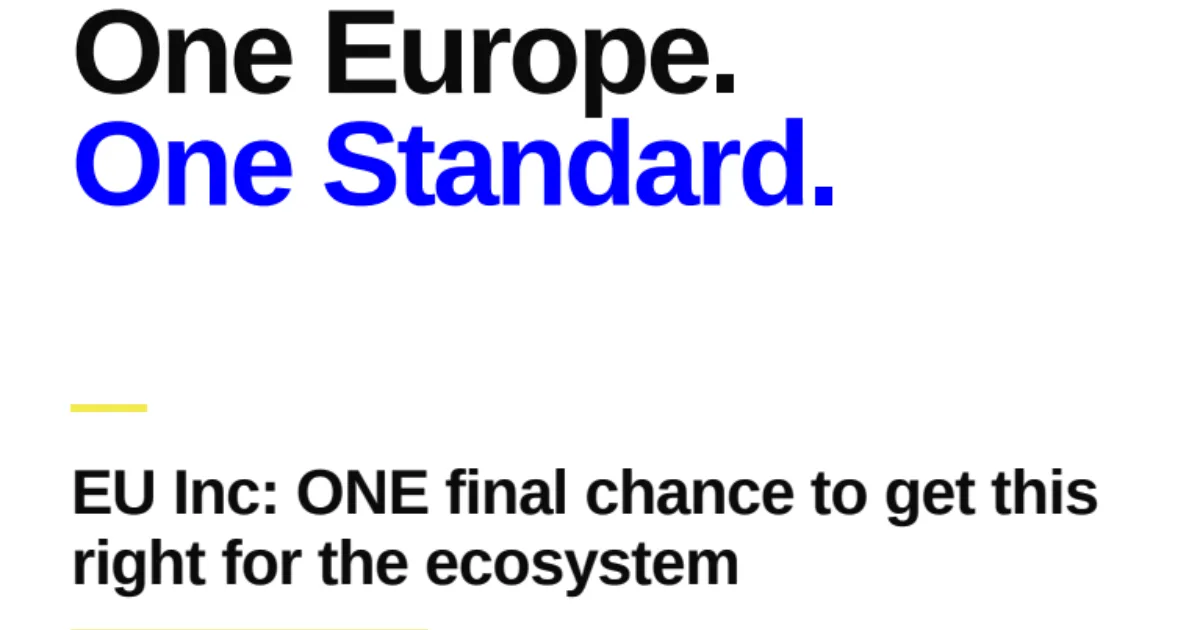
That is why EU–INC repeats the phrase “One Europe, One Standard.”
The single market is not only about goods and services. The company itself must be understandable across the single market. In an age when a founder may develop in Germany, raise capital in France, hire in Poland and find customers in Spain, the corporate form must also work across borders.
The EU Inc. debate touches Europe’s structural complex.
Europe has talent.
It has research institutions.
It has deep-tech capability.
It has a large market.
But its legal and financial standards for scaling remain weak.
That is why founders may build products in Europe while incorporating in Delaware. Investors may invest in European technology while preferring U.S.-style legal structures. As a result, part of Europe’s innovation, capital and intellectual property moves into an external legal order.
EU Inc. is an attempt to reverse that flow.
Of course, EU Inc. alone will not solve every problem. Europe’s startup challenges are larger. Venture-capital scale, stock-market liquidity, mergers and acquisitions markets, regulatory speed, talent mobility, linguistic and cultural diversity, tax systems and labor-market rigidity all matter.
But the corporate standard is a starting point.
If incorporating a company is complicated, investment becomes complicated.
If the ownership structure is unfamiliar, acquisition becomes difficult.
If stock options are unattractive, hiring talent becomes difficult.
If registries are fragmented, bank and investor due diligence slows down.
If countries interpret rules differently, the single market is not felt in practice.
EU–INC’s 100-day campaign is political pressure not to miss this starting point.
In its campaign materials, the initiative urges founders, investors and operators to speak directly to policymakers over the next 100 days. It asks participants to co-sign the open letter, write their own posts and explain what EU Inc. must deliver, as well as what it will cost Europe if it is designed badly.
The campaign also shows how policy lobbying works in the digital age.
In the past, lobbying centered on meeting rooms and reports. Now LinkedIn posts, open letters, founder networks and investor communities become instruments of political pressure. EU–INC says that more than 40,000 unicorn founders and leading European investors pre-signed the original call, using the collective demand of the ecosystem to speak to policymakers.
The core message is clear.
Founders are ready.
Investors are ready.
Now European politics must write a law that actually works.
There is also a reason Korea should pay attention to this debate.
Korean startups face similar questions about global investment and corporate structure. Foreign investors may demand legal forms they understand, or founders may consider incorporating in Singapore or the United States for global expansion. Where a founder incorporates is not just an address. It is connected to fundraising, tax, governance, stock options, mergers and acquisitions, and exit pathways.
The EU Inc. debate asks questions that Korea should also consider.
Is the domestic corporate system easy for global investors to understand?
Are stock-option rules attractive enough for startup talent competition?
Are incorporation, share transfers, investment contracts and shareholder protections fast and predictable?
Does Korea offer legal incentives for startups to keep intellectual property and headquarters at home?
Should the preference for overseas incorporation be dismissed simply as a lack of patriotism?
If Europe worries about Delaware’s gravity, Korea must also think about the gravity of Singapore, Delaware and UK structures.
Startup policy cannot be built only on subsidies. Corporate forms, investment standards, stock-option taxation, digital registration infrastructure and banking due diligence must move together. If founders are not given structures that global investors can understand from the first day of incorporation, innovative companies may send their legal address abroad before they even scale.
The success of EU Inc. is not yet guaranteed.
If the central registry is removed, the system may be weakened. If stock options are not properly designed, talent competitiveness may remain limited. If freedom of registered office is narrowed, founders’ choices will shrink. If Europe chooses a directive rather than a regulation, it may return to 27 versions of the same idea.
This is why EU–INC calls the moment a last chance.
Europe already has a single market. But it still lacks the single corporate infrastructure that startups actually experience. If EU Inc. is not designed properly this time, Europe may again confirm the gap between symbolic integration and practical fragmentation.
In the end, the EU Inc. debate can be summarized in one sentence.
Does Europe want to look like one market to startups, or like 27 administrative procedures?
Delaware is powerful not simply because it is American. It is powerful because it offers one legal language the world understands. For EU Inc. to succeed, Europe must offer one language too.
One registration.
One standard.
One trust infrastructure.
But labor and tax must still follow real economic activity.
If Europe can build that balance, EU Inc. may become an important turning point for the European startup ecosystem. If it cannot, EU Inc. will be European in name but another set of 27 systems in practice.
EU–INC’s 100-day campaign began at precisely this crossroads.
European founders are now asking:
One Europe,
or another fragmentation?