How Do LLMs Become a “Cognitive Virus”?
Modeling the Tipping Point Where Gradual AI Use Turns into Collective Dependence
The Virus Is Not the LLM Itself, but the Way Human-AI Coupling Spreads
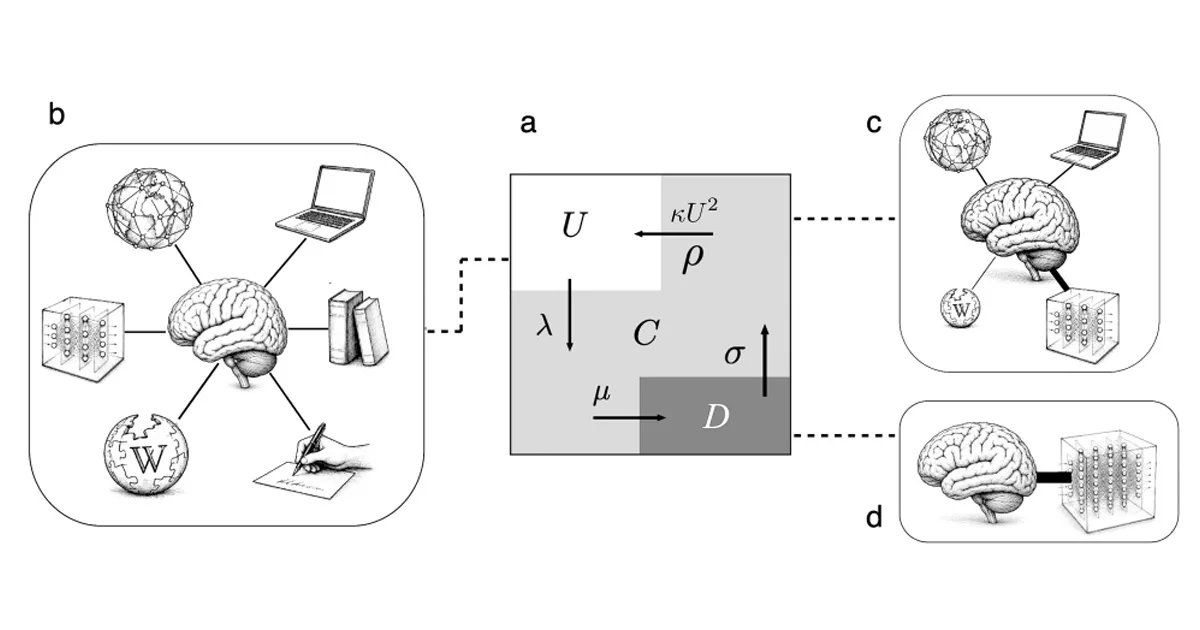
In Large-Language Models as a Cognitive Virus, Ricard Solé and colleagues translate the diffusion of LLMs into the mathematical language of epidemics. Reading the term “virus” as a claim that AI is inherently harmful would miss the paper’s central argument. What the authors track is a broader feedback structure: ways of using LLMs are copied across individuals, schools, workplaces, and platforms, and these practices can in turn reshape human cognition. People imitate successful uses, organizations incorporate them into standard workflows, and the environment created by widespread adoption encourages further adoption.
The paper connects language, memes, computer viruses, and the extended-mind tradition. Books and writing already moved parts of memory and reasoning outside the brain. LLMs extend this process because they do more than store or retrieve information. They generate sentences, summarize, propose judgments, evaluate alternatives, and reorganize information. A larger portion of cognitive work can therefore migrate from the human side of the system toward the machine.
What Matters Is Not Whether We Use AI, but What Remains Without It
The model divides the population into three states. U, or Uncoupled, refers to people who make little or no use of LLMs. C, or Coupled, describes users who employ LLMs while retaining reading, writing, reasoning, verification, and access to alternative sources. D, or Dependent, describes users for whom these cognitive operations have become persistently substitutive.
The distinction between C and D carries much of the paper’s conceptual weight.
The authors describe this difference through scaffolding and substitution. When users examine an AI-generated answer, reconstruct its reasoning, challenge it, and verify its claims, the model can function as cognitive scaffolding. When synthesis, evaluation, composition, and judgment are repeatedly delegated to the system, users stop performing the operations that maintain those capacities. The relevant measure of competence is therefore not how well the human-AI pair performs while the tool is present, but what the human can still do after the tool is removed.
Gradual Adoption Can Produce an Abrupt Collective Shift
One of the paper’s most striking results is that a gradual increase in LLM use does not necessarily produce a gradual social transformation.
In the model, as the social transmission pressure of LLM use, represented by λ, rises beyond a critical threshold, the uncoupled population can collapse abruptly while regular and dependent use increase. Figures 2 and 3 show a region in which two stable states coexist. One corresponds to high cognitive autonomy, the other to extensive cognitive offloading. Which state a population occupies depends partly on the path it took to get there.
This produces technological lock-in through hysteresis.
Before the transition, keeping adoption pressure below one threshold can prevent the shift. Once the dependent regime has been entered, however, merely returning the system to its previous conditions may not restore the former state. Adoption pressure has to fall further before the population returns to the autonomous regime.
The effective-potential diagram in Figure 3 gives this an intuitive form. A population can sit in one “valley” representing high autonomy while another valley representing cognitive offloading emerges beside it. Once the first valley disappears, the system rolls into the second. Reversing the external pressure does not immediately bring it back because the original valley has not yet reappeared.
In the paper’s illustrative simulation, average cognitive competence falls from 1 to about 0.425 after the threshold is crossed. This number is not an empirical measurement of human cognitive decline. The authors explicitly assign illustrative competence values to the three states. The important result is structural: under certain assumptions, a continuous increase in technological adoption can generate a discontinuous change in population-level cognitive competence.
Cognitive Immunization Means Preserving a Route Back
The paper’s concept of cognitive immunization is particularly useful because it does not mean banning or minimizing contact with AI. Its goal is to reduce the probability that useful coupling becomes persistent substitution and to preserve routes back to autonomous cognition.
Unaided assignments, periods of working without AI, verification requirements, maintenance of non-LLM skills, alternative information sources, and workflows in which people think before consulting the model all serve this role. The model therefore allows for a society with high levels of AI adoption that still retains high levels of cognitive autonomy.
One of the less intuitive findings concerns the parameter κ, which represents collective reinforcement of autonomous cognition. Strong norms favoring independent reasoning can initially make the population more resistant to AI dependence. Yet if autonomous users become scarce, a large κ can also widen the hysteretic region, making recovery harder after the transition.
The authors therefore argue that strengthening social norms is not enough. Societies also need to strengthen ρ, the rate at which users return from regular LLM use to relatively autonomous cognition. A culture that praises independent thought but provides no practical route back to unaided work can still become locked into dependence.
Table 1: A Map of Intervention Strategies
Table 1 condenses the model into five intervention variables.
Reducing λ limits the social and institutional propagation of substitutive LLM use. Increasing ρ makes it easier for users to return to unaided cognition. Increasing κ strengthens schools, workplaces, peers, and norms that support autonomous reasoning.
The parameters µ and σ operate differently. Lowering µ reduces the probability that ordinary LLM use progresses into persistent dependence, while increasing σ helps dependent users move back toward autonomous forms of LLM use. These parameters do not directly move the model’s tipping points. Instead, they change the proportion of dependent users within the AI-using population.
This distinction produces one of the paper’s most useful practical insights. Some interventions change whether a society crosses a tipping point at all, while others change what kind of AI users exist after widespread adoption has already occurred.
The paper therefore shifts the question of AI adoption away from “How much are people using AI?” toward more revealing questions: Which cognitive operations are being delegated? What can users still perform after the model is removed? Are there institutional and behavioral routes back to unaided cognition?
Its most distinctive contribution is to move the problem of LLM dependence beyond individual willpower or personal habits. Schools, workplaces, platforms, peers, and technological infrastructures form an ecology that can either maintain autonomous cognition or erode the conditions that sustain it. Under that framework, the future of human cognition depends not only on what AI can do, but on the architecture of the coupling we build around it.