Examining High School Students' Artificial Intelligence Literacy in Visual Arts Subjects and Metaverse-Based Digital Art Attitudes
Selma Ceran
DOI:https://doi.org/10.46328/ijte.5360
Selma Seran’s “An Analysis of High School Students’ Artificial Intelligence Literacy and Attitudes toward Metaverse-Based Digital Art in Visual Arts Education” places the two technologies within a single educational trajectory. The study examines whether students’ ability to understand and use artificial intelligence is related to how they perceive artistic activity in the metaverse. Generative AI and the metaverse are often discussed as separate technologies, but this study argues that, from the student’s perspective, they lie on a continuum of “abilities and attitudes for engaging with digital visual culture.”
The researcher measured AI literacy in visual subjects and attitudes toward metaverse-based digital art among 278 high school students in Türkiye, from grades 9 through 12. In addition to assessing the overall levels of the two variables, the study analyzed differences by gender and grade level and examined the extent to which AI literacy predicts attitudes toward metaverse-based art.
Asking About “Visual AI Literacy” Rather Than General AI Skills
The study measures “artificial intelligence literacy in visual subjects.” It assesses not only whether students understand the concept of artificial intelligence, but also how they understand and apply AI in the process of creating images and other visual outcomes.
Using AI in the visual arts requires students to judge why changing a text prompt produces a different image, why an algorithm repeatedly reproduces certain styles or representations of people, and who should be regarded as the author or owner of the generated work. AI literacy in the visual arts is therefore best understood as a combined capacity involving technical competence, critical interpretation of outputs, and ethical judgment.
AI Is Familiar, but Metaverse Art Still Feels Distant
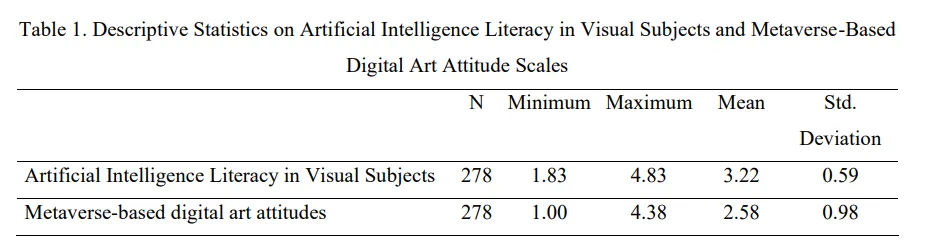
As shown in Table 1, the mean score for AI literacy in visual subjects was 3.22 out of 5, indicating a moderate level. By contrast, the mean score for attitudes toward metaverse-based digital art was 2.58, indicating a relatively low level.
Students had a certain degree of familiarity with artificial intelligence, but they did not yet demonstrate strong interest in or confidence about artistic activity in the metaverse. This reveals a gap between awareness of a technology and willingness to embrace it artistically. AI has already entered everyday visual experience through image-generation tools, recommendation systems, and social-media filters. Metaverse art, however, requires students to understand concepts such as virtual-reality devices, avatars, virtual exhibition spaces, and NFTs as parts of an integrated environment.
The metaverse-based digital art attitude scale used in the study measures whether students know what the metaverse is, whether they find it interesting, whether they continue to seek related information, whether they understand the relationship between the metaverse and art, and whether they regard art in virtual spaces as legitimate. A low score therefore does not necessarily mean that students dislike digital images. Rather, it suggests that they have not yet fully reached the point of accepting the metaverse as an artistic space.
This difference also demonstrates how the label “digital native” can flatten the complexity of students’ technological experiences. Students may be familiar with smartphones and image-generation tools, but they do not understand or trust every digital environment to the same degree. A gap remains between technologies they use routinely and technologies presented primarily as future possibilities.
As Students Advance in Grade Level, Technology Becomes a Creative Tool
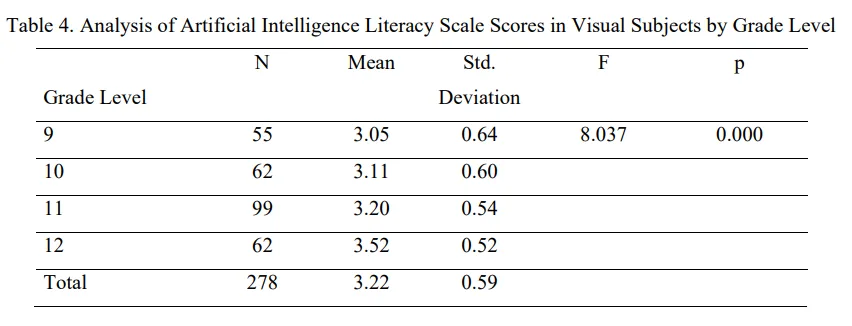
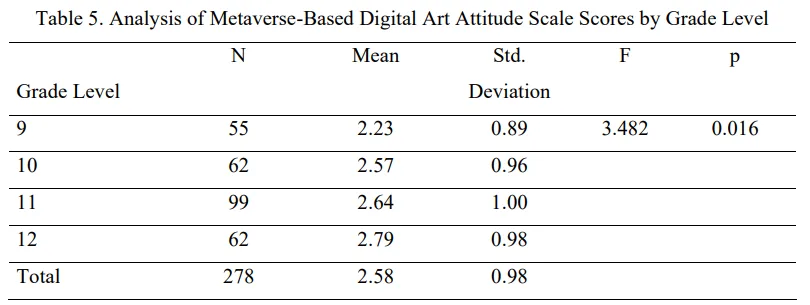
Tables 4 and 5 show changes according to grade level. The mean score for AI literacy in visual subjects increased from 3.05 in grade 9 to 3.11 in grade 10, 3.20 in grade 11, and 3.52 in grade 12. Statistically, grade 12 students demonstrated a significantly higher level than grade 9 students.
Attitudes toward metaverse-based digital art also became more positive, rising from 2.23 in grade 9 to 2.57 in grade 10, 2.64 in grade 11, and 2.79 in grade 12. In particular, students in grades 11 and 12 expressed more positive attitudes than those in grade 9.
The researcher explains this pattern in terms of cognitive maturity, accumulated exposure to technology, and preparation for higher education and careers. For students in the upper grades, digital images no longer remain merely an entertaining form of experimentation. They begin to connect with portfolios, academic specialization, and professional forms of expression. The same technology looks different once it acquires a purpose. Younger students may explore unfamiliar interfaces and images, whereas older students are more likely to judge whether a technology can be used to produce their own work.
These results suggest that digital art education cannot be implemented in the same way across all grade levels. In the early stages, activities centered on exploring virtual spaces and experiencing visual transformation may be important. As students advance, however, the curriculum needs to incorporate more specific creative contexts such as copyright, algorithmic bias, portfolio development, collaboration, and exhibition. It is not enough merely to increase the technical difficulty of the tools. The reasons for which students use the technology should also change.
Gender Differences Reflect the Structure of Technological Experience More Than Artistic Ability
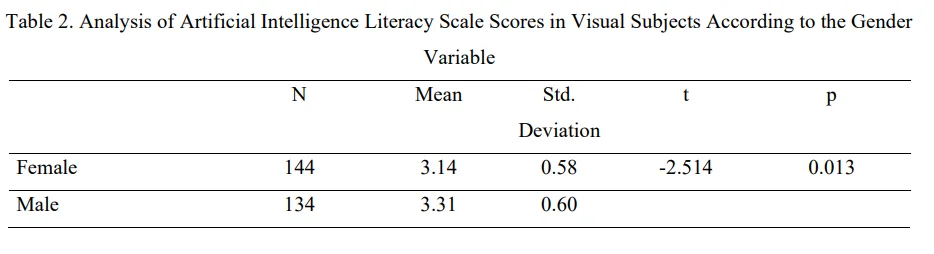
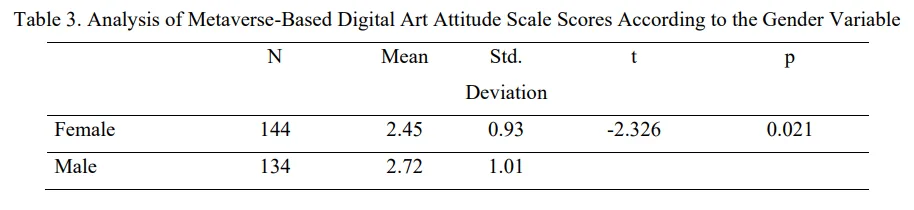
Tables 2 and 3 show that male students achieved higher mean scores than female students on both scales. The mean score for AI literacy was 3.14 among female students and 3.31 among male students. For attitudes toward metaverse-based digital art, the corresponding scores were 2.45 and 2.72.
The researcher relates this difference to experience with digital gaming culture, maker activities, and algorithm-based production environments. Given that the metaverse has often been introduced through the language of games and technology platforms before being presented as an artistic space, the route through which students first encounter the technology may shape their later attitudes.
One notable point is that artistic interest and technological confidence do not necessarily move in the same direction. The attitude scale measures not only aesthetic preference, but also how knowledgeable students feel about the metaverse, how confident they are in their ability to understand the technology, and whether they actively follow relevant information. The difference in scores therefore says less about which group understands art better than about which group perceives the technological environment as more familiar.
Technology is not a neutral entry point in digital art education. Students often encounter it through specific cultural experiences such as gaming, coding, and virtual-reality equipment. Redesigning that point of entry in the classroom may also reduce pre-existing differences in experience. The researcher’s recommendation to distribute roles such as technical operation, visual composition, conceptual design, and ethical review evenly within collaborative projects follows from this finding.
AI Literacy Provides a Basis for Accepting Metaverse Art
coefficient between AI literacy in visual subjects and attitudes toward metaverse-based digital art was 0.443, while AI literacy explained 19.3% of the variance in attitudes toward metaverse art. The standardized regression coefficient was also 0.443, indicating a statistically significant positive relationship.
The unstandardized coefficient of 0.733 indicates that a one-point increase in AI literacy was associated with an average increase of approximately 0.73 points in attitudes toward metaverse-based digital art. The better students understood how artificial intelligence works and how it can be used visually, the more likely they were to hold positive attitudes toward artistic production and appreciation in virtual spaces.
At the same time, the explanatory power of 19.3% conveys two points. AI literacy is clearly a meaningful factor, but it does not determine attitudes toward metaverse art in their entirety. Other factors, including access to equipment, firsthand experience, peer culture, teaching methods, trust in virtual environments, and artistic interest, also play a role. Increasing knowledge alone does not automatically transform attitudes, but students are less likely to explore a new artistic environment if they lack sufficient understanding of it.
The researcher interprets AI literacy as a factor that reduces perceptions of risk surrounding the metaverse and strengthens students’ motivation to explore it. For students who understand algorithms and the production of digital images, the metaverse begins to appear not as an opaque and overwhelming technology, but as an environment that can be analyzed and manipulated. Attitudes toward technology depend less on how spectacular it appears than on what users feel capable of doing within it.
Art Education in Which the Viewer Becomes an Actor Inside the Work
At the center of the study’s understanding of metaverse art is a shift in participation. In a traditional exhibition, viewers stand in front of an artwork. In the metaverse, they enter the space through an avatar, move through it, interact with other viewers, and may alter the state of the work itself. The boundaries between viewing and making, and between artist and audience, shift according to the situation.
This change also transforms the questions asked in art education. Rather than evaluating only what a student has produced, educators must examine what kinds of interactions have been designed, how the actions of participants affect the work, and what kinds of relationships are formed with others in virtual space. The artwork comes to include not only the image visible on the screen, but also the rules through which the image appears and changes.
This is also why the researcher connects AI education with metaverse art education. Artificial intelligence is a system for generating and transforming images, while the metaverse is an environment in which those images and systems are organized as spatial experiences. The former addresses the logic of generation, while the latter addresses the logic of participation and relationships. When students learn the two areas together, digital art can be understood not as a list of software functions, but as a continuous process involving generation, selection, interaction, and responsibility.
Designing the Experience Before Teaching the Technology
The study ultimately proposes moving beyond the practice of adding artificial intelligence and the metaverse to visual arts classes as separate special lectures. Instead, algorithmic thinking and AI ethics should be addressed from an early stage, while visual arts education should incorporate virtual studios and metaverse-based exhibition experiences. Physical studios can be expanded into mixed environments that incorporate augmented reality, and teachers must address not only technical skills, but also digital copyright, data bias, and responsible media production.
What needs to be designed first is not the equipment, but the sequence of experience. Students need to create images with AI, compare the results, question the algorithm’s choices, place the works in a virtual environment, and observe how others respond. When production is connected to exhibition, and exhibition to interaction, the metaverse can move from being an abstract concept requiring explanation to an artistic environment that students are capable of evaluating for themselves.
The high school students described in this study are not a generation that automatically welcomes every new technology. They possess a certain degree of understanding of artificial intelligence, but they remain more distant from metaverse art. That distance arises less from a lack of technological affinity than from a lack of experience and meaning. The more students understand how a technology works and connect it to their own creative purposes, the more their attitudes change. The central task for future visual arts education is therefore not to introduce an ever-growing number of technologies, but to organize experiences that enable students to interpret, select, and take responsibility for the technologies they use.


