
The rapid clinical adoption of artificial intelligence (AI) is a powerful force driving operational efficiency and more advanced decision-making in healthcare settings. Within this transformation, AI literacy is emerging not as an optional skill but as an essential competency for nursing students, who will become frontline healthcare providers in the future. AI literacy is a concept that encompasses technical knowledge, practical skills, and ethical understanding. Alshowkan and Shdaifat’s 2025 study structurally analyzes how this form of technological acceptance affects learners’ subjective well-being. Based on an empirical study of 497 nursing students in Saudi Arabia, the research focuses not only on the educational outcomes brought about by AI adoption, but also on the hidden psychological mechanisms behind them.
Extending the Job Demands-Resources Model
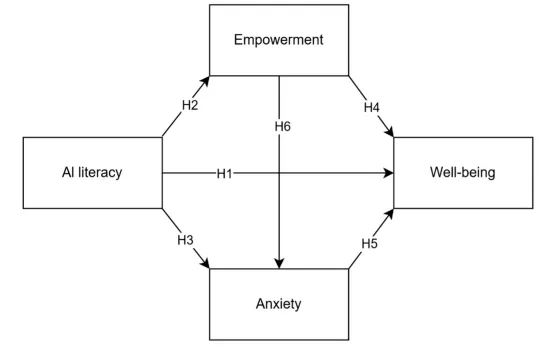
The study’s theoretical framework is grounded in the Job Demands-Resources model and psychological empowerment theory. Technological innovation is a double-edged sword. It can function as a demand, imposing high levels of cognitive effort and forcing learners to adapt to change, while also serving as a resource that expands their capabilities. The researchers position AI literacy as an internal resource and propose a structure in which it controls anxiety through psychological empowerment, ultimately enhancing well-being.
The Unexpected Tension Generated by Knowledge: The Paradoxical Direct Path from AI Literacy to Well-Being
Contrary to common assumptions, the structural model found that AI literacy had a direct negative effect on well-being (β = -0.075). This paradoxical result, in which higher levels of knowledge are associated with lower subjective well-being, represents the emotional burden and crisis of professional identity that can arise from a clearer understanding of technology.
Students who gain a deeper awareness of AI’s mechanisms and potential move beyond merely recognizing the convenience of the tool. They become more sensitive to structural threats, such as the possibility that their distinctive professional role may be replaced in future clinical settings, the ethical dilemmas that may arise in the uniquely human domain of nursing, where human dignity is central, and questions of responsibility in cases of technological misuse. This finding points to the possibility that when knowledge expands quantitatively without accompanying institutional safeguards or organizational reassurance, uncertainty about the future and professional instability may intensify, resulting in emotional overload.
Discovering the Mediating Mechanism That Transforms Anxiety into Subjective Capacity
Nevertheless, the study identifies psychological empowerment and the control of general anxiety as key mediating pathways that can regulate the threatening aspects of technology. AI literacy was found to be a strong antecedent of psychological empowerment (β = 0.344). Here, psychological empowerment gives learners confidence that they can take an active role in shaping their environment through four cognitive dimensions: meaning, competence, self-determination, and impact.
Enhanced empowerment functions as a defensive barrier that reduces the vague fear produced by technological uncertainty and lowers anxiety (β = -0.203). In other words, although the direct path may be negative, when literacy moves through the indirect pathway of strengthening empowerment and significantly suppressing anxiety, a positive total effect emerges within the overall model, restoring and reinforcing well-being. The study demonstrates that only when the internal tension generated by knowledge is transformed into a subjective sense of control can technology settle into place not as a disruptive innovation, but as a constructive resource that supports learner growth.
Universal Acceptance Without Gender Barriers and the Significance of Multi-Group Analysis
Another major finding of the study appears in the multi-group analysis by gender using PLS-MGA. The results showed no statistically significant gender differences in any of the path coefficients proposed by the model. The fact that the dynamics of technological acceptance and psychological change operate in the same way regardless of gender provides an important direction for educational policy. This offers a valid basis for moving away from gender-differentiated approaches or rigid categorical assumptions when designing AI literacy education systems, and instead applying a universal, balanced, and integrated psycho-educational framework.
Toward Future-Oriented Nursing Education Beyond Technocentrism
The final destination of the study’s data and discussion is a full-scale paradigm shift in future curricula. Education that prepares students for the AI era must go beyond the transmission of knowledge. Psychological and ethical support infrastructures should be organically integrated into the educational system so that learners can maintain subjective empowerment in clinical settings. Only when cognitive understanding of technology is closely connected to emotional stability and a subjective sense of control can future nursing professionals protect their own well-being and fully exercise their professional competencies amid the rapid changes of the digital healthcare environment.


