Can AI-Generated Sacred Art Be Holy? From the Creation of Holiness to Its Reception
As generative AI has become capable of learning the visual style of Rembrandt and producing images of Jesus and the saints, religious imagery has entered a new phase. Hong Chang-ick and Joo Jong-woo’s study, Acceptability of Religious Holiness to AI Sacred Painting: From the Perspective of Catholic Sacramental Aesthetics, raises a difficult question: Can a sacred image generated by AI also be holy?
The difficulty lies in the fact that, within Catholic tradition, sacred painting has meant more than an image depicting a religious subject. Sacred images have been understood as a form of “visual sacrament” through which invisible grace becomes perceptible in visible form. The relevant question, therefore, is not simply how convincingly AI can depict Jesus or the saints, but whether such an image can mediate grace within an experience of faith.
The Criterion of Holiness Does Not Lie in Visual Appearance Alone
The study first organizes the holiness of sacred painting around three elements: presence, symbol, and grace. Presence refers to the manifestation of divine reality through sensible form. Symbol describes the way form, color, light, and composition connect what is visible with what is invisible. Grace concerns the transformation of viewing from aesthetic appreciation into contemplation and participation in faith.
Once these three dimensions are considered together, the value of a sacred image can no longer be determined solely by representational accuracy or painterly accomplishment. What matters is also what the viewer is led to perceive through the image and how the viewer participates in the experience.
This is where an important shift occurs in the argument. AI has no faith and does not pray. It reconstructs visual patterns statistically from training data. In this sense, it is difficult to attribute theological intention or spiritual presence to AI itself.
The authors, however, do not end the discussion there. Instead, they change the location of the question: Must holiness always originate in the inner life of the maker?
If sacred painting functions as a medium through which a community of faith interprets and experiences grace, then one of the places where holiness emerges may be not only the act of production but also the event of reception. The study therefore proposes that AI sacred images should be judged less by formal resemblance than by whether they can mediate an experience of grace within a community of faith.
Rembrandt’s Light and AI’s Light
To develop this argument, the researchers compare Rembrandt’s The Return of the Prodigal Son with AI-generated images created using a prompt such as “The Return of the Prodigal Son in the style of Rembrandt.” What is significant here is that the comparison does not focus simply on stylistic resemblance.
In Rembrandt’s painting, the father’s hands embracing the returning son are interpreted as a sacramental gesture embodying divine forgiveness and mercy. The light emerging from darkness also functions as more than an optical device: it carries a theological meaning as the light of grace. The silence of the figures, their stillness, and the surrounding darkness slow down the viewer’s encounter with the image. Formal elements and theological meaning are organized toward the same experience.
The AI-generated versions can reproduce chiaroscuro, oil-paint texture, and Rembrandt-like compositions with considerable skill. Yet the study identifies three significant differences.
First, AI does not understand “the father’s mercy” as the narrative center around which the entire image should be organized. Second, light that functions in Rembrandt as a theological symbol of grace becomes, in the AI image, a stylistic lighting effect learned from visual data. Third, the silence and darkness that create what might be called a “thickness of time” in Rembrandt’s painting are weakened in the AI-generated image.
The result is an important distinction. AI imagery may generate an immediate emotional response, but the duration of contemplation and symbolic coherence that the study associates with sacred painting are separate matters.
The same visual phenomenon—light—can therefore operate in two very different ways. In one work, it organizes narrative and theological meaning. In another, it may simply create a visually persuasive scene. Under conditions of AI generation, the more relevant question becomes not merely what is depicted, but why particular elements occupy their positions and what kind of meaningful relationship they establish with one another.
Holiness May Emerge Through Reception Rather Than Generation
The central claim of the study becomes clearer after this comparison. The authors do not argue that AI itself can generate holiness. Instead, they suggest that an AI-generated image may become a space in which holiness is received.
Suppose an AI-generated image leads a believer to contemplate divine forgiveness or mercy, and that contemplation develops into prayer, repentance, or consolation. In such a situation, holiness need not be understood as a property contained within the image from the beginning. A sacramental event may arise through the relationship surrounding the image.
The authors develop this possibility through concepts such as indirect sacramentality and complementary sacramentality.
From this perspective, the meaning of presence also changes. Presence need not be regarded only as an intrinsic property fixed inside an artwork. It may instead be understood as an event occurring between image, viewer, and religious community.
AI cannot possess faith, but humans can encounter an AI-generated image through faith. The question consequently shifts from “Is there something divine within the machine?” to “Can a religious event take place for a human being through an image produced by a machine?”
The Prompt Is Where Human Religious Interpretation Re-enters the Process
The study then returns to the production process itself. Automation does not eliminate human participation.
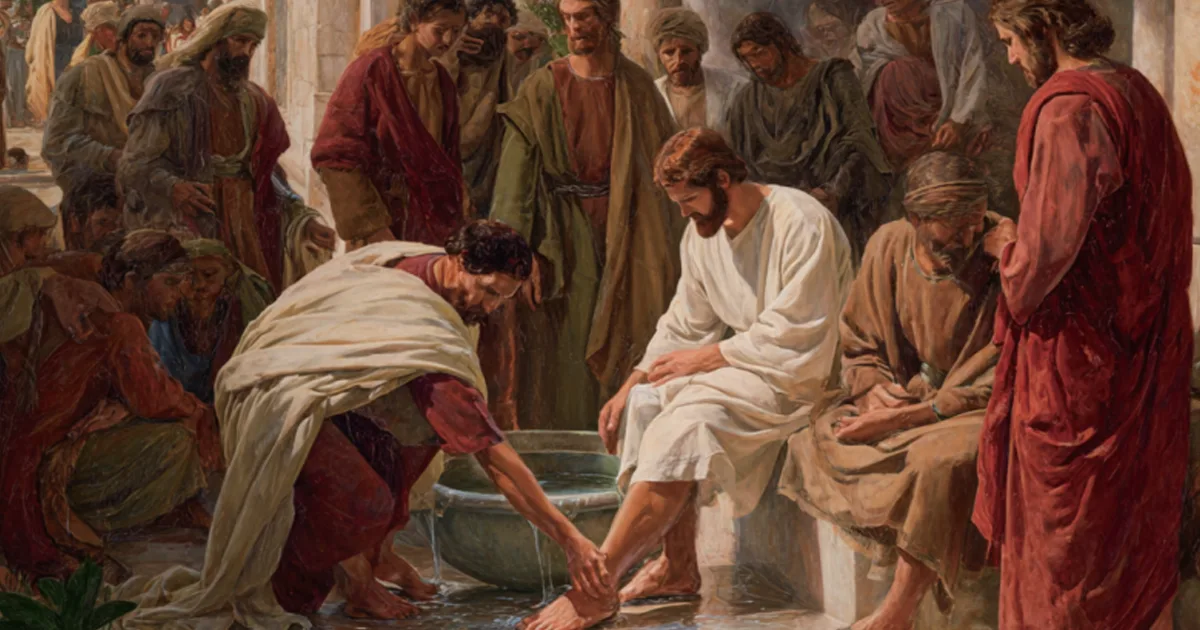
The researchers compare a general prompt requesting an image of Jesus washing the feet of his disciples with another prompt informed by a priest’s interpretation of the biblical passage, emphasizing service, humility, and the theological significance of the act. Even when the same generative system is used, the resulting images change according to how theological context is articulated in language.
From this perspective, the prompt is more than a technical command. It can become a point where biblical knowledge, doctrinal understanding, and religious interpretation enter the process of image generation.
Even if AI produces the pixels, decisions about which scene to depict, what to emphasize, and what meaning the scene should communicate return to the human participant. The role of the religious artist may therefore shift from physically applying paint to designing the conditions through which theological meaning can enter the generative process. The study argues that the religious reflection and theological language of the human participant become decisive factors in deepening the interpretability of AI sacred images.
Three Stages in the Reception of Holiness
The tables in the paper organize this argument into a more systematic structure.
Table 1 explains the holiness of traditional sacred painting through the three-part structure of presence, symbol, and grace.
Table 2 then describes three levels through which an AI-generated sacred image may be received: aesthetic reception, interpretive reception, and liturgical reception.
At the aesthetic level, formal beauty and visual completeness stimulate the viewer emotionally and intellectually. Holiness has not yet emerged fully; the viewer is being prepared for a possible encounter.
At the interpretive level, the viewer begins to read the image as a religious symbol and contemplate its theological meaning. At this point, the image may become a “sign of grace.”
At the liturgical level, the image enters a communal setting such as worship, preaching, or catechesis. Here, the AI image is not understood as transmitting divine presence itself. Rather, it serves as a visual medium that enables a community to participate in a shared act of contemplation.
Table 3 connects this concept with concrete church practices. In catechesis, AI images may visualize biblical scenes and abstract doctrinal concepts. In liturgy and preaching, they may provide visual support for particular Gospel passages. In missionary and pastoral communication, they may function through websites, social media, and digital exhibitions as new forms of visual religious language.
Table 4 establishes the boundaries of this possibility. AI does not contain human prayer or what the study calls “creative obedience.” There is also currently no established institutional theological procedure within the Church for validating AI sacred images. Moreover, when visual attraction becomes stronger than contemplative depth, religious imagery risks being reduced to superficial consumption.
The function of this final table is therefore not simply to exclude AI sacred images. Rather, it defines the boundaries within which the proposed idea of complementary sacramentality can operate.
The Deeper Question Is Where Holiness Takes Place
The most interesting contribution of the paper is not its prediction about whether AI will eventually become good enough to replace traditional sacred painting. Its deeper move is to relocate the site at which holiness is understood to occur—from the maker and the object alone toward the interpretive relationship between image, viewer, and community.
AI has neither faith nor prayer, but a believer can pray through an AI-generated image. The paper describes the space between those two facts through the concept of complementary sacramentality.
This perspective also leads to a broader problem in AI art. When the inner intention of the creator becomes increasingly difficult to locate, where does the meaning of an artwork emerge? How do humans read meaning into images produced by systems without intention, and how does that meaning develop into a shared cultural or communal experience?
AI sacred art makes this problem especially visible because aesthetic beauty alone is insufficient within religious art. The distance between generated form and experienced meaning therefore becomes unusually clear.
Complementary sacramentality, in this sense, is less a concept for assigning holiness to AI than a way of arguing that holiness cannot be determined solely by the origin of an image. The time after an image has been generated—the time in which it is viewed, interpreted, contemplated, and incorporated into communal practice—becomes equally important.
The question raised by AI sacred art can therefore be formulated in another way: When we judge the holiness of a religious image in the future, should we ask only who or what created it, or should we also ask what kind of religious event actually occurs before it?


