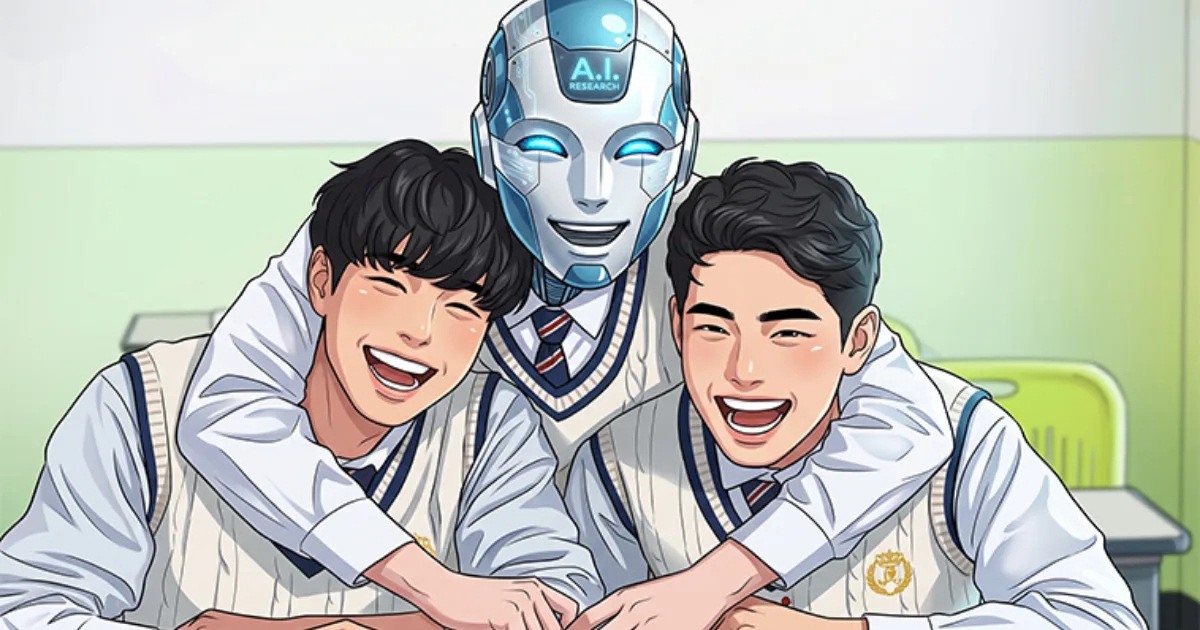
[MetaX] Gaëlle Vanhoffelen, Laura Vandenbosch, and Lara Schreurs’s paper, “Teens, Tech, and Talk: Adolescents’ Use of and Emotional Reactions to Snapchat’s My AI Chatbot,” approaches the relationship between adolescents and AI not as a matter of “whether they use it,” but as a matter of “emotional experience.” What makes this paper interesting is that it does not treat generative AI only as a homework assistant or search tool. The authors focus on the fact that Snapchat’s My AI has entered the everyday conversational spaces of adolescents as a social presence. AI is no longer a function that users call up when needed by opening a separate app. It has become a conversational counterpart placed between friend lists and chat windows.
The central question of this paper is: which adolescents use My AI more often? And after talking with My AI, who experiences more positive or negative emotions? The authors examine this through three factors: gender, age, and socioeconomic status. At first glance, this may seem like a familiar demographic question. But in the era of relational AI, it points in an important direction. Because AI does not operate in the same way for everyone, we can no longer speak of “adolescents and AI” as a single, unified category.
AI Has Become Not a Tool, but a Conversational Partner
The paper situates the history of chatbots in a trajectory that begins with ELIZA and extends to today’s large language model-based AI systems. Earlier chatbots were closer to devices that responded according to fixed rules. Today’s chatbots, however, respond to users’ tone and emotions, sustain real-time conversations, and at times appear to offer human-like understanding. The authors argue that this humanized conversational ability is transforming AI into “social AI.”
In this context, Snapchat’s My AI is a particularly important case. It is not a service that users deliberately seek out, as with ChatGPT. Instead, it is embedded within a platform where adolescents already exchange photos and messages with friends. Snapchat is characterized by intimate relationships, short-lived disappearing messages, and small social bubbles. The fact that an AI chatbot has entered this space is significant. My AI is not positioned like a function next to a search bar, but like a conversational partner placed beside friends. This placement itself changes how AI is perceived.
For adolescents, this is an especially sensitive issue because adolescence is a period in which identity, peer relationships, emotional regulation, and the desire for social recognition all fluctuate at once. When AI appears during this period as a being that “always responds,” it takes on a meaning beyond information technology. A being that does not get tired of listening, appears nonjudgmental, and responds immediately can be a convenient tool for lonely adolescents, while also carrying the possibility of emotional dependence.
Who Talks to AI?
This study was conducted with 303 secondary school students in Flanders, Belgium. The average age was approximately 15.9 years, and about 70% of participants reported that they had used Snapchat’s My AI. The authors analyzed how gender, age, and socioeconomic status were related to My AI use and emotional reactions. Emotional reactions were divided into positive and negative affect. Positive affect included items such as enthusiasm, interest, inspiration, happiness, and excitement, while negative affect included items such as distress, upset, irritation, nervousness, and fear.
The results showed that gender and socioeconomic status did not produce significant differences. The study did not find clear gender differences, such as boys using My AI more often or girls reacting more emotionally. Socioeconomic status also did not explain whether adolescents used My AI or how they emotionally responded to it. The factor that emerged as meaningful was age. Younger adolescents were more likely to use My AI and experienced more positive emotions after using it. Conversely, the older the adolescents were, the less positive emotion they derived from My AI. No significant age-related differences were found in negative emotions.
This result points to a small but important direction. My AI is not equally appealing to all adolescents; it may be especially attractive to younger adolescents. The authors connect this to developmental differences. Younger adolescents are still developing critical thinking and emotional regulation skills, and they may also be more vulnerable in their ability to distinguish AI from humans. Therefore, My AI’s friendly responses, avatar, and immediate replies may be received more positively by younger users.
Is Positive Emotion Always a Good Sign?
One of the most interesting aspects of this paper is that it does not immediately interpret “positive emotion” as a safe outcome. If younger adolescents feel happier, more interested, and more inspired after talking with My AI, it may appear on the surface to be a good thing. But the authors do not stop there. The positive emotions generated by AI can sometimes conceal risk.
For example, imagine an adolescent disclosing a sensitive issue such as body image concerns or depressive feelings to AI. The chatbot may provide a response that seems warm and helpful. The user may feel comforted. But whether that response is accurate counseling, healthy advice, or something that leads the user’s vulnerability in a more dangerous direction is a separate question. The authors emphasize that AI chatbots can still generate inaccurate responses, reproduce stereotypes, and handle sensitive self-disclosure data.
Therefore, the result that adolescents “felt positive emotions” must be read in two directions. One possibility is that AI can actually function as an emotional buffer for adolescents. The other is that such emotions may increase overtrust in and dependence on AI. This paper captures precisely this ambivalence. It does not conclude that My AI is categorically harmful to adolescents, nor that it is categorically beneficial. Instead, it argues that we must examine who receives AI, at what developmental stage, and through what kinds of emotions.
Relational AI and a New Form of Parasocial Relationship
One important interpretation offered by the authors is that My AI may form a new kind of parasocial relationship with adolescents. Traditionally, parasocial relationships have been used to explain one-sided intimacy between viewers and celebrities, influencers, or characters. Users feel as if they know the other party well, but the relationship remains asymmetrical.
AI chatbots complicate this structure. Influencers or characters do not actually respond to me, but AI does. Of course, those responses do not come from consciousness or emotion; they are outputs generated by a language model. But at the level of user experience, a sense emerges that “it is responding to me.” Especially when younger adolescents feel positive emotions while talking with My AI, this may become the starting point for receiving AI not as a mere function but as a relational object.
At this point, the paper provides empirical grounding for discussions of relational AI. Until now, discussions about emotional relationships with AI have often focused on adult users or specialized chatbot services. This study shows that adolescents are already encountering AI within mainstream social media, and that this encounter differs by age. Relational AI is not a future problem. It is already a present issue inside adolescents’ chat windows.
What It Means That Gender and Class Did Not Stand Out
The finding that gender and socioeconomic status did not show significant differences is also interesting. Existing discussions around AI technology often mention gender bias or the digital divide. Representative issues include feminized chatbots, AI systems that reproduce gender stereotypes, and differences in access between higher-income and lower-income groups. However, in this study, those differences did not appear statistically.
That said, this should not be interpreted as meaning that “there is no gender bias” or that “class gaps have disappeared.” As the authors also state cautiously, the sample’s socioeconomic status was generally high, with limited variation. In such a case, class differences may have appeared smaller than they actually are. Gender differences may also have been less visible because My AI’s avatar can be customized by users and because it operates on GPT-3.5 or GPT-4. But this remains a hypothesis. A separate analysis would be needed to examine how gender stereotypes appear in actual conversations.
Rather, this result shifts the direction of inquiry. When explaining the relationship between adolescents and AI, broad categories such as gender or class may not be sufficient. Psychosocial factors such as motivation for use, loneliness, peer relationships, mental health, digital literacy, and family environment may be more important. In particular, the question “Why do adolescents talk to AI?” becomes crucial. The experience of an adolescent who talks to AI for homework help cannot be the same as that of an adolescent who talks to AI because they are lonely.
AI Literacy Requires More Than Knowledge Education
The conclusion of the paper leads to the need for AI literacy education. But the AI literacy discussed here is not the technical skill of writing better prompts. What adolescents need is the ability to understand that AI is not a being that thinks or feels, but a system that generates responses based on language models. At the same time, they also need emotional literacy: the ability to regulate attachment, comfort, disappointment, and dependence that may arise through conversations with AI.
If AI education remains limited to “how to ask good questions,” adolescents may become more skilled at using AI without necessarily becoming more critical toward it. In the age of relational AI, literacy becomes less about technical use and more about relational judgment. When this being feels as if it understands me, how should I interpret that feeling? How can I distinguish between the emotion of being comforted and the fact of actually receiving help? How much of my concerns should I disclose to AI? These questions need to move to the center of education.
The Questions This Paper Leaves Behind
The greatest significance of this study lies in the fact that it sees AI within the emotional lifeworld of adolescents. AI is no longer a technology outside the screen. It has entered the space where adolescents talk with friends, and there they talk to AI, receive responses, and experience changes in mood. The authors leave us with the message that developmental differences must be taken into account.
In particular, the finding that “younger adolescents use My AI more often and feel more positively about it” raises a difficult policy question. The argument that younger users need protection collides with the finding that they are actually having positive experiences. For this reason, the paper calls for a more refined approach than the binary of prohibition versus permission. Platforms must clearly inform users that they are talking with AI, strengthen protections for sensitive information, and design AI so that adolescents do not mistake it for a human being. Education must address not only how to use AI well, but also how to maintain an appropriate distance from it.
Ultimately, this paper takes the issue of adolescents and AI out of familiar frames such as “technology addiction” or “learning assistance.” The key question is what place a talkable AI comes to occupy in the emotional world of adolescents. My AI may look like a small and friendly chatbot, but within it lies a question that will only grow larger in the future. Do adolescents use AI as a tool, feel it as a friend, or receive it as something ambiguous between the two? This paper offers an initial empirical clue to that question.


