Discussions around generative AI often turn toward technological performance. How naturally can it converse? How quickly can it respond? How well can it remember context? This paper, however, slightly shifts the position of the question. Rather than asking what makes AI good, it asks under what conditions people continue to use generative AI. The fact that a technology has improved is not enough to explain continued use. Users do not simply accept technological performance as it is. They interpret and reposition the technology within their own purposes, understanding, judgment, and work habits.
The focus of this study is the intention to continue using generative AI. Trying something once and continuing to use it are different matters. Curiosity may lead to first-time use, but repeated use demands different criteria. Over time, users begin to ask: Does this tool actually reduce my work? Does it help me achieve my goals faster? Can I trust, revise, and reuse its outputs? This paper examines that very point by considering both the technological characteristics of generative AI and users’ AI literacy.
Moving the Technology Acceptance Model into the Context of Generative AI
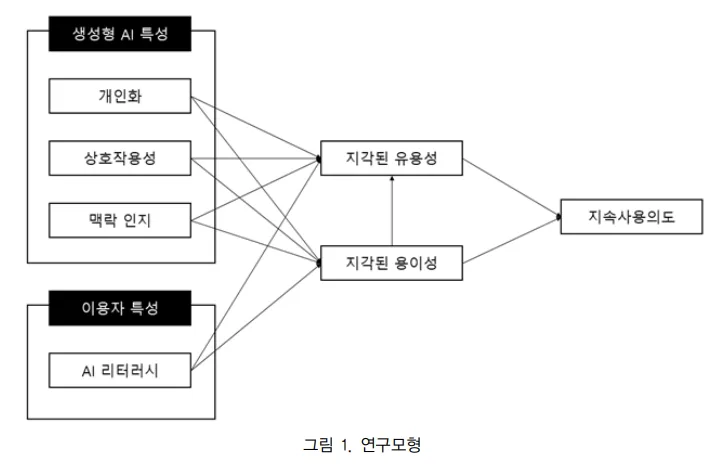
The theoretical foundation of the paper is the extended Technology Acceptance Model. The Technology Acceptance Model has often been used to explain how people adopt new technologies. Its core ideas are twofold: whether users perceive a technology as useful, and whether they perceive it as easy to use. In general, the model assumes that when a technology is easy to use, users are more likely to perceive it as useful, and when it is both useful and easy, their intention to continue using it increases.
Generative AI, however, operates somewhat differently from earlier technologies. It is not a tool where users simply press a button to execute a predefined function. Instead, users ask questions, revise answers, and make new requests as they work toward a result. It resembles a hybrid of a search engine, writing tool, counselor, and idea partner. For this reason, the researchers define the technological characteristics of generative AI as personalization, interactivity, and context awareness. Personalization refers to the extent to which AI provides responses tailored to users’ needs. Interactivity refers to the feeling of conversing with AI and exchanging feedback. Context awareness refers to the ability to understand previous questions and situations and respond accordingly.
The researchers then add AI literacy as a user-related factor. This is the core point of the paper. AI literacy refers to the ability to understand information provided by AI, judge whether it is trustworthy, select what is appropriate for one’s own situation, and communicate effectively with AI to obtain the desired information. If generative AI is a conversational tool, then user competence is not a peripheral variable but part of the user experience itself. Even when people use the same AI, its usefulness changes depending on who asks, how they ask, how they evaluate the response, and how they revise it.
Personalization Creates Usefulness, But Not Ease
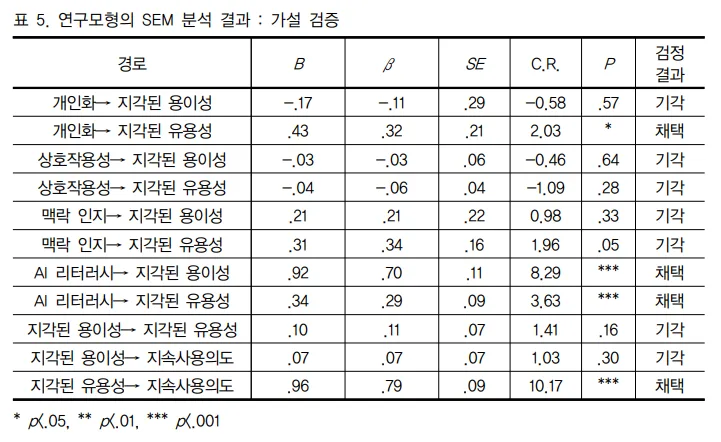
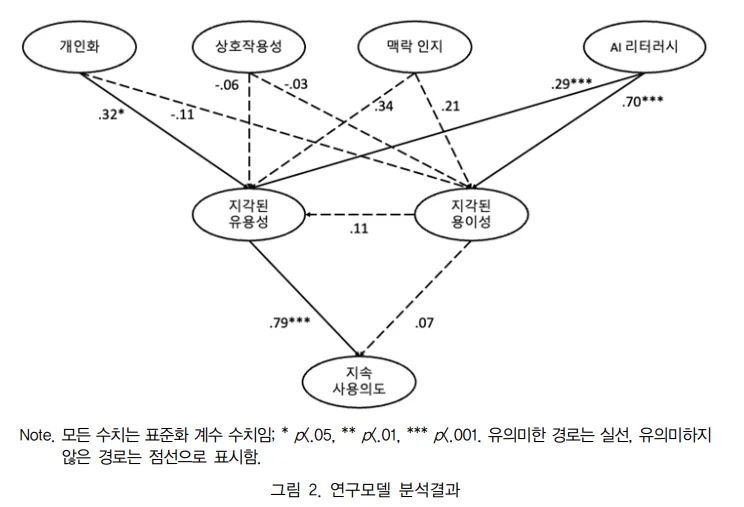
The first notable result concerns the role of personalization. Personalization had a significant effect on perceived usefulness. The more users felt that generative AI responded according to their needs, the more they perceived AI as a useful tool. This is intuitively understandable. The appeal of generative AI does not lie in giving the same answer to everyone. Its value as a tool emerges when it adjusts its responses to the user’s situation, purpose, and mode of expression.
However, personalization did not affect perceived ease of use. In other words, receiving customized answers did not necessarily make users feel that the tool was easier to use. This distinction is important. Users do not treat “it gives me an answer suited to me” and “it is easy to use” as the same experience. To obtain a good answer, users may actually need more precise questions, more revisions, and more careful judgment. In generative AI, personalization functions less as convenience and more as a sense of achieved utility.
This result helps us understand the user experience of generative AI. When users feel that AI provides answers tailored to them, they discover a reason to keep using the tool. But that process does not automatically feel easy. In generative AI, customization is not a function completed with a single button. It is closer to an outcome produced through repeated adjustments between the user and the AI.
Interactivity and Context Awareness Were Weaker Than Expected
One of the most interesting parts of the paper concerns the results for interactivity and context awareness. These are two features frequently mentioned when explaining generative AI: its conversational nature and its ability to understand context. Yet in this study, interactivity and context awareness did not have significant effects on perceived usefulness or perceived ease of use.
This result suggests that users’ standards for generative AI have already shifted. The fact that AI can converse, respond in real time, or follow context to some extent may no longer be a decisive source of wonder. Rather than being impressed that AI can hold a conversation, users evaluate whether that conversation actually helps them complete a task. Even if AI appears to remember context, users do not perceive it as useful if the result is unsatisfactory. Conversely, even if the conversation feels natural, users do not perceive it as easy to use if it is difficult to obtain the answer they want.
A technological feature can leave a strong impression when it first appears. But as use becomes repeated, the feature recedes into the background. Users gradually pay less attention to what the technology can do in itself and more attention to how well it solves their own problems. The results of this study show that the acceptance of generative AI is moving from the stage of novelty to the stage of practical utility.
AI Literacy Is the Ability to Change the User Experience
The most important finding of this paper is the effect of AI literacy. AI literacy had a significant effect on both perceived ease of use and perceived usefulness. This means that people who can communicate effectively with AI, critically evaluate the information AI provides, and apply it according to their own purposes are more likely to perceive generative AI as both easier and more useful.
Here, AI literacy is not a matter of ethics education or abstract cultural knowledge. It appears as a condition of actual user experience. Nor does it simply mean the ability to write good prompts. It includes the broader ability to judge how far AI’s answers can be trusted, what needs to be asked again, which outputs should be discarded, and how results should be transformed for one’s own situation. Generative AI is less a machine that provides finished answers than a work environment that requires user judgment. Users with higher literacy can draw more possibilities from the same tool.
At this point, the paper points to an important direction for the age of generative AI. Making good AI matters, but so does developing users who can handle AI well. It is easy to assume that technological advancement replaces user ability, but actual use often reveals the opposite. The more powerful the technology becomes, the more important the user’s ability to ask questions, evaluate outputs, and contextualize results becomes. Because AI can do many things, users must judge more carefully.
Ease of Use Did Not Explain Continued Use
From the traditional perspective of the Technology Acceptance Model, a technology that is easy to use would seem more likely to be used for a long time. However, in this study, perceived ease of use did not have a significant effect on the intention to continue using generative AI. In addition, the path from perceived ease of use to perceived usefulness was not significant. This means that when generative AI users decide whether to continue using it, they place more weight on usefulness than on ease.
This fits well with the characteristics of generative AI. If we look only at the process of opening the interface and typing a question, generative AI does not seem difficult. But obtaining good results is not so simple. Users must change their questions, add conditions, review answers, identify errors, and keep only the necessary parts. Use may appear easy, but using it well is not easy. For this reason, continued use is driven not by the simplicity of the interface, but by the utility of the results.
In the study, perceived usefulness had a strong effect on the intention to continue using generative AI. Users intend to keep using generative AI when they feel that it helps them achieve their goals faster, handle their interests more efficiently, and obtain useful information. Ultimately, continued use of generative AI is closer to “I use it because it helps” than “I use it because it is convenient.”