
How Conversations with Generative AI NPCs Reshape Player Experience in VR Games
When players speak to a character in a game, they usually select one of several predefined lines. The developer has already determined which questions can be asked, which tone can be used, and how far the conversation may continue. The introduction of generative AI is beginning to change this long-established structure. Players can construct their own sentences, while NPCs generate responses in real time.
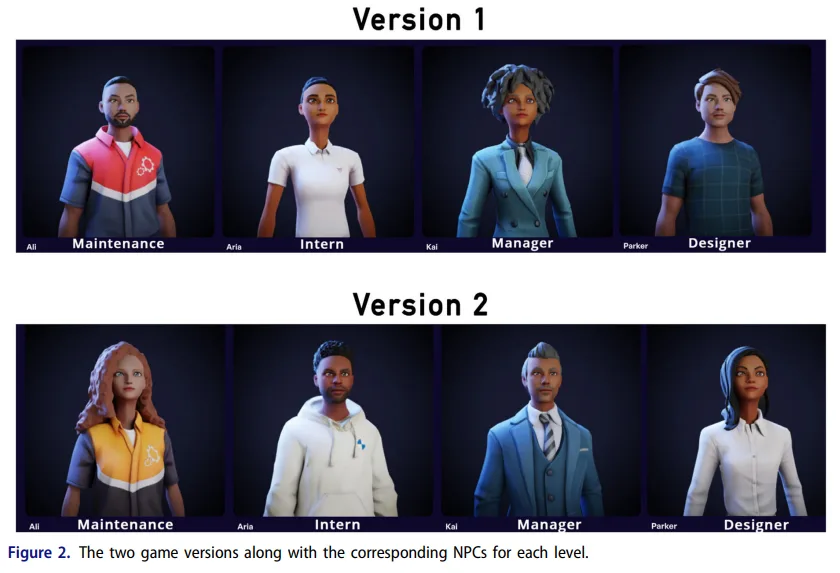
Nima Zargham and his colleagues examined this change by developing Office Whispers, a VR adventure-puzzle game. Players move through a virtual office and speak directly with a manager, designer, intern, and maintenance worker to locate a laptop needed for an important presentation. The four NPCs are powered by generative AI, allowing players to ask questions in their own words rather than relying on predefined commands.
The researchers recruited 48 participants in Canada and the Netherlands. Each participant played the game for 20 minutes and then completed questionnaires and interviews. The team also created two versions of the game in which the NPCs retained the same workplace roles but had their genders swapped. This allowed the researchers to compare the influence of visible character traits with the influence of conversational performance.
Freedom of Speech Changes the Feeling of Agency, Not Merely the Number of Choices
A majority of participants identified speaking with NPCs as one of the game’s strongest features. Many also described the voice interaction as its most interesting element. In particular, participants valued being able to formulate questions themselves rather than selecting a sentence prepared by the developer.
The significance of this result lies not simply in the increased number of possible lines. A conventional dialogue tree can also contain hundreds of options. What changes with generative AI is the position from which the player acts. Instead of choosing an expression permitted by the game, the player first forms an intention and then expresses it in their own language. For a moment, the player is no longer merely navigating the designer’s menu. The game world appears to respond to something the player has personally initiated.
VR strengthened this effect. Participants stood in front of NPCs, spoke aloud, saw their words transcribed above the characters, and heard the characters answer. Together, these elements made the interaction feel less like operating an interface and more like taking part in a social encounter.
Several participants moved physically closer to an NPC when speech recognition failed. The system did not require them to reduce the distance, but they behaved as they might in an everyday conversation, approaching the listener so that they could be heard more clearly. Their bodies followed the social logic of the scene, even when the technology did not demand it.
Immersion in this study therefore cannot be explained by visual realism alone. It emerged partly from the sense that the player’s speech had consequences inside the virtual world. Speaking became more than an input method. It served as evidence that the player occupied a position within the world and could act upon it.
The More Human the Conversation Appears, the More Visible Its Failures Become
Voice interaction increased immersion, but that immersion was fragile. Many participants encountered speech-recognition problems. Some felt that NPCs interrupted them or took too long to begin answering. Players responded by speaking more slowly, exaggerating their pronunciation, or raising their voices.
One of the more revealing findings was that many participants blamed their own pronunciation or accent rather than the system. Even when players recognized that the machine had failed to understand them, they changed their own way of speaking. Because the interface was presented as a conversational partner, players adjusted themselves as though repairing a social relationship rather than learning the syntax of a machine.
Incorrect AI responses were interpreted in a similar way. When NPCs invented facts or contradicted one another, some players understood these failures not as hallucinations or technical errors but as lies. The characters had not been intentionally designed to deceive, yet players attributed motives and personality to their mistakes.
For some participants, this damaged the game. They could no longer determine which information was reliable, and puzzle progression became frustrating. For others, the same uncertainty made the NPCs feel more human and entertaining. A character who concealed information or appeared to lie could be perceived as having an agenda.
The same technical failure therefore broke immersion in one situation and created character in another. The difference depended less on the existence of the error than on what the error did within the game. When false information blocked progress or contradicted the game world, the underlying system became visible. When it could be interpreted as part of an attitude, conflict, or personal motive, unpredictability contributed to the character’s identity.
Since the uncertainty of generative AI cannot be eliminated entirely, game design cannot rely only on hiding errors. NPCs may need to admit that they do not know something, express different levels of confidence, or correct themselves later. When a mistake is remembered and repaired over time, uncertainty may remain inside the relationship rather than immediately exposing the machinery behind it.
Players Judged Characters First by Whether They Were Useful
The four NPCs were assigned different jobs, appearances, voices, and positions within the office hierarchy. However, player preference was influenced more strongly by the accuracy and usefulness of their responses than by gender or surface-level personality traits.
The designer, Parker, was selected most often as a favourite character, while the intern, Aria, was most frequently disliked. The most common reason for favouring an NPC was that the character provided correct and useful information. Friendliness, politeness, concise answers, and approachability also mattered.
In contrast, players disliked characters who failed to help, withheld information they were expected to know, contradicted themselves, or appeared dishonest. Long answers, unpleasant voices, recognition errors, and visual appearance were also mentioned, but they were less central than the NPC’s practical contribution to the game.
This finding suggests that the personality of a generative AI NPC is not formed only through the profile written by the developer. For the player, personality emerges through the accumulated history of actual responses. A character that reliably provides information may be perceived as intelligent, competent, or considerate. One that repeatedly fails may appear indifferent, evasive, or uncooperative. Accidental variations produced during generation become part of the character evaluation.
The two gender-swapped versions produced no significant differences in overall player experience, perceived character attractiveness, or enjoyment of interaction. Changing the NPCs’ gender presentation was not enough to outweigh the quality of their behaviour.
Workplace hierarchy, however, did influence how some players spoke. Participants reported using a more direct and task-oriented style with the manager, while speaking more casually with colleagues or lower-ranking characters.
At this point, the NPC operates both as a fictional character and as a surface onto which real social habits are projected. Once a hierarchy is introduced, players bring expectations concerning authority, competence, politeness, and familiarity into the game. Generative AI responds within these expectations and may reinforce them. Character design therefore extends beyond describing personality. It also determines which social behaviours players are encouraged to repeat.
Human-Like Conversation Depended More on Rhythm Than on Well-Written Sentences
Participants appreciated being able to ask open-ended questions, yet they still described some conversations as artificial. NPCs answered questions but rarely asked follow-up questions. They often ended conversations in similar ways and did not consistently nod, look attentive, or respond physically while the player was speaking. Some participants described them as response machines rather than people.
The study indicates that conversational realism involves more than grammatical fluency. Players considered whether the NPC remembered earlier exchanges, understood what had just happened in the game, waited for the player to finish speaking, initiated conversation, and reacted to the surrounding environment.
Voice, intonation, facial expression, gaze, gesture, and movement also shaped the interaction. Participants wanted NPCs to speak to one another, approach the player first, or offer assistance when the situation called for it. They expected not merely a character capable of generating long sentences, but an entity that could observe, remember, and act within the game world.
Dialogue cannot remain parallel to gameplay. As the player moves objects, completes puzzles, and travels through the environment, NPC speech and behaviour must respond to those changes. Otherwise, the conversation may be linguistically flexible while remaining disconnected from the world in which it occurs.
Open dialogue also requires guidance. When players are free to say anything but do not know which questions will help them progress, freedom can turn into confusion. The answer is not necessarily to restore visible dialogue choices. NPCs can instead offer subtle direction by mentioning a relevant event, object, or character within the conversation.
The design problem is therefore not a simple choice between freedom and control. It concerns how to preserve expressive freedom while preventing the narrative and gameplay from losing direction.
What the Table Reveals About Attractiveness and Conversational Enjoyment

Table 1 examines the relationship between the perceived attractiveness of each NPC and the enjoyment of interacting with that character. The correlation coefficient was 0.385 for the intern Aria, 0.457 for the manager Kai, 0.590 for the maintenance worker Ali, and 0.565 for the designer Parker. Across all four characters, the overall correlation was 0.566 and statistically significant.
Participants who considered a character more attractive also tended to evaluate their conversations with that character more positively. The relationship was particularly strong for Ali and Parker.
These results do not prove that visual attractiveness directly caused conversational enjoyment. A participant who had a friendly and productive conversation may subsequently have evaluated the character’s appearance more favourably. The causal direction could therefore run in either direction, or both evaluations may have influenced each other.
Even so, the table shows that the arrival of generative AI does not make conventional character design irrelevant. Players combine facial appearance, voice, role, conversational tone, and behavioural reliability into a single impression of a person. Functional credibility and visual appeal do not operate as entirely separate layers. Each can influence the interpretation of the other.
The quantitative results also indicate that the overall game experience was evaluated positively. Participants showed a strong willingness to play similar games again. Among the dimensions of player experience, clarity of goals received the highest score, while mastery received the lowest.
Players generally knew what they were expected to do, but the unpredictability of speech recognition and AI-generated responses weakened their sense of control. They could understand the goal while remaining uncertain about whether their own skill was sufficient to produce the desired result.
An NPC Is Not a Finished Character but a Relationship Generated During Play
The most important contribution of the study is its shift in how generative AI NPCs should be evaluated. A traditional NPC is largely fixed in advance through appearance, dialogue, animation, and scripted behaviour. The impression of a generative AI NPC continues to change through response time, factual accuracy, memory, interruptions, accidental errors, and the player’s interpretation of those errors.
The relevant question can no longer remain limited to how many different sentences an NPC can produce. Designers must also ask when the character speaks, what it knows, how it expresses uncertainty, whether it remembers its mistakes, and what traces those mistakes leave in later interactions.
Expanding the range of possible dialogue does not automatically create a living character. Players begin to perceive the NPC’s responses as the actions of a person only when language is connected to the state of the game world, social role, memory, voice, and bodily behaviour.
The promise of generative AI NPCs therefore does not lie in unlimited dialogue alone. It lies in building a structure in which the player’s words persist over time and alter both the virtual world and the relationship formed within it.


